
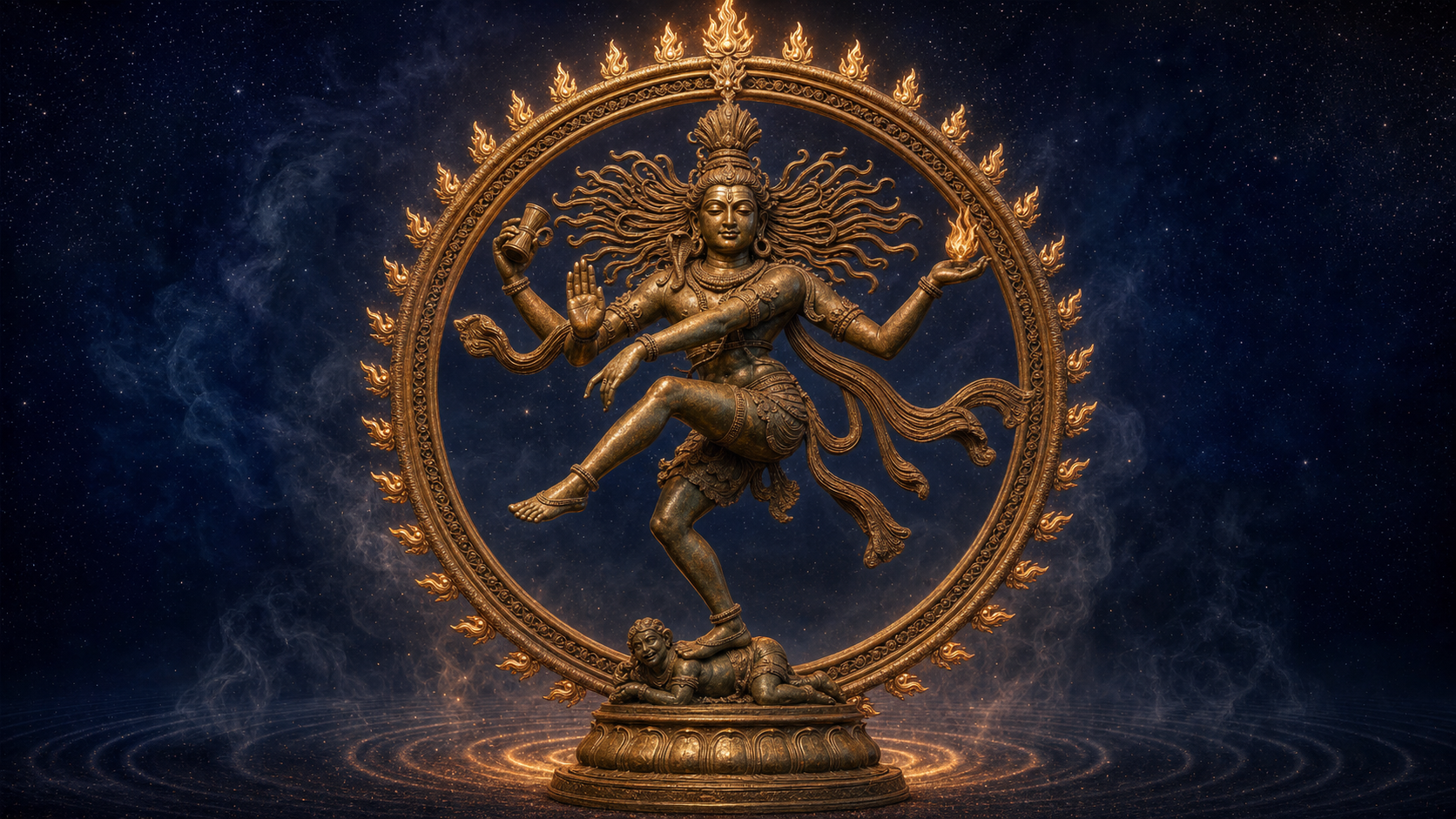
You stand before a fierce form of Shiva and see too much at once: several arms, a drum, fire, a trident, flying locks, a lifted foot, perhaps a skull-cup or a figure underfoot. If you treat each feature as a separate symbol to memorize, the murti soon becomes an illustrated glossary.
There is a more useful way to look. Read the image as a coordinated movement between stability and transformation. Its attributes show what consciousness does; its posture shows how power is held; its gestures show how you are meant to respond. That approach turns iconography from information about Shiva into a disciplined way of seeing your own life.
Begin with the body’s action, not the objects in its hands
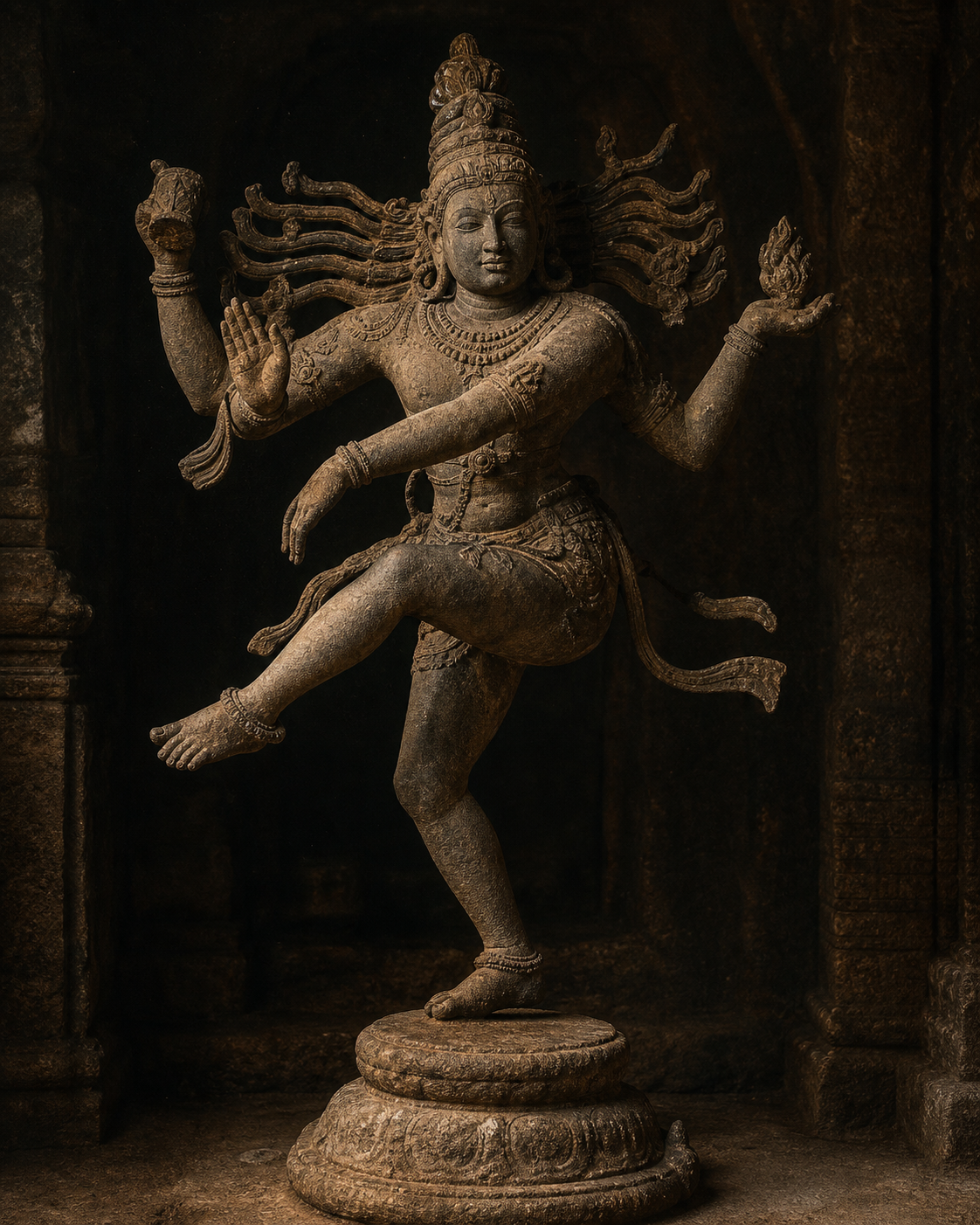
Before naming a single attribute, describe the action of the whole figure. Is Shiva dancing, guarding, subduing, lifting, granting refuge, or holding several of those actions in one pose? This first observation matters because a flame held within a balanced dance communicates something different from a flame interpreted in isolation.
Kalika-associated Tandava forms, Nataraja images, and fierce manifestations of Bhairava belong to a related Shaiva vocabulary, but they are not interchangeable templates. An image with eight arms does not automatically carry one universally fixed set of eight meanings. Agamic prescriptions, installation traditions, regions, and historical workshops permit meaningful variation. Identify the particular murti when you can; when you cannot, describe only what is actually visible.
Use this viewing order whenever you encounter a Shaiva image:
- Trace the outer frame. A radiant aureole or ring of flames places the action within an all-encompassing field. Ask whether the boundary encloses Shiva or represents the conscious radiance through which the entire scene appears.
- Find the point of support. Look at the planted foot, pedestal, or ground. If Apasmara appears underfoot, notice that forgetfulness and ignorance are restrained. They are not allowed to direct the dance.
- Follow the lifted movement. A raised foot can indicate release or grace. Read it in relation to the grounded foot: liberation is not flight from reality but freedom made possible by a stable center.
- Read gestures before implements. An open palm in abhaya addresses you directly with fearlessness. A boon-giving gesture makes grace available. Only then move outward to the drum, flame, trident, noose, goad, or skull-cup.
- Compare the center with the perimeter. The hair and limbs may surge outward while the face or torso remains composed. That contrast is a visual lesson: intensity does not require inner disintegration.
- Return to the whole. Ask what relationship the image establishes among power, restraint, impermanence, and grace. The answer will be more accurate than a pile of disconnected definitions.
This sequence also corrects a common misreading of fierce imagery. A weapon, skull, serpent, or flame need not celebrate violence. Within the full composition, such features can expose impermanence, cut attachment, discipline attention, or burn through contracted patterns. Fierceness is power consecrated to liberation, not permission for aggression.
The five divine acts reveal the image’s metaphysical structure

The most reliable interpretive key is Shiva’s pañcakṛtya, the fivefold activity of consciousness: creation, preservation, dissolution, concealment, and gracious revelation. These are not five unrelated jobs assigned to a distant deity. They describe the recurring structure through which worlds, thoughts, relationships, identities, and stages of practice arise and change.
| Divine act | Common visual expression | Question for your practice |
|---|---|---|
| Sṛṣṭi, creation | The ḍamaru, whose rhythm links sound with manifestation | What is trying to emerge, and what rhythm would allow it to take form? |
| Sthiti, preservation | The balanced stance or stable supporting foot | What is sound and worth sustaining rather than abandoning in haste? |
| Saṃhāra, dissolution | Agni, the transforming flame | What has completed its work and now needs to be released? |
| Tirobhāva, concealment | The veiling movement of divine play and the ignorance represented by Apasmara | What assumption or habit is preventing you from seeing clearly? |
| Anugraha, grace | Abhaya, boon-giving gestures, and the liberating lifted foot | What truth, help, or responsibility are you now willing to receive? |
This map prevents two opposite errors. The first is clinging to creation and preservation while treating every ending as failure. The second is romanticizing destruction while neglecting what deserves protection. Shiva’s dance includes both, then adds concealment and grace. Transformation becomes complete only when you recognize what has been hidden and become receptive to a clearer way of acting.
The other implements refine this map. The triśūla can gather triads such as past, present, and future; the three guṇas; or waking, dreaming, and deep sleep into a governed whole. The kapāla confronts you with the impermanence of embodied form. The pāśa and aṅkuśa represent restraint and redirection: the mind that wanders does not need hatred, but it does need guidance. These meanings are complementary possibilities, not a license to assign every object whatever meaning feels convenient.
When you apply the five acts to a real difficulty, do not jump directly to the flame. First identify what is emerging, what must be protected, what should end, what you are failing to see, and what grace would require from you. That full inquiry is much closer to Shaiva transformation than using dissolution as a spiritual name for impatience.
The moving universe rests on an unmoving ground

A dancing Shiva can appear to teach perpetual motion. Bhairava as Bhūdhāraya supplies the necessary corrective. The name joins bhū, earth, with dhara, that which bears or holds. Bhairava is therefore contemplated not merely as a being standing on the world, but as the supporting principle through which forms can cohere, endure, and change.
In the Shaiva tattva map, pṛthvī is the most condensed of the great elements. It signifies weight, continuity, firmness, and the capacity to bear. Yet the ground is not inert. It hosts movement without being overwhelmed by movement. This is why a dynamically poised body can communicate stability more powerfully than a rigid one.
Kashmir Shaivism’s language of spanda offers the corresponding view from consciousness: reality pulses through expansion and contraction without ceasing to be itself. Shakta Tantra emphasizes the inseparability of Shiva and Shakti, awareness and its power of manifestation. Stillness and energy are therefore not rivals. Stillness without energy would never appear as a world; energy without conscious ground would have no intelligible order.
You can notice this teaching visually through three zones:
- The base: the foot, pedestal, or subdued Apasmara shows what supports the action and what must no longer rule it.
- The center: the face, chest, and central axis show whether awareness remains collected amid intensity.
- The perimeter: the locks, limbs, implements, and flames show energy differentiating into the many.
Hold all three in one field of attention. If you watch only the perimeter, fierceness can look like agitation. If you watch only the center, stillness can look like withdrawal. The complete image teaches composed force: movement rooted in awareness and stability expressed through responsible action.
This is also an ethical test. Groundedness is not merely a pleasant bodily sensation. It appears as reliability, truthfulness, patience, and the ability to protect a field in which others can flourish. Bhairava’s guardianship of a sacred precinct makes the point concrete: power proves its sacred character by maintaining the conditions under which dharma can stand.
Turn visual interpretation into a repeatable practice
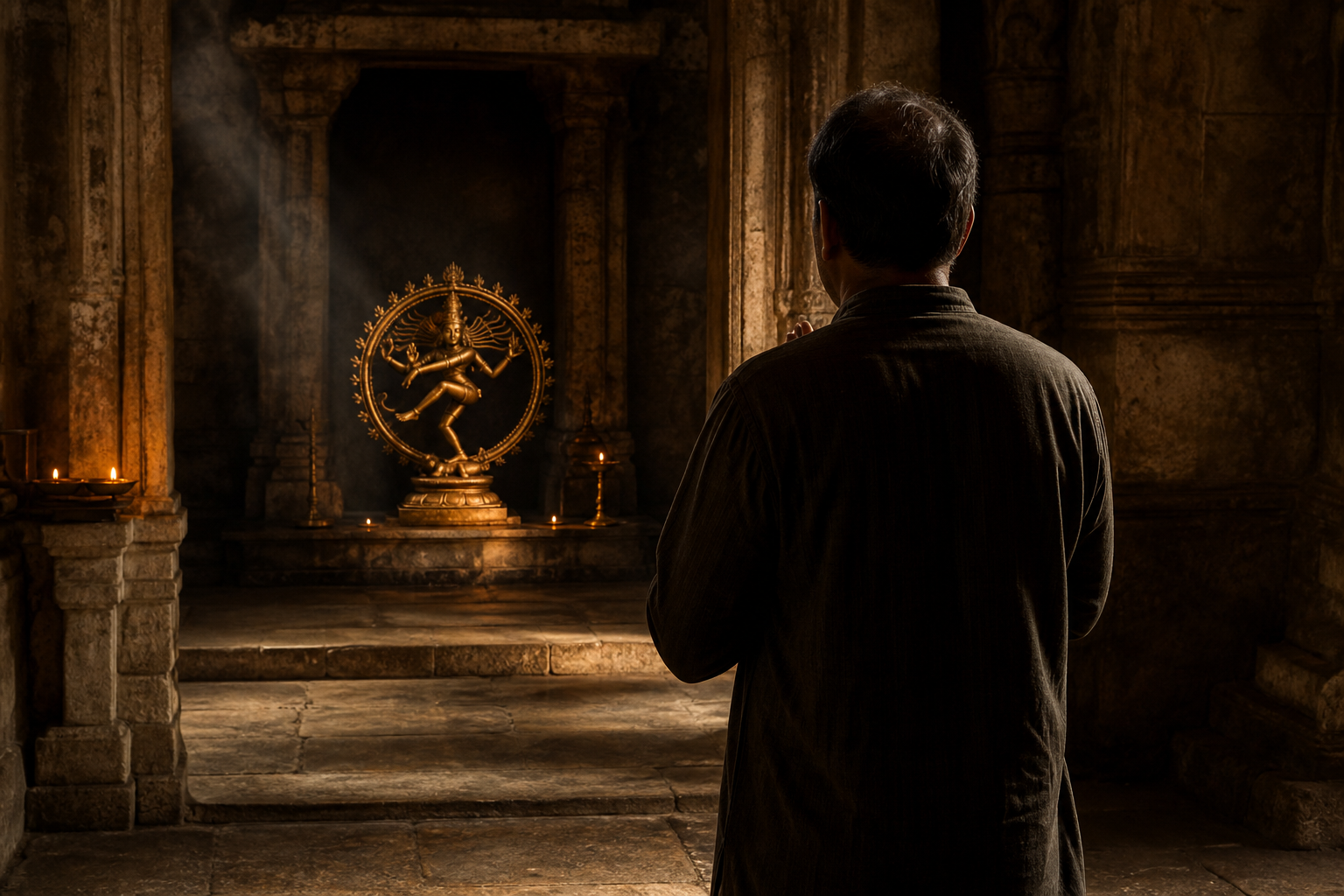
You do not need to reproduce an advanced Tantric ritual to contemplate a Shaiva murti. A simple practice can remain devotional, philosophically exact, and safe from improvisation. Use the same image for a period of regular practice so that familiarity deepens perception instead of sending you in search of constant novelty.
- Acknowledge the ground. Sit steadily and feel the actual contact between your body, seat, and floor. A brief bhūmi-namaskāra can mark your dependence on the support that is already present.
- Let the breath settle naturally. Take a few unforced diaphragmatic breaths. Do not manipulate the breath to manufacture intensity.
- See the whole form. Rest your gaze on the composition before selecting a detail. Notice the relation between the stable center and the moving limbs.
- Contemplate emergence and release. Let inhalation correspond gently with the ḍamaru and manifestation. Let exhalation correspond with agni and release. The purpose is not to suppress thoughts or feelings, but to notice arising and passing without losing the ground of awareness.
- Receive the gestures. At abhaya, name the fear you need to face without dramatizing it. At the boon-giving hand or lifted foot, ask what grace would look like as a concrete change in conduct.
- Close with one dharmic commitment. Choose one action that expresses the contemplation: preserve a necessary discipline, end a harmful habit, correct a neglected duty, or offer steadiness to someone who depends on you.
If mantra already belongs to your practice, Om Namaḥ Śivāya can accompany this contemplation without crowding the image. Elemental practice may include attention to the root support and the bīja Lam in appropriate settings. More specialized bīja combinations and fierce-deity procedures should not be assembled casually from isolated symbols; lineage guidance preserves their ritual context and purpose.
Judge the practice by its effects on conduct, not by the intensity of an inner episode. A sound encounter with fierce iconography should make you less governed by fear, less fascinated by destruction for its own sake, and more capable of holding power without misusing it. If the image leaves you merely excited, return to the planted foot, the composed center, and the gesture of refuge.
Key takeaways for reading a fierce Shaiva form
- Identify the whole body’s action before decoding individual attributes.
- Do not assume every multi-armed image follows one universal inventory; verify the form and respect regional or lineage variation.
- Use the five acts of creation, preservation, dissolution, concealment, and grace as the primary metaphysical map.
- Read dynamic energy together with its ground: the perimeter moves, the center remains collected, and the base bears both.
- Translate contemplation into one act of courage, restraint, release, receptivity, or reliable support.
The next time you meet a Shaiva murti, resist the urge to identify everything immediately. Follow the frame, base, center, hands, and outward movement. Then take one difficulty from your own life through the five acts: What is arising? What must be sustained? What should end? What remains concealed? What grace are you prepared to accept? Act on one honest answer before returning to the image.
References
- DharmaRenaissance Blog — Kalika Tandava Decoded: Shiva’s Eight-Armed Cosmic Dance of Renewal and Liberation
- DharmaRenaissance Blog — Bhudharaya Bhairava: The Unmoving Ground of Being for Stability, Courage, and Clarity