
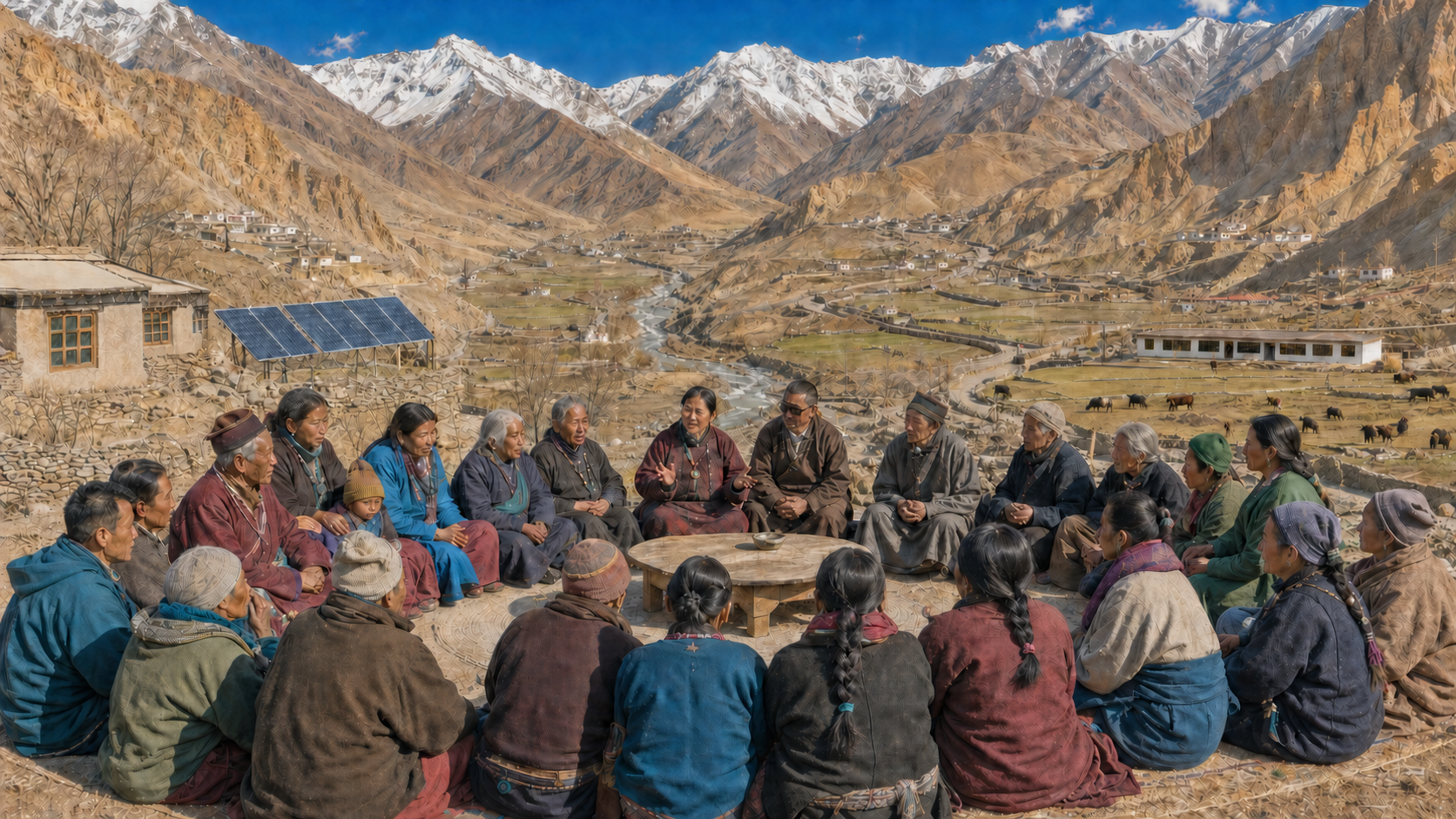
If you are trying to decide whether seven hill councils will give Ladakh meaningful local government, do not stop at the number seven. Ask whether a resident of Padum, Diskit or Hanle will be able to get a local priority heard, funded and completed without every routine decision travelling to a distant administrative centre.
The decision to establish Autonomous Hill Development Councils in all seven districts is promising because it begins with Ladakh’s lived geography. But seven institutions can produce either genuine decentralisation or seven additional layers of paperwork. The difference will lie in their powers, finances, accessibility and public accountability.
Key takeaways
- Ladakh’s distances and winter closures make district-level decision-making a practical necessity, not an abstract preference.
- A hill council becomes meaningful only when clearly assigned functions are matched by usable funds, staff and authority.
- Administrative decentralisation does not, by itself, settle the separate question of special protection for Ladakh’s predominantly tribal population.
- Local voice and national security are not competing loyalties. The councils need explicit coordination rules for matters that cross district or security boundaries.
- You should judge the reform through published decisions and completed work after a full planning, budgeting and delivery cycle, not through the announcement alone.
Ladakh’s map is the first governance document
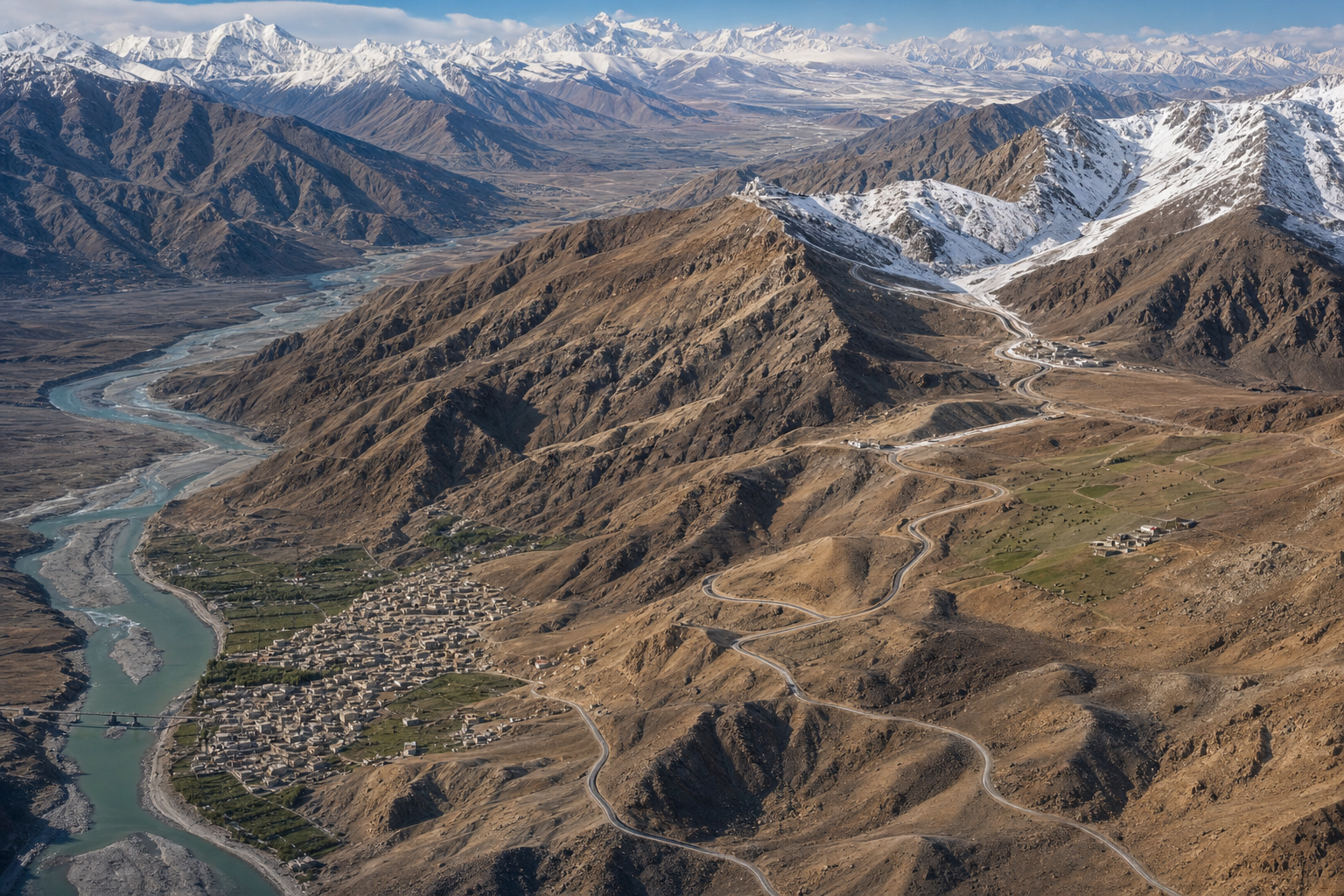
Ladakh covers about 59,146 square kilometres, much of it between 3,000 and 7,000 metres above sea level. The 2011 Census recorded 274,289 residents, giving the region roughly four to five people per square kilometre, compared with a national average of 382. Those figures establish the scale of the governing challenge, although a 2011 population count should not be treated as a current headcount for allocating present-day resources.
Low density changes what administrative access means. An office may exist on paper and still be functionally remote if reaching it requires a long mountain journey. A policy designed around population totals alone can therefore look efficient while leaving scattered settlements with the longest routes, the fewest opportunities to be heard and the highest cost of following up.
The travel examples make the problem concrete. Padum is roughly 240 kilometres from Kargil town and more than 400 kilometres from Leh by the older road; Diskit is about 120 kilometres from Leh across Khardung La; and Hanle is around 250 kilometres away. Snow can close routes for months. In such conditions, the location of a decision-maker affects whether a resident can submit a request, answer a query and correct an administrative error within a useful period.
This is why a simple question should guide the reform: how many journeys does a resident have to make before a routine district matter is decided? Count referrals, repeated document submissions and required visits, not merely the straight-line distance to an office. A new council has improved access only if it shortens that real chain.
The seven-council model also recognises that Ladakh is not one uniform social or economic unit. Leh is Buddhist-majority, Kargil is Shia Muslim-majority, and Zanskar, Nubra, Changthang, Sham and Drass have distinct valleys, economies and social characters. That diversity is an argument for decisions close to the people affected by them. It is not an excuse to seal districts off from one another or reduce every local question to religious identity.
Seven councils are only the shell; authority makes the reform
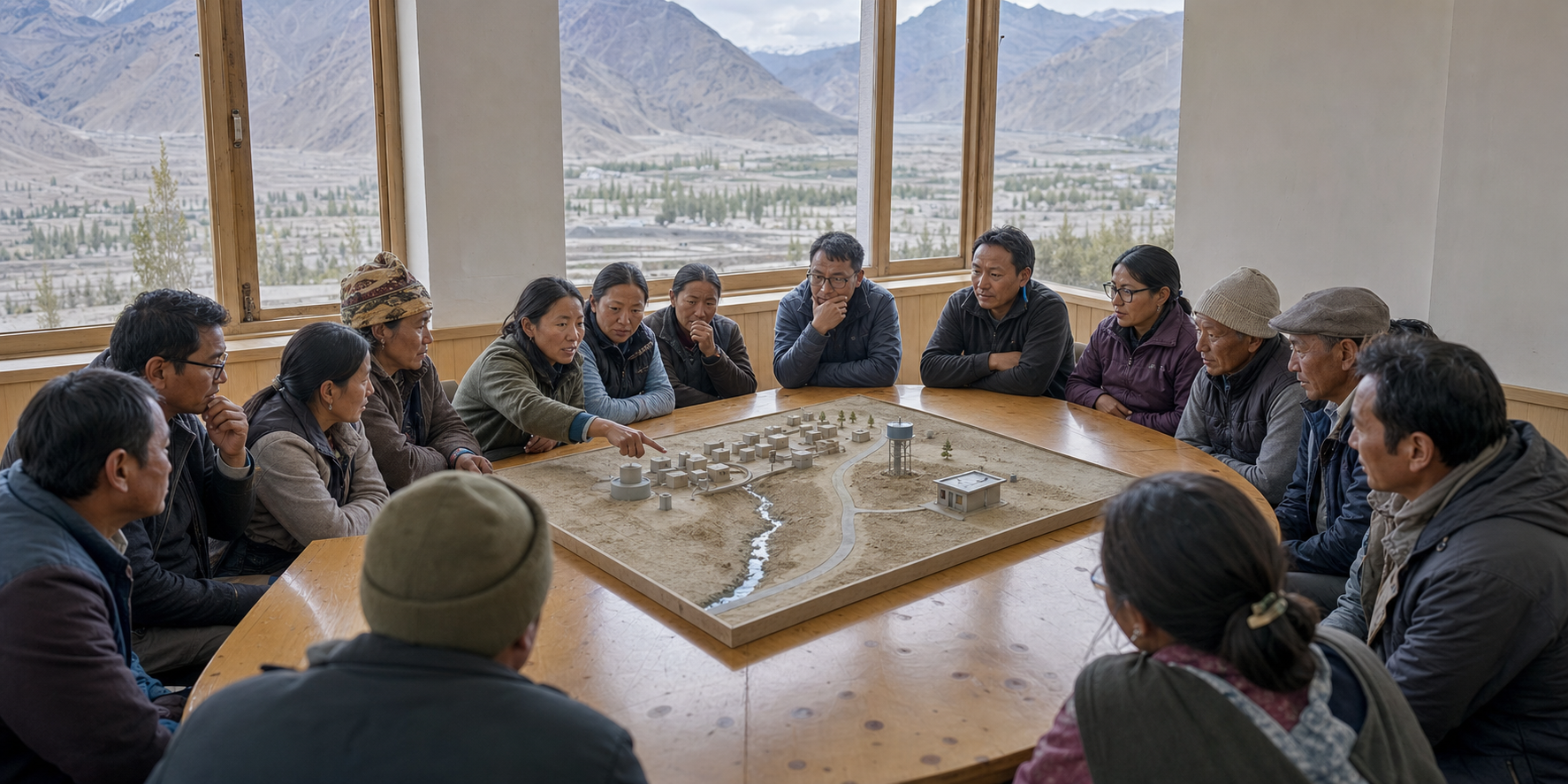
Creating a council answers who is present in the institutional map. It does not answer what that body can decide. Before calling the reform successful, look for six operational features.
- Defined functions: The public should be able to find a clear list of matters each council may decide, matters it may recommend and matters retained elsewhere. Vague language about development will produce disputes precisely when a difficult decision arises.
- Money matched to responsibility: A council cannot deliver an assigned function if its funds are uncertain, late or controlled through repeated approvals outside the district. Published allocations should be accompanied by release information and actual expenditure.
- Administrative capacity: Decisions require staff who can prepare plans, examine proposals, maintain records and oversee implementation. Transferring a duty without the people needed to perform it merely relocates the backlog.
- Access beyond the district headquarters: Residents of distant settlements need a practical way to submit, track and correct matters. The design could use scheduled local sittings, service points or other arrangements suited to each district, but it should not assume that one central office has solved the distance problem.
- Visible accountability: Agendas, decisions, budgets, project status and a grievance route should be available in a form ordinary residents can follow. If the public cannot see who decided, who is responsible and what happens next, autonomy becomes difficult to distinguish from discretion.
- Rules for overlap and appeal: Some matters will cross council boundaries or require action by more than one authority. The reform needs a named route for coordination and a clear place to challenge delay, refusal or jurisdictional confusion.
The most useful immediate demand is therefore a public operating charter for every council. It should identify functions, funding routes, responsible offices, meeting and disclosure practices, coordination procedures and the path for appeals. If those details are missing, that does not prove the councils will fail. It does mean no one can yet verify how much power has actually moved.
Watch the sequence as well. An announcement may be followed by rules, staffing, budgets and then implementation. Treat each as a separate milestone. A council that has received a legal identity but not usable funds should be described accurately: constituted, perhaps, but not yet equipped to deliver.
Local identity, tribal protection and national security

Do not confuse decentralisation with special protection
Scheduled Tribes accounted for about 80 per cent of Ladakh’s population in the 2011 Census. On the strength of that overwhelmingly tribal character, the National Commission for Scheduled Tribes recommended special protection for the region in September 2019.
Hill councils and special protections address related but different questions. A council concerns where local decisions are considered and made. Special protection concerns the safeguards under which sensitive interests, representation and cultural continuity are secured. Increasing the number of councils should not be presented as automatically exhausting that second question.
For readers concerned with Ladakh’s Buddhist heritage, the practical test is stronger than symbolic recognition. Can communities influence decisions that shape the continuity of their local life? Can a remote settlement place an issue on the agenda before priorities are fixed? Can a smaller community within a district obtain a recorded answer rather than being eclipsed by its district headquarters? The same tests should protect every Ladakhi community without erasing the distinctive civilisational importance of the region’s Buddhist traditions.
Representation should also be judged within districts, not only between them. A district may have its own council and still reproduce centre-periphery problems internally. Meeting locations, agenda-setting, public records and the distribution of completed work will reveal whether outlying valleys have a real voice.
Security requires coordination, not administrative remoteness
Ladakh directly faces the Line of Actual Control with China and the Line of Control with Pakistan. That makes coordination with the Union Territory administration and national institutions indispensable. It does not make every ordinary local matter a security matter.
A hill council should not be expected to perform defence or foreign-policy functions. Nor should an undefined appeal to strategic sensitivity prevent residents from knowing which local body is responsible for a service, plan or development decision. The sound approach is to draw the boundaries explicitly: local matters handled locally, cross-district matters coordinated through a published route, and security-sensitive matters directed to the appropriate authority without leaving the resident trapped between offices.
A pro-Bharat outlook need not choose between national security and Ladakhi agency. Competent local institutions can strengthen the Union by making everyday government more reachable and accountable. The safeguard is not blanket centralisation; it is a precise division of responsibility, reliable coordination and transparent escalation when jurisdictions meet.
How you can audit the first full cycle
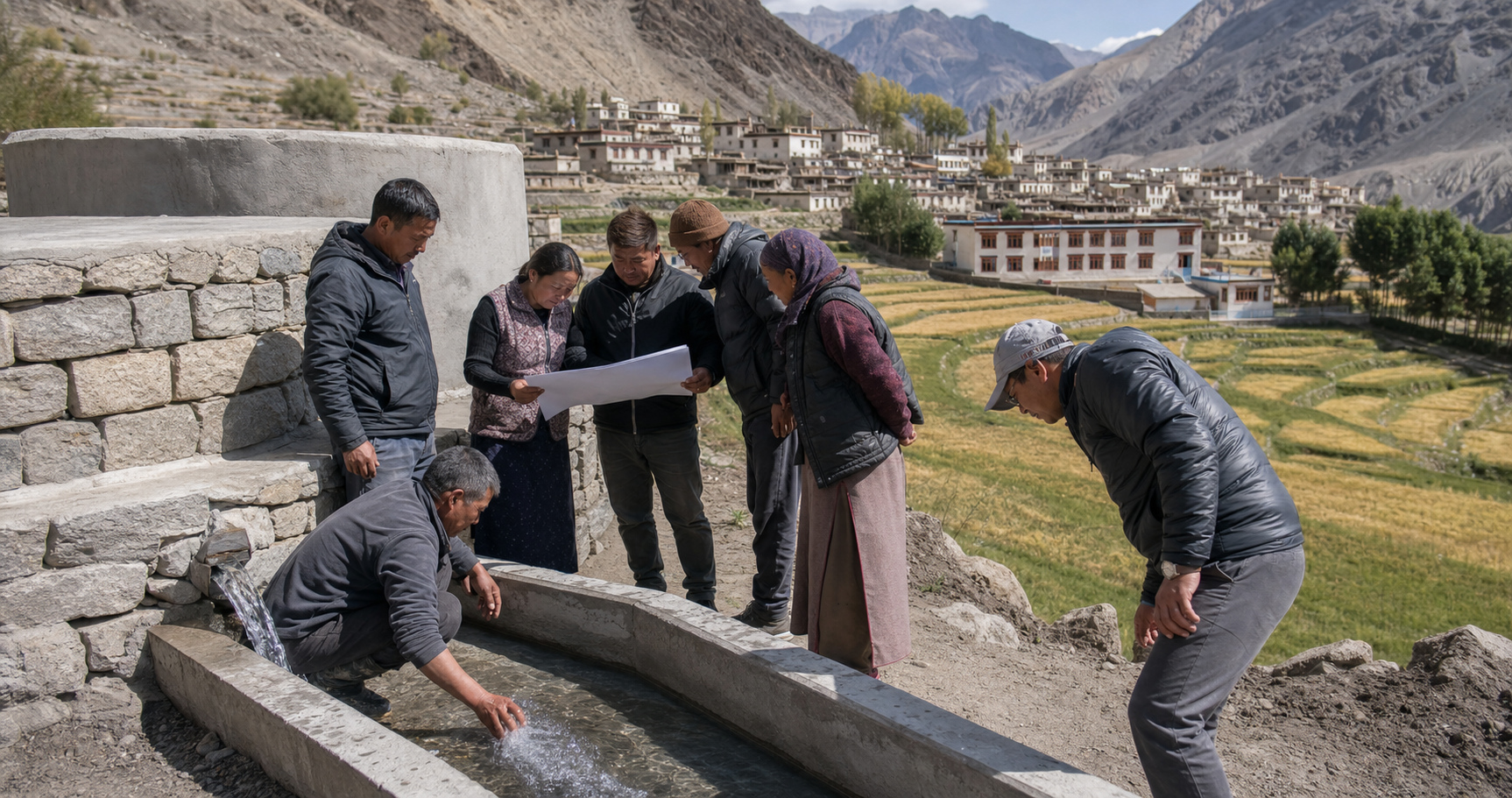
Do not wait for a sweeping verdict on whether the reform has succeeded. Build a small evidence file around one issue that matters in your district, then compare its administrative journey before and after the council completes a full planning, budgeting and delivery cycle.
| Test | Evidence to look for | Warning sign |
|---|---|---|
| Authority | A public order or charter naming the council’s functions and decision points | Broad promises with no identifiable final authority |
| Finance | Published allocations, release information and expenditure against assigned work | Responsibilities announced without usable or traceable funds |
| Access | A resident in an outlying area can submit, track and correct a matter through the district arrangement | Routine follow-up still requires repeated travel to Leh or Kargil |
| Representation | Agendas and decisions show that remote settlements can raise priorities and receive recorded answers | The district headquarters determines the entire agenda |
| Delivery | Each approved item has a responsible office, status and visible outcome | Announcements multiply while responsibility remains unclear |
| Coordination | A published route exists for cross-district, retained or security-sensitive matters | Residents are repeatedly redirected because jurisdiction is disputed |
Make the comparison concrete. Write down where the matter was submitted, how many offices referred it onward, whether the responsible authority was identified, how often an in-person journey was required, whether reasons for the decision were recorded and whether an appeal route existed. Save the relevant budget entry, meeting record or decision notice when one is available. The absence of a public record is itself a finding, but note it plainly rather than guessing what happened.
Assess each test separately instead of hiding everything inside one success score. A council may improve physical access while remaining financially dependent, or publish strong records while lacking staff. Naming the precise gain and the precise deficiency gives residents, community organisations and public representatives a demand that can actually be answered.
Seven councils deserve a fair chance because Ladakh’s geography makes closer government necessary. The next step is to insist on the instruments that turn proximity into self-government: a published division of powers, money attached to duties, access beyond district headquarters, open records and a clear coordination path. When a resident can identify a local decision, follow its funding, see its outcome and challenge a failure, the reform will have moved from a promising map to a working institution.