
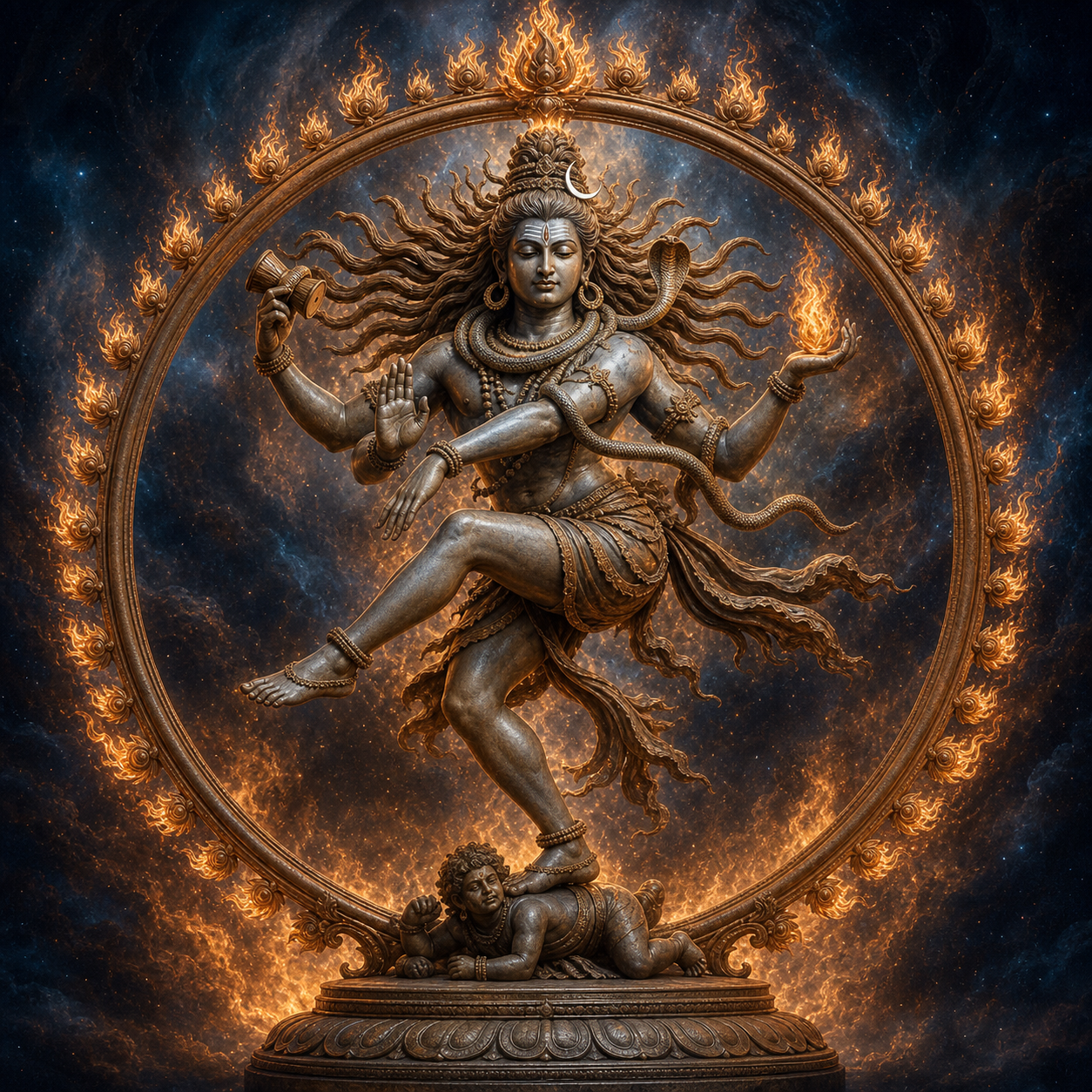
You may recognize Nataraja instantly yet still wonder what you are meant to see beyond a magnificent form: Why does Shiva dance above a dwarf? Why does overwhelming power appear as a flowing curve rather than a rigid stance? And what does the serpent-like movement have to do with your own confusion?
Bhujanga Lalita Tandava answers those questions through movement. It presents Shiva’s victory over ignorance not as an act of rage, but as awareness made steady, graceful, and strong. Once you learn to read that grammar, the image becomes more than sacred iconography. It becomes a practical test for how you handle fear, certainty, ego, and change.
Read Nataraja from the ground upward
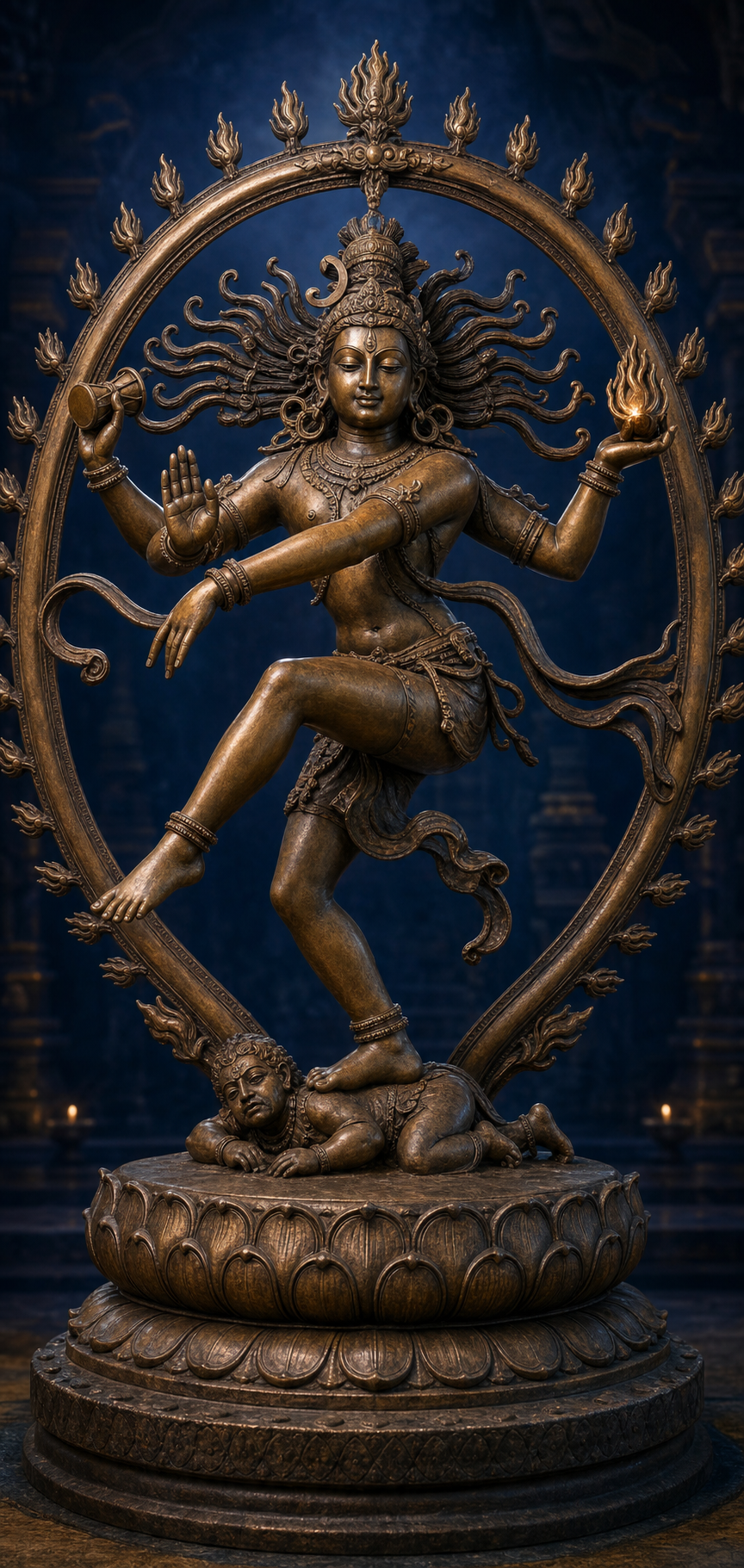
Begin at Shiva’s foot, not at the ring of fire. Beneath it lies Apasmara, the dwarf associated with avidya, or ignorance. This placement establishes the central problem before the other symbols offer their response.
Avidya is more than a shortage of information. You can possess facts and remain caught in it. It is the failure to see clearly: confusing a partial view with the whole, mistaking a passing reaction for truth, or letting ego defend a belief after its foundation has weakened. Ignorance can therefore appear as bewilderment, but it can also appear as absolute confidence.
Apasmara is subdued rather than made the focus of Shiva’s anger. That distinction matters. Ignorance is not overcome by hating the ignorant part of yourself or humiliating another person. It is held beneath disciplined awareness. The planted foot suggests that clarity must remain embodied and continuous; a single insight does not end every future lapse in discernment.
Now let your attention travel upward through the image:
- The foot over Apasmara establishes mastery over ignorance without making ignorance the centre of the composition.
- The raised hand gives abhaya, the assurance of fearlessness. Clear seeing requires the courage to relinquish a comforting error.
- The damaru marks primal pulsation, the rhythm through which form and movement arise.
- The flame signifies transformative dissolution. What is false, exhausted, or binding cannot be carried forever.
- The surrounding circle of fire evokes the unbounded field of becoming, where creation and dissolution belong to one living process.
- Shiva’s poised body holds all this motion without losing its centre.
Read together, the symbols do not promise escape from change. They show how to remain lucid within it. The dancer is active without being scattered, powerful without becoming crude, and surrounded by transformation without being ruled by fear.
Shaiva thought situates this dance within the five cosmic acts, or panchakritya: creation, maintenance, dissolution, concealment, and grace. Concealment explains why reality can be misperceived; grace makes recognition possible. The defeat of ignorance is therefore not separate from the cosmic dance. It is one of the dance’s decisive movements.
The serpent shows what intelligent strength looks like
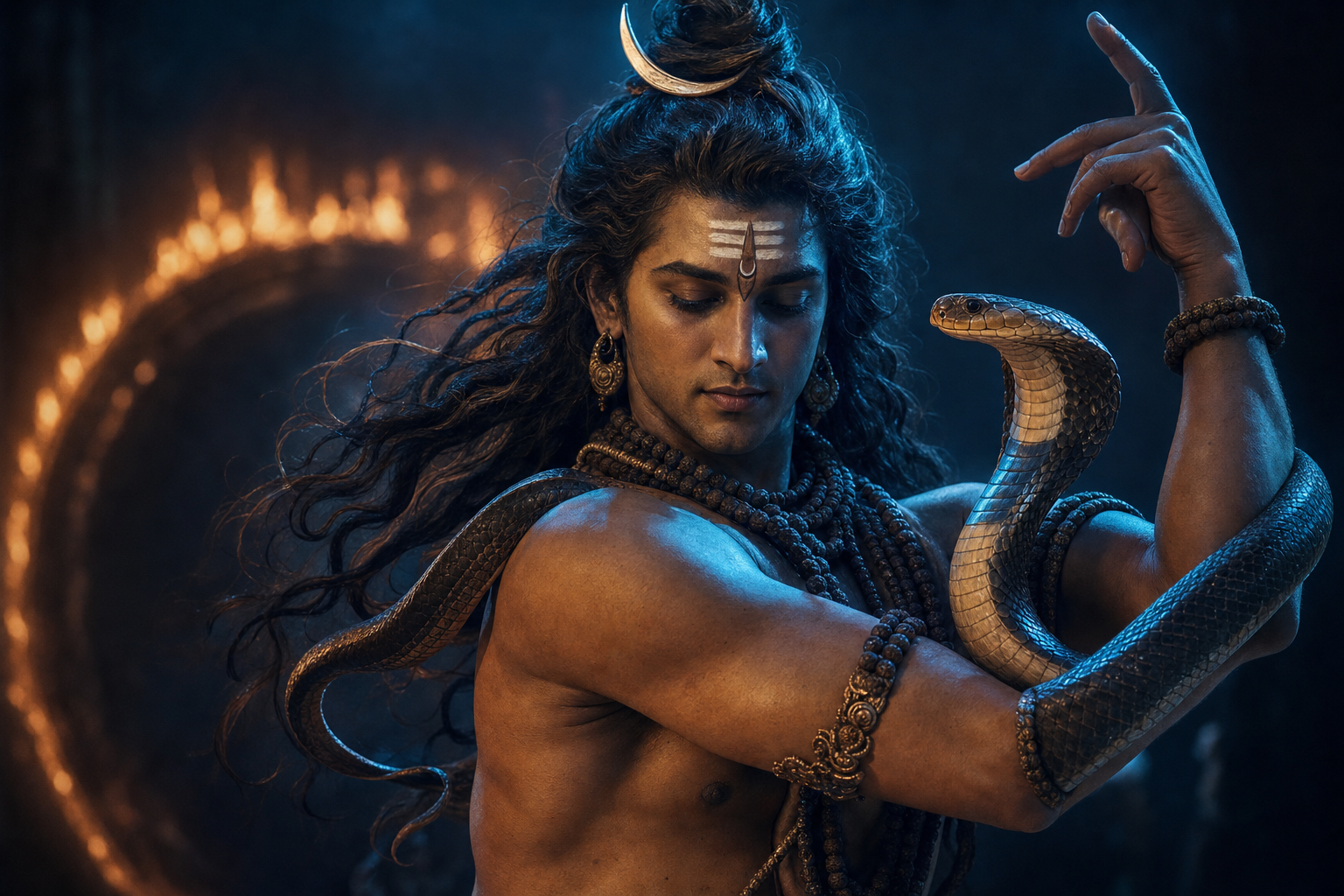
The name Bhujanga Lalita joins two ideas that are easy to separate in ordinary thinking. Bhujanga evokes the serpent and its sinuous movement. Lalita conveys grace, playfulness, and unforced beauty. Tandava supplies vigour and dynamism. The result is not softness replacing strength, but strength refined until it can move without stiffness.
This is the dance’s correction to a common mistake: we often imitate strength by becoming rigid. A rigid response may feel decisive because it removes uncertainty, but it also reduces sensitivity. It cannot adjust when conditions change. Serpentine movement remains centred while continuously adapting, which makes it a fitting image for discernment.
In movement terms, Bhujanga Lalita can be understood through three disciplines:
- Alignment keeps the pelvis stable and the axial line supported, so fluidity does not become collapse.
- Continuity allows force to travel from the centre through the spine, chest, shoulders, arms, wrists, and fingertips without breaking into disconnected gestures.
- Modulation regulates speed and amplitude, so vigour does not destroy the flowing line.
The resulting wave-like continuity through the torso and limbs gives the impression that the movement itself breathes. Tandava provides emphasis; lalita prevents emphasis from hardening into force for its own sake.
The vocabulary of karanas associated with the Natya Shastra helps dancers and scholars discuss this coordination of stance, gesture, and transition. Temple sculpture also preserves movement grammars in stone. Yet it is wise to avoid claiming an exact, uninterrupted one-to-one reconstruction across every historical period. Sacred iconography, sculptural posture, inherited performance, and contemporary reconstruction can illuminate one another without becoming identical forms of evidence.
The serpent carries a similarly disciplined range of meanings across Dharmic traditions. Ananta-Sesha represents immeasurable support in Hindu imagery. Mucalinda shelters the meditating Buddha. The serpent canopy of Parshvanatha communicates serene vigilance in Jain tradition. These forms do not make every serpent symbol interchangeable, but they do challenge the assumption that the serpent must signify moral corruption. Properly ordered energy can protect, support, and awaken.
Bhujanga Lalita may also remind you of kundalini and the subtle ascent through the sushumna nadi. Treat that as a contemplative resonance, not as proof that reproducing a spinal wave automatically awakens kundalini or produces a particular bodily result. The useful connection is more modest and more demanding: breath, attention, and movement must be coordinated rather than forced.
Use Apasmara as a mirror, not a label for opponents

The symbolism becomes ethically useful only when you first turn it inward. It is tempting to identify Apasmara with a rival ideology, an irritating relative, or anyone who rejects what you hold sacred. That move preserves your own blind spots by placing ignorance entirely under someone else’s name.
Instead, look for the moment when your attention loses its centre. Three patterns are especially revealing.
Rigid certainty
You have decided what a person, event, or teaching means before examining the full context. New information feels like an attack rather than an opportunity to refine your judgement. Here the serpent’s lesson is adaptability: preserve your principles, but test whether your interpretation still fits reality.
Ask: What do I know directly? What have I inferred? What would make me revise the inference? If you cannot name any possible correction, certainty may have become attachment.
Reactive heat
You may be responding to something genuinely wrong, yet anger is compressing the space between perception and action. Tandava does not require passivity, but lalita requires proportion. Before replying, identify the outcome you actually seek. Then remove the sentence, gesture, or accusation that serves only to discharge emotion. Strength that cannot regulate itself remains vulnerable to manipulation.
Diffuse confusion
At other times, ignorance does not feel forceful. It feels scattered. Too many claims, obligations, and interpretations compete for attention, so you postpone the one action that would restore clarity. The remedy is not to solve the entire world at once. Name the next truthful and non-harmful action: verify one claim, complete one duty, seek one necessary clarification, or admit what you do not yet know.
These patterns show why Apasmara is under Shiva’s foot rather than in Shiva’s hand. Ignorance must be kept in its proper place, not carried around and displayed as an identity. You do not need to deny confusion. You need enough awareness to stop letting it direct the dance.
This direction has distinct parallels across the wider Dharmic family. Buddhism places avidya at the beginning of dependent origination. Jain thought describes mohaniya karma as the deluding influence that obscures discernment. Sikh teachings identify haumai, egoic self-absorption, as a cause of separation and suffering. These are not interchangeable doctrines, and each belongs within its own spiritual framework. They nevertheless converge on a practical demand: see more truthfully, loosen self-centred attachment, and let clearer vision produce ethical conduct.
Practise the movement from reaction to discernment

You do not have to be a classical dancer to contemplate Bhujanga Lalita. Nor should a short personal exercise be confused with formal dance instruction. Use the symbolism to coordinate attention, breath, and intention; study the actual choreography with a qualified teacher if that is your aim.
- Stand comfortably with a soft gaze. Feel the contact of both feet with the ground and allow the spine to lengthen without locking the knees or forcing the chest upward.
- Take three to five unhurried cycles of nadi-shodhana if the practice is already familiar to you. If it is not, use quiet natural breathing instead of improvising a technique.
- Repeat Om Namah Shivaya with attention. Let the mantra gather the mind rather than treating repetition as a race toward a fixed count.
- Within a comfortable range, imagine or make a very small wave beginning at the pelvic centre, travelling through the axial spine and chest, passing into the shoulders, and resolving through the hands. Keep it continuous and gentle. If the movement is uncomfortable, remain still; the contemplation does not depend on reproducing a dance sequence.
- Bring one present difficulty to mind. Ask whether your obstacle is rigid certainty, reactive heat, or scattered confusion.
- Choose one corresponding act: examine an assumption, delay an impulsive response, or complete the next clarifying step.
The sequence matters. First establish a centre, then allow movement. First notice the knot, then choose an action. Trying to force clarity while the mind is agitated usually adds another layer of aggression. Bhujanga Lalita proposes a subtler discipline: organize your energy so that the false can fall away without your becoming false in the struggle against it.
Key takeaways
- Apasmara represents avidya, the failure of clear seeing, not merely a lack of accumulated facts.
- Shiva subdues ignorance through centred awareness; the image does not license contempt for people you consider mistaken.
- Bhujanga Lalita unites the vigour of tandava with serpentine grace, showing that adaptable strength is not weakness.
- Alignment, continuity, and modulation provide a practical grammar for keeping power from becoming rigidity.
- The serpent has protective and sustaining meanings across several Dharmic traditions, though those traditions should not be collapsed into a single doctrine.
- A useful daily response to ignorance is concrete: examine one assumption, regulate one reaction, and take one truthful next step.
The next time you encounter Nataraja, begin with the small figure beneath the foot and then follow the current upward. Let the image ask you one direct question: what is guiding your next action—unexamined reaction or disciplined awareness? Place your attention there, and make the next movement with both firmness and grace.