
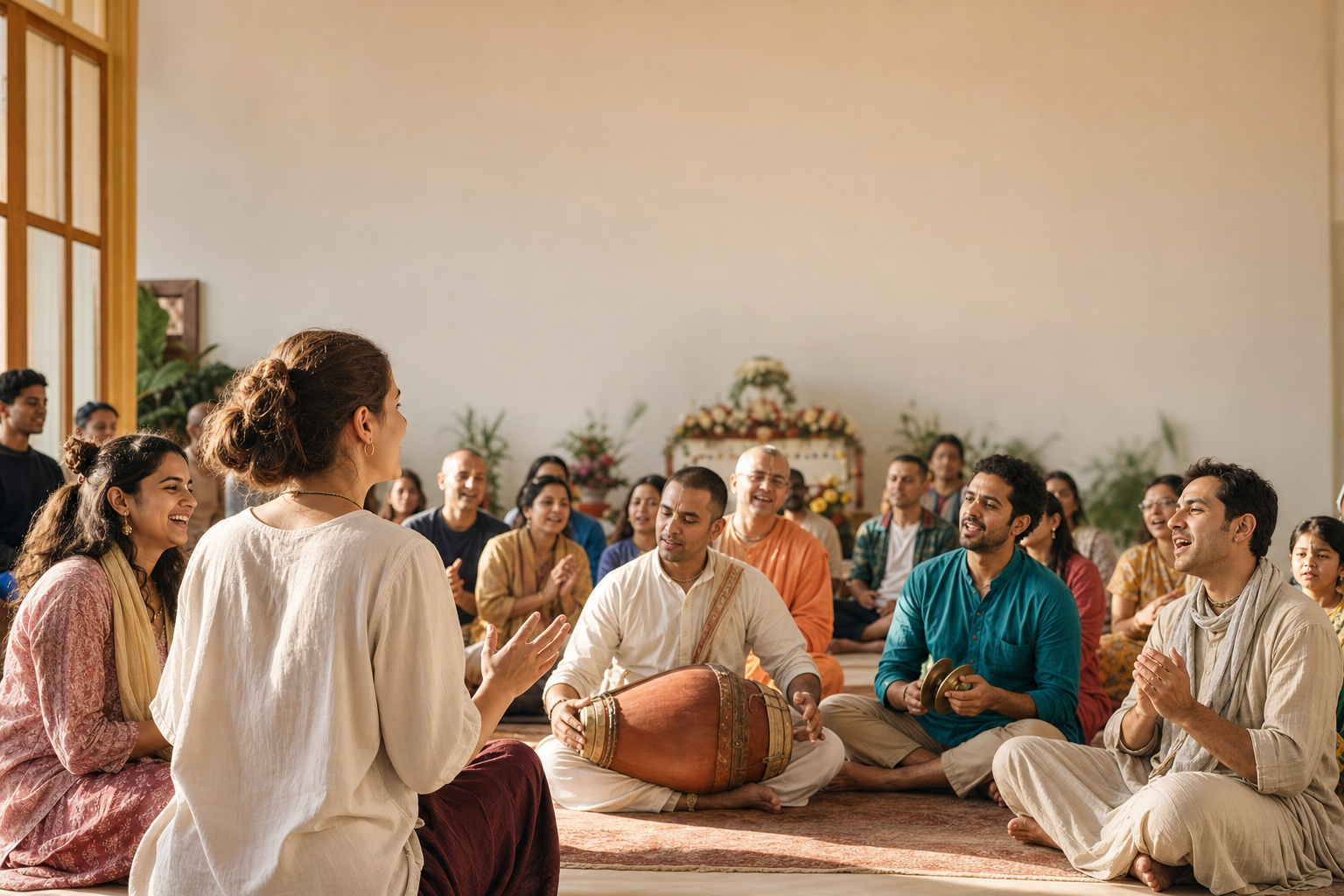
You can understand that an ISKCON temple is welcoming and still freeze at the edge of your first kirtan. Do you sing every line? Is sitting quietly acceptable? When does respectful observation become actual participation?
The simplest way in is to enter bhakti in layers: first receive, then respond, then serve. You don’t need musical training, fluency in Sanskrit, or a ready-made devotional identity. You need enough attention to follow the community’s rhythm and enough humility to ask when local practice isn’t clear.
Participation begins with attention, not expertise
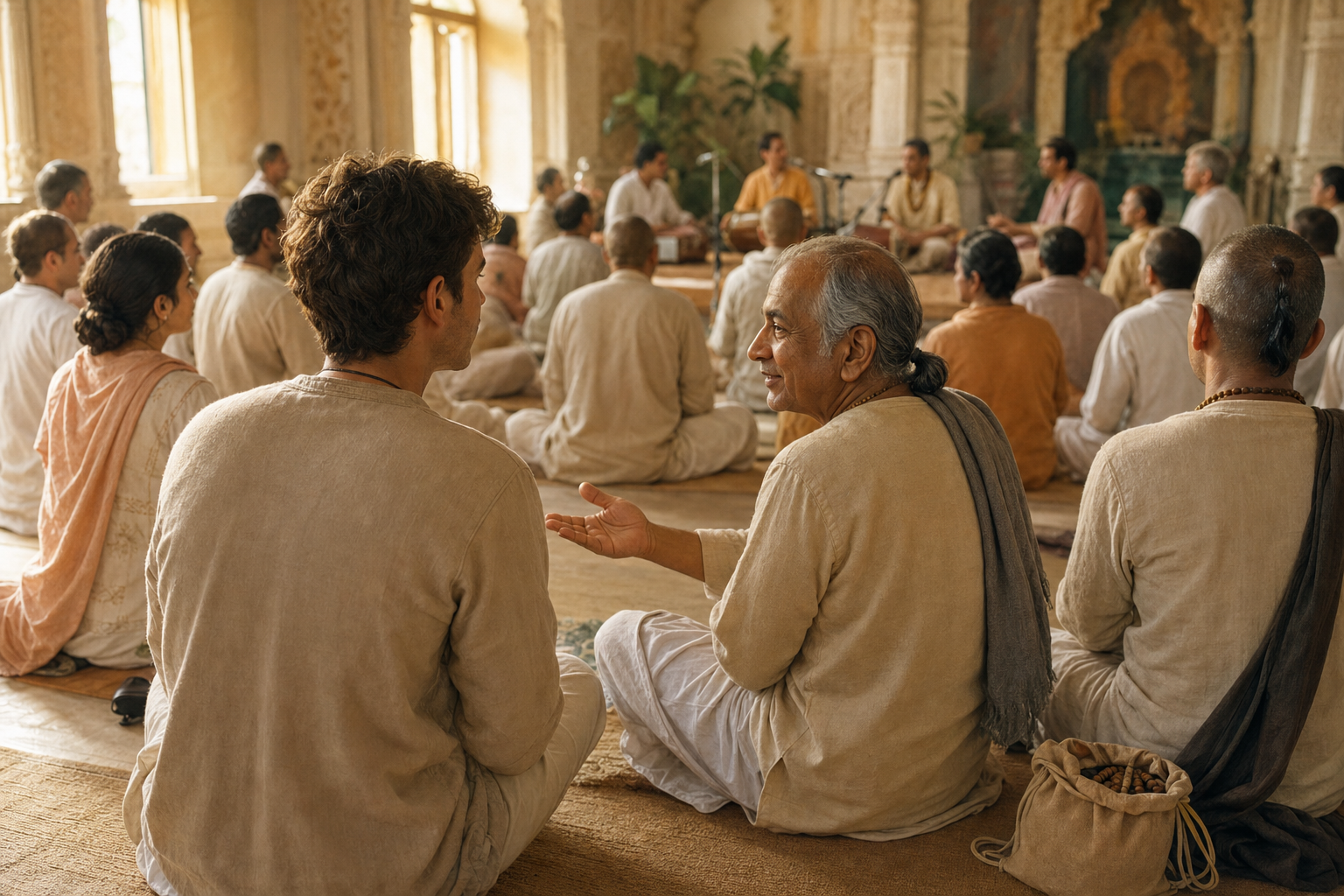
Within Gaudiya Vaishnavism, the holy name is understood as non-different from the Divine whom it names. Kirtan is therefore not merely religious music accompanying worship; sacred sound is itself a form of encounter. That theological claim explains why the congregation matters. The responding voices are not an audience decorating somebody else’s offering. Their hearing and chanting are part of the offering.
This participatory form carries forward the sankirtana movement associated with Sri Chaitanya in 16th-century Bengal. Its call-and-response structure makes devotion accessible without requiring every participant to master a complicated ritual. ISKCON later carried that structure into communities across the world, where a familiar mantra can unite people who don’t share a first language.
Three classical movements of bhakti make a practical map for your first encounter: sravanam, attentive hearing; kirtanam, chanting or speaking divine names and praise; and smaranam, remembrance. They belong to the broader framework of navadha-bhakti, the nine limbs of devotion. In an ISKCON community, you may move through all three during one sequence of darshan, kirtan, scriptural discourse, japa, and prasadam.
- Receive: listen to the mantra, observe how worship proceeds, hear the teaching, and accept hospitality without rushing to display what you know.
- Respond: repeat the congregational refrain, ask a sincere question, or begin a personal practice of remembrance.
- Serve: accept a task the community actually needs and perform it under the guidance of the person responsible for it.
Quiet participation is still participation. Listening carefully during one full refrain may be more devotional than singing loudly while ignoring the leader, the words, or the people around you.
Make your first visit a complete devotional arc
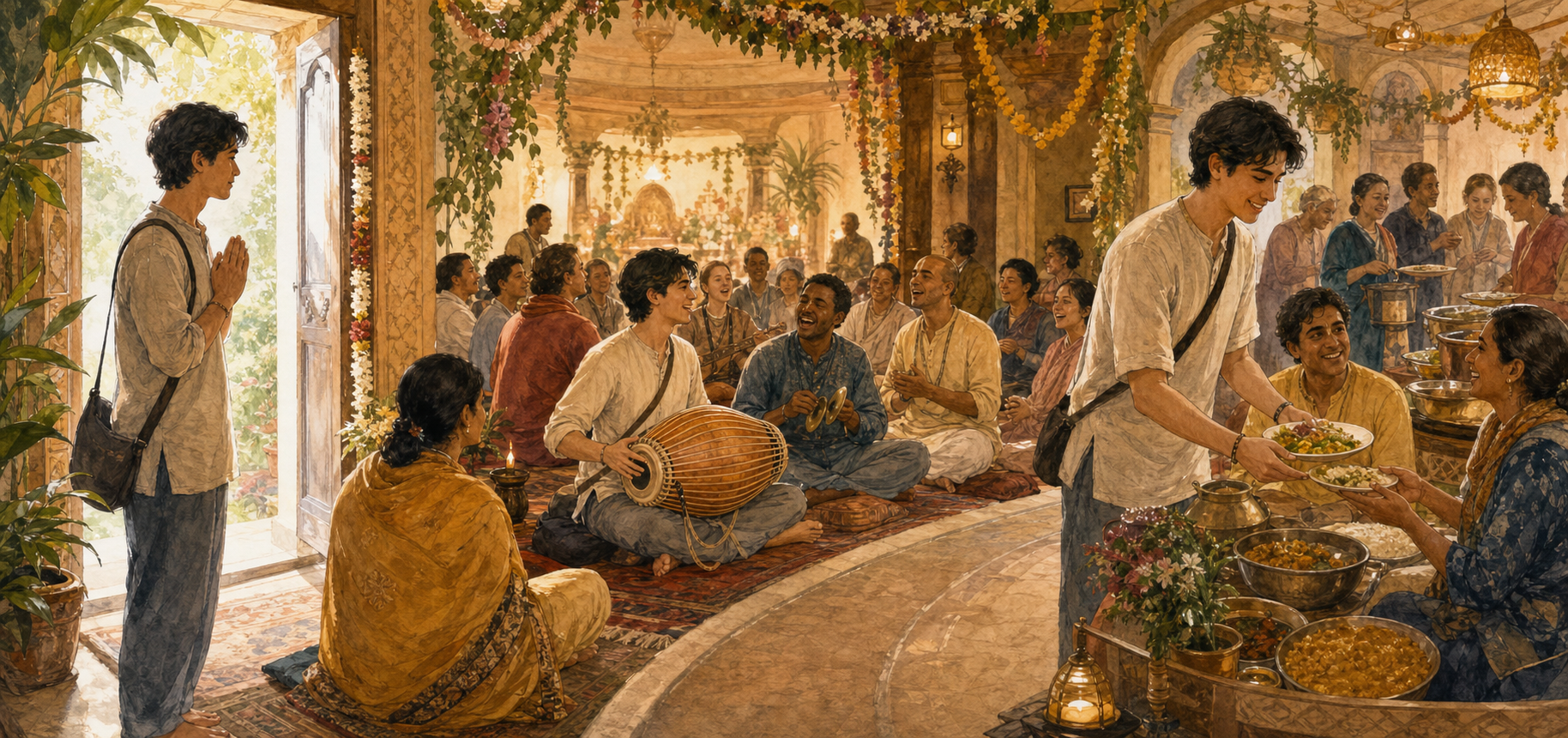
ISKCON schedules vary by location, so confirm the local program instead of assuming that every temple follows identical timings. A typical daily cadence can include mangala-arati, group japa, guru-puja, a Srimad-Bhagavatam discourse, midday worship, evening Gaura-arati, congregational kirtan, and prasadam. You don’t have to attempt the entire day. For a first visit, choose a program long enough to experience worship, chanting, and hospitality as connected practices.
- Check the program before travelling. Look for a service that includes congregational kirtan and ask whether prasadam follows. If you want scriptural teaching, confirm the class separately.
- Arrive before the announced start. Use the shoe-storage area, find the worship space without disrupting a ceremony, and notice where regular participants sit or stand.
- Ask one volunteer for orientation. Three useful questions are: Where may newcomers sit? What is the photography rule? Where and when is prasadam served?
- Follow before improvising. Watch how the congregation responds during arati and wait for a complete call-and-response cycle before joining the chant.
- Stay for the transition after worship. The movement from kirtan to a discourse, conversation, or prasadam shows how devotion becomes learning and hospitality rather than ending with the music.
- Leave with one next step. Ask about the next suitable program, a beginner-friendly class, or a small seva role. A vague intention to return is easier to lose than a known date or responsibility.
Temple etiquette is simple but local. Wear modest clothing, move mindfully in worship areas, and follow volunteer guidance. Photography rules can change by space or ceremony, so permission matters more than what another visitor is doing. Leather items may be accepted in many ISKCON settings, but customs near a sanctum can differ; ask rather than turning uncertainty into either anxiety or argument.
Good hospitality removes uncertainty without making the newcomer the centre of the gathering. Clear directions, predictable programs, orderly facilities, and patient explanations give you enough confidence to participate while preserving the sanctity of the temple.
Join kirtan as a respondent, not a spectator
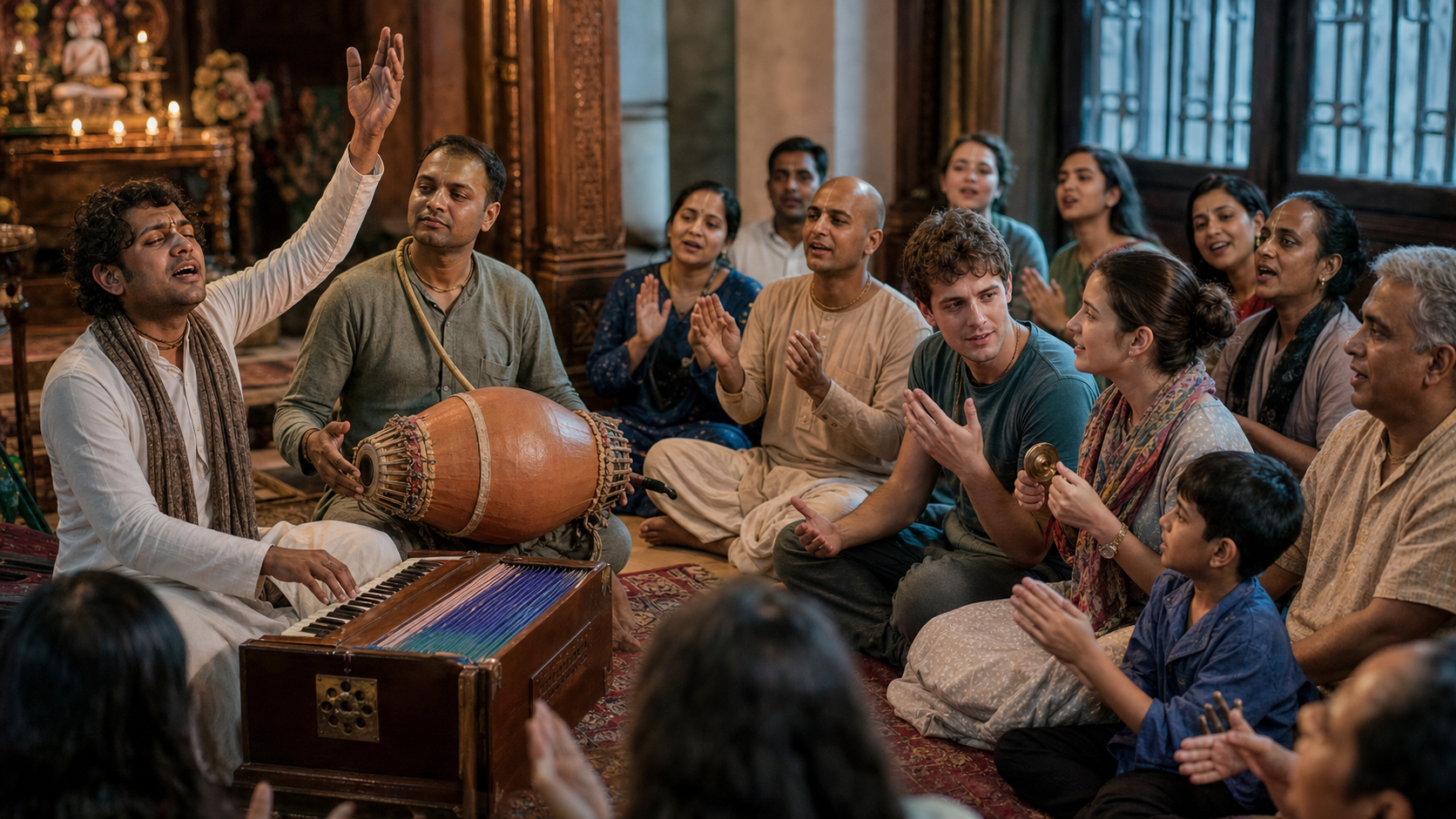
The Hare Krishna maha-mantra is: Hare Krishna, Hare Krishna, Krishna Krishna, Hare Hare, Hare Rama, Hare Rama, Rama Rama, Hare Hare. A leader sings a phrase and the congregation returns it. Harmonium can carry the melody, while mridanga or khol and kartals establish the rhythmic frame. The essential instrument for a newcomer, however, is attentive hearing.
- Let the leader finish the call. Beginning your response too early blurs the words and turns a shared exchange into competing sound.
- Return the mantra you actually heard. Clear repetition matters more than adding flourishes or proving that you know another melody.
- Match the congregation’s pulse and volume. You don’t have to overpower nearby voices. The response should sound communal.
- Wait for guidance before taking an instrument. Kartals and mridanga shape everyone else’s timing. Singing is a complete form of participation when you haven’t been invited or trained to play.
- Alternate voicing with listening. Resting your voice for a cycle can restore attention. It does not remove you from the kirtan.
Extended kirtans usually rise and settle in arcs rather than sustaining maximum intensity. Tempo, melody, and dynamics can move from contemplative chanting into a stronger response before returning to a quieter centre. If the room intensifies, you don’t have to shout or strain in order to remain spiritually engaged.
For a long or 24-hour kirtan, practical pacing becomes part of responsible participation. Alternate singing with listening, remain hydrated, use supportive footwear or a cushion, and protect your hearing near percussion or loudspeakers. If the sound feels uncomfortable, move farther away rather than enduring it as a test of devotion. Organizers likewise serve the congregation when they balance microphones, control feedback, moderate sound levels, and provide sensible transitions or quiet areas.
Paced vocalization and group singing can support calm attention and social connection, but those effects are not the measure of bhakti and kirtan is not a substitute for medical or psychological care. Its devotional centre is remembrance of Krishna. A pleasant internal state may accompany the practice without becoming its sole purpose.
Build a bhakti rhythm from complementary practices
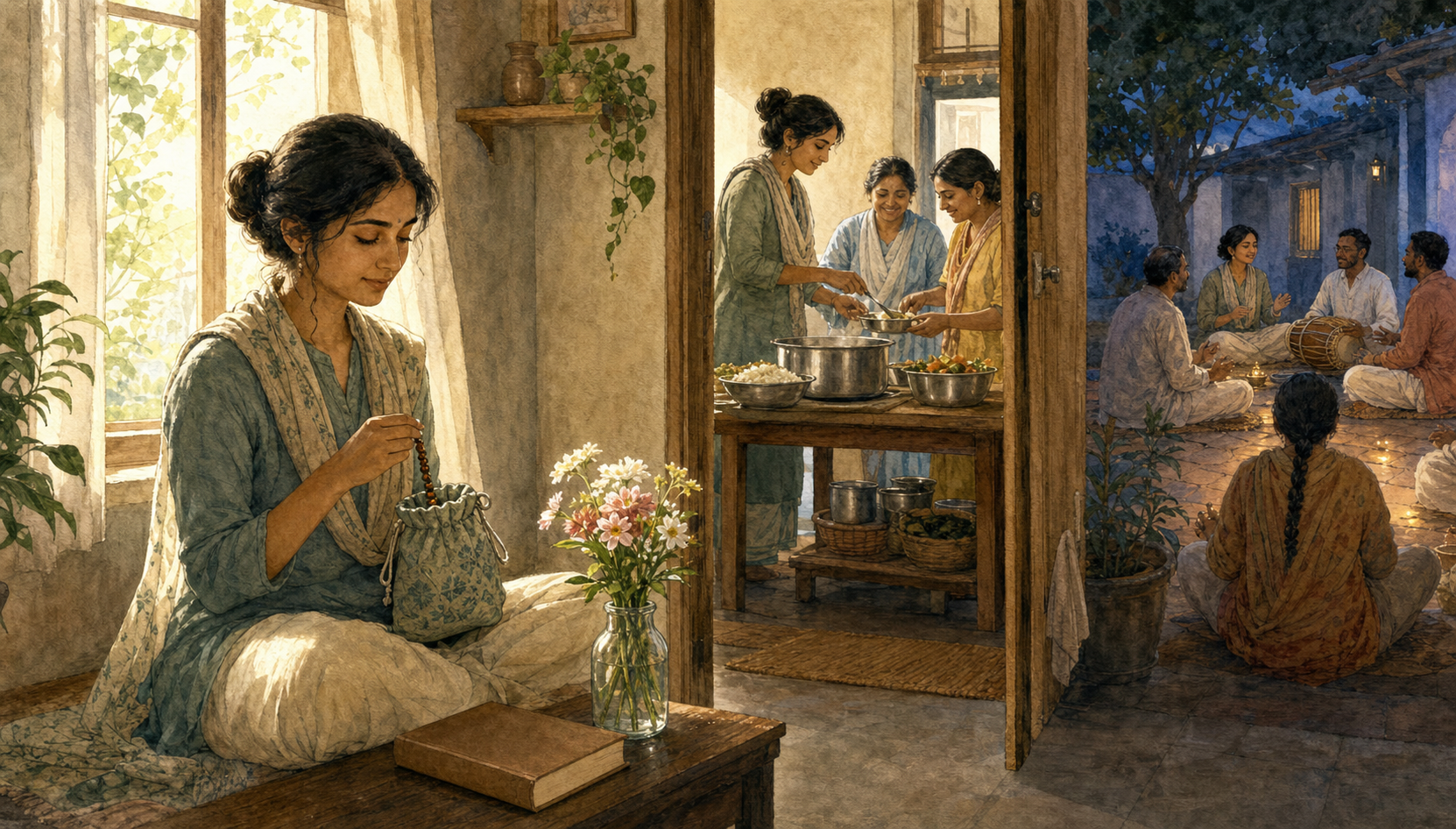
Kirtan can make a first visit memorable, but participatory bhakti becomes durable when collective emotion is joined to personal attention, scriptural understanding, service, and the reception of prasadam. Each mode corrects a different imbalance.
| Practice | Your part | What to notice |
|---|---|---|
| Darshan and arati | Attend reverently and follow the congregation’s movement | Worship has an order that you receive before interpreting it |
| Kirtan | Hear the call and return the mantra | Your voice belongs inside a congregational response, not above it |
| Japa | Repeat the mantra as a personal practice | Individual remembrance brings inward steadiness after collective energy |
| Scriptural hearing | Listen to Bhagavad-Gita or Srimad-Bhagavatam teaching and identify one application | Philosophy should clarify conduct, relationships, purpose, or practice |
| Seva | Accept a defined responsibility under local guidance | Devotion becomes care that other people can rely on |
| Prasadam | Receive sanctified vegetarian food respectfully | Grace, nourishment, hospitality, and community meet in an ordinary human need |
The alternation between collective kirtan and personal japa is especially useful. Congregational chanting gives you shared momentum; individual repetition reveals whether attention can continue without the support of instruments and a crowd. Combining voiced devotion, quieter remembrance, scriptural hearing, and prasadam creates a more balanced rhythm than chasing one emotional peak after another.
A workable beginning is modest: choose one recurring congregational program, keep one personal practice you can sustain, and accept one clearly bounded service responsibility. Consistency matters more than assembling an impressive devotional schedule that collapses after a brief burst of enthusiasm.
Seva turns attendance into accountability
Temple hospitality and large kirtans do not run on atmosphere alone. Volunteers orient guests, coordinate programs, distribute prasadam, manage transitions, care for instruments, monitor sound, support hydration, and keep responsibilities clear. In long events, rotating teams and explicit roles preserve continuity while individual participants rest.
Ask for a bounded task rather than announcing that you are available for anything. Find out what is needed, who coordinates it, when it begins and ends, and what standard you should follow. This protects the community from well-intentioned confusion and gives you a responsibility you can actually complete.
Recognize dharmic kinship without flattening traditions
Participatory bhakti can feel familiar to people formed by other dharmic communities. Anna-seva and prasadam hospitality recall the social openness of Sikh langar. Sacred sound finds a parallel in Sikh shabad kirtan and nam simran, Buddhist repetitive chanting, and Jain recitation of the Namokar Mantra. ISKCON’s vegetarian service also resonates with the wider dharmic concern for ahimsa, generosity, restraint, and compassionate conduct.
These are family resemblances, not interchangeable theologies. Dharmic traditions can share disciplined sound practice while understanding its object and meaning differently. If you come from a Sikh, Buddhist, Jain, or another Hindu lineage, let the similarity help you participate respectfully without pretending that every doctrine is the same. Enter the Gaudiya practice on its own terms and ask what the holy name means within that tradition.
Notice whether the community enables participation
A powerful lead singer is not enough to make a healthy participatory culture. Notice whether the mantra remains intelligible, the congregation has room to respond, newcomers receive clear guidance, children and elders can participate safely, service roles are coordinated, and prasadam is offered with dignity. During extended programs, accessible sound levels, orderly transitions, hydration, and places to rest are forms of pastoral care rather than secondary logistics.
This is also a useful standard for organizers. Balance between call and response, rhythmic cohesion, newcomer accessibility, and participant care reveal more about a kirtan’s quality than volume or spectacle alone.
Key takeaways
- Use your first visit to experience a connected arc of worship, kirtan, hearing, and prasadam rather than sampling only the most dramatic moment.
- In kirtan, listen to the complete call and return it clearly. Accuracy, shared rhythm, and attention matter more than volume.
- Alternate congregational chanting with personal japa or quiet remembrance so collective uplift can become steady practice.
- Ask before photographing, entering restricted areas, playing instruments, or taking on seva. Local guidance resolves uncertainty without diminishing your sincerity.
- During extended kirtan, rest your voice, hydrate, choose a sustainable posture, and move away from sound that feels uncomfortable.
- Judge participatory culture by how well it helps people hear, respond, learn, serve, and receive care, not merely by the intensity of the program.
On your next visit, choose one complete program and ask a volunteer one concrete question before you leave: Which regular gathering or service role is the right next step for a newcomer? Put that answer into your calendar. Bhakti becomes participatory when welcome turns into a practice you can faithfully return to.
References
- Dandavats – ISKCON Salem in Tamil Nadu: Transformative Bhakti, Kirtan, and Unforgettable Temple Hospitality
- Dandavats – Inside ISKCON Birmingham’s 24-Hour Kirtan 2026: Sonic Devotion, Bhakti Science, and Unity