
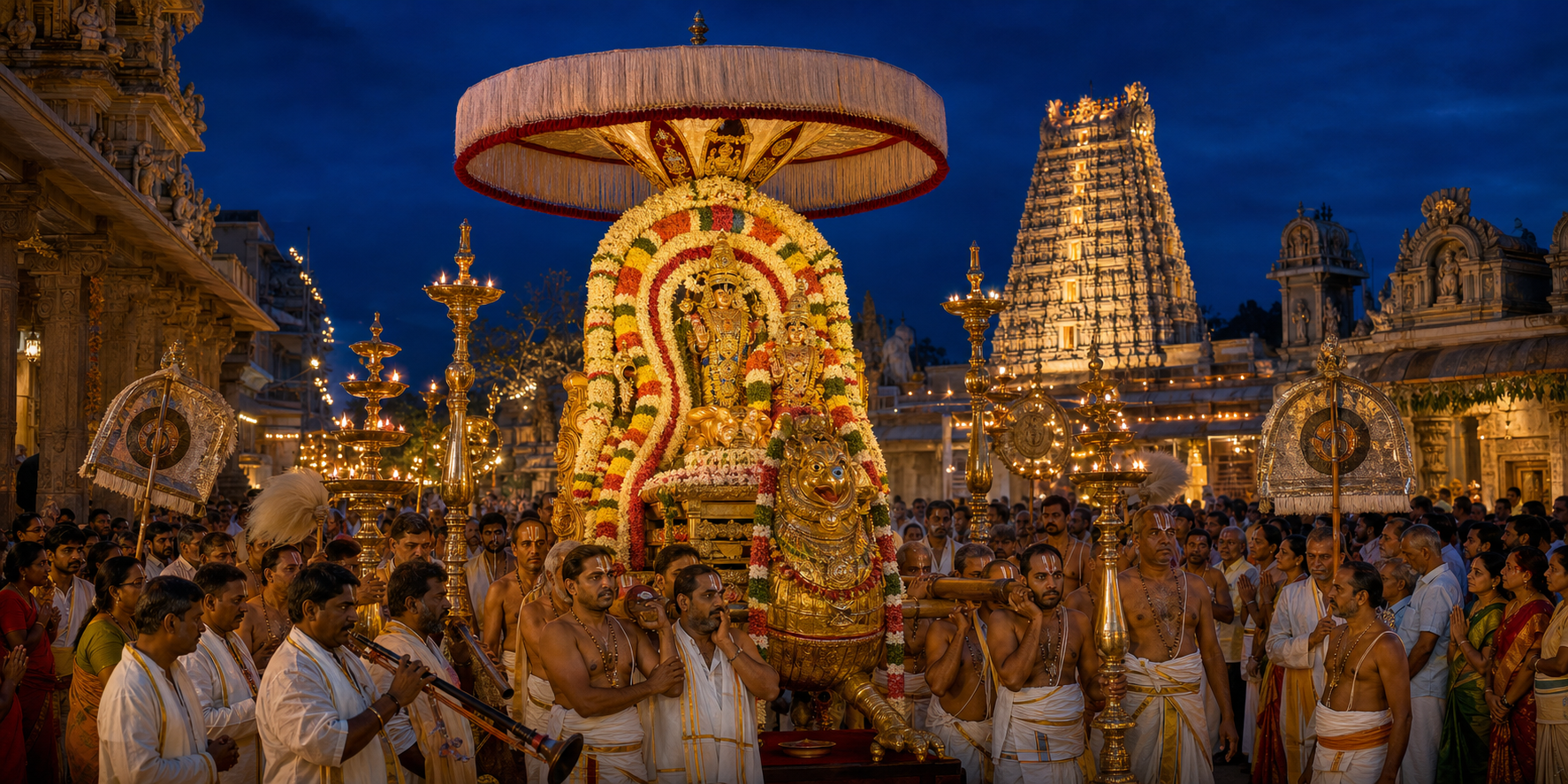
If you are planning from the 2026 Brahmotsavam calendar, keep two things separate: the confirmed festival window and the final day-wise program. Mixing them up can leave you booking around a customary Vahana sequence that was never confirmed for this particular celebration.
The announced 2026 calendar places Ankurarpanam on the evening of May 22, followed by the nine principal festival days from May 23 through May 31. Morning and evening are the main windows for Vahana Sevas, while temple rituals generally occupy the middle of the day. Exact procession times, the final Vahana order, access arrangements, and crowd advisories must be checked against TTD’s final day-wise notice.
What is fixed for 2026, and what still needs verification
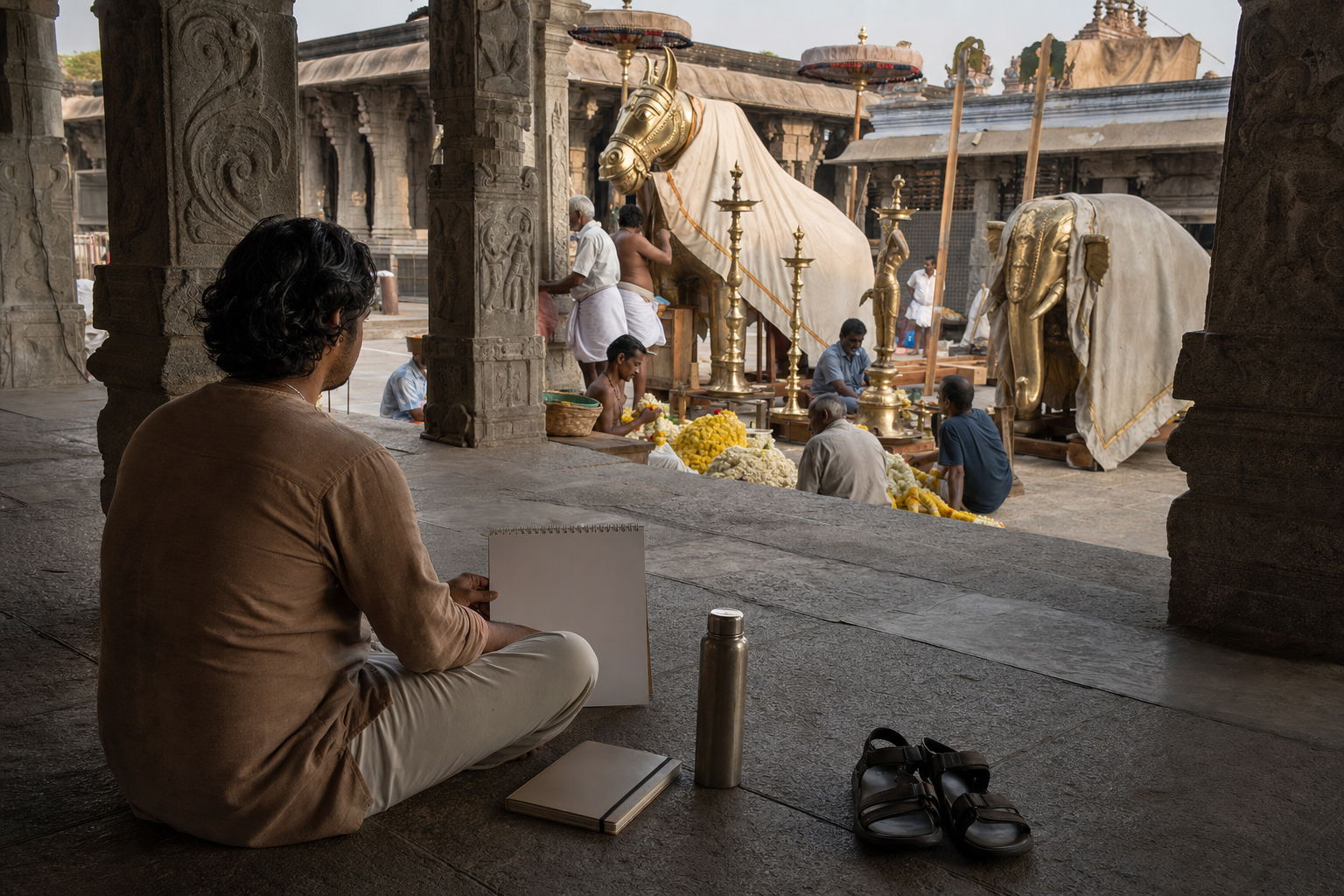
The dates give you a reliable framework, but they are not a complete itinerary. Build travel and accommodation around the festival window first. Add individual Sevas only after verifying the final program.
| Date | Festival stage | What it means for your plan |
|---|---|---|
| May 22, evening | Ankurarpanam | The ceremonial sowing of seeds prepares the sacred setting for the festival. Treat it as the opening rite, separate from the nine main days. |
| May 23 | First main festival day | Dwajarohanam, the raising of the Garuda-emblem flag, customarily inaugurates the public festival phase. Confirm its exact 2026 time. |
| May 23-31 | Nine principal days | Expect the main public Vahana Sevas in morning and evening windows, with temple-based observances during the day. Do not infer the daily Vahana order from another temple or year. |
| May 31 | Final main festival day | Chakrasnanam and Dhvaja-avarohanam customarily bring the ritual cycle to its close. Verify the final sequence and public access before attending. |
A list of Vahanams commonly seen at Vaishnava Brahmotsavams is not the same thing as the Govindaraja Swamy Temple’s final 2026 schedule. The distinction matters most if Garuda Vahanam is your priority, if you are coordinating a family group, or if your hotel and transport bookings depend on a particular morning or evening.
Before fixing the detailed itinerary, verify these three items through official TTD communications:
- The date and start time of the Vahana Seva you want to attend.
- Any special entry, security, photography, or crowd-control instructions for that day.
- Traffic diversions, assistance points, and designated viewing arrangements around the four Mada streets.
Keep a saved copy or screenshot of the final notice, but continue to follow public announcements on the day. Procession access and photography rules can change when crowd or security conditions require it.
How the ritual arc changes what you experience
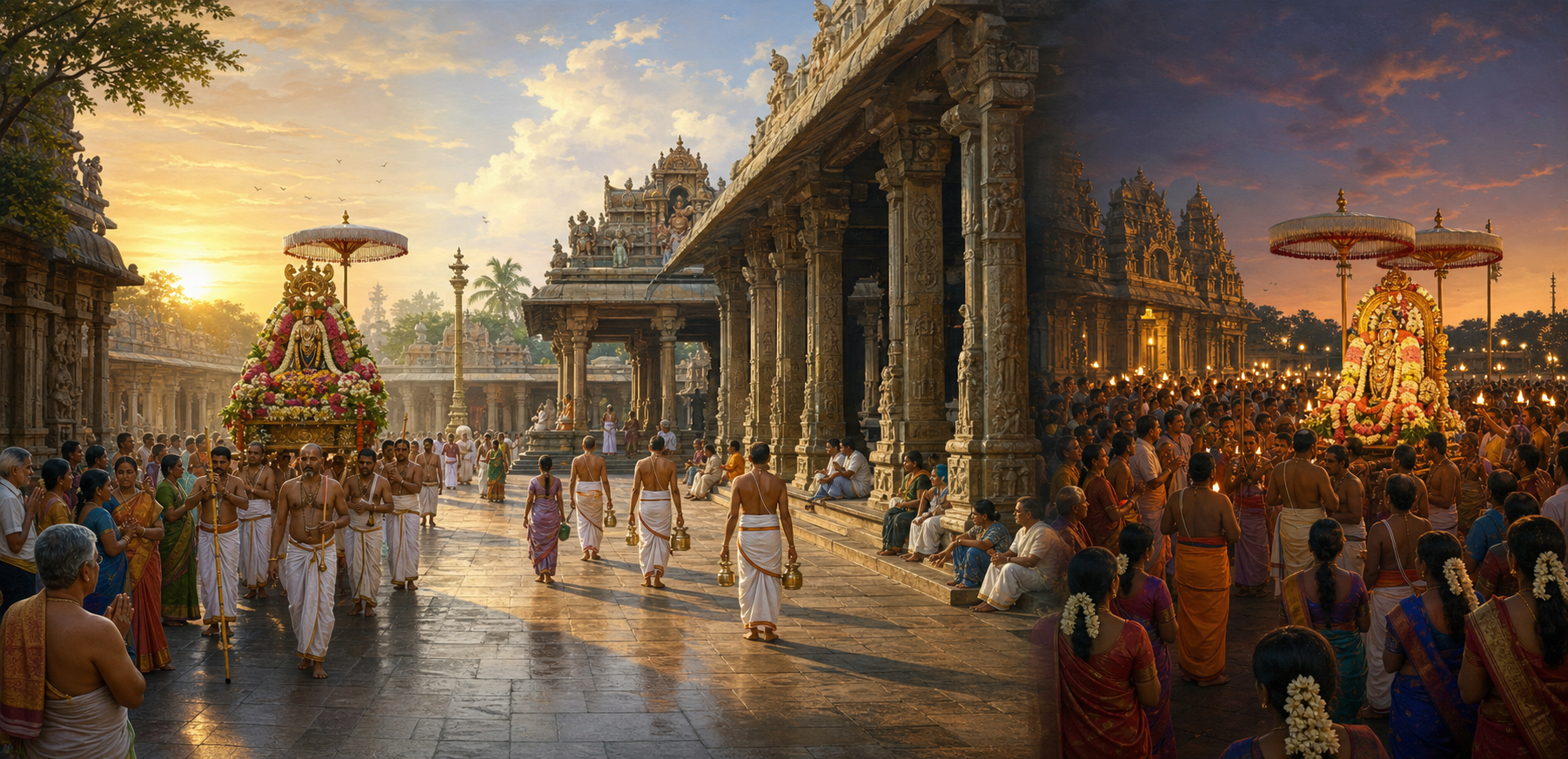
Brahmotsavam is not simply nine independent processions. Its Vaishnava Agamic structure gives the days a beginning, a protected sacred interval, a repeated movement of divine grace into the streets, and a formal conclusion. Understanding that arc helps you choose a visit for more than spectacle.
From the ritual seed to the closing bath
- Ankurarpanam: Seeds are ceremonially sown on May 22. The rite expresses auspicious beginning, fertility, renewal, and the planting of merit. It is the festival’s ritual preparation rather than an extra Vahana procession.
- Dwajarohanam: The flag carrying Garuda’s insignia is raised as the public phase begins. It marks the festival period as sacred time, not merely a series of calendar appointments.
- Daily Vahana Sevas: The utsava murti of Sri Govindaraja Swamy is carried in clockwise pradakshina around the four Mada streets. The deity comes beyond the inner shrine so that devotees gathered along the route can receive darshan.
- Snapana Tirumanjanam: When included in the official program, this ritual bathing emphasizes purification and renewal. Because it is conditional on the published schedule, do not promise yourself access without checking.
- Chakrasnanam and Dhvaja-avarohanam: The ceremonial bathing of the Sudarshana Chakra and lowering of the festival flag close the cycle and restore the ordinary liturgical rhythm.
If you have only one short window in Tirupati, a public Vahana Seva usually gives you the clearest experience of Brahmotsavam’s collective dimension. If you can attend two different stages, pair a Vahana procession with an opening or concluding observance, subject to public access. You will then encounter both the outward celebration and the ritual architecture holding it together.
The setting carries a deeper Sri Vaishnava inheritance. Tradition associates the consecration of Sri Govindaraja Swamy’s icon with the 12th-century acharya Bhagavad Ramanujacharya. During Brahmotsavam, that inheritance is not confined to memory or scholarship: it becomes visible through Agamic worship, alankaram, temple architecture, music, pradakshina, and public devotion.
You do not need to master every ritual term before attending. Notice the ethical movement instead: preparation before action, surrender without passivity, disciplined service, courage against adharma, and restoration of balance. Those ideas also explain why seva, satya, karuna, and loka-sangraha resonate with visitors from across the wider Dharmic family.
Choose a Vahana by meaning as well as popularity
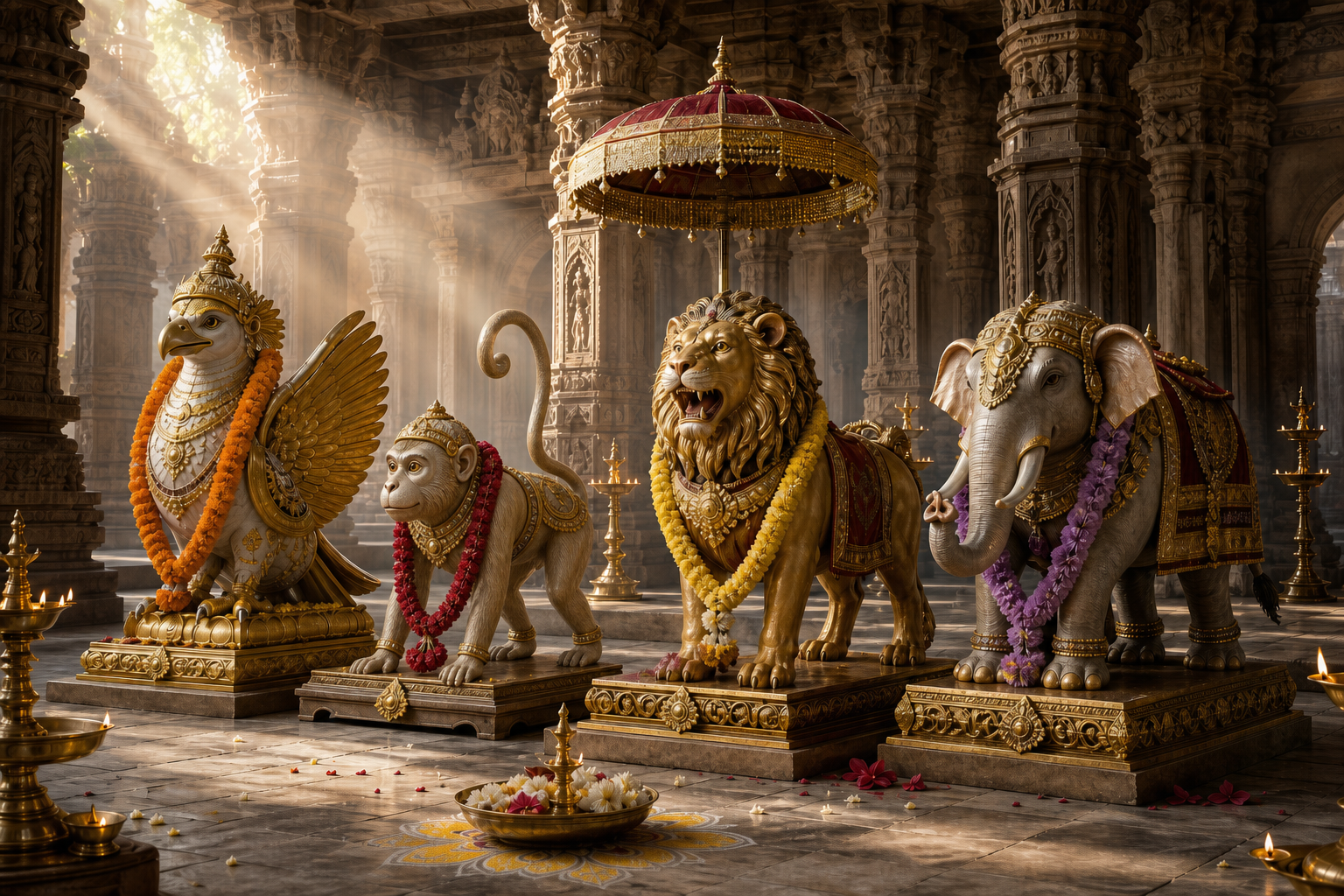
Each Vahana gives the procession a distinct theological emphasis. The exact 2026 sequence must come from TTD, but the commonly associated meanings can help you decide what you want to contemplate during darshan:
- Sesha: Cosmic support, protection, and surrender. It invites you to examine what it means to rely upon dharma rather than personal control alone.
- Hamsa: Viveka, or discriminative wisdom. The practical question is whether you can separate what is merely urgent from what is actually right.
- Simha: Courage and strength in the face of adharma. Its lesson is disciplined moral courage, not aggression.
- Hanumantha: Tireless seva-bhava. It directs attention away from status and toward faithful service.
- Gaja: Royal strength and dignity. It can be read as a reminder that power acquires value only when placed in the service of order and protection.
- Surya Prabha: Illumination, clarity, and purposeful action.
- Chandra Prabha: Serenity, balance, and the complementary rhythm of effort and rest.
- Garuda: The most sought-after Vahana experience in many Sri Vaishnava festivals and therefore a likely peak-crowd occasion. Attend for the powerful collective darshan, but prepare for greater density and tighter movement.
If Garuda Vahanam is your central reason for coming, make it the anchor of that day’s plan. Do not crowd the same day with an ambitious Tirumala or regional temple circuit. Preserve time for security screening, controlled access, walking, a meal, hydration, and an unhurried return after the procession.
Families accompanying seniors or young children may have a better experience at a widened junction or corner along the Mada streets. These places can offer more lateral clearance as the Vahana turns, although barricades and police instructions always take priority. Select a recognizable rendezvous point before entering the viewing area; mobile contact alone is not a sufficient regrouping plan in a dense procession.
Once the Vahana approaches, let darshan remain the purpose. Nadhaswaram, tavil, Govinda namasmarana, alankaram, lamps, and the movement of the utsava murti belong to one devotional experience. A photograph is secondary. If photography is restricted, put the device away immediately rather than arguing with volunteers or security personnel.
Build a temple-day plan that survives heat and crowds
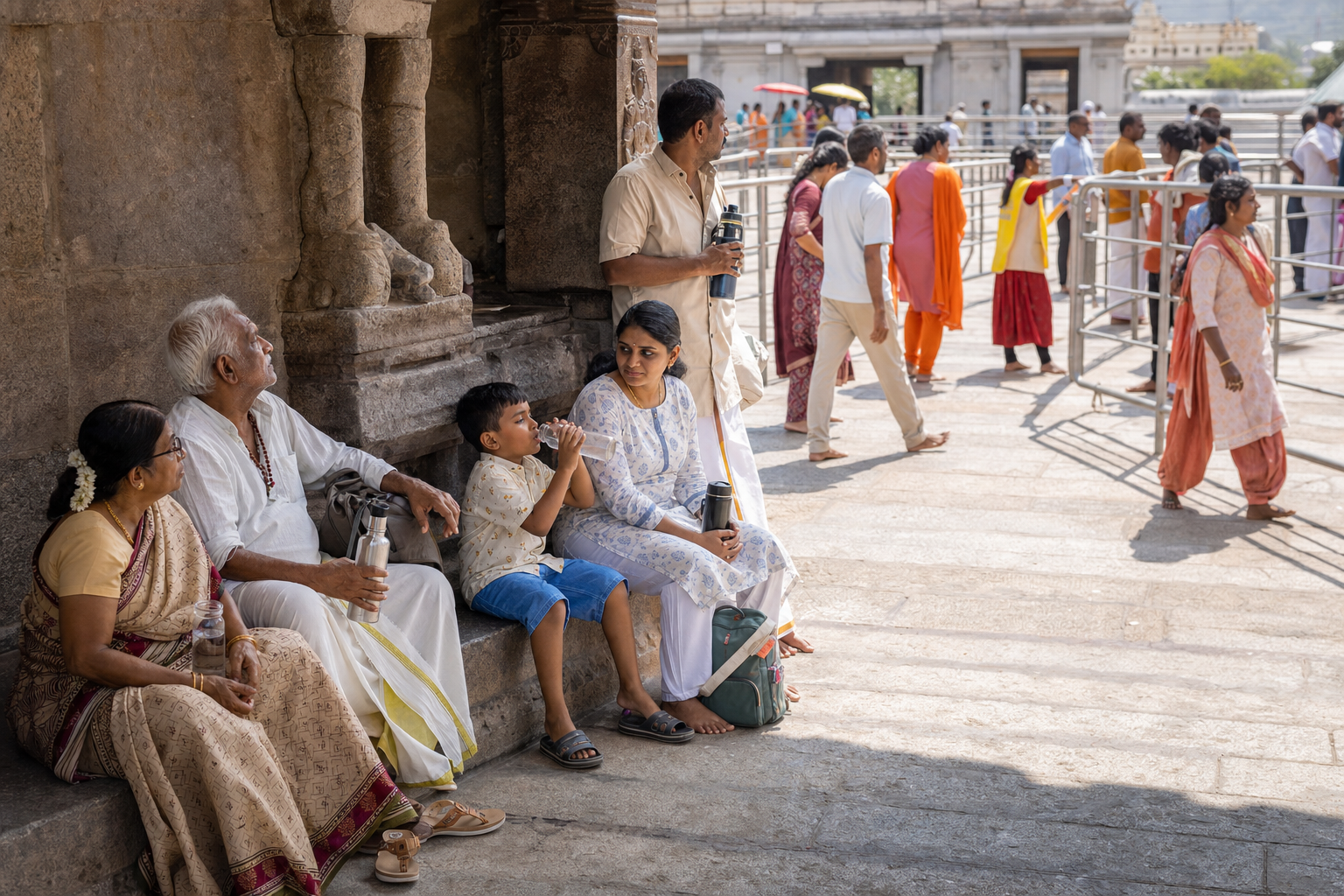
Late May requires more than a list of shrines. The strongest plan has one devotional anchor, a protected midday rest period, and enough flexibility to absorb traffic or queue changes.
- Choose one anchor Seva. Select either a morning or evening Vahana procession as the non-negotiable part of the day. Treat other activities as optional until the final timetable is known.
- Protect the middle of the day. Midday is generally associated with temple-based rituals and greater exposure to heat. Use it for food, rest, and hydration instead of continuous outdoor movement.
- Pack for movement, not for every possibility. Wear breathable, modest clothing that meets temple norms. Carry a cap or umbrella for daytime, a light shawl if useful in the evening, essential medicines, minimal valuables, and water in a reusable bottle where permitted.
- Plan the last mile separately. Tirupati railway station and bus station provide practical access to the city, but evening traffic diversions can change how close an auto can travel to the heritage precinct. Be prepared to complete part of the journey on foot.
- Give vulnerable family members a lower-stress option. Check for notified assistance points, shaded viewing stretches, medical camps, hydration kiosks, and accessible corridors. Their availability and location should be verified rather than assumed. Schedule a real break between morning and evening events.
- Keep the group easy to identify and regroup. Agree on a fixed meeting point, keep children beside a named adult, and avoid carrying loose bags that make screening and crowd movement harder.
For children, seniors, and anyone more vulnerable to heat, carry appropriate hydration supplies and consider oral rehydration salts among the emergency items. If someone becomes unwell, move out of the procession flow and seek assistance; do not depend on supplies alone or block an emergency corridor.
Accommodation near major temple celebrations can fill quickly. TTD choultries and guest houses may suit pilgrims who want institutional accommodation, while reputable hotels can offer other levels of comfort. The useful criterion is not merely the advertised distance from the temple: ask how evening road restrictions affect actual access, and avoid assuming that a vehicle will reach the entrance during a major Vahana Seva.
If you want a wider Tirupati pilgrimage, Sri Venkateswara at Tirumala, Sri Padmavati Ammavari Temple at Tiruchanur, and Kapila Theertham form a meaningful sacred circuit with Sri Govindaraja Swamy Temple. Place that circuit in a separate travel window when possible. A tightly packed checklist can leave you exhausted before the Brahmotsavam darshan that brought you to Tirupati.
Temple etiquette also has logistical value. Use the marked footwear areas, cooperate with screening, remain within designated entry and exit corridors, respect priority lanes, and keep emergency routes open. Handle prasadam reverently, bring only permitted offerings, use designated waste bins, and minimize single-use plastic. Following Srivari Seva volunteers and police marshals is part of collective seva because one person’s shortcut can obstruct hundreds of other devotees.
Key takeaways
- Ankurarpanam is set for the evening of May 22, and the nine principal festival days run from May 23 through May 31, 2026.
- The final day-wise Vahana order and exact timings must be verified through official TTD communications.
- Morning and evening are the primary Vahana Seva windows; keep midday available for rest, food, hydration, and temple-based observances.
- Garuda Vahanam is likely to attract one of the largest congregations, so make it the day’s anchor rather than one stop in an overloaded itinerary.
- Families with seniors or children should consider widened junctions or corners, confirm assistance facilities, and establish a fixed rendezvous point.
- Separate a Tirumala-Tiruchanur-Kapila Theertham circuit from a peak procession day when your schedule allows.
Make the confirmed May 22-31 window the skeleton of your plan, then fill in only those Sevas supported by TTD’s final notice. Choose one procession that matters to you, leave room around it, and arrive ready to participate in darshan rather than merely pass through a crowded event.