
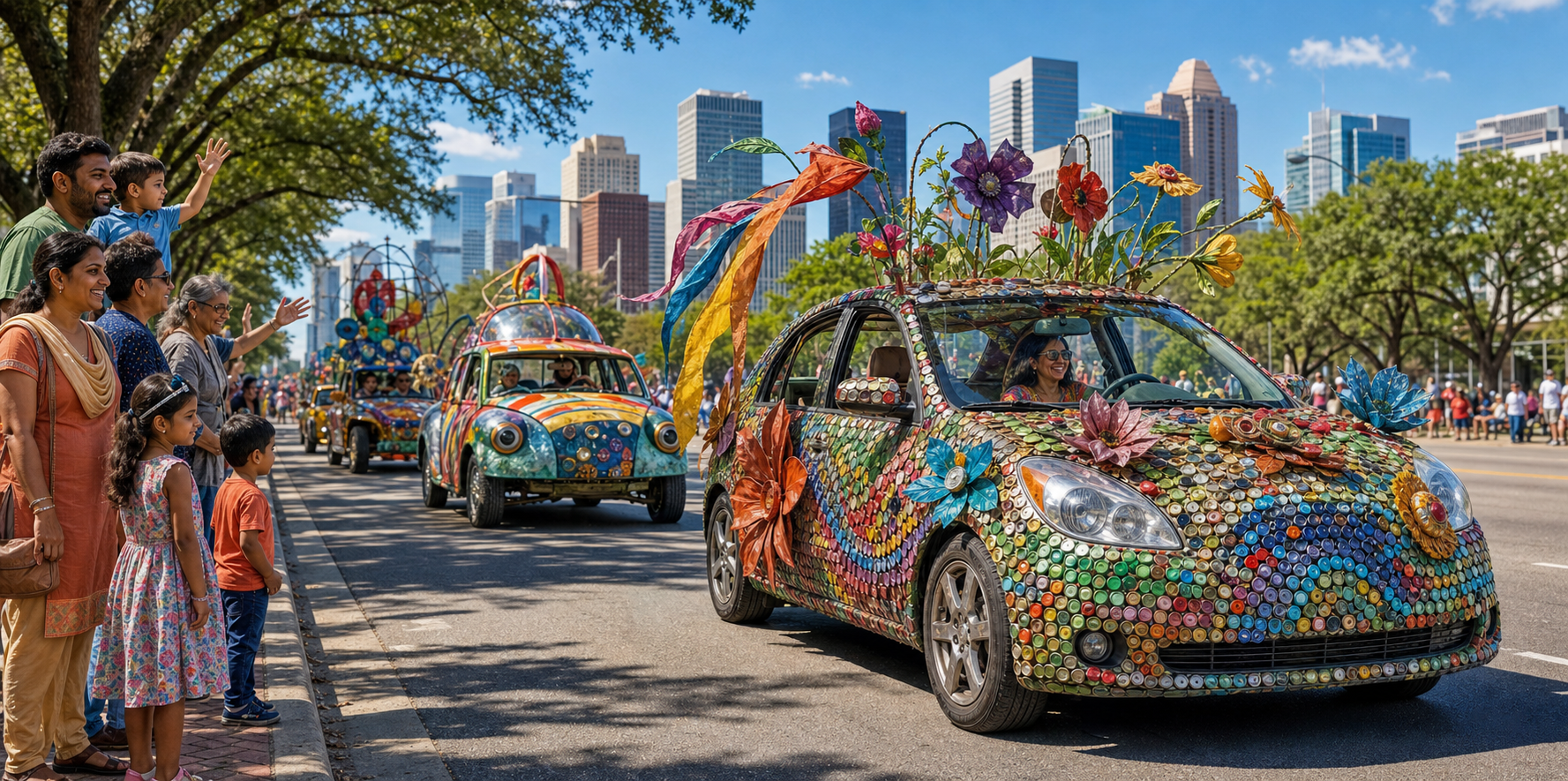
If you are wondering whether the Houston Art Car Parade belongs on your family, temple, gurdwara, sangha, or community calendar, the short answer is yes—but not because it is a religious festival. Its value lies in what you can do there: encounter neighbors without a doctrinal argument, show children how discarded materials become art, and put seva into practice through an unusually welcoming civic tradition.
The parade began with eleven art cars in 1986, followed by forty the next year. That modest experiment grew because ordinary people could understand the invitation immediately: take something functional, apply imagination and skilled work, and share the result in public. You can approach the event as a spectator, volunteer, educator, or builder. The right choice depends on how much responsibility you want to carry.
Choose your role before you arrive
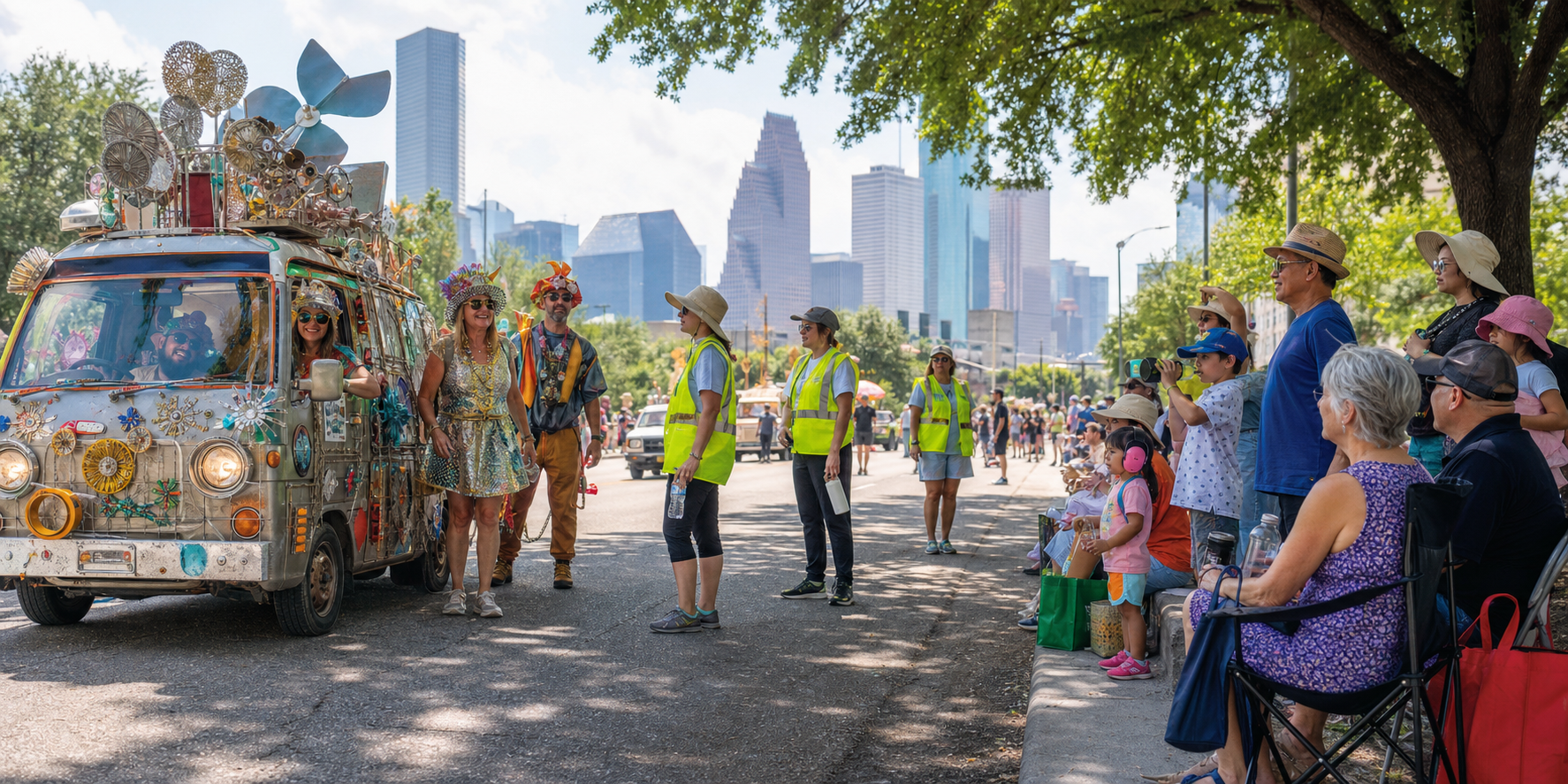
A parade can become passive entertainment if you arrive without a purpose. Decide in advance what you want your household or community group to notice, contribute, or learn. Four roles offer different levels of commitment.
- Spectator: Attend to enjoy the procession, but give children or first-time visitors a simple observation task. Ask them to find one vehicle built with reused objects, one that solves a mechanical problem creatively, and one that communicates a community story.
- Volunteer: Choose this if your priority is seva rather than visibility. Large public events depend on route marshals, staging teams, information stewards, medical support, communications, accessibility assistance, and waste management. Confirm the current organizer’s application process and training requirements before committing your group.
- Educator: Use the cars as prompts for applied geometry, materials science, basic electrical work, visual storytelling, and environmental responsibility. The useful question is not merely, “Which car looks best?” It is, “How did the makers keep this structure attached, balanced, visible, and movable?”
- Builder: Enter this role only if your team has both an artistic lead and someone competent to protect the vehicle’s mechanical integrity. An ambitious sculpture without sound engineering can endanger its occupants and the people beside it.
If your Dharmic organization has never participated, volunteering or attending as an educational group is the sensible first step. You will learn how staging, crowd movement, accessibility, and vehicle inspection work before committing money and labor to a build. A classroom, makerspace, or community organization can then turn those observations into a future team project.
The parade is institutionally anchored by the Orange Show Center for Visionary Art, whose continuity, educational work, and coordination help grassroots creativity function as a major public event. That matters when you choose how to participate: this is not simply an informal drive with decorated cars. Builders and volunteers enter a coordinated civic space with safety, route, and event requirements.
Bring a Dharmic lens without turning the parade into a sermon
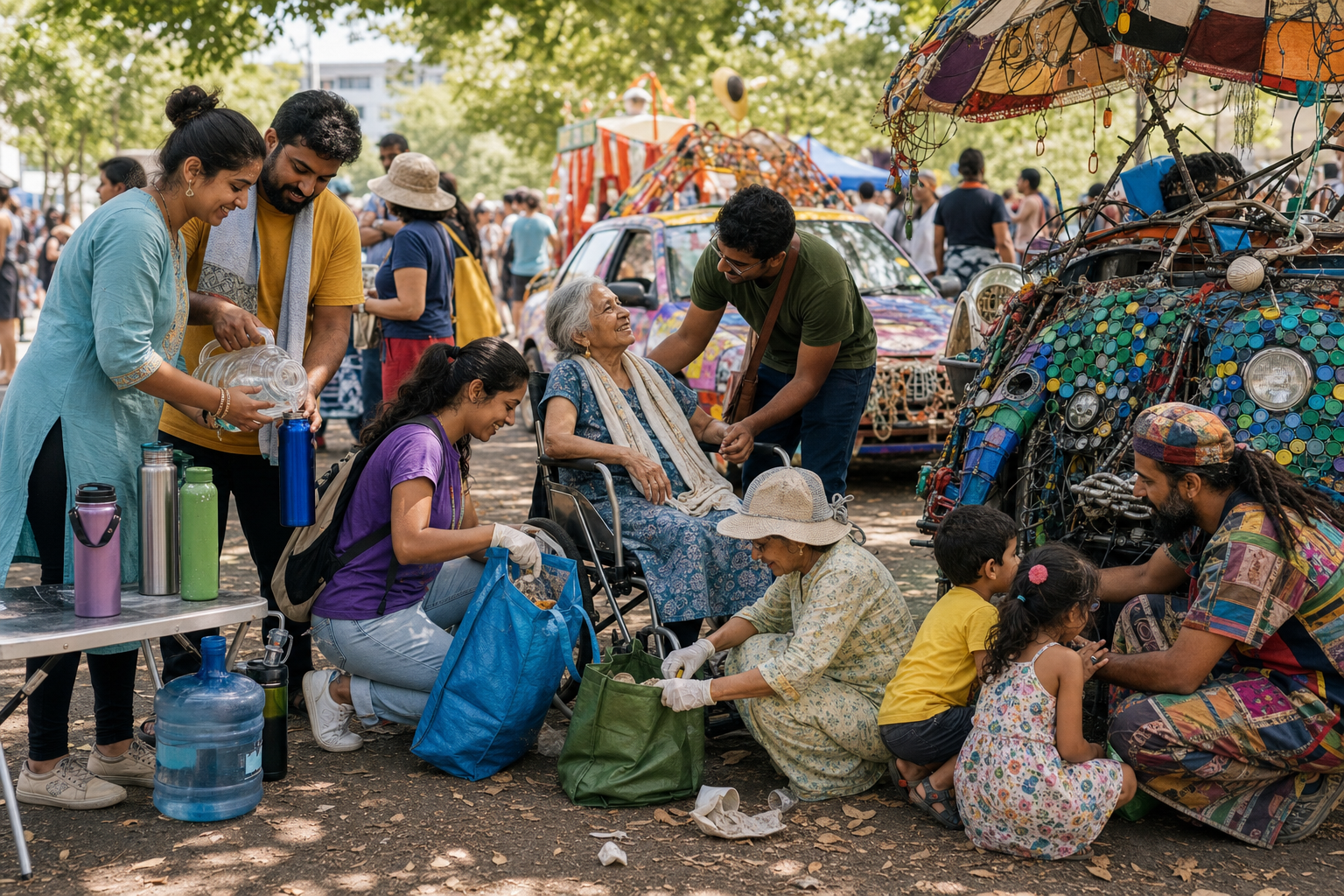
The strongest connection to Dharma is ethical and practical. Ahimsa asks whether a design and its operation protect people. Seva appears in the labor that keeps the event accessible and orderly. Dana is visible when people contribute materials, skills, time, or hospitality without making personal recognition the purpose. Karuna shapes attention to children, patients, elders, and people with disabilities. Maitri begins when strangers can meet through curiosity rather than suspicion.
These resonances do not make the parade Hindu, Buddhist, Jain, or Sikh. Nor should different traditions be flattened into one vague message. Unity in diversity is meaningful precisely when distinct identities remain intact. If your group creates a vehicle, decide which value you are expressing, explain it in plain language, and let the craftsmanship carry the message. A moving sculpture about responsible reuse can embody restraint and stewardship more convincingly than a vehicle crowded with unexplained sacred symbols.
If you do use sacred imagery, involve knowledgeable members of the represented tradition before fabrication begins. Consider where the image will be mounted, what road dirt or weather may reach it, whether moving parts could distort it, and how it will be treated after the event. Do not place scripture, revered figures, or symbols on bumpers, wheel areas, floors, disposable panels, or surfaces likely to be stepped on or discarded. Respectful intent is not enough when the physical use creates an avoidable indignity.
Interfaith goodwill works best here through hospitality and shared making, not through competitive claims. Invite neighbors to help cut, paint, fasten, document, or sort reusable materials. Put a short explanation of the design where visitors can understand it without prior religious knowledge. Ask participants what their own communities teach about service, restraint, compassion, and care for common space. The street-level exchange of stories and creative work is the point; no one needs to win a theological debate.
Plan the day around what is confirmed, not what happened before
The Houston Art Car Parade is associated with spring and has traditionally used a downtown-and-park corridor that includes stretches of Allen Parkway. Treat that as background, not as a current itinerary. Routes, street closures, viewing arrangements, outreach locations, sound rules, and accessibility provisions can change. Before leaving home, confirm the event year’s published date, route map, arrival guidance, weather information, prohibited items, and ADA arrangements.
For a family or community group, assign one adult to hold the current route information and choose a meeting point in case people become separated. If anyone is sensitive to amplified sound, prepare for it and select a viewing position that permits an easy exit. Do not assume every part of a traditional route will offer the same shade, seating, restroom access, or accessible sightline.
Houston Art Car Weekend can also include outreach beyond the main procession. A program often known as Main Street Drag has brought selected cars to schools, hospitals, and community centers, commonly on the eve of the parade. If your institution hopes to attend or host an outreach visit, verify the current program directly rather than relying on a previous year’s pattern.
Once the cars begin moving, look beyond surface decoration. Bottle caps, compact discs, fabric, wood offcuts, wheel covers, and found metal can become ornament or structure. Ask three questions about any vehicle that holds your attention: What was reused? How is it secured? What story becomes clearer because the artwork moves? Those questions turn an afternoon outing into a compact lesson in resourcefulness, engineering, and public communication.
Afterward, ask each person in your group to choose one vehicle and sketch how its mass, attachments, visibility, and message might have been planned. A child does not need advanced technical knowledge to notice that a tall decoration catches wind, a heavy object changes balance, or an opaque panel blocks a driver’s view. That is the beginning of useful STEAM learning: connecting visual imagination to physical consequences.
Build the artwork around a roadworthy vehicle
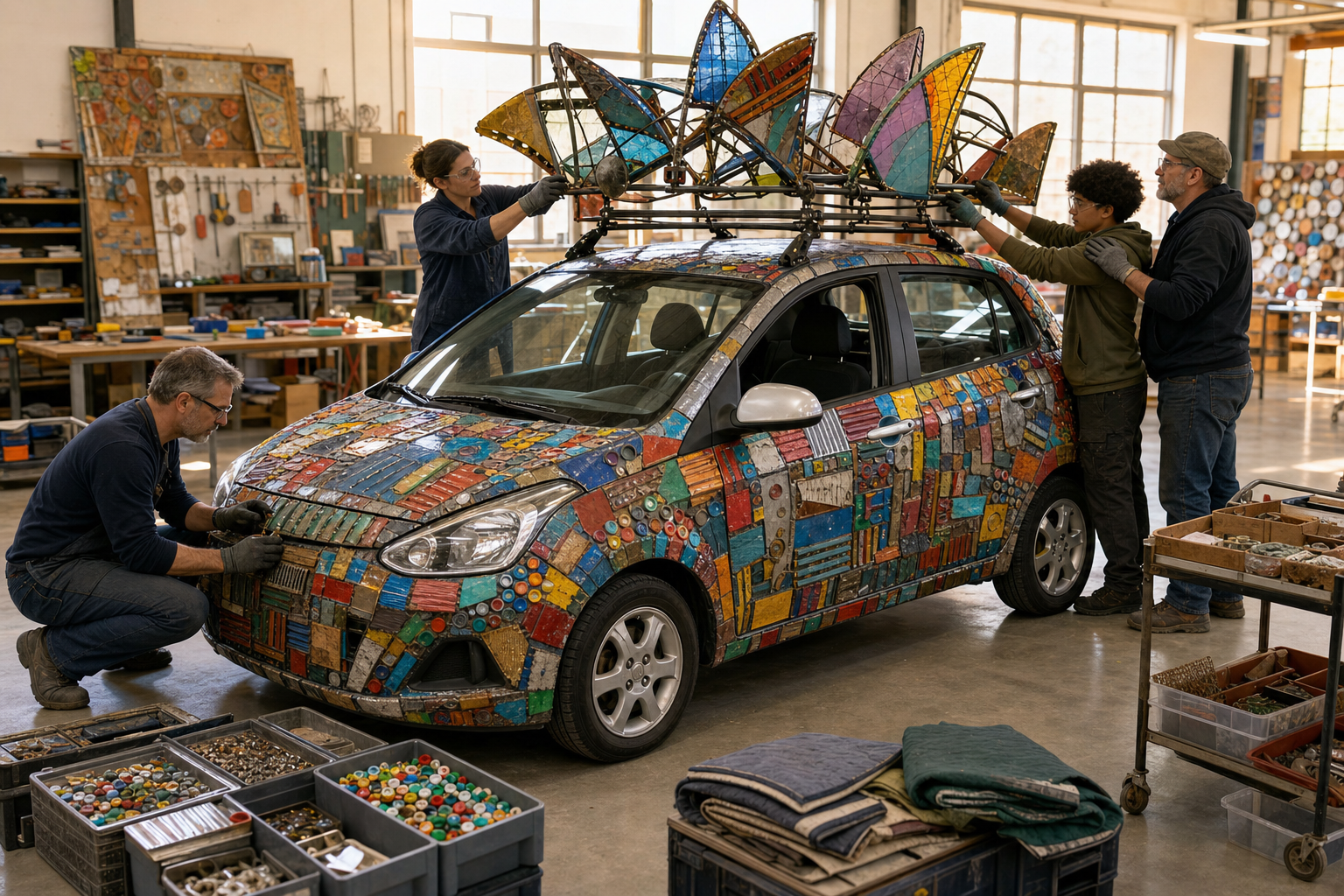
An art car is still a vehicle. Braking, steering, drivetrain condition, engine cooling, driver visibility, emergency exit, and pedestrian clearance take priority over the visual concept. If your team cannot evaluate those systems competently, use a qualified mechanic or fabricator before the modified vehicle moves on a public road. A parade-speed test does not prove that a modification is safe under braking, crosswind, heat, vibration, or an emergency maneuver.
Start with materials and mass
Reused material is valuable only when it is suitable for the load and environment. Sort potential components into decorative surfaces, structural parts, and moving elements. A bottle cap may be harmless as surface ornament but useless as a structural connector. Wood offcuts and found metal can carry substantial weight, so the mounting method and the condition of the base vehicle matter more than the appeal of the material.
Keep added mass low and near the vehicle’s center where possible. Tall, heavy, or side-loaded structures can change handling and increase sway. Lightweight subframes, marine-grade fasteners, weather-resistant adhesives, and protective coatings are common approaches, but no named material is automatically correct for every surface or load. Mechanical attachment should carry structural forces; adhesive can supplement it where the product and substrate are suitable.
Use a safety sequence, not a final glance
- Inspect the unmodified vehicle first. Resolve problems with brakes, steering, drivetrain, tires, cooling, required lights, mirrors, and existing electrical systems before adding artwork.
- Map every mounting point. Reinforce where necessary, and avoid treating thin body panels as if they were structural members.
- Weigh and position major components with balance in mind. Check roof load, side loading, front and rear overhang, and the effect of passengers.
- Use redundant attachments where appropriate. A secondary mechanical restraint can keep a loosened ornament from becoming a road or crowd hazard.
- Preserve 360-degree awareness through unobstructed windows, mirrors, or properly installed cameras. Test the actual seated driver’s view, not the designer’s view from outside.
- Fuse electrical additions and isolate them from essential vehicle circuits. Secure wires against abrasion, heat, water, and moving parts.
- Test kinetic pieces for sway and wind loading. Check their full travel against pedestrians, nearby vehicles, overhead clearance, doors, and emergency exits.
- Run the completed system long enough to identify heat buildup inside the cabin and around lights, motors, adhesives, fabric, and wiring.
- Carry a properly rated fire extinguisher in a location the occupants can reach, and make sure everyone knows how to exit without relying on a decorated or obstructed door.
- Have the finished vehicle reviewed by a competent person who did not build the feature being checked. Familiarity makes omissions harder to see.
Check road and event compliance separately
A vehicle may satisfy an event’s artistic expectations and still violate transportation requirements. Confirm current Texas rules and the event’s own instructions before driving. Do not obscure the license plate, required lamps, signals, or reflectors. Do not imitate restricted emergency lighting. Measure the completed height, width, and overhang rather than relying on the sketch. Confirm that the vehicle fits the permitted corridor and any staging or transport clearance.
Sound equipment also needs separate review under event guidance and municipal ordinances. Secure speakers and batteries as physical loads, fuse their circuits, and make sure sound does not interfere with driver communication or route instructions. If a modification cannot meet public-road requirements, transport it appropriately and use it only in a setting where it has been accepted. Artistic ambition does not justify transferring risk to spectators or other road users.
Document the build as you go. Photograph mounting points before they are covered, label added circuits, record the materials used, and keep a list of inspection decisions. A maker diary or build timeline does more than promote the finished vehicle: it lets students and future team members understand how a sketch became a safe moving structure. It also makes maintenance easier when vibration, rain, sun, or repeated assembly begins to affect the work.
Key takeaways
- You do not need to build a car to participate meaningfully. Spectating with a learning task, volunteering, and educational outreach are substantial forms of involvement.
- A Dharmic contribution is strongest when it practices ahimsa, seva, dana, karuna, and maitri through conduct and craftsmanship rather than merely displaying religious symbols.
- Respect distinct Hindu, Buddhist, Jain, Sikh, and other identities. Shared civic work should create friendship without pretending that all traditions are interchangeable.
- Confirm the current date, route, accessibility arrangements, outreach program, sound rules, and entry requirements. Historical patterns are not a substitute for current instructions.
- If you build, protect steering, braking, cooling, visibility, balance, electrical safety, emergency exit, and required road equipment before refining the decoration.
- Begin a first community project with a manageable concept and a competent technical lead. A safe, intelligible vehicle serves the public better than a larger design your team cannot properly inspect.
Your next step can be small. Gather your family or community team, choose one role, and write down the value you want that role to express. If you eventually build, let the first design demonstrate one idea clearly, use reclaimed material intelligently, and make safety part of the art from the first sketch.