
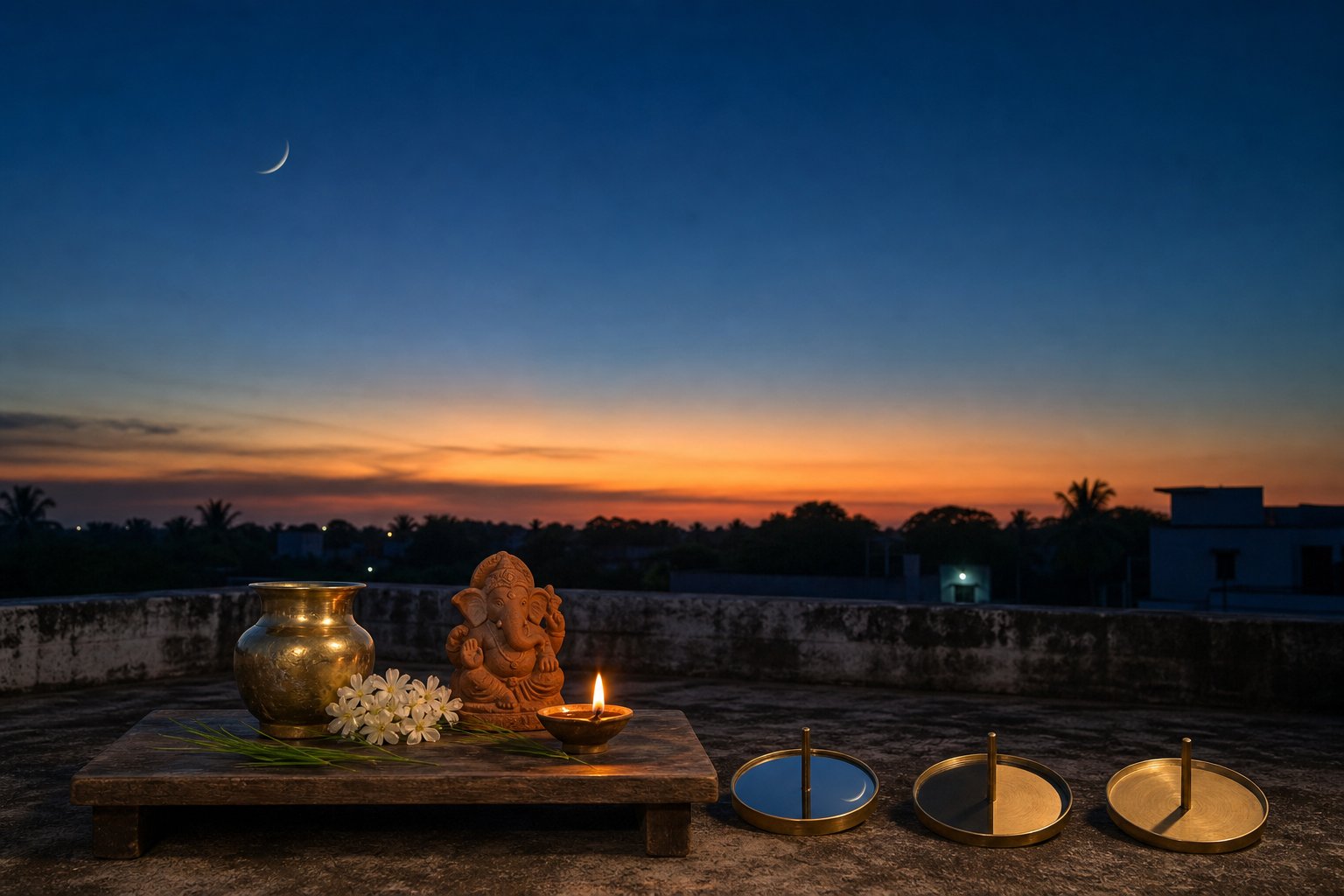
You may already have May 17 and May 20 marked on your calendar and still be unsure when to act. A date-only reminder is not enough here. The first observance depends on seeing a low evening crescent, while the second date contains a change of Tithi during the afternoon.
The practical answer is to keep three clocks separate: lunar visibility, the calculated Tithi boundary, and the local weekday Muhurta. Once you do that, you can decide when to offer arghya, when to perform Ganesha Puja, and when a new undertaking should wait.
Key takeaways for May 17 and May 20
- Chandra Darshan falls on Sunday, May 17, 2026. Look low in the west-northwest, generally from about 20 to 45 minutes after your local sunset and before moonset.
- Clouds can prevent a physical sighting, but they do not alter the calculated beginning of Shukla Paksha. Keep the vrata intention and follow your household tradition for completing the offering.
- On Wednesday, May 20, Shukla Chaturthi prevails until 3:56 PM local time in most regions, followed by Shukla Panchami. Treat 3:56 PM as a planning marker until a city-specific Panchang confirms it.
- The Tithi present at sunrise ordinarily determines the primary vrata for the day. The exact Tithi boundary then determines whether a time-specific act belongs to Chaturthi or Panchami.
- For a new beginning on May 20, calculate Wednesday’s Yamaganda, Gulika, and Rahu Kalam from local sunrise and sunset. Routine worship and continuing work do not need to stop during these segments.
- Nakshatra, Moon Rashi, Yoga, and Karana have not become irrelevant merely because the Tithi is favorable. Check them locally when the decision is consequential or the family tradition requires a full Muhurta.
May 17: plan around visibility, not a fixed clock
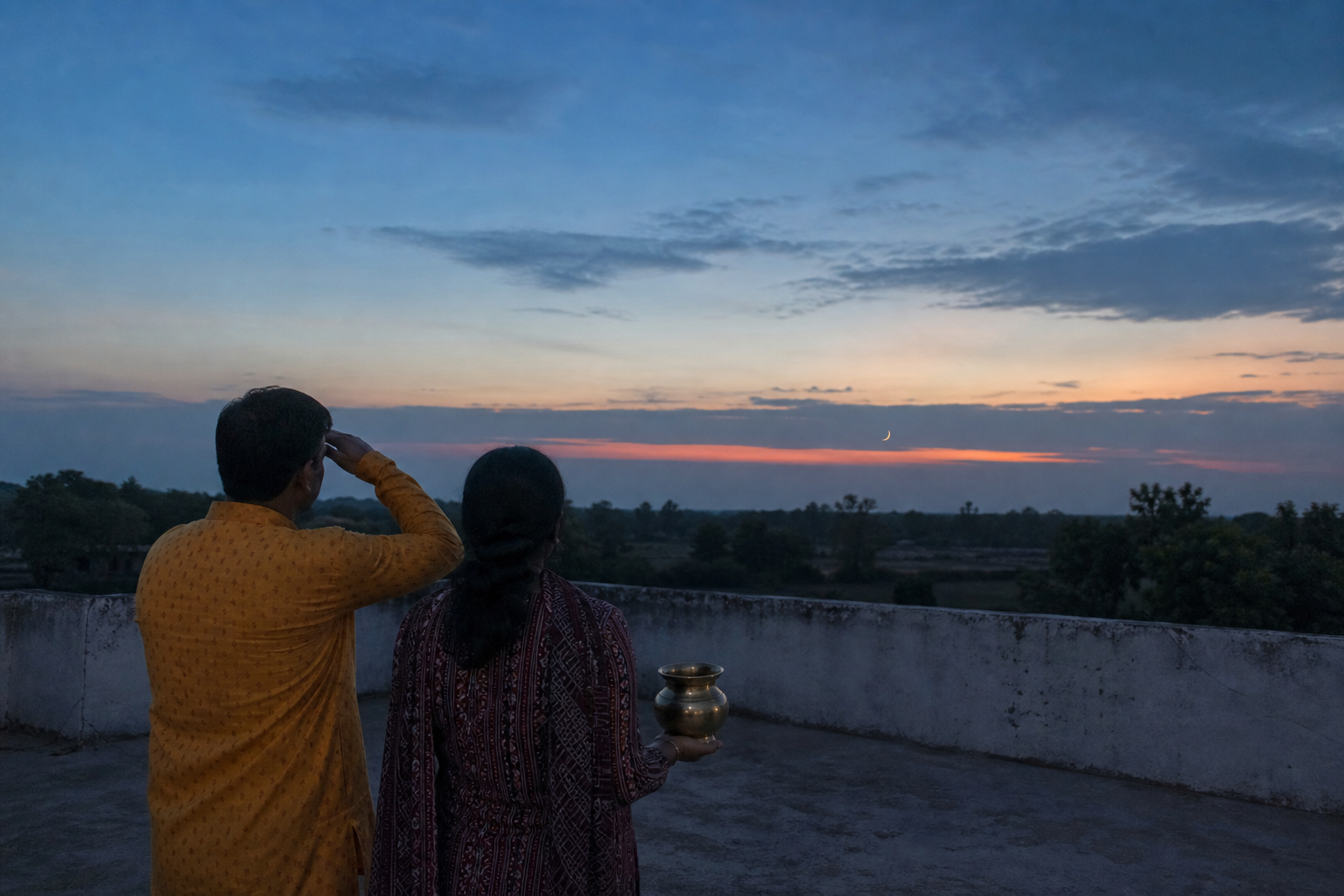
Chandra Darshan is the first sight of the waxing crescent after Amavasya. It belongs to Shukla Paksha Pratipada, but the devotional act is observational: you wait for the young Moon to become visible after sunset. That makes your western horizon and local moonset more useful than a timetable copied from another city.
The crescent may be difficult to see even when the calendar date is correct. Its age after conjunction, separation from the Sun, height above the horizon, haze, cloud, and nearby buildings all affect visibility. A clear view toward the west-northwest gives you the best practical chance on the evening of May 17.
Prepare before the Sun sets
- Check the sunset and moonset times for your city, not merely for your country or time zone.
- Choose an observing place with an unobstructed western horizon. Arrive before sunset so that you are not searching for a location during the short viewing window.
- After sunset, let the twilight dim. Begin scanning low in the west-northwest at roughly the 20-minute point and continue patiently through the favorable window, remaining mindful of local moonset.
- If your household observes a light fast, prepare the arghya and simple meal in advance. Fasting is a vrata discipline, not a test of devotion; use a prayer-based observance if food restriction is unsuitable for you.
- On sighting the crescent, offer clean water as arghya. Akshata, white flowers, sandal paste, white rice, or a milk preparation may be included where customary.
- Recite Om Chandraya Namah or Om Somaya Namah, sit quietly for a few breaths, and conclude with a prayer for steadiness of mind and the welfare of the household.
If cloud or haze blocks the Moon, do not confuse failed visibility with a failed observance. The Panchang calculation remains valid. You can retain the evening sankalpa, offer prayer without claiming a sighting, and, where your tradition permits, complete the visual offering on the next clear evening.
Why Adhika Jyeshtha matters this year
The 2026 observance occurs in Adhika Jyeshtha. An Adhika Maas is inserted when a lunar month contains no solar ingress into a new zodiac sign. This adjustment, arising roughly every 32.5 lunar months, keeps the lunisolar calendar connected to the seasonal solar cycle. The regular month that follows is distinguished as Nija or Shuddha Jyeshtha.
Regional language does not change the evening act. May 17 falls in Adhika Jyeshtha in North Indian, Andhra Pradesh, Telangana, and Karnataka reckonings; the corresponding regional month is Vaigasi in the Tamil calendar, Edavam in the Malayalam calendar, and Jyeshtho in the Bengali calendar. Purnimanta and Amanta systems count the boundaries of a month differently, yet both place this Chandra Darshan in the intercalary Jyeshtha framework.
Use the intercalary month for depth rather than ceremonial overload. Choose one repeatable discipline for the bright fortnight: daily japa, a manageable passage of svadhyaya, dana, restrained consumption, or a definite act of seva. The first crescent then becomes the beginning of something you can sustain, not merely an attractive sight in the evening sky.
May 20: keep Chaturthi worship and Panchami work distinct
Wednesday, May 20 begins under Shukla Chaturthi, so the sunrise rule places the day’s primary vrata under Chaturthi. The Tithi continues through midday and changes to Shukla Panchami at 3:56 PM in the general timing. Your first task is therefore to verify whether that boundary shifts in the Panchang for your city.
| Planning question | Working answer for May 20 |
|---|---|
| Which Tithi governs the sunrise vrata? | Shukla Chaturthi |
| Which monthly observance fits the day? | Masik Vinayaka Chaturthi |
| When is the customary worship period? | Midday while Chaturthi remains in force |
| When does the general Tithi transition occur? | 3:56 PM, subject to local confirmation |
| What follows the transition? | Shukla Panchami, suitable for steady study, devotional reading, and continued effort |
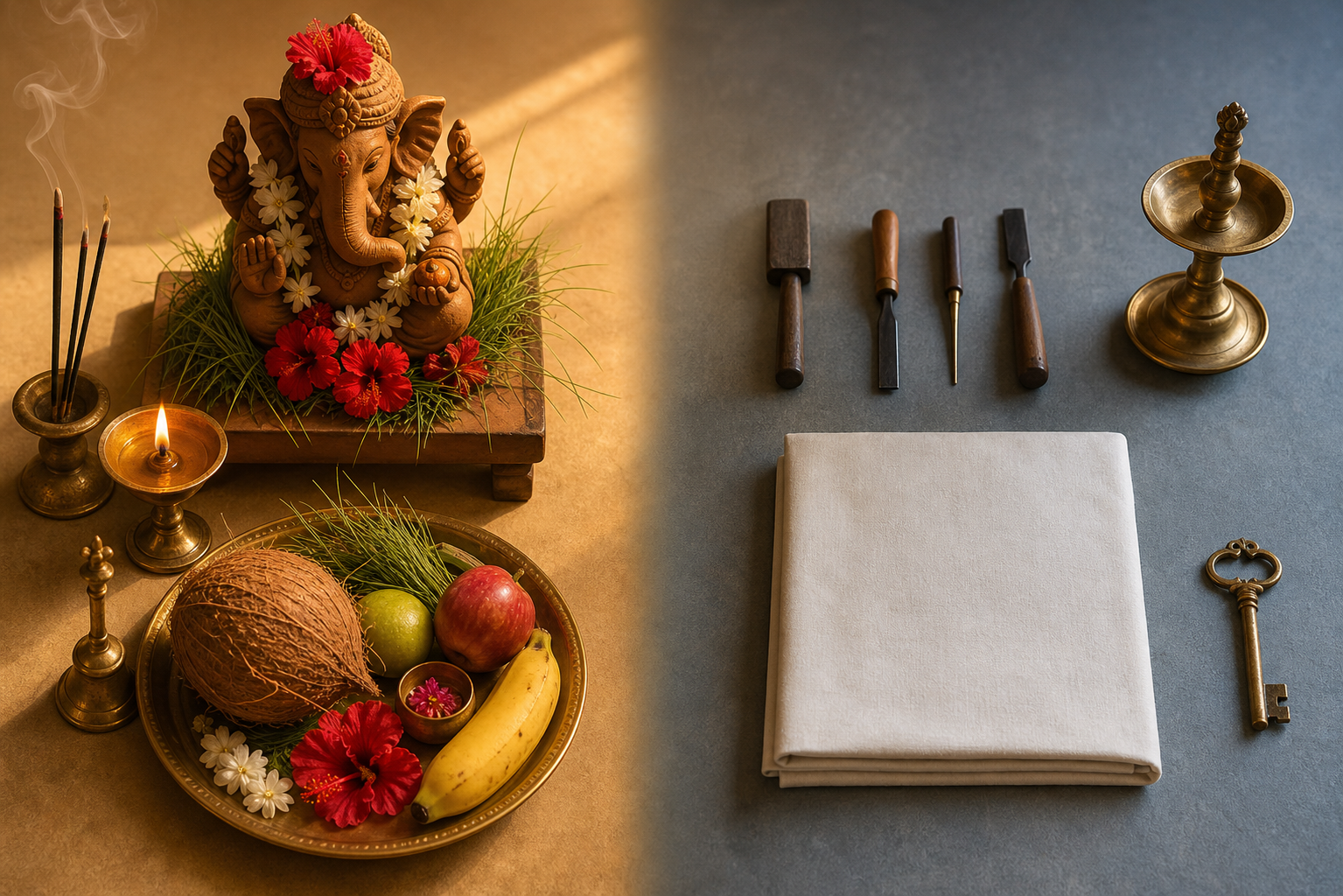
Chaturthi is dedicated to Sri Ganesha as the remover of obstacles and guardian of knowledge and auspicious beginnings. Wednesday, or Buddhavara, adds an emphasis on learning, communication, analysis, and measured decisions. That combination makes the day especially coherent for a Ganesha Puja connected with study, writing, correspondence, or the removal of a specific practical obstruction.
A concise midday Vinayaka Chaturthi practice
- Set aside a clean place and begin with simple physical and mental purification.
- Make a precise sankalpa. Name the discipline, obstruction, or duty for which you seek clarity instead of asking vaguely for success.
- Invoke Sri Ganesha and offer water, flowers, durva grass, and a sweet such as modaka or laddu.
- Recite Om Gam Ganapataye Namah with an even breath. A reading from the Ganesha Atharvashirsha or a familiar stotra may follow.
- Sit briefly without adding more petitions. Decide on the first ethical and practical step that belongs to your sankalpa.
- Close with gratitude and commit to one act of kindness or service.
A 12-to-20-minute version can contain all six elements when family or work obligations make a longer Puja unrealistic. Consistency matters more than multiplying offerings. If this is an established monthly practice, you also do not need to treat it as a new initiation merely because it occurs during a sensitive weekday segment.
Abhijit Muhurta is centered on local solar noon and extends approximately 24 minutes on either side. It can support a concise Puja or sankalpa while Chaturthi is active, but local solar noon is not automatically 12:00 on the civil clock. Longitude, the equation of time, time-zone boundaries, and daylight-saving rules can all separate the two.
After the confirmed Chaturthi boundary, let Panchami set the tone. This is a suitable period for study, skill refinement, temple darshan, devotional reading, editing, mentoring, or the continuation of disciplined work. Do not assign a Naga-related festival to this Panchami merely because other Panchami observances have that association; those rites belong to their own seasonal and calendrical settings.
Build a local Panchang worksheet before choosing a time

A Panchang has five limbs: Tithi, Vara, Nakshatra, Yoga, and Karana. Tithi tells you the lunar day, while Vara supplies the weekday pattern. Nakshatra, Yoga, and Karana refine the quality of a prospective time. A favorable Tithi by itself can schedule a basic vrata, but it does not guarantee that every minute of the date is equally suitable for a contract, first journey, new mantra, or major financial commitment.
For Wednesday, divide the interval from local sunrise to local sunset into eight equal parts. The second part is Yamaganda, the fourth is Gulika Kalam, and the fifth is Rahu Kalam. These positions remain the same for Wednesday, but their clock times change with the length of daylight.
- Write down the exact local sunrise and sunset for May 20.
- Convert the daylight interval into minutes and divide it by eight. Call the result one part.
- Mark Yamaganda from sunrise plus one part to sunrise plus two parts.
- Mark Gulika Kalam from sunrise plus three parts to sunrise plus four parts.
- Mark Rahu Kalam from sunrise plus four parts to sunrise plus five parts.
- Overlay the locally confirmed Chaturthi-to-Panchami boundary, the required ritual period, and any Nakshatra transition.
- Choose a clean starting time and leave enough margin that a small delay will not carry the beginning across a boundary.
If daylight is exactly 12 hours, each of the eight parts is 90 minutes. This is an arithmetic example, not a fixed Wednesday timetable. Copying conventional clock ranges without recalculating from your own sunrise and sunset is how seasonal and overseas errors enter a plan.
Apply the sensitive segments to beginnings, not to life as a whole. Avoid inaugurating a venture, signing formally, setting out on a first-time journey, making an initial client call, or beginning a new mantra during Rahu Kalam, Yamaganda, or Gulika when your tradition observes those restrictions. Continuing work, ordinary study, temple seva, household duty, and regular worship may proceed.
Abhijit and a sensitive segment can overlap. If you are only performing regular Chaturthi worship, the overlap need not become a source of anxiety. If you are electing a time for a consequential new undertaking, do not resolve mixed indications by selecting whichever factor you prefer. Choose another clean interval or seek a location-specific determination from a competent priest or Jyotisha practitioner.
Check the Nakshatra and Moon Rashi rather than guessing them from the civil date. Their transitions depend on time and location, and a personal Muhurta may also consider the relationship with the natal chart. When those indications are mixed, reduce the scale of the beginning: make a preliminary outline, conduct a review, or continue preparation instead of taking the irreversible first step.
Keep the shared Dharmic frame accurate
A lunar marker can create a shared household rhythm without pretending that every Dharmic tradition observes the same festival. Hindu practice on these dates can center on Chandra arghya, Tithi, Nakshatra, and Sri Ganesha. Buddhist families may use a lunar marker for mindfulness and compassion. Jain practitioners may deepen samayik, pratikraman, anushthana, ahimsa, and restraint.
Sikh Gurpurabs are governed primarily through the solar Nanakshahi calendar, so Chandra Darshan or Vinayaka Chaturthi should not be recast as Sikh observances. A Sikh member of the household can still join the wider ethical rhythm through simran, kirtan, and seva. The point of unity is disciplined remembrance and conduct, not an artificial merger of distinct practices.
Before saving your reminders, add your city, May 17 sunset and moonset, May 20 sunrise and sunset, the locally confirmed Tithi boundary, and any relevant Nakshatra change. Set one reminder early enough to reach a clear western horizon and another before your chosen Chaturthi Puja window. That small amount of preparation lets the observance remain both accurate and unhurried.
References
- DharmaRenaissance Blog — May 20, 2026 Panchang: Shukla Chaturthi to Panchami, Auspicious Timings and Expert Ritual Guide
- DharmaRenaissance Blog — Chandra Darshan 17 May 2026: Adhika Jyeshtha Significance, Visibility Guide, and Vrat Rituals