

Perhaps your altar is Hindu, your meditation practice is Buddhist, your ethics have been sharpened by Jain ahimsa, and your understanding of service has been strengthened by Sikh langar. The unease comes later: are you living Dharmic pluralism, or quietly turning distinct traditions into a private spiritual blend?
Neo-Vedanta gives you a useful boundary. Stay rooted in a chosen path, receive genuine insight from other paths, preserve their real differences, and let spiritual understanding become seva. Pluralism is working when it gives you a deeper center and makes you a better neighbor. It is failing when the claim that all paths are one becomes an excuse not to learn what any path actually teaches.
Treat Neo-Vedanta as a synthesis, not a claim of sameness
Neo-Vedanta is modern in formulation, but that does not mean it discarded the foundations of Vedanta. It rearticulated the Upanishads, Brahmasutras, and Bhagavad Gita amid late nineteenth-century colonial criticism, print culture, historical philology, and new interfaith encounters. Its modernity lies partly in the questions it answered and the public language it developed.
Sri Ramakrishna Paramahamsa supplied an experiential center for this development. His sadhana crossed devotional and contemplative modes and affirmed both personal and impersonal approaches to the Divine. Swami Vivekananda then gave that insight a systematic and public form. At the 1893 Parliament of the World’s Religions, he connected the divinity of the atman with jnana, bhakti, karma, and raja yoga. His Practical Vedanta joined spiritual realization to service.
This history matters because it tells you what kind of claim Neo-Vedanta is making. It is a constructive way of holding inherited wisdom together under modern conditions. It is not proof that every Dharmic lineage has always taught the same metaphysics, used the same methods, or defined liberation identically.
Vedanta itself contains substantial disagreement. Advaita, Vishishtadvaita, Dvaita, Bhedabheda, Achintya-bhedabheda, and Shuddhadvaita do not make interchangeable claims about the relationship among the self, the world, and ultimate reality. An Advaita-friendly synthesis can honor Vaishnava and Shaiva traditions, but it should not quietly recast every theistic teaching as a preliminary stage on the way to Advaita.
Some scholars therefore criticize Neo-Vedanta for flattening classical differences or adapting Hindu thought too neatly to modern expectations. Its defenders point to older habits of synthesis in Smarta practice, bhakti ecumenism, and philosophical debate. You do not have to settle that entire historical dispute before using the framework. You do need to present Neo-Vedanta honestly: it is an influential interpretation of Sanatana Dharma, not the sole interpretation that every sampradaya must accept.
Whenever you hear a universalist claim, ask three separate questions:
- Are these paths being compared because they cultivate a similar ethical quality, such as compassion or freedom from egoic grasping?
- Are their practices compatible in a particular seeker’s life, even though their explanations of those practices differ?
- Is someone claiming that their metaphysical teachings are identical? If so, can that claim survive the vocabulary and objections of each tradition?
The first two comparisons can support serious pluralism. The third requires much more care. Shared fruits do not automatically prove identical roots.
Let Ishta give your pluralism a center
The doctrine of Ishta offers a practical answer to a problem that abstract universalism often leaves unresolved: if many paths have dignity, why commit to one? An Ishta is your chosen form of the Divine or primary spiritual orientation. Neo-Vedanta turns this principle into a discipline of confidence in one’s own way and reverence for the chosen ways of others.
Choosing does not imply that everyone else has chosen wrongly. It means accepting the depth that only sustained formation can provide. A practice repeated under guidance can correct you. A collection of practices selected only by preference usually cannot, because you can abandon each one as soon as it challenges your assumptions.
Write a short practice charter for yourself. It should answer four questions plainly:
- Root: What is my primary path, Ishta, text, lineage, or discipline?
- Guidance: Who or what has authority to correct my interpretation when convenience begins to masquerade as insight?
- Hospitality: Which other Dharmic tradition am I learning from, and am I learning it in the language its practitioners actually use?
- Boundary: Which doctrinal difference will I refuse to hide merely to make the encounter feel harmonious?
If you cannot name the root, your pluralism may have no center. If you cannot name the hospitality, your commitment may be turning sectarian. If you cannot name a boundary, you may be replacing dialogue with assimilation.
This framework also changes how you enter another community’s practice. Attend as a guest before treating the practice as your possession. Learn what the ritual means to the community, what obligations accompany it, and whether it is intended for general participation. Respect does not require immediate adoption. Sometimes the most pluralist act is to witness carefully without claiming ownership.
Keep the differences that make Dharmic dialogue worthwhile
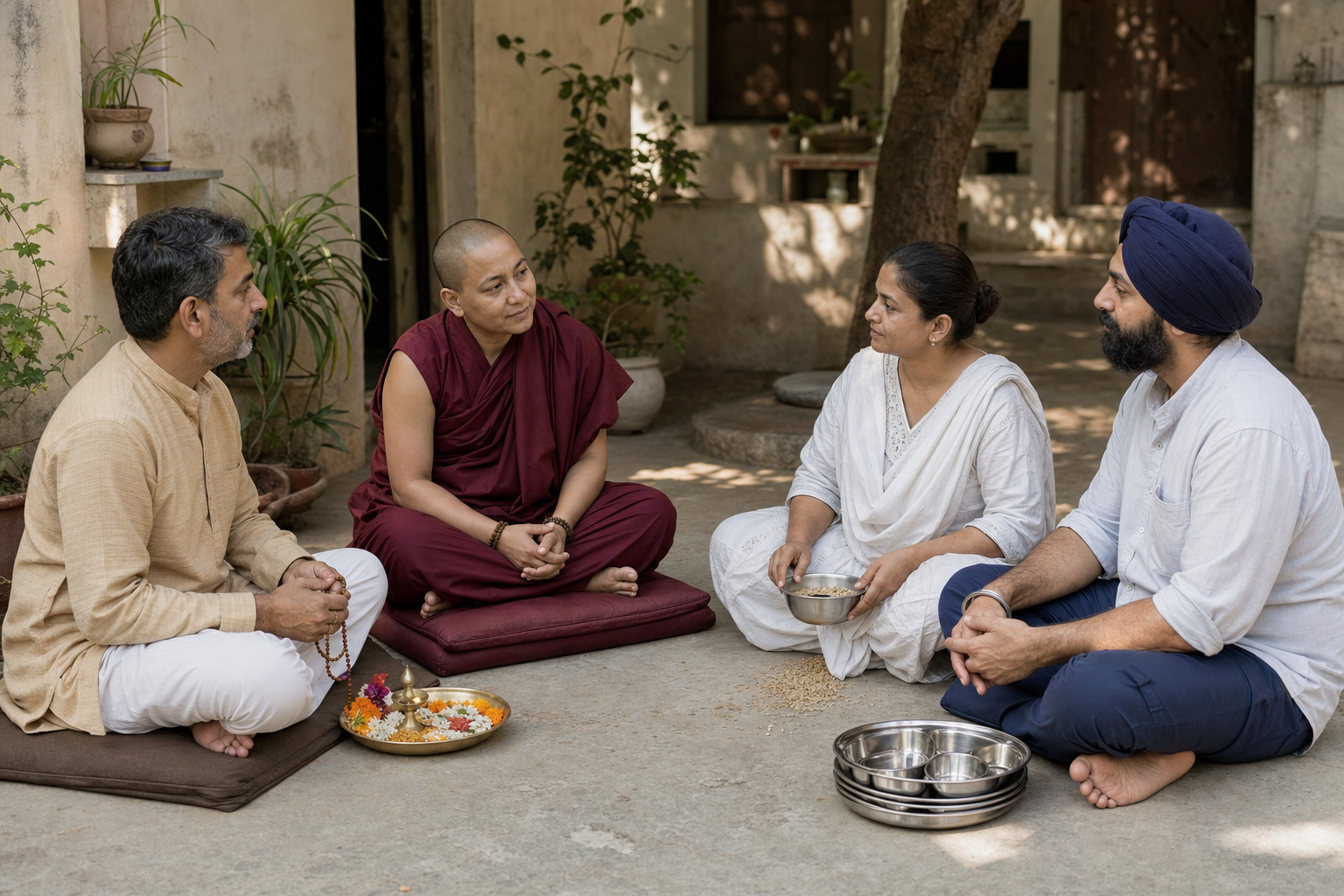
Dharmic traditions can meet through contemplative discipline, ethical restraint, freedom from compulsive egoism, compassion, and service. Those convergences are substantial. They become more trustworthy when you can also say where comparison must stop. The following distinctions offer a working map, not a final account of any tradition.
| Stream | What pluralism can receive | What must not be erased |
|---|---|---|
| Vedantic schools | Shared engagement with the Upanishads, Bhagavad Gita, and Brahmasutras, together with paths of knowledge, devotion, disciplined action, and contemplation. | Advaita, Vishishtadvaita, Dvaita, and difference-and-non-difference traditions make genuinely different claims about the self, the Divine, and the world. They should not be arranged automatically as lower and higher versions of one doctrine. |
| Buddhist traditions | Disciplined meditation, the loosening of egoic clinging, and the cultivation of karuna can enter a fruitful practical conversation with Vedantic sadhana. | Anatman and shunyata are not simple equivalents of atman and Brahman. Vipassana and self-inquiry may coexist as practices without making their doctrinal explanations identical. |
| Jain traditions | Anekantavada teaches intellectual humility by recognizing that complex realities cannot be exhausted by one unqualified proposition. Syadvada disciplines the conditions under which a statement is made. | Many-sided reasoning is not the claim that every opinion is equally true. It invites more exact judgment, not the abandonment of judgment. |
| Sikh tradition | Ik Onkar, the interplay of nirguna and saguna devotion, seva, and the saint-soldier ideal show how interior realization can become courageous responsibility. | Sikh language should be allowed to stand on its own terms. Ik Onkar need not be renamed as merely another word for Brahman before a Vedantin can honor it. |
Use the map in actual conversation by postponing translation. If a Buddhist speaks of anatman, do not immediately answer with the true atman. If a Sikh speaks of Ik Onkar, listen to the term within Gurbani and Sikh practice before fitting it into a Vedantic category. If a Jain invokes anekantavada, do not turn it into vague tolerance. Ask what standpoint, condition, and limitation are being identified.
A reliable dialogue sequence is simple: let the other tradition define its term, restate that meaning in words its practitioners would recognize, identify a genuine convergence, and then name the remaining difference. Agreement reached after that process means something. Agreement declared before it usually does not.
Build one coherent sadhana instead of collecting techniques

Spiritual variety can conceal a lack of formation. Moving among chanting, meditation, philosophy, and service may look integrated while each activity remains isolated from the others. The answer is not to reject every influence outside your primary tradition. It is to give each practice a defined place and purpose.
The classical movement of shravana, manana, and nididhyasana supplies a sound structure: receive a teaching carefully, examine it through reflection, and stabilize what has been understood through contemplation. Skipping the first two stages turns meditation into an empty container that can be filled with whatever you already believe.
- Name the anchor. Choose the primary teaching, Ishta, lineage, or yogic orientation that organizes your spiritual life. If possible, study with a qualified teacher rather than constructing every interpretation alone.
- Study before borrowing. Learn a practice’s aim, key vocabulary, and relationship to its larger path. A meditation method is not automatically detachable from every ethical and philosophical commitment surrounding it.
- Label what you are adopting. Decide whether you are receiving a technique, an ethical discipline, a devotional relationship, or a metaphysical claim. These are different levels of commitment.
- State the compatibility precisely. Vipassana may help you observe reactivity while Vedantic self-inquiry examines identification. That practical pairing does not require you to declare anatman and atman synonymous.
- Balance the four yogic functions. Let jnana question confused assumptions, bhakti educate desire and devotion, raja yoga discipline attention, and karma yoga challenge self-centered action. One activity can serve more than one function, but none should exist only as an attractive label.
- Review the fruits. Look for less grasping, more steadiness, greater capacity to hear correction, deeper compassion, and dependable service. Constant novelty with no change in conduct is a warning sign.
A brief written audit can keep this concrete. Ask: What am I studying? What do I revere? What discipline am I actually repeating? Where am I serving without needing spiritual prestige? If one answer is always missing, adjust the pattern rather than adding another technique.
Watch especially for a schedule that keeps expanding while accountability keeps shrinking. Replacing teachers whenever correction becomes uncomfortable is not pluralism. Neither is using one tradition to avoid the demands of another: meditation to escape service, non-dual language to escape devotion, or activism to escape self-examination.
Apply three tests: truthfulness, empirical discipline, and seva

Truthfulness: can every tradition recognize itself?
A pluralist account should be recognizable to the people it describes. Before teaching or publishing a comparison, check whether one tradition always supplies the master vocabulary while the others appear only as examples. If Brahman becomes the automatic translation for every account of ultimate reality, the dialogue has already been decided in advance.
Truthfulness also means acknowledging the limits of the synthesis. Neo-Vedanta can offer a hospitable framework without becoming the hidden theology that Buddhist, Jain, Sikh, Vaishnava, Shaiva, or Dvaita participants must accept. Welcome does not depend on prior metaphysical surrender.
Empirical discipline: are you keeping levels of explanation distinct?
Neo-Vedanta often uses the distinction between vyavaharika, the empirical domain, and paramarthika, the ultimate standpoint. This can prevent a false contest between science and spiritual insight. Empirical causality can be investigated through disciplined natural inquiry while contemplative traditions examine metaphysical meaning and liberation.
Use that distinction responsibly. An ultimate claim does not cancel evidence within the empirical world. Calling the world maya does not make suffering ethically irrelevant, and spiritual conviction does not settle a testable physical claim. In the other direction, a scientific method designed to study observable processes does not by itself decide every question about consciousness, value, or ultimate reality.
Seva: does insight become an obligation?
Practical Vedanta refuses to leave realization inside the meditator’s private experience. Vivekananda joined contemplation to service, and Ramakrishna Mission and Vedanta institutions carried that union into education, healthcare, disaster relief, and spiritual formation. Sikh seva and langar give Dharmic pluralism another concrete language of shared responsibility.
Service does not prove that competing metaphysical claims are identical. It does something more practical: it prevents difference from becoming indifference. Choose a dependable form of service under community accountability. Teach, help prepare or serve food, support relief work, or contribute to a local institution whose responsibilities are clear. The task should place another being’s need ahead of your desire to appear spiritually broad-minded.
Shared service can also improve inter-Dharmic dialogue. Begin with one clearly stated doctrinal difference and one common civic responsibility. Work together without requiring agreement on the first in order to fulfill the second. That is cooperation with integrity, not a ceremonial display of unity.
Key takeaways
- Neo-Vedanta is best understood as a modern Vedantic synthesis, not evidence that all Dharmic doctrines have always been identical.
- Use Ishta to establish a primary spiritual center; commitment to one path and reverence for others can strengthen each other.
- Compare practices, ethical fruits, and metaphysical claims separately. Compatibility at one level does not guarantee identity at another.
- Keep anatman distinct from atman, anekantavada distinct from relativism, and Ik Onkar in its own Sikh context.
- Organize sadhana through study, reflection, contemplation, and service rather than collecting disconnected techniques.
- Judge pluralism by truthfulness, respect for empirical evidence, openness to correction, and dependable seva.
At your next encounter with another Dharmic path, take four actions: name your own anchor, preserve one real difference, learn one practice in its native vocabulary, and undertake one concrete act of service. If the encounter deepens your roots while making room for another tradition to remain fully itself, you are practicing pluralism rather than merely speaking about it.