
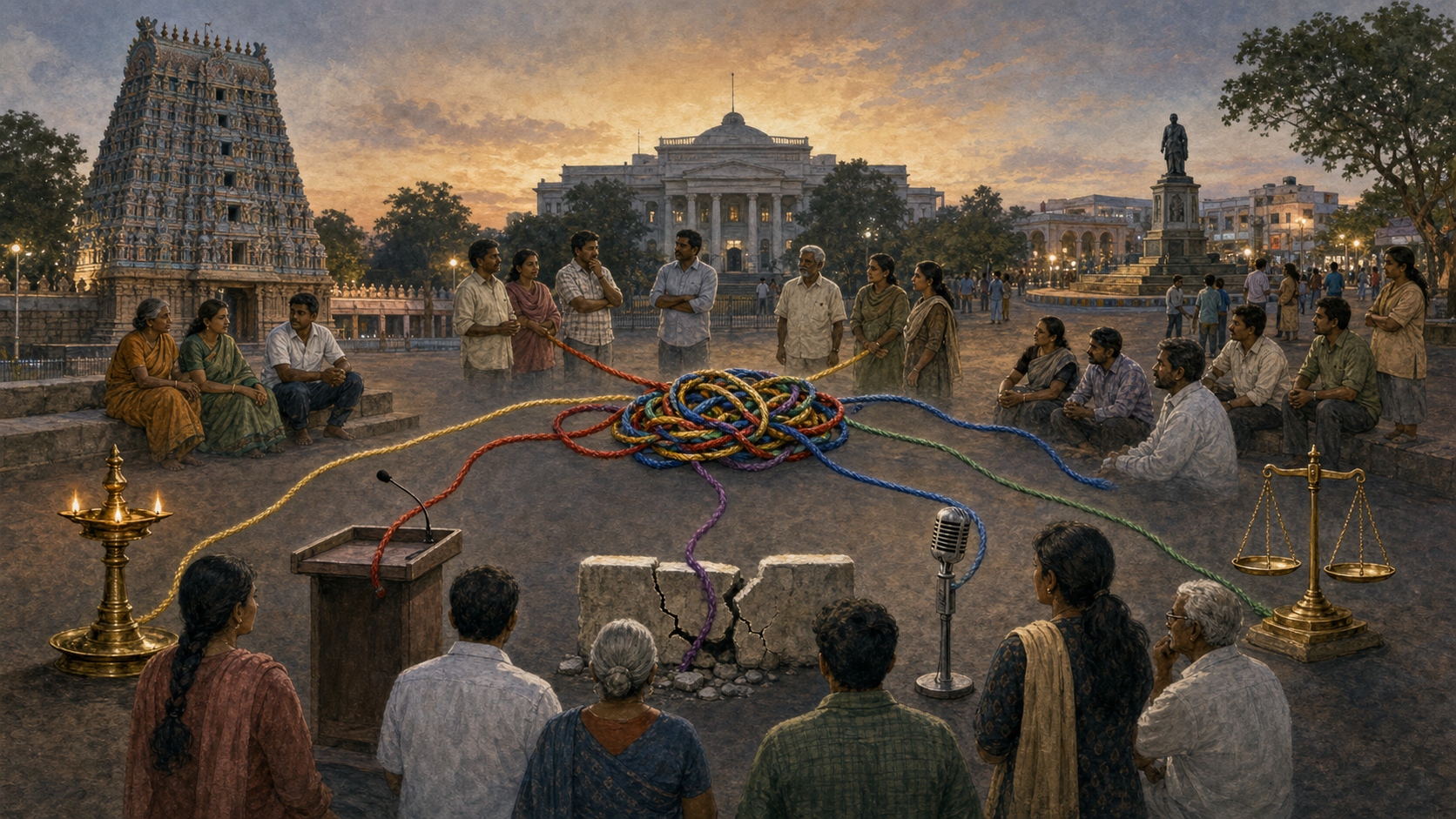
If you reached this controversy through a clipped video, a translated caption, or a furious social-media reply, you were probably handed a verdict before you were given the argument. The result is a false choice: either ignore language that wounds Hindu communities or treat every criticism of Hindutva, caste, or religious practice as an attack on every Hindu.
You do not have to accept that choice. You can defend Sanatan Dharma, support the removal of discrimination, and demand the same constitutional discipline from every political party. The first step is to identify exactly who or what a speaker opposed, what action the speaker advocated, and where the statement was made.
Why several different disputes have been compressed into one
The Tamil Nadu row is not a single, neatly bounded disagreement. One strand began with a ministerial formulation that the political opposition was directed at Hindutva rather than Hindus. BJP state president K. Annamalai rejected that reassurance, reading it alongside remarks associated with Udhayanidhi Stalin and TVK’s V.M.S. Mustafa as part of a more serious affront to Sanatan Dharma. In a connected episode, comments made by Udhayanidhi Stalin in the Tamil Nadu Assembly were characterized by critics as an explicitly anti-Sanatan position.
These episodes may reinforce one another politically, but they still require separate examination. Opposition to a modern political ideology, criticism of a religious practice, denunciation of an entire tradition, and hostility toward the people who follow it are four different acts. Treating them as interchangeable makes honest judgment almost impossible.
The decisive detail is usually the object of the sentence. A demand to eradicate untouchability targets an injustice. A demand to eradicate Sanatan Dharma targets, or at least appears to target, a civilizational and religious inheritance. Opposition to Hindutva does not literally mean opposition to Hindus, but that distinction cannot do unlimited rhetorical work. If the surrounding language moves from policy criticism to contempt for sacred identity, the speaker must answer for that movement rather than retreat behind a carefully chosen label.
When you assess any new clip from this dispute, ask three questions before choosing a side: What exact noun was attacked? What verb described the intended action? Did the speaker identify a policy or social wrong, or generalize about a faith and its adherents? Those questions will tell you more than the party logo attached to the clip.
Keep Hindu, Sanatan Dharma, Hindutva, and Dravidian reform distinct
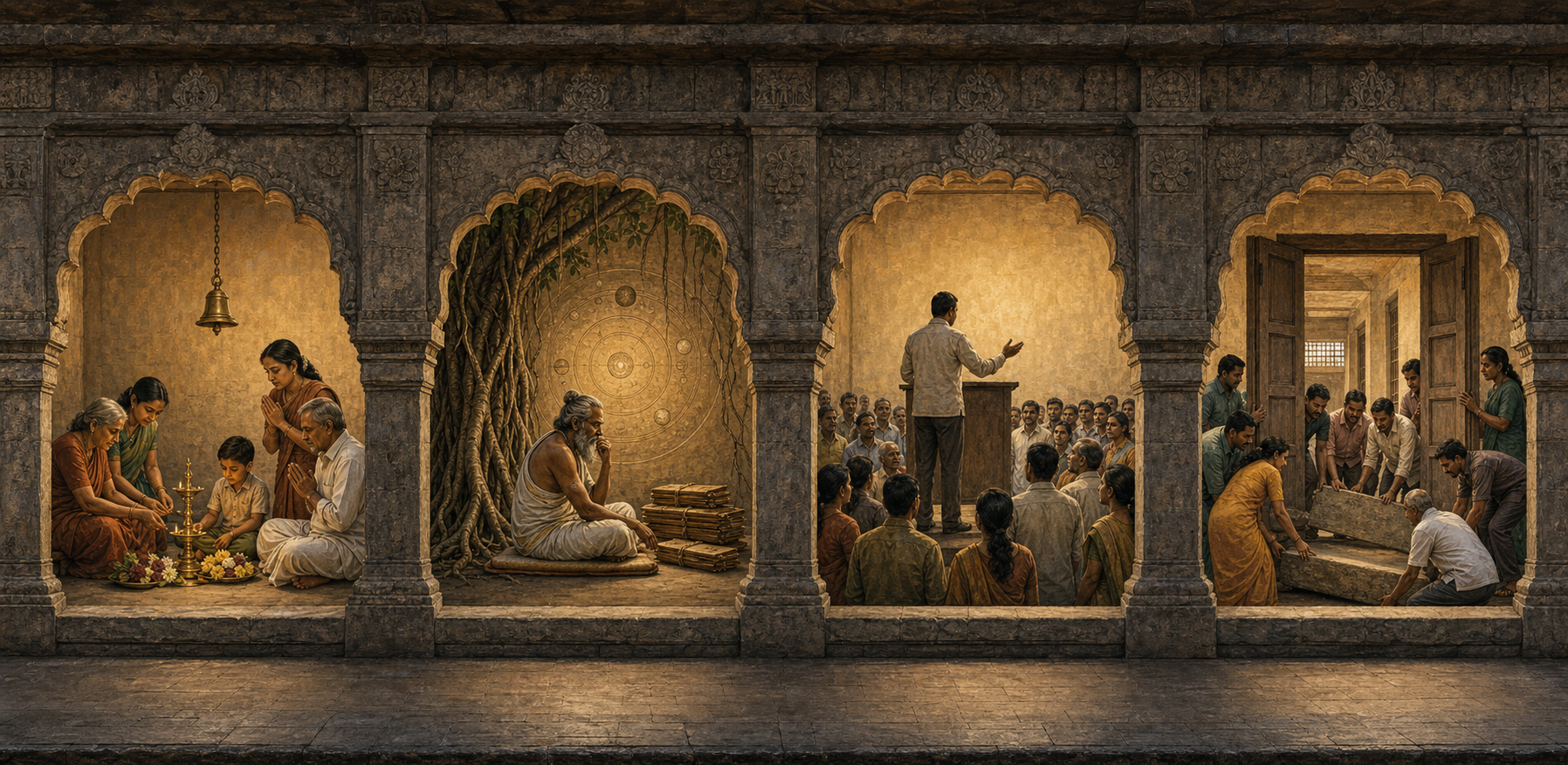
Much of the confusion comes from using several related terms as if they named the same thing. They do not. A workable distinction looks like this:
| Term | What it primarily denotes | The fair test to apply |
|---|---|---|
| Hindu | A person or community identity encompassing diverse beliefs, practices, and degrees of observance | Does the statement stereotype, demean, or politically blame people merely for that identity? |
| Sanatan Dharma | A plural religious and civilizational framework expressed through many philosophies, rituals, devotional paths, and regional traditions | Does criticism identify a doctrine or practice precisely, or condemn the whole inheritance? |
| Hindutva | A modern political and sociocultural ideology with competing interpretations | Which policy, institution, argument, or civic consequence is actually being criticized or defended? |
| Dravidian social reform | A political and intellectual tradition associated with rationalism, linguistic identity, social justice, and opposition to caste discrimination | Is the reformist argument aimed at a concrete injustice, or has it expanded into contempt for religious belonging? |
Sanatan Dharma, commonly understood as eternal dharma, is not one church, central office, manifesto, or mandatory creed. Its Vedic, Upanishadic, Bhakti, Tantra, Smarta, and regional expressions do not speak with one institutional voice. That internal plurality matters because a claim about one custom cannot automatically be projected onto every Hindu school, family, temple, or sampradaya.
Hindutva is also not a word with only one uncontested political meaning. Some use it for civilizational self-assertion, some for cultural nationalism, and some as a criticism of majoritarian politics. A serious opponent must therefore name the policy or claim being opposed. A serious defender must explain the civic content being defended. Merely repeating the word with approval or disgust settles nothing.
Tamil Nadu’s own history makes crude binaries especially misleading. Rationalist politics and struggles against caste exclusion are real parts of the state’s public life. So are temple networks, Tamil devotional literature, sacred arts, pilgrimage, folk worship, and exchanges between Tamil and Sanskrit learning. You do not have to erase either inheritance to acknowledge the other.
The same care is needed when Buddhism, Jainism, and Sikhism enter the discussion. These are distinct traditions, not decorative witnesses for a Hindu party argument. They nevertheless share important ethical vocabularies with Hindu traditions, including ahimsa, compassion, service, restraint, and concern for the welfare of all. Those points of contact can discipline public conduct without collapsing separate identities into one political category.
The constitutional line is not simply offensive versus permitted

Political discussion often jumps too quickly from hurt to criminality, or from free speech to complete immunity. India’s constitutional structure supports neither shortcut.
Article 19(1)(a) protects freedom of speech, while Article 19(2) permits reasonable restrictions on specified grounds that include public order and decency or morality. Article 194 gives legislators freedom of speech within a state legislature, subject to the Constitution and the rules governing the House. Articles 25 to 28 protect freedom of conscience and religious practice while defining relevant public-order, institutional, fiscal, and educational boundaries. In particular, legislative privilege and religious freedom belong to the same constitutional setting; privilege does not erase political responsibility, and religious freedom does not prohibit every critical argument about religion.
This produces three separate standards. The legal question asks whether a statement crosses a defined statutory or constitutional threshold. The electoral question asks whether religion or communal sentiment is being used impermissibly to solicit political support. The ethical question asks whether a public representative has treated citizens and their sacred commitments with the precision and dignity expected in a plural democracy. A statement can fail the ethical standard without satisfying the legal elements of an offence.
Three judicial reference points help prevent sloganized legal claims. The Supreme Court’s 1995 line of Hindutva cases arose in particular electoral contexts; it did not provide blanket immunity for communal appeals. Abhiram Singh v. C.D. Commachen (2016) reinforced restrictions on soliciting votes in the name of religion under the Representation of the People Act. Shreya Singhal v. Union of India (2015) strongly protected political expression while preserving a line at incitement. Read together as legal principles rather than party slogans, these decisions protect forceful debate without granting a licence for religious mobilization or incitement.
The Election Commission’s Model Code of Conduct adds another layer during campaigning. Political leaders are expected to avoid appeals to communal sentiment and to keep electoral argument focused on policy and public welfare. A speech inside the Assembly, a campaign address, a television debate, and a private citizen’s social-media comment therefore do not occupy identical institutional settings, even when their moral content sounds similar.
If you are considering a formal complaint, do not rely on a caption or edited clip. Preserve the complete recording, transcript, date, venue, translation, and surrounding remarks, then obtain advice from a lawyer familiar with constitutional, criminal, or election law as appropriate. The exact words and context can determine whether you have evidence of an offence, an electoral violation, a breach of legislative rules, or only a statement deserving political rebuttal.
Use this five-step test before you react or share

Online outrage compresses context faster than most people can verify it. A disciplined review does not require you to become neutral about the underlying values. It requires you to be accurate enough that your response cannot be dismissed as a reaction to words nobody actually said.
- Recover the primary record. Find the longest available video, an official transcript, or a complete statement. If the claim depends on translated subtitles, compare them with a reliable translation of the original Tamil. Note where the speech occurred and whether the disputed line was the speaker’s own claim, a quotation, or a response to another person.
- Mark the target and the proposed action. Write down the exact object of words such as oppose, remove, eradicate, reform, or defeat. Eradicating caste discrimination is not the same proposition as eradicating Sanatan Dharma. Opposing Hindutva is not grammatically identical to opposing Hindus. Do not silently substitute the more defensible sentence for the one that was actually spoken.
- Test both plausible readings. State the strongest non-hostile interpretation, then identify the wording that supports the more alarming interpretation. If a politician meant only a social practice, ask why that practice was not named. If a critic alleges hatred of Hindus, ask which exact words move the statement from ideological disagreement to hostility against people or faith.
- Separate venue, legality, and ethics. Assembly privilege, campaign rules, general speech protection, and a party’s internal discipline answer different questions. Avoid declaring a statement criminal merely because it is offensive. Avoid calling it harmless merely because a prosecution may face a high legal threshold.
- Choose a remedy that fits the evidence. Use rebuttal for a political argument, demand clarification or retraction for damaging ambiguity, seek institutional review for a possible breach of legislative or campaign rules, and preserve evidence while obtaining legal guidance if the language plausibly involves threats or incitement. Do not answer alleged anti-Hindu rhetoric with threats, collective blame, or abuse of another community.
A useful final check is to describe the dispute in one neutral sentence before forwarding it. If you cannot do that without inserting a motive that the record does not establish, you are not yet ready to share it as fact. This discipline matters because clips, captions, and algorithmic amplification reward conflict while stripping away semantic distinctions.
A Dharmic response can be firm without becoming indiscriminate
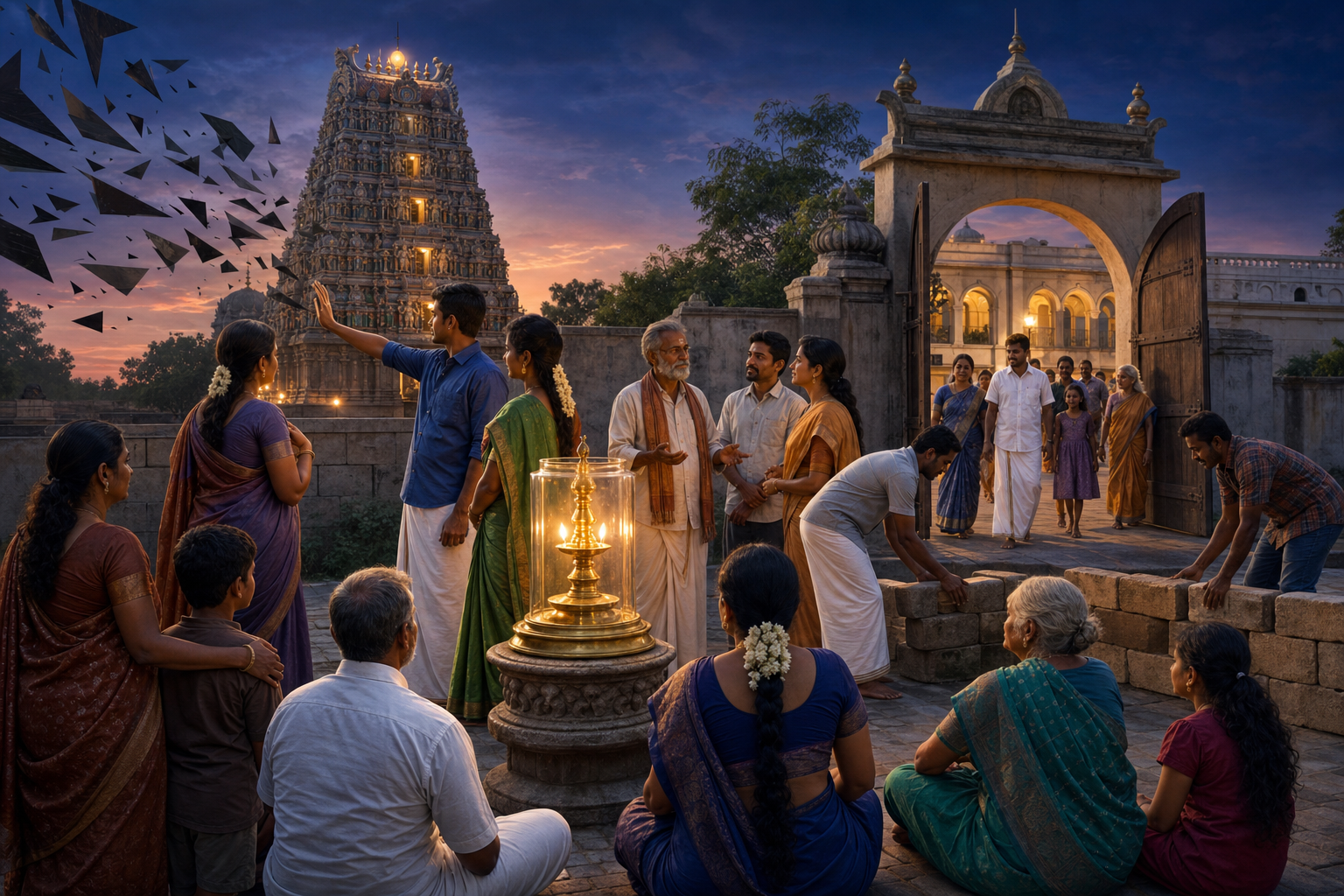
A pro-Dharma response should reject the notion that social reform and religious dignity are enemies. Untouchability, exclusion, discrimination, and violence should be confronted directly. But reform becomes civilizational hostility when a speaker transfers guilt from a wrong practice to an entire religious inheritance or treats millions of believers as obstacles to be removed.
The Dharmic family offers practical disciplines for resisting that slide. Samvada requires an opponent’s claim to be represented accurately before it is challenged. Jain Anekantavada warns that one perspective rarely exhausts a complex reality. Buddhist maitri and karuna rule out dehumanization even in serious disagreement. The Sikh ideal of sarbat da bhala asks whether a political response serves the welfare of all rather than merely defeating an enemy camp. These principles support fearless criticism; they change its object, method, and limits.
What citizens should ask political leaders to do
- Name the object of opposition precisely. If the target is untouchability, caste discrimination, exclusion from institutions, or violence, say so without using an entire faith as shorthand.
- Affirm freedom of conscience explicitly. A leader can oppose Hindutva, caste hierarchy, or a particular religious interpretation while also affirming that Hindus have the right to profess and practise their faith under Article 25.
- Replace symbolic denunciation with measurable reform. Propose enforcement against discrimination, equal access where the law requires it, transparent institutional processes, or another identifiable remedy. A political slogan should not substitute for action on the injustice invoked to justify it.
- Release the full record and correct errors visibly. Parties, legislatures, and media organisations should publish complete transcripts and primary video where available. A misleading caption or translation should be corrected with prominence comparable to the original claim.
- Create rules that apply across parties. Codes for ministers and party representatives should prohibit theological derision while protecting programmatic criticism. Assembly leaders and parties can also reaffirm religious freedom across party lines instead of invoking it only when their own constituency is offended.
- Make dialogue produce an outcome. Forums involving political representatives, scholars, temple administrators, reform advocates, and Dharmic communities should end with clarified language, recorded commitments, and specific anti-discrimination measures, not ceremonial photographs.
Key takeaways
- Sanatan Dharma, Hindutva, Hindu identity, and Dravidian reform are related parts of the controversy, not interchangeable terms.
- Criticism becomes more credible when it names a policy, doctrine, practice, or injustice instead of condemning a whole civilizational identity.
- Freedom of speech, legislative privilege, religious freedom, election rules, and political accountability impose different tests.
- Defending Hindu dignity does not require defending discrimination, and opposing discrimination does not require denigrating Hindu faith.
- The reliable response is to verify the complete words, identify their target, and demand a remedy proportionate to what the record establishes.
The next time this controversy returns through a fresh clip, pause before joining the assigned camp. Write down the target, the venue, and the remedy you want. Then make the strongest case you can for both religious dignity and concrete reform. Tamil Nadu’s public life has room for both, but only if citizens refuse language that turns either faith or justice into a disposable political weapon.
References
- Hindu Existence – Political Row Erupts in Tamil Nadu over Remarks on Hindutva and Sanatan Dharma
- Hindu Janajagruti Samiti – Udhayanidhi Stalin’s anti-‘Sanatan’ remarks: outrage, constitutional limits, and a call to unity