
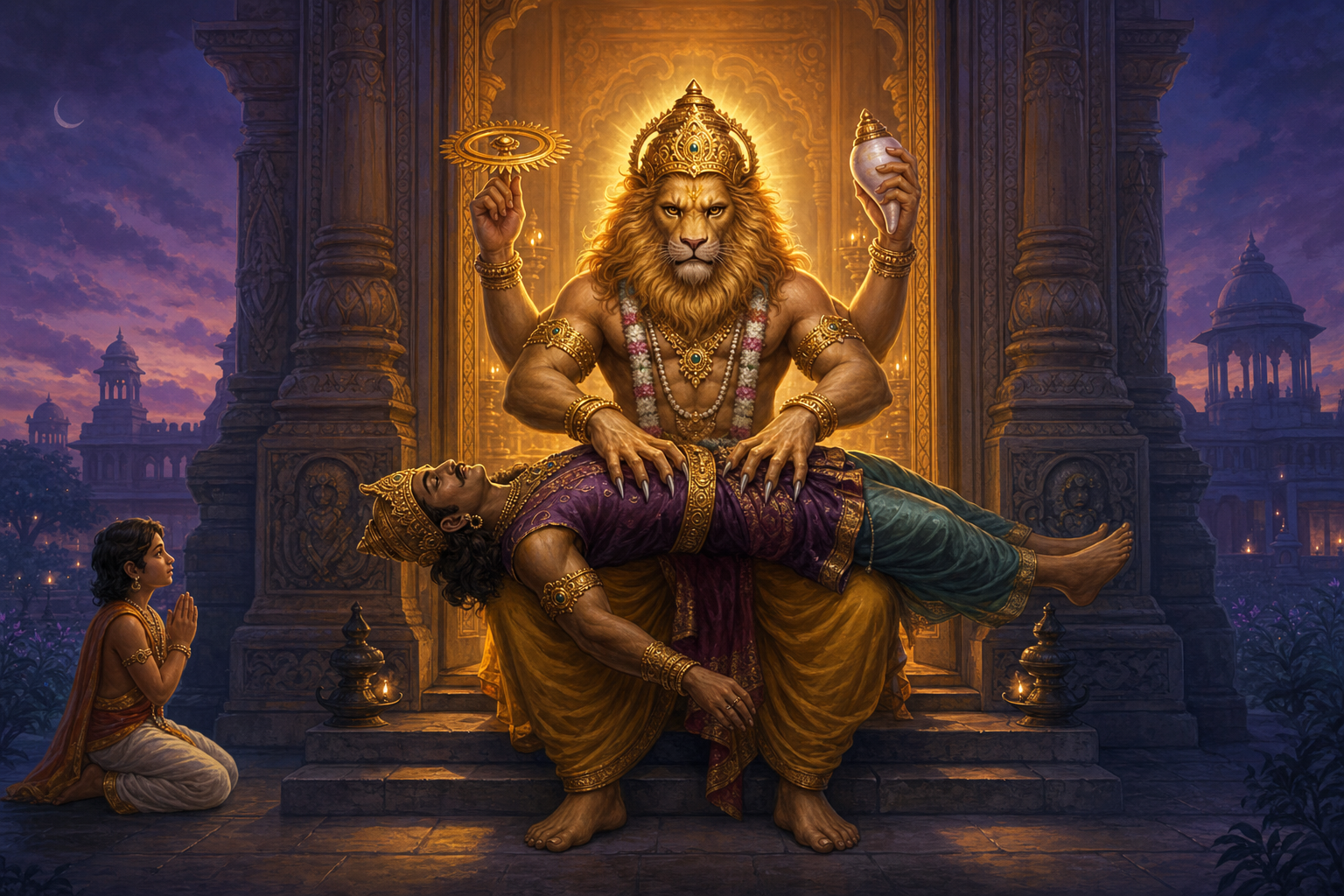
You are standing before Narasimha in a temple, a museum, or even a photograph, and one question unlocks the whole image: why do the deity’s bare claws matter more than any conventional weapon?
Start with the hands. Once you identify what the claws touch, how sharply they are shown, and whether they are extended or restrained, the murti becomes easier to read. What first appears to be an image of unbounded fury resolves into a precise statement about dharma, protection, and power held under moral discipline.
Why the claws, rather than a conventional weapon, defeat tyranny
Hiranyakashipu tries to place himself beyond death through a carefully constructed boon. He is not to be killed by man or beast, by day or night, inside or outside, on the earth or in the sky, or by a conventional weapon. Narasimha answers every condition without fitting neatly within any of its categories. He is neither merely human nor merely animal. He appears at twilight, acts at a threshold, and holds the asura upon his lap. His claws complete the pattern.
The Sanskrit expression nakhayudha joins nakha, nail or claw, with ayudha, weapon. The related term nakhastra is also used. Yet the claw does not sit comfortably within the usual distinction between shastra, a handheld weapon, and astra, a projectile or mantra-empowered weapon. It is neither forged, acquired, carried, nor thrown. It belongs to Narasimha’s embodied form.
That distinction is the theological center of the icon. Vishnu does not need an external instrument before he can protect Prahlada and restore dharma. The capacity to act is already inherent in the divine form. The claws therefore do more than close a loophole in the boon: they show that no technical arrangement can make adharma permanently immune from moral consequence.
When you look at a narrative sculpture, locate three relationships before judging its emotional tone: Narasimha’s hands in relation to Hiranyakashipu, the asura in relation to the deity’s thigh, and Prahlada in relation to the entire scene. Not every composition includes every narrative detail, but Prahlada supplies the moral orientation. The same claws that terrify the oppressor are the reason the devotee has refuge.
This keeps us from mistaking divine fury for uncontrolled rage. Narasimha’s force is directed, bounded, and purposeful. It answers a specific abuse of power and stops when protection has been secured. The icon does not ask you to admire violence by itself; it asks whether strength serves dharma or merely appetite.
A five-step method for reading the hands
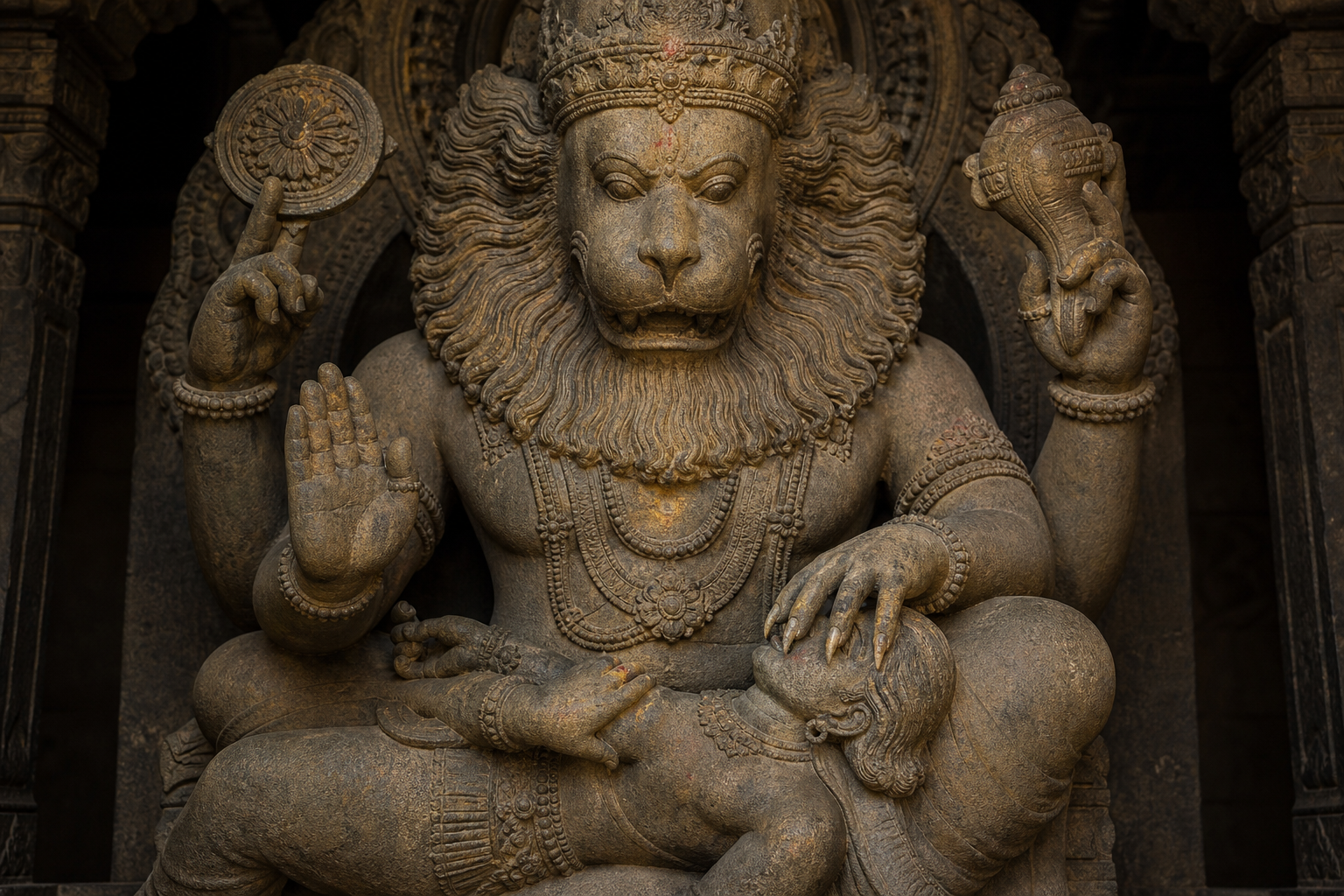
You do not need specialist training to examine a Narasimha murti carefully. Use this sequence, especially when a crowded composition or damaged surface makes the image difficult to interpret.
- Find the point of decisive contact. Narasimha may have several arms bearing attributes or forming gestures, but identify what actually touches or subdues Hiranyakashipu. In the central narrative action, the claws are not decorative additions to a leonine body. They are the means through which the boon is answered.
- Separate the nail from the fingertip. Look for a crisp edge where the nail begins, a tapered tip, or a narrow shadow created by undercutting. Even a claw only a few millimeters long can become visually dominant when the sculptor gives it a sharp ridge and places shadow beneath it.
- Trace the direction of the fingers. Forward-curving fingers lead your eye into action in fierce forms. Relaxed or upright hands redirect attention toward reassurance in peaceful forms. The claws remain meaningful in both cases; their direction tells you whether power is being exercised or held in readiness.
- Read the hand together with posture. A hand cannot be interpreted in isolation. Hiranyakashipu stretched across the thigh, Lakshmi seated upon Narasimha’s left side, or the deity bound into yogic composure changes the meaning of the same sharply defined nails.
- Adjust for scale, damage, and ritual use. Long talons may be obvious on a monumental stone image but impractical on a bronze carried in procession. Erosion can soften a once-sharp nail, while ornamentation can draw fresh attention to the hands. A subdued claw is not automatically an iconographic omission.
The face will naturally command your first glance: mane, open mouth, fangs, and large eyes establish Narasimha’s leonine presence. The hands, however, tell you what that presence is doing. Move your gaze from face to shoulder, along the arm, and into the fingertips. Sculptors often support that movement through the arrangement of the surrounding aureole and the choreography of the other arms.
If the claw tips have worn away, inspect the sides and undersides of the fingers. Protected recesses can preserve the original separation between nail and flesh after exposed surfaces have become smooth. This is especially useful when viewing an old stone image whose frontal details have suffered abrasion.
The same claws speak in three different emotional registers
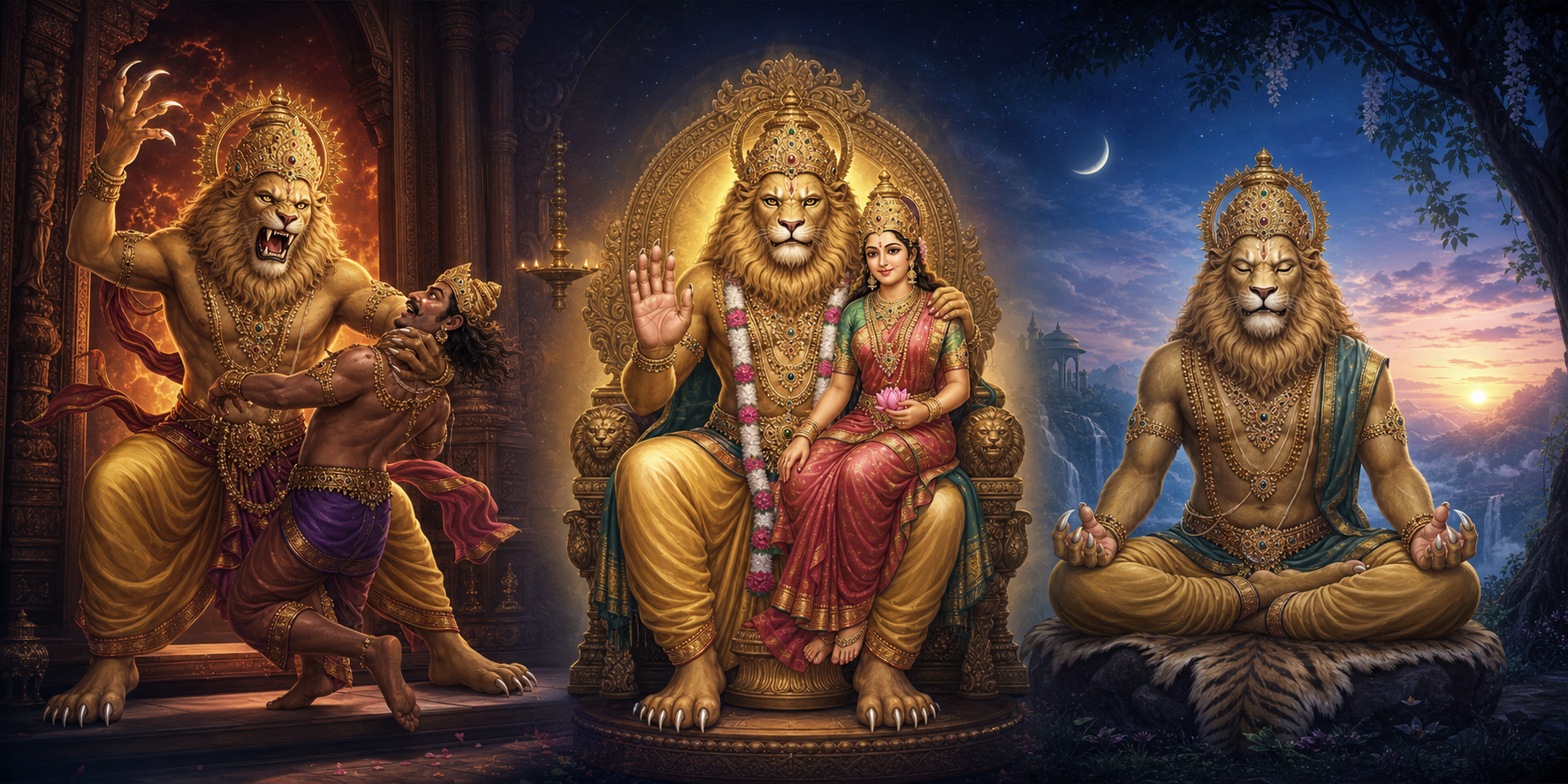
Narasimha’s iconography does not remain permanently fixed at the moment of Hiranyakashipu’s defeat. Fierce, benevolent, and yogic forms place the same protective capacity in different states. Comparing them prevents a common mistake: assuming that visible ferocity means evil, or that serenity means the disappearance of strength.
| Form | What to notice in the claws | How to read them |
|---|---|---|
| Ugra, Veera, or Jvala Narasimha | Fingers curve toward the action; tapered tips and decisive contact receive strong emphasis. | Protective power is being exercised in a crisis. The intensity belongs to the defeat of adharma, not to indiscriminate aggression. |
| Lakshmi Narasimha | The nails remain clearly visible, but the hands and expression are more restrained. Abhaya and varada gestures may become prominent. | Power has become shelter. The deity can reassure the devotee precisely because the capacity to protect has not vanished. |
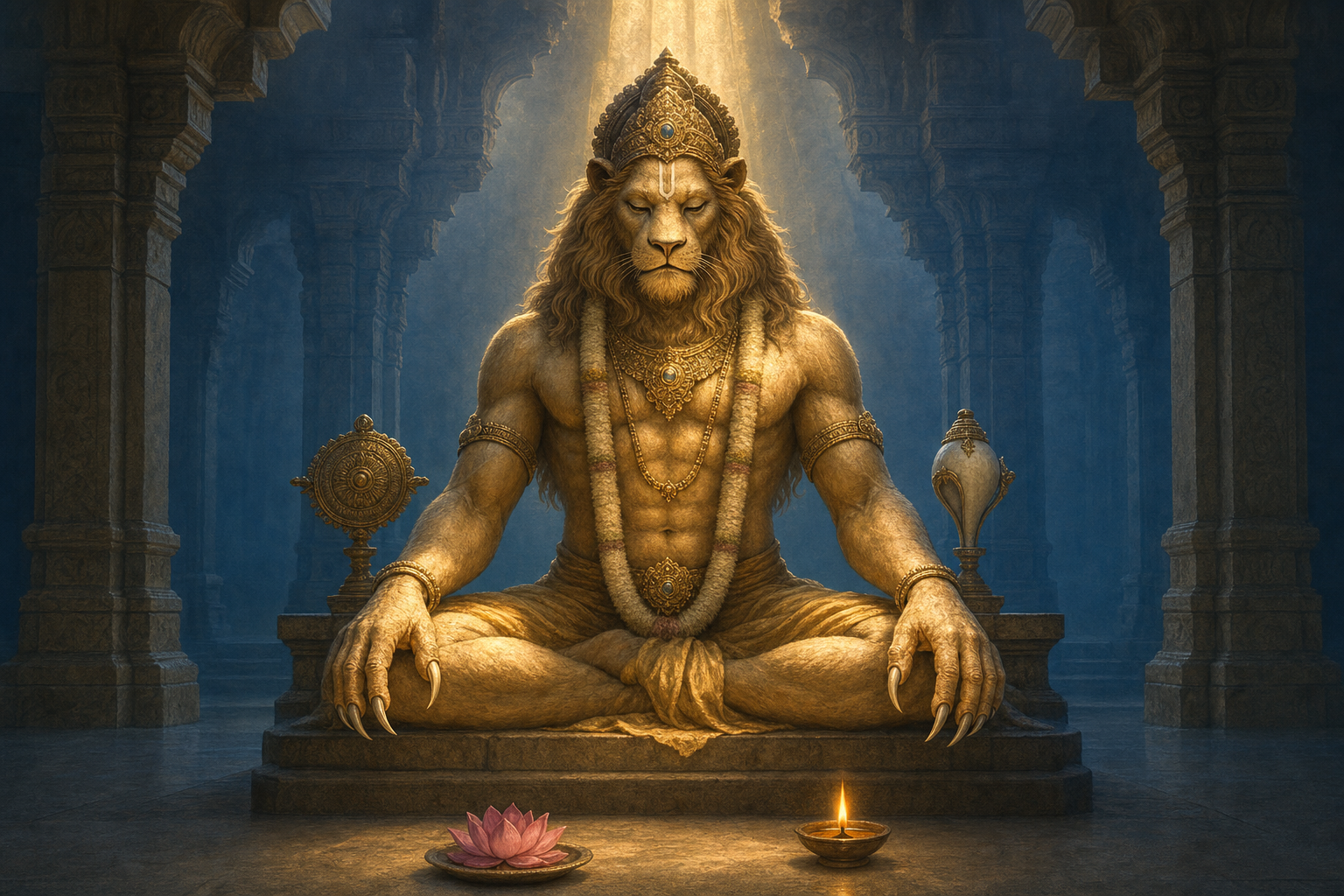
| Yoga Narasimha | Claws are defined but contained within a composed posture rather than driven into outward action. | Strength is present as disciplined potential. Kshatra, the capacity to defend, has been harmonized with tapas and inward control. |
In Lakshmi Narasimha, the coexistence of claws and abhaya mudra deserves special attention. The gesture says that the devotee need not fear; the visible nails explain why that assurance has substance. The claw does not cancel the blessing, and the blessing does not erase the power behind it. Protection requires both capacity and restraint.
Yoga Narasimha makes a related point through stillness. The force visible in an Ugra composition has not been discarded. It has been gathered inward. When examining this form, do not search for a dramatic victim or extended talons. Look instead at how carefully the fingers remain differentiated within the controlled geometry of the seated body.
The Nava Narasimha forms worshipped at Ahobilam provide a particularly rich field for this comparison: Ahobila, Jvala, Malola, Kroda, Karanja, Bhargava, Yogananda, Chatravata, and Pavana. Their range demonstrates that Narasimha cannot be reduced to one facial expression or one instant of combat. The claws retain their basic association with protection while the surrounding posture, companions, and devotional mood change its register.
Use these three broad modes as a reading aid, not as a rigid substitute for a temple’s own tradition. A local name, ritual history, or composite form may carry meanings that a simple fierce-peaceful-yogic chart cannot capture. Begin with what the image actually shows, then use its formal category to refine your interpretation.
Material, distance, and ritual change what you can see
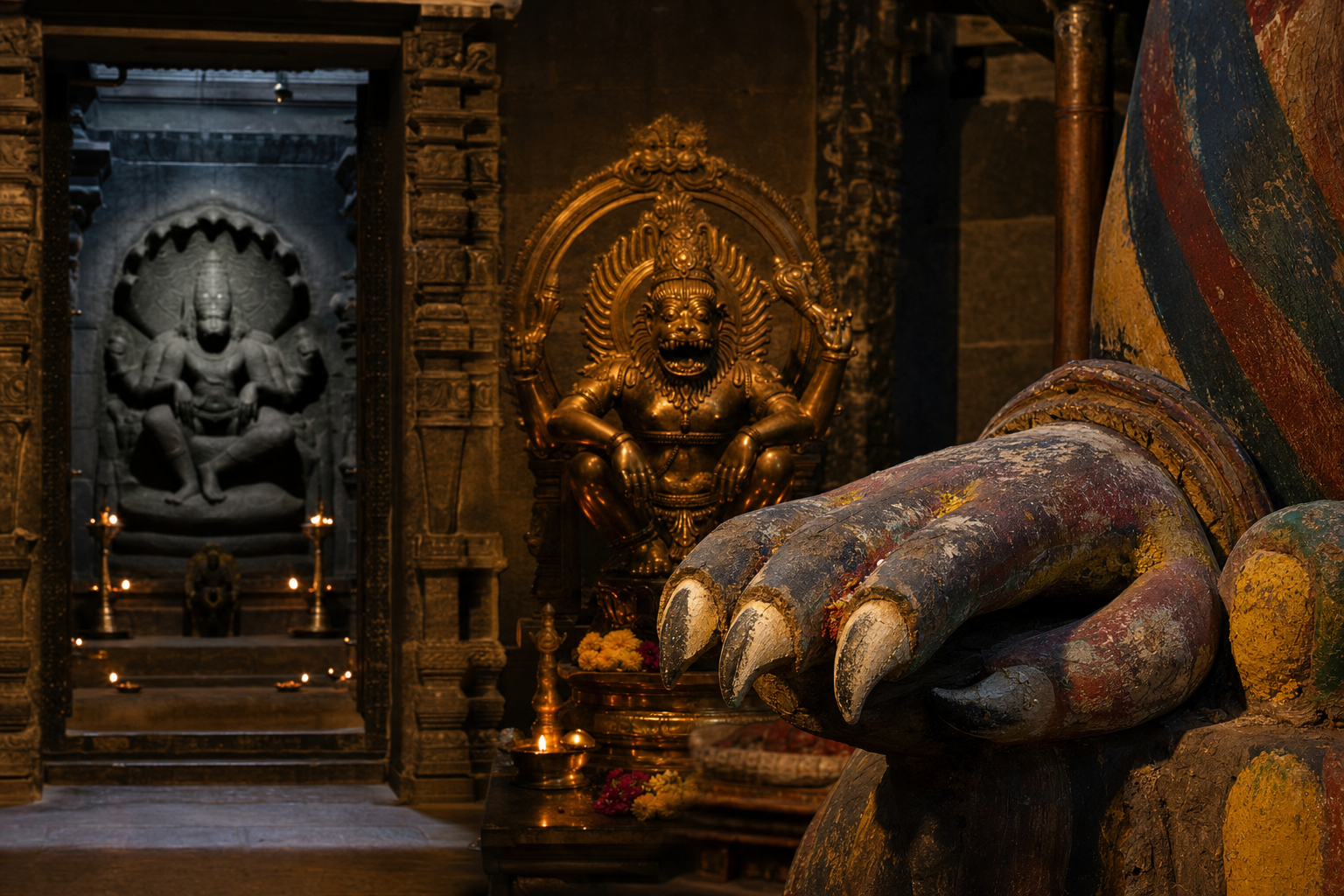
A claw that works in monumental granite cannot be carved exactly like one intended for a small processional bronze. Before concluding that one region or period gave the claws greater importance, account for the physical problem the artisan had to solve.
- At Hampi, read at monumental scale. The image popularly called Ugra Narasimha uses enlarged hands and emphatic finger articulation so that the gesture remains legible from a distance. Step back before moving close; the composition was not designed only for inspection at arm’s length.
- At Belur and Halebidu, let shadow reveal the detail. Hoysala artisans used fine-grained soapstone for minute carving. Small, sharply tapered nails gain visual force through precise edges and undercut shadows. A slight change in your viewing angle can make those details appear.
- In processional bronzes, look for finish rather than length. Projecting talons are vulnerable when a murti must be dressed, handled, and carried. Shorter nails can still be emphasized through incised or chased work along the fingers.
- At Simhachalam, compare claws with tusks. The Varaha Lakshmi Narasimha form brings boar and man-lion features together. Tusks and claws can therefore be read as two natural, embodied instruments of rescue rather than manufactured arms.
- At Singaperumal Koil, include the standing body. The dynamic posture and leonine features work with the definition of the hands. Do not isolate the claws from the forward energy of the entire figure.
These regional and material differences explain why identical measurements should not be expected across granite, soapstone, and metal. The consistent requirement is semantic rather than mechanical: the viewer must be able to recognize the nails as part of Narasimha’s protective agency.
Temple alankara adds another layer. Sandalwood paste, kumkuma, gilding, and ornaments can visually mark the hands, while bathing and long use can alter the surface over time. Instead of treating decoration as something that hides the sculpture, notice where ritual attention is concentrated. Repeated emphasis on the hands tells you how the living tradition wants the murti to be encountered.
During Narasimha Jayanti and other Vaishnava observances, visual form and recited praise reinforce each other. Epithets such as vajra-nakha, thunderbolt-like claws, and vajra-damshtra, thunderbolt-like fangs, direct attention to resolve and protection. If you hear these names during worship, return your eyes to the fingertips. The chant is supplying a verbal key to the image.
From divine fury to the discipline of discernment
The claws also operate beyond the literal defeat of Hiranyakashipu. Devotional interpretation compares their cutting action with viveka, the discernment that separates the real from the unreal. Under that reading, ignorance is not defeated by vague goodwill. It must be identified, divided from truth, and relinquished with precision.
This metaphor works because a claw is exact. It does not flatten everything before it like an uncontrolled force. It pierces and separates. Applied inwardly, the image asks you to distinguish courage from anger, protection from domination, and principled firmness from the pleasure of defeating an opponent.
The lion also carries resonances across Dharmic traditions. The Buddha’s lion’s roar and the lion-throne associate the animal with the fearless proclamation of truth. The lion is linked with Mahavira in Jain iconography. In the Sikh tradition, Singh expresses leonine valor, while the kirpan binds courage to the duty of righteous protection. These symbols are not interchangeable, and each belongs to its own theology and discipline. Their family resemblance lies in a shared ethical test: strength becomes worthy when it serves truth, restraint, and the vulnerable.
Narasimha’s claws sharpen that test. They are fearsome without making fear their final purpose. Their narrative movement runs from danger to refuge: Hiranyakashipu’s apparent invulnerability ends, Prahlada survives, and force yields to protection. That is why serene Narasimha forms can retain clearly marked nails without contradiction.
Key takeaways
- Begin at the point of contact. The claws, rather than a carried weapon, reveal how Narasimha answers the terms of Hiranyakashipu’s boon.
- Read claws together with gesture. Extended fingers indicate active intervention; abhaya and varada turn the same capacity toward reassurance; yogic containment presents it as disciplined potential.
- Keep Prahlada in the moral frame. The image’s fury is directed against oppression and toward the protection of the devotee.
- Account for medium and viewing distance. Monumental stone favors bold articulation, fine soapstone rewards close inspection, and processional metal may communicate through finish rather than projecting length.
- Do not confuse restraint with weakness. Narasimha’s peaceful forms retain their claws because compassion without the capacity to defend would be an incomplete image of refuge.
The next time you encounter Narasimha, do not begin with the label beside the image. Begin where the divine hand meets the problem it has come to resolve. Follow the claws outward into the story and then inward toward the discipline they demand: be strong enough to protect, restrained enough not to dominate, and discerning enough to know the difference.