
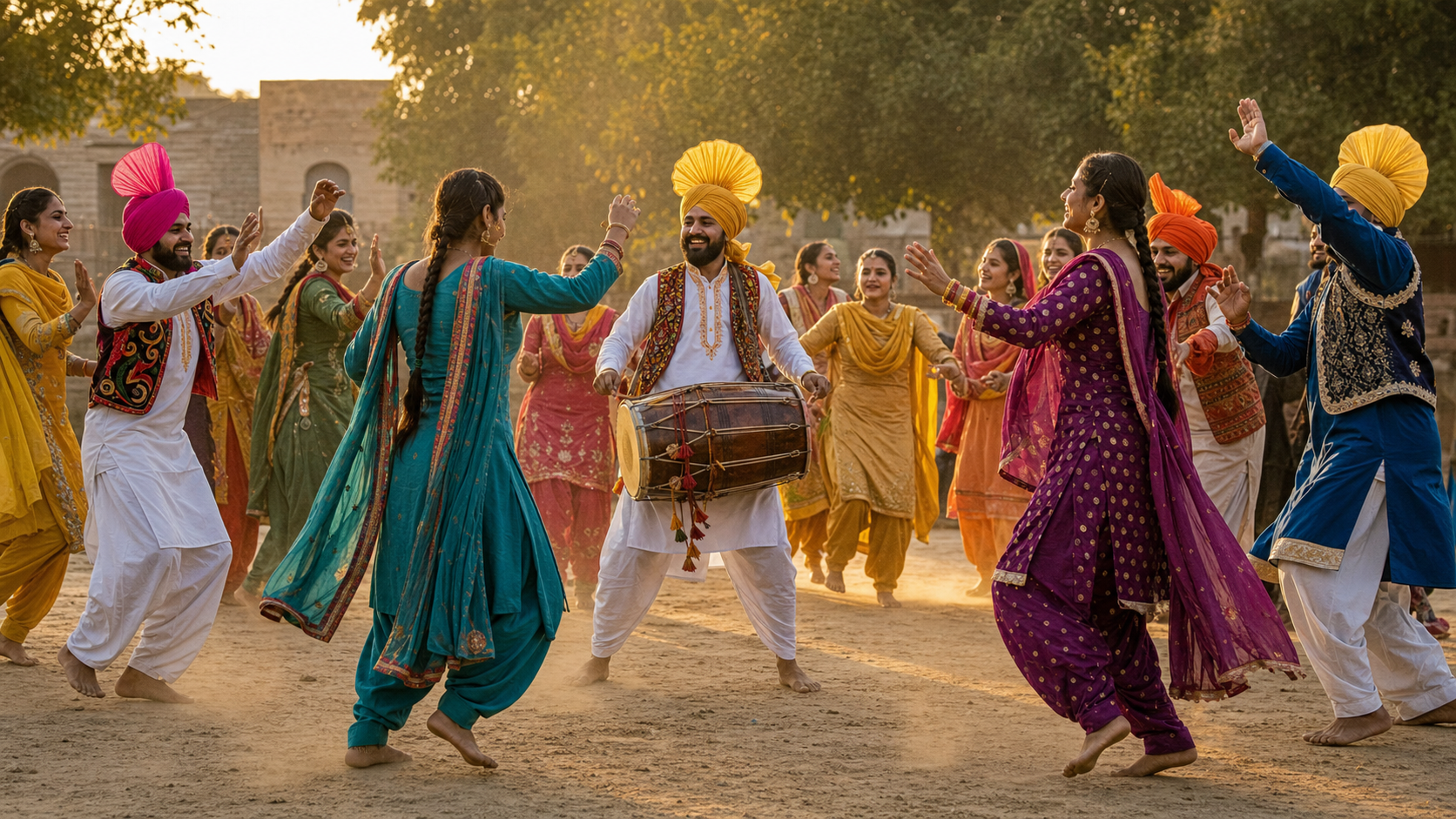
Your feet can land on time and the dance can still look disconnected. The usual missing link is not another step. It is the passage from pulse to weight, from weight to rebound, and from rebound to expression.
If you are learning, teaching, or choreographing Punjabi folk dance, begin there. A controlled sway, a well-timed shoulder response, and an attentive glance will often communicate more than a large movement pasted onto the music. The method below will help you hear that difference and build it into your body.
Find the cycle before you add the spectacle
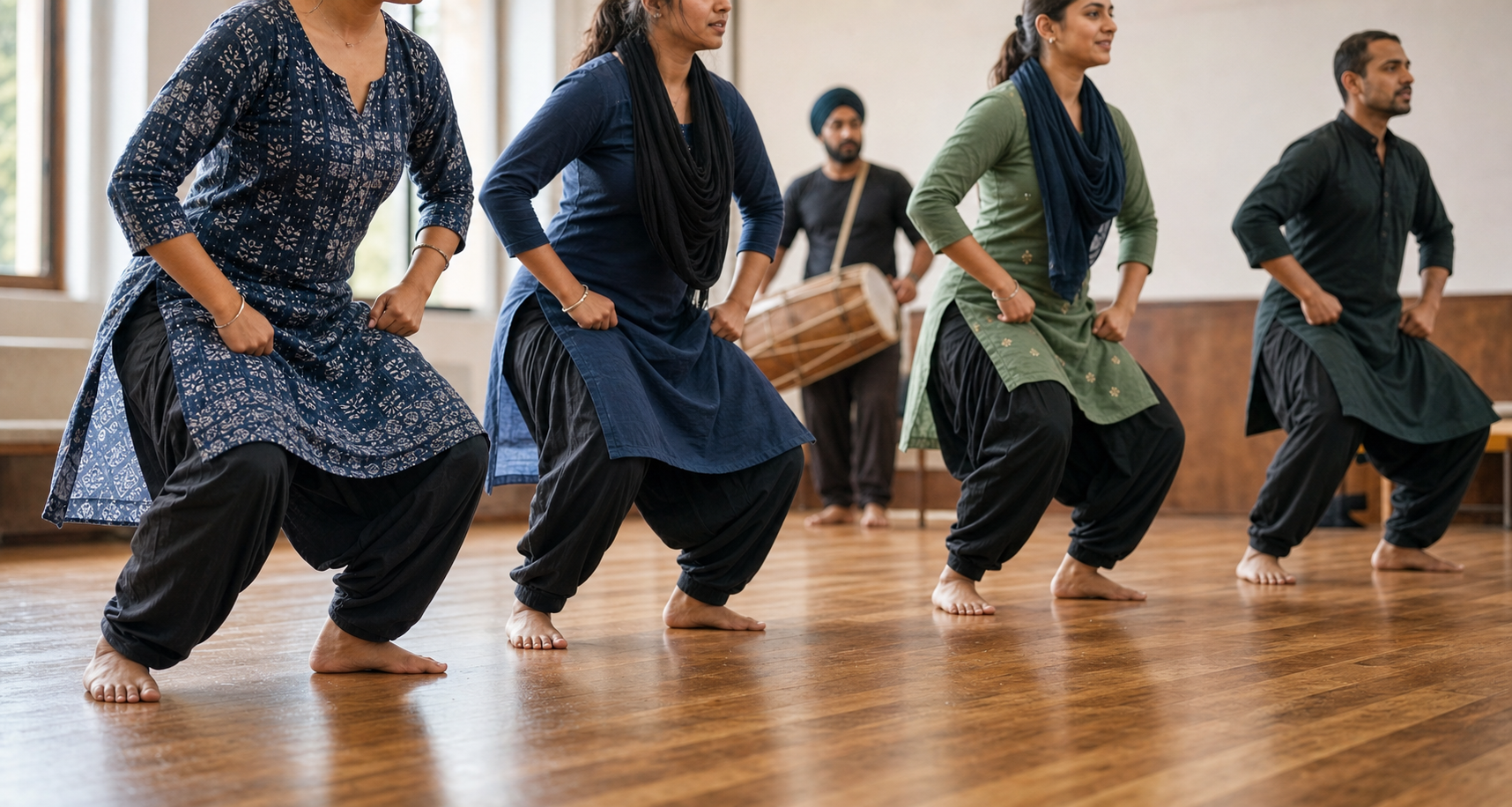
Many Punjabi social-dance settings rest on Keherva, an accessible eight-beat framework. That does not mean every song should receive the same fixed accent pattern. Tempo, subdivision, melodic phrasing, and the energy of a refrain can change. The eight-count is your map; the recording in front of you tells you where the road bends.
Use this listening drill before learning arm positions:
- Play one refrain and count evenly from one through eight. Do not move yet.
- Repeat the refrain and shift your weight gently from one foot to the other. This is a diagnostic exercise, not a finished folk step. If you lose the count, make the transfer smaller.
- Listen for the dhol’s contrasting deep and sharp sounds. Notice which sound grounds the phrase and which seems to answer or lift it. Follow what you actually hear instead of imposing an accent from another track.
- Add a small knee compression when the music feels grounded and a natural rebound as the phrase rises. Keep your heels, ankles, and breath available rather than bracing the whole body.
- Only after the weight transfer is steady should you add clapping. A clap should confirm the shared time, not conceal uncertainty in the feet.
This order matters because Punjabi rhythm is carried by more than a metronomic count. The dhol drives the phrase through the contrast between its bass and treble heads. Algoza can sustain a rustic melodic current, chimta supplies metallic brightness, and tumbi contributes its unmistakable single-string attack. You do not have to identify every instrument by ear before dancing. You do need to notice that they perform different jobs.
Let the dhol organize your sense of weight. Let the melodic instruments tell you how long the movement should breathe. Let a bright chimta or tumbi detail sharpen a clap, shoulder response, or change of gaze. If every instrument produces the same full-body action, the dance becomes busy but musically flat.
There is another useful test: turn your arms into quiet passengers for a full cycle. If the dance collapses when the arms stop, your lower body has not yet absorbed the groove. Return to the count, the knees, and the transfer of weight.
Build matak hulare as a movement relationship
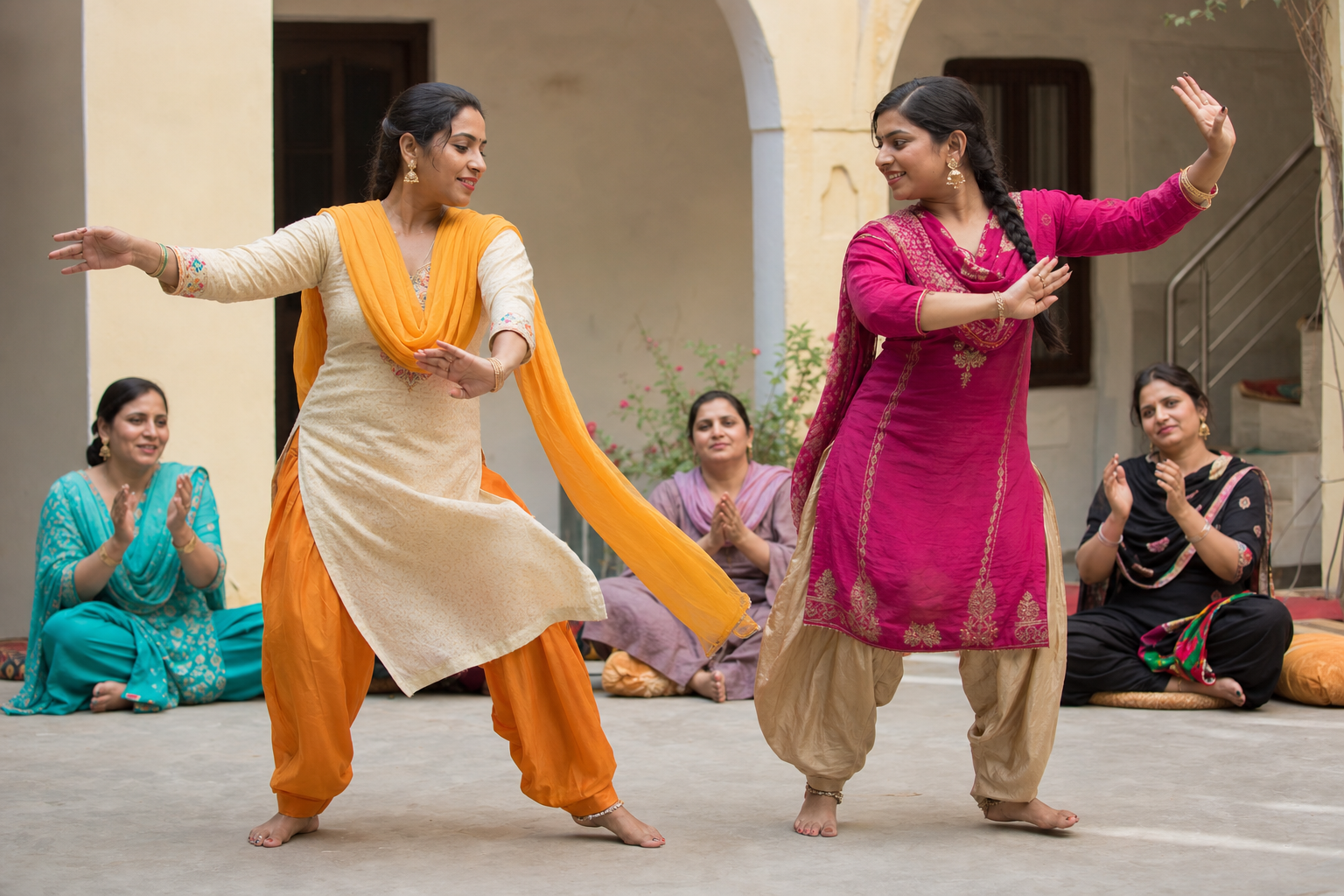
Matak is a controlled sway, most clearly visible through coordinated hip and torso movement. Hulare adds buoyant lilt and easy momentum. The phrase does not ask you to push the hips as far as possible or throw the upper body off balance. It asks for a conversation between grounding and release.
| Movement layer | What you should feel | What to avoid |
|---|---|---|
| Grounding | Soft knees and pliant ankles receiving the weight | Locked knees or a rigid, upright brace |
| Matak | A measured lateral sway shared by the hips and torso | Shoving one hip outward while the ribs tip the other way |
| Hulare | A pendular release that follows the rebound | Arching the lower back to manufacture a larger shape |
| Lift | A free chest and animated shoulders above a stable base | Permanent shrugging or tension around the neck |
| Expression | Eyes and face responding to words, rhythm, and other dancers | A fixed smile unrelated to what the group is doing |
You can assemble those layers without learning a long combination:
- Stand or step in place with the knees unlocked. Keep the ribs over the pelvis so the lower back is not carrying the whole posture.
- Transfer your weight far enough that one foot becomes available, but not so far that you have to catch yourself.
- Allow the pelvis and torso to travel together in a small sway. The action should remain controlled when the music slows.
- As the knees rebound, let the torso become lighter. The shoulders may answer the phrase, but they should not initiate it.
- Add the eyes last. Look toward a partner, a leader, or the circle at a musically meaningful moment instead of staring past everyone.
The body mechanics behind this folk ease are practical. Deep core and gluteal support stabilize the sway, soft knees absorb impact, and diaphragmatic breathing helps sustain repeated cycles. The visible movement can remain light because the body underneath it is organized.
If you feel the sway mainly as pressure in the lower back, reduce its range and check whether the knees and hips are sharing the load. If landings become noisy or the knees stiffen, lower the height of the rebound. Sharp or persistent pain is not a stylistic challenge to push through; stop the movement and seek appropriate professional guidance before returning to impact work.
Do not mistake small for timid. A compact sway that arrives exactly with the phrase is clearer than an enormous one that finishes late. Punjabi folk grace comes from control followed by release.
Let Giddha and Bhangra keep their different priorities
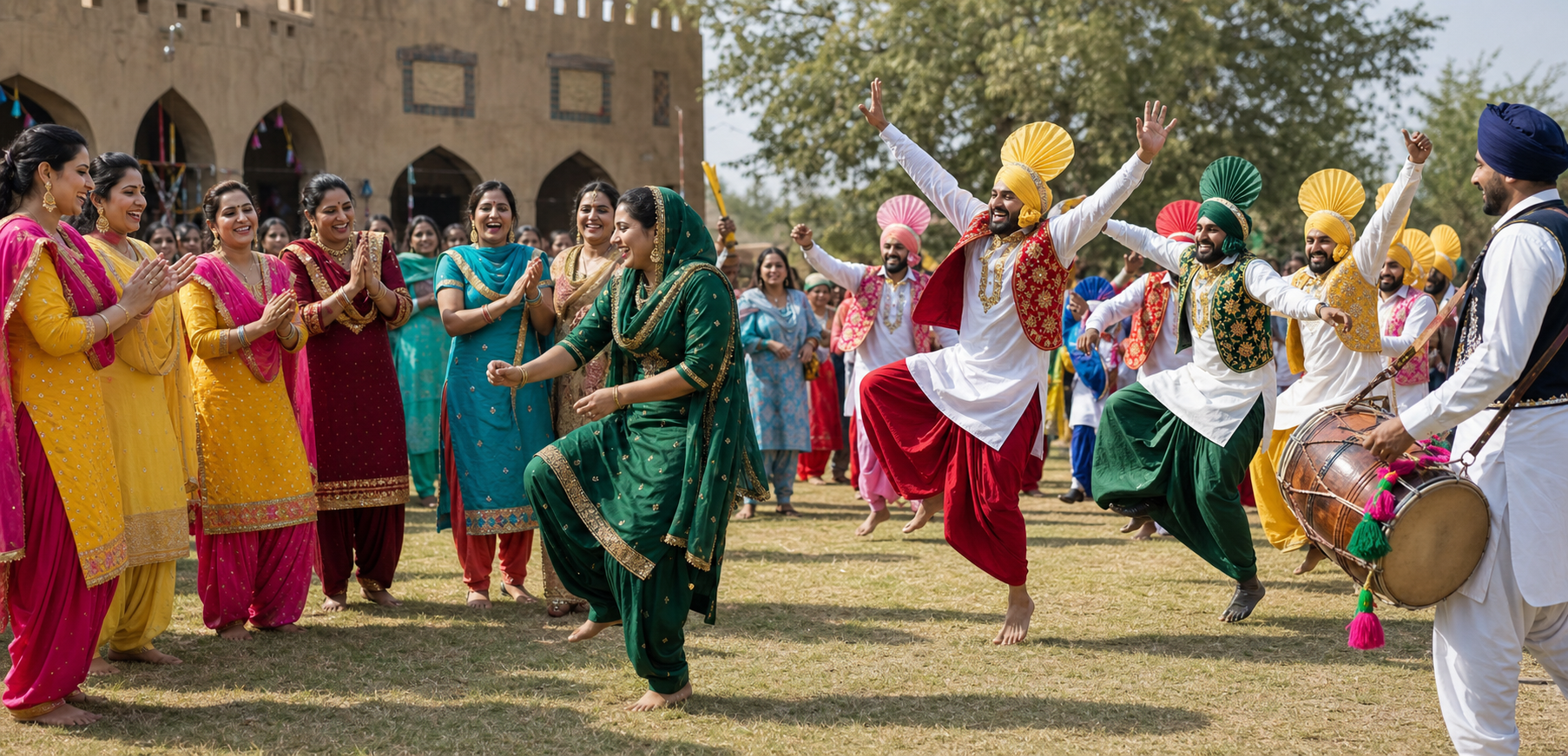
Giddha and Bhangra share a Punjabi rhythmic world, but they do not ask the body to speak in precisely the same register. If you use one undifferentiated idea of folk energy for both, you lose the qualities that make each form legible.
In Giddha, begin with the words and the exchange
Boliyan are concise oral verses capable of carrying affection, wit, satire, and everyday observation. A leader voices a line, the circle answers, and gesture gives the words a visible life. This makes Giddha more than movement performed beside a song. Text, rhythm, expression, and collective response are one event.
If you are learning a Giddha passage, find out what the boliyan mean before assigning gestures. Mark the word or phrase that turns the thought. That is usually a better place for a glance, clap, shoulder articulation, or heightened sway than an arbitrary point chosen only because the count feels empty.
Then check whether your gesture can be read by someone across the circle. Clarity matters more than complication. Keep the knees buoyant, the claps dependable, and the torso available for nuance. The face should carry the social intention of the verse: teasing, answering, observing, or affirming. Generic cheerfulness cannot replace that intention.
In Bhangra, organize lift from the ground upward
Bhangra generally favors more vertical lift and expansive carriage. The trap is to begin with large arms and jumps while the pulse underneath remains unstable. Build the rebound first. Let the legs receive and return the weight, then permit the chest and arms to enlarge that energy.
Ask three questions while rehearsing: Can you still hear the eight-beat cycle? Are you landing softly enough to continue without bracing? Does the upper body arrive as a consequence of the rebound? If the answer to any of these is no, reduce the size before increasing the speed.
The historically masculine coding of Bhangra and feminine coding of Giddha should not be treated as a rule about who may learn their movement vocabularies. Mixed ensembles, youth academies, and collegiate teams increasingly share steps and expressive methods. Choose movement according to the form, musical phrase, and social context rather than assigning ability by gender.
Classically trained dancers should also resist translating every Punjabi phrase into classical technique. Kathak systematizes footwork and abhinaya within codified taal structures; Punjabi folk movement retains more elastic phrasing and communal authorship. Their shared concern with rhythm, text, and audience relationship reveals an Indic kinship, but kinship is not sameness. Preserve the folk weight, directness, and social exchange instead of polishing them away.
Keep the circle’s social grammar, even on a stage
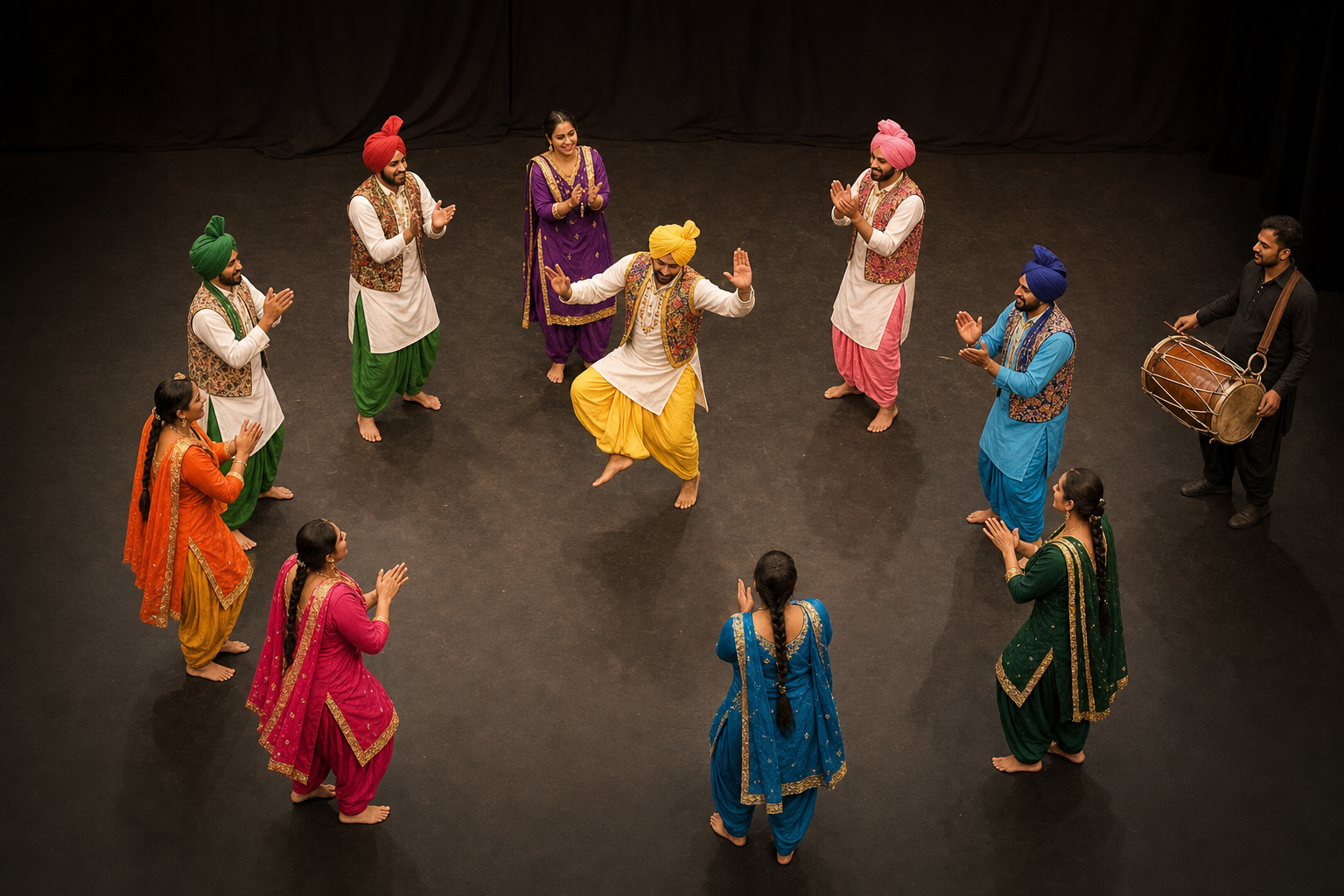
The circle is not merely an attractive formation. It allows dancers to see one another, supports safer spacing, and makes leadership and response immediately legible. Lines, diagonals, and counter-rotations can add visual contrast in staged work, but they should not erase the underlying relationship: someone offers, others answer, and the motif returns to the group.
Use that principle as a rehearsal tool. Form a circle and give one dancer a clear motif that fits the cycle. Let the group answer it without adding individual decoration. Rotate leadership after the refrain. Once everyone can recognize the offer and response, add variations. This exposes timing problems quickly because nobody can hide inside continuous choreography.
Punjabi folk dance grew through agrarian rhythms, seasonal gatherings, and neighborhood celebrations. Bhangra became closely associated with harvest exuberance, while Giddha sustained the intimate, dialogic world of boliyan and social comment. Partition, urbanization, and migration later carried these practices from village settings into civic halls, auditoriums, cultural festivals, and international competitions. That history should affect your decisions: retain a place for invitation, humor, listening, and group response even when the audience faces a proscenium stage.
Vaisakhi fairs, weddings, and Teeyan celebrations remain natural settings for this movement language. Before performing in any of them, establish what the occasion needs. A technically impressive sequence can still be wrong for the room if it overwhelms a sung exchange, blocks participation, or turns a communal moment into an uninterrupted solo display.
Costume should deepen the movement rather than substitute for it. Phulkari odhnis and dupattas add color and flowing direction; parandi braids contribute sculptural motion; jewelry can frame the face and make expression easier to read. Festive reds, yellows, and greens recall abundance and agrarian vitality. Learn how each element is worn and what it communicates before treating it as a detachable visual effect.
The same care applies in diaspora classrooms. Weekend programs and cultural festivals in Canada, the United Kingdom, the United States, and elsewhere can keep repertoire alive across generations, but steps alone are not enough. Pair movement instruction with lyric glossaries, named step vocabulary, instrument recognition, and acknowledgment of teachers or lineage-bearers. If you learn from a digital clip, trace the dance and boliyan back as far as the available information allows before teaching or publishing your own version.
A dharmic reading can recognize ananda, or joy, in the buoyancy of the dance and a seva-oriented community spirit in the way dancers sustain one another’s participation. This is an interpretation of social practice, not a claim that Giddha or Bhangra is liturgy. Punjabi Hindu and Sikh communities have both carried this repertoire, while contemporary ensembles can also include people from Jain, Buddhist, and other backgrounds. Shared celebration becomes meaningful when distinct identities are welcomed, not blurred.
That distinction gives you a practical standard for cultural respect. Ask whether your choice makes the music, words, community relationship, and inherited movement clearer. If it displays Punjabi color while stripping away all four, it is decoration without grammar.
Key takeaways
- Count the full eight-beat cycle before adding arms, claps, or facial expression; then follow the accents of the specific recording rather than assuming every track phrases the cycle identically.
- Place weight before shape. Soft knees, pliant ankles, and a stable center allow the visible sway and rebound to remain free.
- Treat matak as controlled sway and hulare as buoyant release. A smaller phrase on time is more convincing than a large phrase that pulls you off balance.
- In Giddha, let boliyan and social response guide gesture. In Bhangra, build expansive carriage from a grounded vertical rebound.
- Preserve the call-and-response logic of the circle even when arranging lines or diagonals for a stage.
- Carry cultural context with the steps: learn the words, name teachers and traditions, understand costume, and make room for communal participation.
On the next Punjabi track you practice, delay the choreography. Count one complete cycle, transfer weight through the next, and add only one expressive detail after the pulse feels dependable. If you can breathe, see the people around you, and make that detail answer the music, you have begun to move from memorized steps into Punjabi folk rhythm.