

You have probably met the Dashagvas in a Rigvedic translation only to find that the name passes without explanation. Are they ten individual rishis, a priestly lineage, performers of a long sacrifice, or symbols of illumination? A hurried answer can make the passage either flatly literal or so allegorical that its Vedic setting disappears.
The useful answer begins with their function. The Dashagvas are an Angirasa-aligned cohort of sages and ritual specialists associated with disciplined observance, effective sacred speech, and the release of the light hidden within Vala. Once you understand that role, their number, their partnership with the Navagvas, and their lasting spiritual significance become much easier to read.
Start with the right identity: a priestly cohort
The Dashagvas are remembered collectively, not primarily through ten separate biographies. They belong to the Angirasa stream, the priestly and visionary lineage associated with Angiras. Angiras is counted among the Saptarishis, but that does not make the Dashagvas another name for the Seven Rishis. Think of Angiras as the ancestral figure and the Dashagvas as a distinguished company within the wider Angirasa memory.
The Rigvedic pattern repeatedly places the Dashagvas beside the Navagvas. This pairing is more informative than an attempt to invent a list of individual members. Both groups are associated with hymns and sustained observances that assist Indra in overcoming Vala and releasing what has been withheld. Their identity is therefore liturgical and collaborative: they are known by the sacred work they carry through together.
Later Vedic interpretation preserves the same basic profile. Sāyaṇa remembers the Dashagvas as an Angirasa branch marked by stamina, cadence, and ritual efficacy. The emphasis remains on continuity and completion rather than on isolated feats of personal brilliance.
When you encounter the name in a hymn, begin with a simple margin note: collective, Angirasa, liturgical. That prevents three common errors at once. You will not mistake the Dashagvas for one person, detach them from their lineage, or reduce them to a number before asking what they do.
Map the Vala episode before interpreting its symbols

The Dashagvas become intelligible within the Vala episode. Read that episode first as a sequence of agents, actions, and consequences:
- Vala is the enclosing cavern or constriction within which valuable powers have been confined.
- The Panis guard the hoard rather than allowing it to nourish the wider world.
- The Navagvas and Dashagvas sustain the hymnic and ritual work connected with its recovery.
- Indra performs the decisive breaking-open through which the cows, dawns, waters, and radiance are released.
This division of roles matters. Indra is the victorious opener, but the priestly companies are not decorative witnesses. Their disciplined speech and observance belong to the conditions of victory. The episode presents divine power, mantra, rite, and collective effort as cooperating parts of one restoration.
The released cows should be read on several connected levels:
- Material: cattle are real wealth and nourishment within the world of the hymns.
- Cosmic: the cows also carry the radiance of dawn, while the larger hoard includes waters and other powers needed for flourishing.
- Illuminative: the release evokes inspiration, insight, sacred language, and knowledge that can nourish a community.
You do not have to choose one level and discard the others. Vedic imagery can retain the concrete value of cattle while also making them bear cosmic and spiritual meaning. Calling the cows only metaphors erases their material setting; treating them only as livestock misses the repeated movement from darkness and confinement toward dawn and disclosure.
The ethical structure is equally important. The Panis keep beneficial wealth enclosed; the successful rite helps return it to circulation. Vala can therefore be noticed as more than a location. It is a form of constriction. The counter-movement is release: light becomes visible, waters can flow, knowledge can be shared, and a hoard becomes nourishment.
When reading a particular occurrence, underline the verbs before interpreting the nouns. Ask what is hidden, who guards it, who speaks, who breaks the obstruction, and what returns to the world. This keeps your interpretation anchored in the hymn’s action instead of turning Vala into an unrestricted symbol for any difficulty you happen to have.
What nine and ten do – and do not – establish
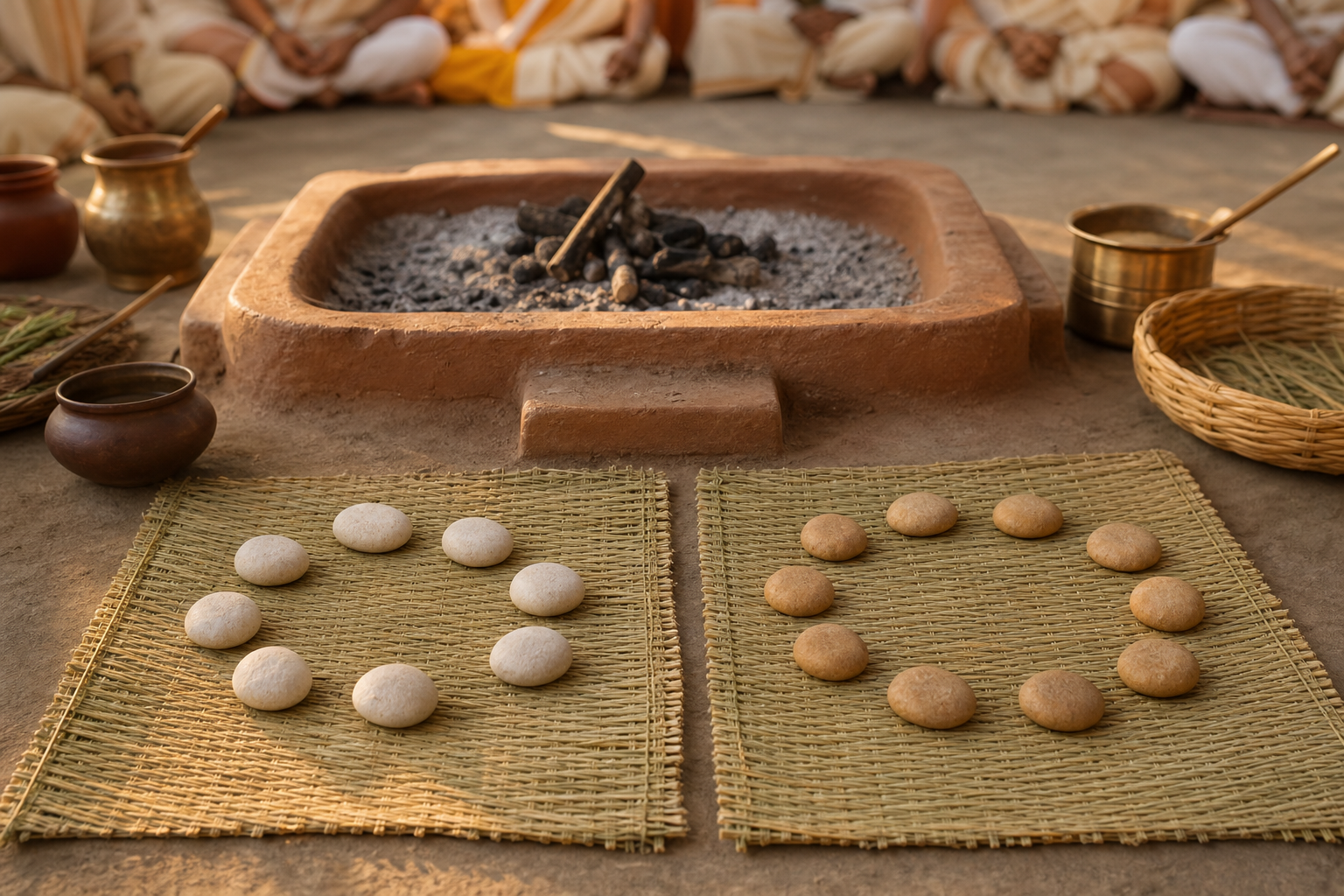
The numerical contrast is deliberate in traditional interpretation: the Navagvas are linked with nine and the Dashagvas with ten. Brāhmaṇa and later commentarial traditions connect the two names with the duration and rhythm of extended Soma observances, especially nine-month and ten-month sacrificial sessions. On this reading, the Dashagvas carry the work through the fuller cycle and into its culminating measure.
That interpretation explains why ten signifies more than a headcount. It can mark continuity brought to completion: the discipline lasts long enough for preparation, recitation, offering, and timing to converge. The Navagvas and Dashagvas then represent related phases rather than competing teams, with the former associated with preparation and the latter with the completed threshold.
The second part of the compound, -gva, is less secure. Its derivation has been connected with go, carrying senses such as cow or light, while other explanations treat it as a marker of a specialized ritual identity. The uncertainty matters. The numerical reading is deeply established within liturgical interpretation, but that does not mean every part of the word has one uncontested philological explanation.
| Careful reading | Claim to avoid |
|---|---|
| The Dashagvas are a collective associated with ten in Vedic ritual memory. | The name supplies a securely identified list of ten individual biographies. |
| Nine- and ten-month Soma sessions provide an influential traditional explanation. | Every Rigvedic occurrence independently proves an exact calendar schedule. |
| The Navagvas and Dashagvas can represent preparation and culmination. | Nine is spiritually deficient while ten is automatically superior. |
| The cows and light help illuminate the group’s function. | The derivation of -gva is settled beyond dispute. |
Use the numbers as interpretive signals, not as replacements for context. If the surrounding passage concerns hymns, dawn, release, Indra, or Vala, the nine-ten contrast can deepen your understanding of ritual continuity. If those features are absent, do not force the entire later explanation into a single word.
Why Vedic swiftness is the opposite of haste
The Dashagvas are associated with swiftness, but their speed is not carelessness. It is the speed of readiness. A long discipline can make the decisive moment appear sudden because breath, meter, memory, action, and intention have already been aligned.
This becomes clearer in the Soma-sacrificial setting, where responsibilities are distributed among Adhvaryu, Hotr, Udgatr, and Brahman functions. No single participant substitutes for the whole. The rite depends on each part occurring correctly and at the proper time. Collective precision produces the apparent acceleration.
The same principle governs sacred speech. Vāc is not treated as an ornamental explanation added after an action. Properly intoned and ethically grounded speech participates in the work itself. Sound, intention, sequence, and conduct must agree. Mere speed of utterance would therefore be a failure of the Dashagva ideal, not its fulfilment.
You do not need to pretend that an ordinary project is a Soma sacrifice in order to learn from this pattern. For a scripture circle, temple volunteer team, cultural archive, or publication project, the principle can become an integrity test:
- State the sankalpa: write one sentence naming what is to be learned, preserved, restored, or completed.
- Assign real responsibilities: decide who prepares, who performs, who checks accuracy, and who confirms completion.
- Choose a sustainable cadence: use a rhythm the group can actually maintain instead of relying on bursts of enthusiasm.
- Correct before accelerating: when pronunciation, textual accuracy, sequence, or responsibility is uncertain, repair that weakness rather than rushing past it.
- Define the phala: name an observable completion, such as a carefully checked recitation, an annotated passage, or a usable public resource.
This is a modern application of a Vedic principle, not a reconstruction of a Vedic rite. Its value lies in the distinction it preserves: sacred swiftness comes from fidelity carried to ripeness. The Dashagvas do not merely begin with intensity. They remain with the work until intention and outcome meet.
A shared Dharmic grammar, read without flattening differences
The Dashagva pattern also helps you notice a wider Dharmic respect for sustained, embodied practice. Buddhism joins right speech with continuing practice in sangha. Jainism joins vrata with meticulous moral attention. Sikh tradition gives collective cadence to simran and kirtan. These are not interchangeable practices, and the resemblance does not erase their different teachings or authorities. The shared structural insight is narrower and more useful: disciplined speech, ethical continuity, and community can turn illumination into lived action.
That insight has civilizational consequences. Knowledge cannot nourish a community while it remains inaccessible, carelessly transmitted, or guarded as private prestige. The image of released cows encourages a culture in which learning is preserved accurately and then circulated responsibly. Preservation without sharing becomes another enclosure; sharing without discipline can corrupt what was preserved.
Key takeaways
- Read the Dashagvas first as a collective within the Angirasa ritual lineage, not as one rishi.
- Notice when they appear with the Navagvas; the pairing is central to their identity.
- Trace the Vala sequence through confinement, disciplined sacred action, Indra’s breakthrough, and release.
- Keep the material, cosmic, and illuminative meanings of the cows in view at the same time.
- Treat nine and ten as ritually significant while preserving uncertainty about the exact derivation of -gva.
- Understand their swiftness as the result of sustained coordination, correct timing, and completion.
The next time you meet the Dashagvas in a Rigvedic passage, mark five things before reaching for a grand interpretation: cohort, partner, obstruction, release, and number. That small discipline will let the hymn’s own structure guide you. It also honours the lesson carried by the Dashagvas themselves: light is released through work that is accurate, shared, and brought fully to its proper end.