
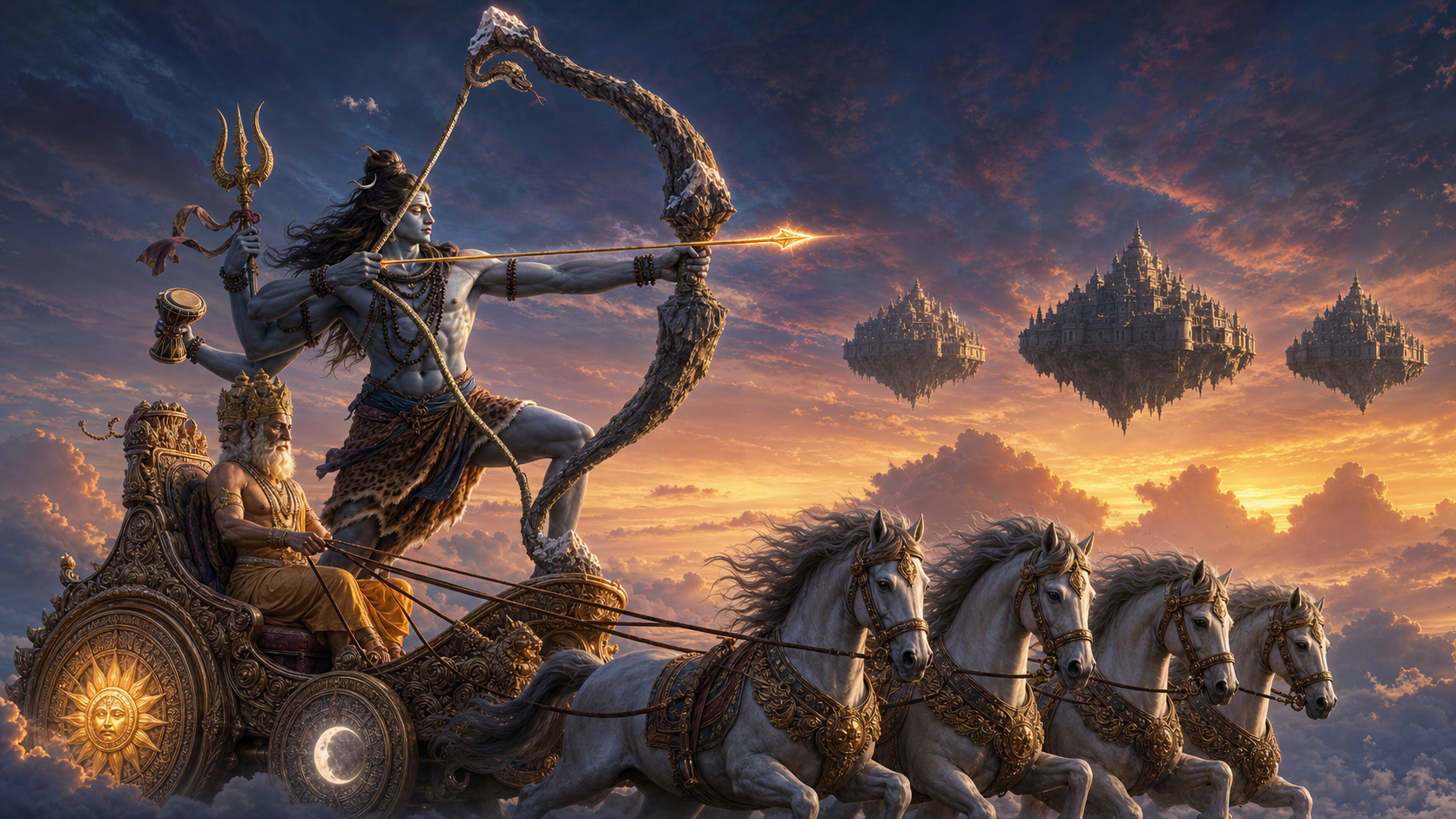
You are standing before a Shiva image whose body seems to have become a drawn bow. One leg braces, the torso turns, and the hands gather enormous force around a single arrow. The label may say Tripurantaka or Tripura Samhara, but it won’t tell you how the posture, surrounding figures, and cosmic weapon fit together.
The clearest way to read this form is to move in a deliberate order: identify the action, widen your gaze to the whole ensemble, and only then consider its theology. That sequence keeps you from reducing Tripurantaka either to a dramatic battle scene or to a vague symbol of overcoming evil.
Identify Tripurantaka by the action, not one accessory
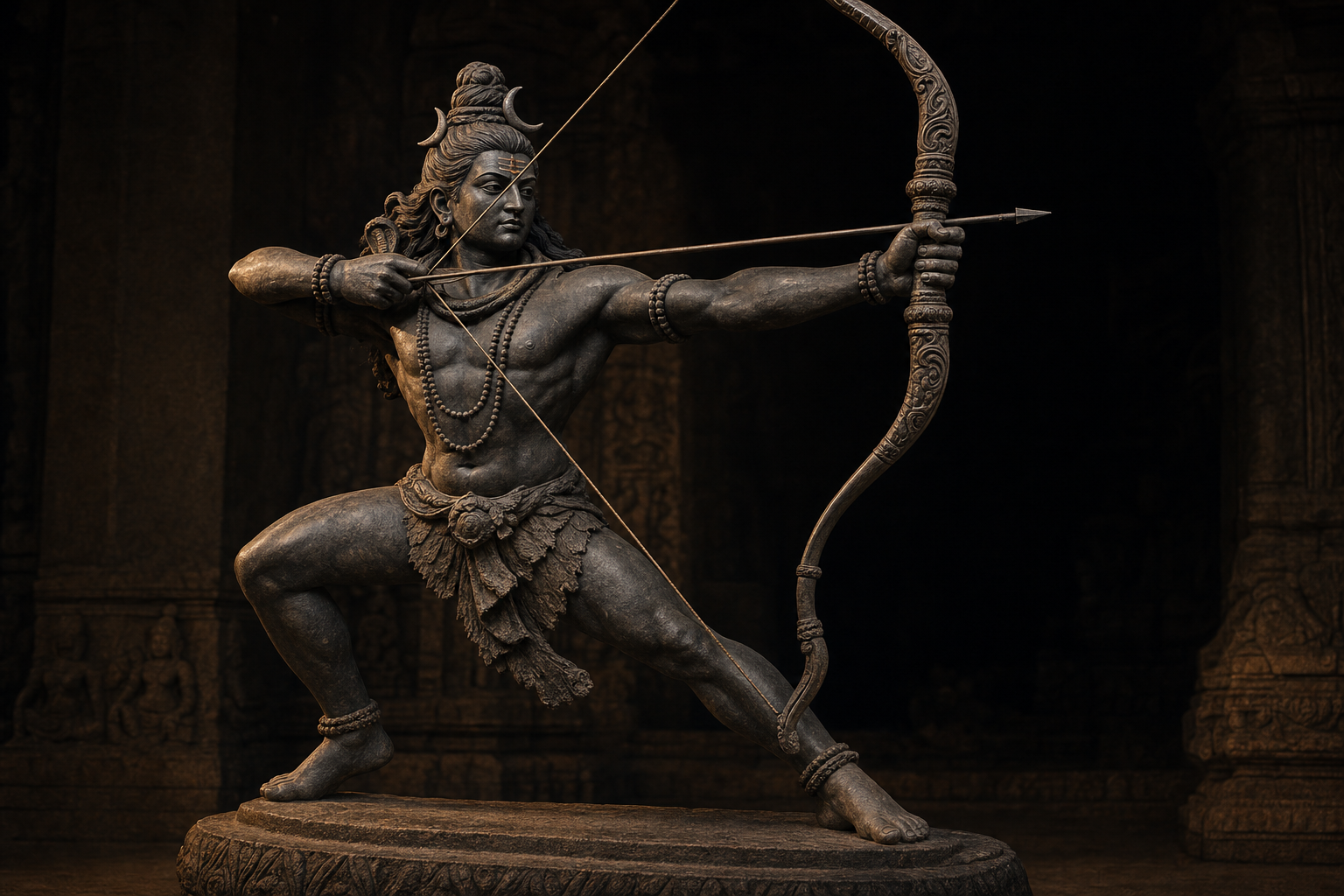
Begin with the verb expressed by the murti. Tripurantaka is Shiva acting as an archer. An axe, antelope, serpent, or matted crown can help establish Shaiva identity, but none of those attributes by itself identifies this particular manifestation. The decisive visual clue is the coordinated act of nocking, aiming, or drawing the bow.
- Find the principal pair of arms. In two-armed or four-armed forms, they normally organize the central action around the great Pinaka bow and its arrow.
- Confirm Shiva’s identity through the third eye, the jata-mukuta of piled matted locks, serpentine ornaments, or the tiger-skin garment at the waist.
- Read the feet and hips. The alidha or pratyalidha archer’s stance sets one side of the body against the other, producing the tension needed for release.
- Follow that tension upward. The hips turn, the shoulders answer, and the arms complete a single line of force rather than a collection of separate gestures.
- Only then scan the surrounding field for Nandi, ganas, devas, asuras, the chariot, or the three cities. These elements establish the wider Tripura narrative when they are present.
This order matters because Tripurantaka images vary between compact murtis and crowded narrative reliefs. A bronze may concentrate almost everything in Shiva’s poised body, while a temple panel may distribute the story among several tiers. Don’t disqualify an image merely because it lacks every item found in another regional version.
Now look at the face. Some forms meet the coming destruction with a keen, heroic intensity. Others retain the inward quiet of a yogin. These aren’t opposed portrayals. The face shows awareness without agitation; the body shows action without hesitation. Tripurantaka’s force is governed rather than uncontrolled.
That distinction also clarifies the rasa. The scene contains raudra, the terrible energy appropriate to the destruction of entrenched adharma, but it is shaped by vira, heroic resolve. If you see only anger, you have missed the composure that makes the action dharmic. If you see only serenity, you have missed the demand for decisive action.
Read the cosmic chariot as a theology of coordination
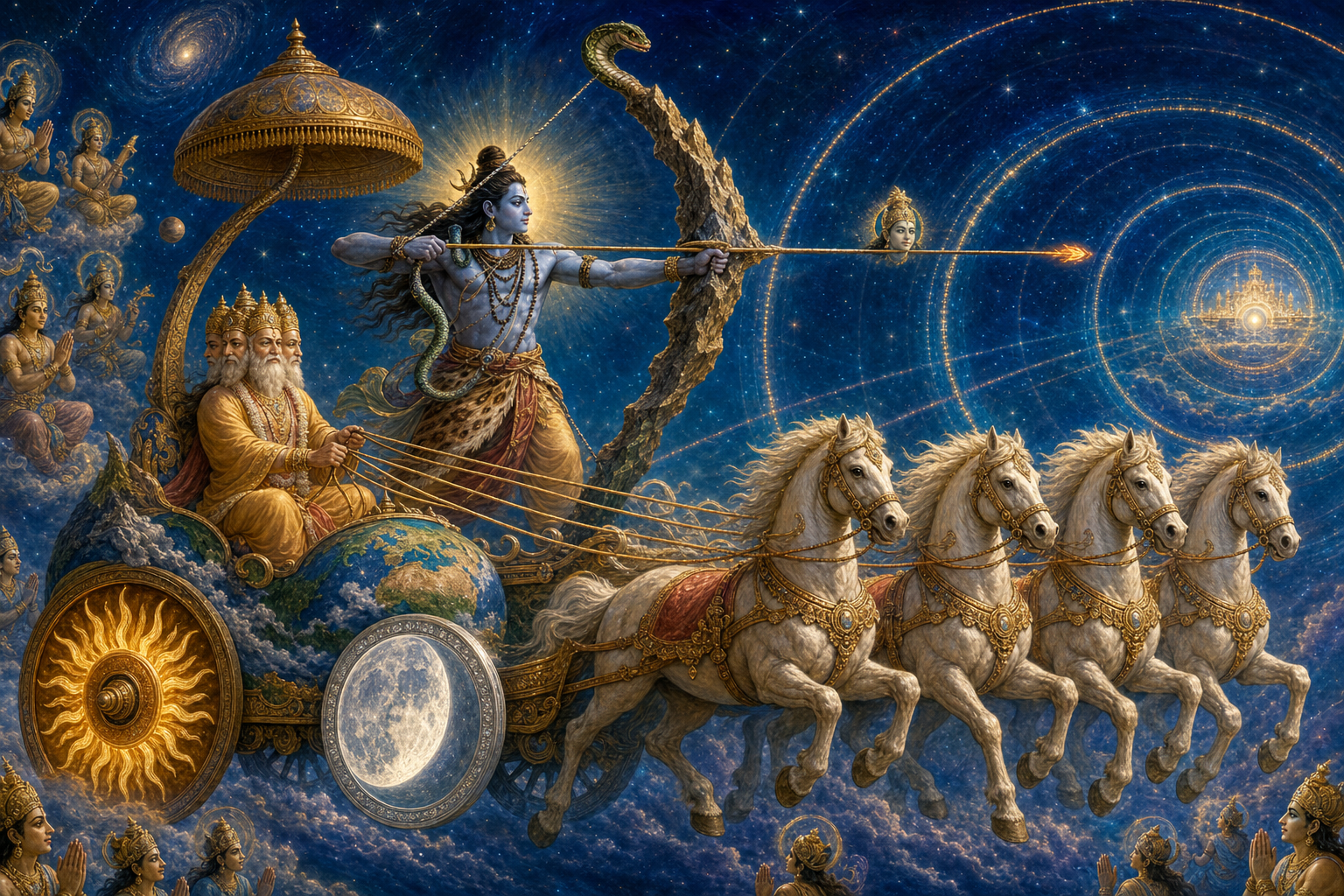
The narrative begins with a system of power, not an isolated enemy. Maya constructs three citadels for the sons of the asura Taraka. The cities are made of gold, silver, and iron and occupy heaven, the middle region, and earth. Protected by boons, they can be destroyed only when they align at a rare moment. Shiva answers that carefully reinforced disorder with one perfectly directed shaft.
The armament assembled for this act is itself cosmic. Across widely transmitted versions, the world and its divine powers assume the functions of chariot, bow, string, arrow, and flame.
| Cosmic member | Role in the armament |
|---|---|
| Earth | Chariot |
| Sun and Moon | Wheels |
| Brahma | Charioteer |
| Mount Meru | Bow |
| Vasuki | Bowstring |
| Vishnu | Arrow |
| Agni | Arrowhead |
| Vayu | Fletching |
Details differ among Puranic and Agamic tellings, so use this mapping as a family resemblance rather than a rigid authentication checklist. The governing idea is more important than the assignment of every component: under Shiva’s sovereign consciousness, distinct powers cease to pull in separate directions and become one instrument of dharma.
This is why the cosmic equipment shouldn’t be treated as evidence that Shiva lacks power without assistance. The ensemble shows integration, not deficiency. Earth provides the field of action; celestial and divine powers take their proper places; the whole cosmos becomes coherent at the instant disorder becomes vulnerable.
The single arrow is equally easy to misread. It doesn’t praise impulsiveness or a magical shortcut. The chariot must be assembled, the bow drawn, the aim held, and the cities allowed to enter alignment. One arrow therefore signifies unified agency joined to exact timing. The act is singular because the preparation is complete.
You can use that distinction when applying the image beyond the temple. A problem with three visible symptoms may still have one organizing cause. Before attacking each symptom separately, ask what permits them to reinforce one another. Tripurantaka’s method is to understand the system, gather the necessary powers, and act at the point where one coherent intervention can reach the whole.
Keep the three cities open to several levels of meaning

The three cities are first the cities of the sacred narrative. That level shouldn’t be discarded once a philosophical interpretation appears. Story, image, ritual, and contemplation work together: the physical alignment of the citadels gives symbolic readings their structure, while the single arrow explains what kind of liberation those readings envision.
A disciplined interpretation keeps three levels in order. First ask what is happening in the narrative. Then ask how the sculptor has made that action visible. Only after those questions should you ask what the cities may disclose about bondage within consciousness.
- The Shaiva impurity lens reads the cities through anava, karma, and maya. Bondage is reinforced across more than one dimension, while Shiva’s undivided awareness penetrates the combined structure.
- Other contemplative readings associate the triad with the three bodies, three states of consciousness, or three gunas. These are interpretive lenses, not competing claims about the metals or geographical locations of the narrative cities.
- The yogic lens associates the bow with embodied prana, the tension of the string with the polarity of ida and pingala, and the arrow with ascent through sushumna. Release then becomes an image of one-pointed concentration resolving divided energies.
- A wider Dharmic lens notices comparable disciplines of liberation: Buddhism transforms greed, aversion, and delusion; Jainism places right knowledge, right faith, and right conduct at the heart of release from karmic accumulation; Sikh teaching confronts haumai through remembrance and righteous action.
These parallels should be handled with precision. The Buddhist three poisons name afflictions. The Jain tri-ratna names the path by which bondage is overcome. Sikh haumai is an egoic condition rather than one member of a matching triad. They express a civilizational concern with compounded ignorance and disciplined liberation, but they don’t become interchangeable doctrines merely because they can be placed beside Tripura.
A useful reading must also explain more than the number three. Ask why the cities have to align and why one arrow can destroy them. The imagery points toward limitations that appear separate but share an underlying organization. Undivided awareness reaches the whole structure at once. If an interpretation merely supplies any convenient set of three things, but cannot account for alignment and unified release, it is too loose to illuminate the icon.
Nor does destruction here mean indiscriminate negation. The target is a fortified configuration of adharma and limitation. The cosmos isn’t rejected; it becomes Shiva’s vehicle. Energy isn’t suppressed; it is ordered. Multiplicity isn’t blamed for existing; it is restored to coherence under a higher unity.
Let posture, material, and regional style finish the reading
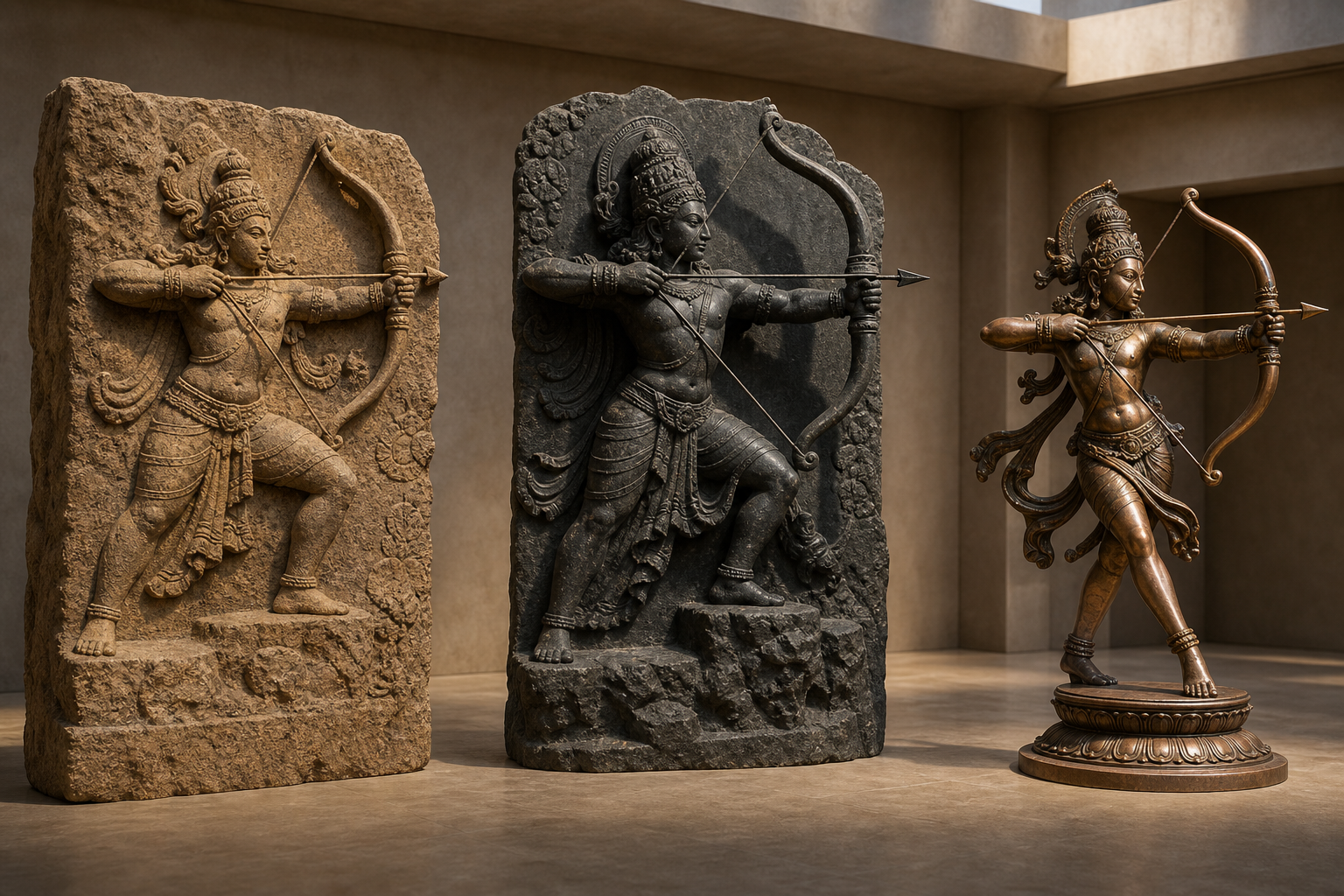
Iconography tells you who is present and what is happening. Form tells you how the event should be experienced. Tripurantaka’s theology is carried by the torque of the torso, the counterpressure of the legs, the curve of the bow, and the interval before release. The body compresses an extended cosmic drama into one suspended instant.
When viewing the image in person, trace a continuous path rather than inspecting ornaments at random. Begin at the planted foot, move through the hips to the opposing shoulder, continue along the drawing arm, and end at the arrow’s intended line. That route lets you feel how the sculptor has joined stability and motion. It also reveals why a calm face can belong to such a forceful body.
- Chola-period panchaloha bronzes often concentrate on tensile balance. The lost-wax medium allows the archer’s anatomy, extended arms, bow, and fine linear details to remain powerful without becoming visually heavy.
- Hoysala and later Vijayanagara reliefs tend toward denser surfaces, crisp ornament, and expanded narrative information. Slow down and separate the central action from the surrounding abundance.
- Early medieval Deccan and western Indian treatments may give the chariot allegory greater architectural emphasis. Read the framing and supporting figures as part of the theological composition, not as background decoration.
- Major temple settings at Ellora’s Kailasanatha complex, Kanchipuram’s Kailasanathar Temple, and monuments of the Chola heartland place the episode within larger programs of Shaiva sacred history. The Ashta Veerattana Kshetras likewise preserve Shiva’s heroic acts through place, worship, and visual memory.
Material changes the mode of encounter as well as the appearance. Precise undercutting in stone can make the space between bow, arm, and string feel charged. A shallower narrative relief can accommodate cities, chariot, devas, and Tripurasuras while keeping the archer as its center of gravity. In bronze, warm metal surfaces and open silhouettes make the tension legible from changing angles.
A consecrated panchaloha murti also belongs to a different setting from an isolated museum object. Through pranapratishtha and continuing worship, it is approached within temple life as a living presence and may enter public space in procession. Art-historical attention remains useful, but it shouldn’t erase the devotional relation for which the image was made.
This becomes especially important around Tripurari Purnima on Kartika Purnima, when lamps, Shiva abhisheka, hymns, yajna, and processional forms can renew the memory of Tripura Samhara. In such a setting, watch how light, movement, sound, and communal attention complete meanings that a static photograph cannot carry.
Turn darshan into a five-pass contemplative practice
You don’t need to decode every attribute in one glance. Whether you encounter Tripurantaka in a temple, a museum, a photograph, or a book, five deliberate passes will give you a more reliable reading.
- Establish the event. Locate Shiva, the bow, and the anticipated line of the arrow. If the composition is narrative, look for the aligned cities, chariot, devas, and asuras before assigning symbolic meanings.
- Read the body. Follow the line from the grounded foot through the turned torso to the drawing hand. Notice where the sculptor places effort and where the form remains composed.
- Widen to the ensemble. Identify which parts of the cosmos have become vehicle, weapon, guidance, motion, and flame. Ask how many distinct powers have been brought into one purpose.
- Select one theological lens. Work first with the Shaiva impurities, the bodies or states, or the yogic anatomy. Don’t pile every triad onto the image at once. A chosen lens should clarify the alignment and the single arrow, not merely provide three labels.
- Bring the teaching into one real decision. Name three conditions that are sustaining the difficulty in front of you. Then identify the one governing principle, disciplined action, or moment of clarity that could address their connection rather than chasing them independently.
That final pass isn’t a claim that every complex problem has an easy solution. Tripura is difficult to destroy precisely because its defenses are layered and its moment of vulnerability is rare. The practical teaching is integration: prepare the vehicle, gather the faculties, understand the timing, and don’t release merely to escape the discomfort of holding the bow at full draw.
In a living temple, let this method serve darshan rather than replace it. Receive the form first. Observe the local ritual discipline and the movement of devotees. Detailed analysis can follow without turning worship into an exercise in object identification.
Key takeaways
- Recognize Tripurantaka primarily through Shiva’s coordinated archer action, then confirm the identity through Shaiva attributes and the surrounding Tripura narrative.
- Read the cosmic chariot as an image of distinct powers becoming coherent instruments of dharma.
- Understand the single arrow as integrated awareness, preparation, and exact timing, not as impulsive force.
- Keep the narrative, Shaiva, yogic, and wider Dharmic readings related but distinct. Similarity doesn’t require doctrinal equivalence.
- Use posture, rasa, material, and temple context as carriers of theology rather than treating them as decorative additions.
- When applying the image to your own life, look for the connection among several obstacles before choosing the action meant to address them.
The next time you meet Tripurantaka, resist the urge to solve the image from its label. Follow the force from the planted foot to the arrow, widen your gaze until the cosmos enters the act, and then return to the decision before you. Name what must align, determine what deserves your single arrow, and release only when attention, means, and dharma point in the same direction.