

You may be leaving a familiar role, entering marriage, rebuilding after loss, returning to spiritual practice, or carrying responsibility through a period you did not choose. The old bank is already receding, but the new one does not yet feel solid. Dharmic crossing imagery is especially useful in this uncomfortable interval because it asks practical questions: What is carrying you? Who or what needs protection? Which direction is dharmic? What must change when you arrive?
A sacred crossing is not a promise that difficulty will disappear. It is a way to move through difficulty without surrendering direction. Hindu narratives, Buddhist teachings, Jain ideals and Sikh devotional language share the image of passage across dangerous waters, yet each gives the vessel, guide and destination a distinct meaning. If you preserve those distinctions, the shared image becomes a precise map rather than a vague slogan.
First identify the crossing, not just the crisis
In ordinary speech, a tīrtha is often understood as a sacred place or pilgrimage destination. Its older spatial meaning is more revealing: the word literally denotes a ford, a place where otherwise difficult waters can be crossed. A tīrtha is sacred geography, but it is also a pattern: a dangerous passage becomes navigable because a reliable way through it has been established.
Use five elements to read any crossing image:
- The near shore: the condition, attachment, status or protection being left behind.
- The water: the unstable force that cannot simply be commanded away. It may represent fear, craving, social upheaval, exile, grief or saṃsāra itself.
- The vessel or ford: the practice, teaching, vow, relationship or grace that makes passage possible.
- The protector or guide: the one who knows the route, steadies the traveller or guards what is vulnerable.
- The far shore: the reordered life toward which the passage is directed. In a religious setting, this may point beyond worldly improvement toward liberation.
This grammar prevents a common mistake: calling every disruption a transformation. Movement is not automatically spiritual. A person can cross a border, change a job or adopt a new identity while carrying the same confusion intact. The decisive question is not whether you have moved, but whether the movement has brought conduct into better alignment with dharma.
The familiar sequence of separation, an in-between interval and incorporation into a reordered life gives you a simple diagnostic. If you know what you left but cannot describe the life you are entering, you may still be in midstream. Do not force a premature sense of arrival. Name the discipline that must hold until the new pattern becomes real.
One image carries four distinct Dharmic teachings
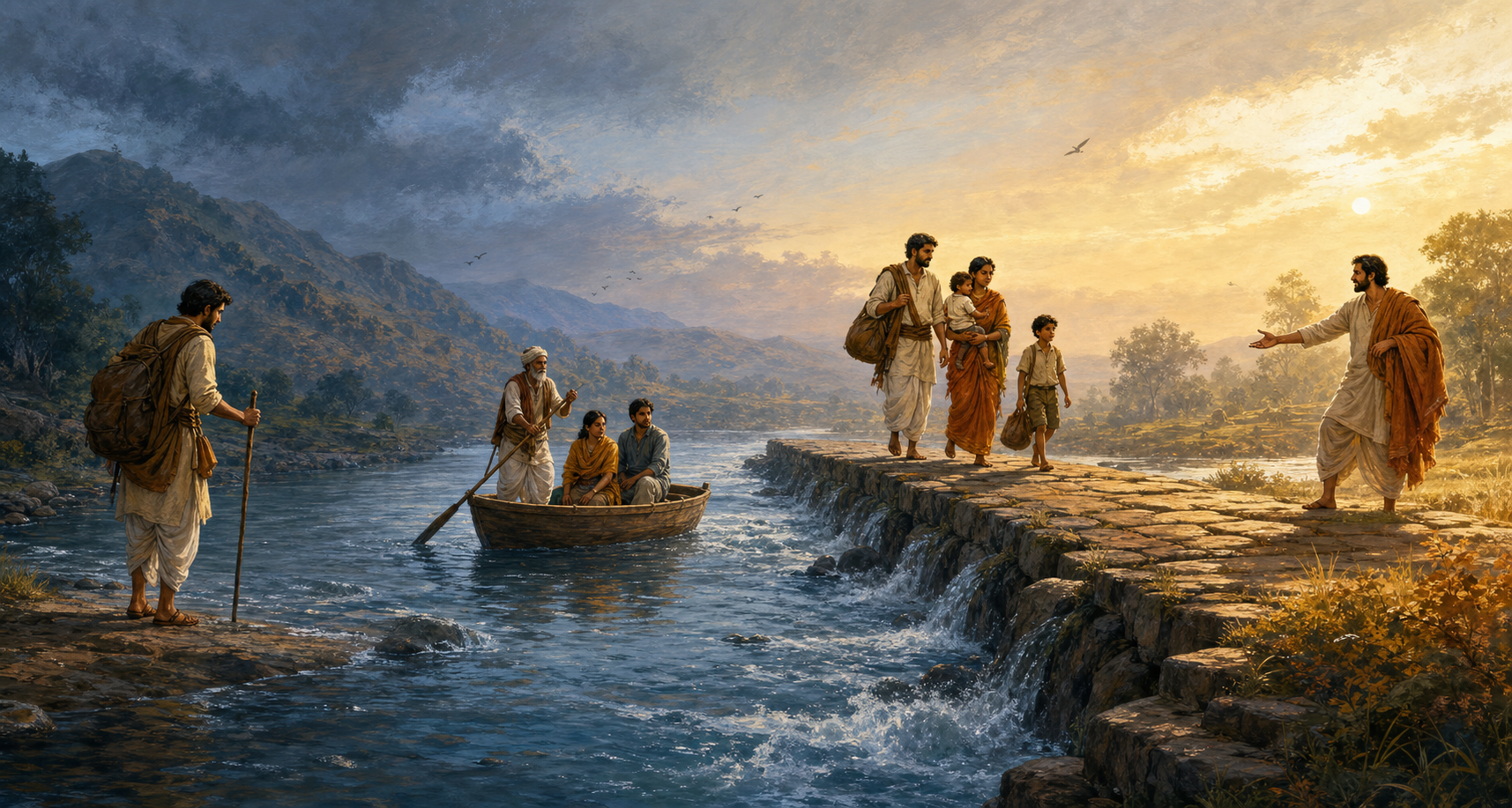
The traditions meet around a shared human problem: beings are caught in unstable conditions and need a trustworthy passage. They do not therefore become interchangeable. The Buddhist raft, the Jain ford-maker, the Sikh boat of Nāam and Hindu scenes of divine protection answer the crossing problem through their own theological and ethical vocabularies.
| Tradition | What the waters express | What enables passage | What you should notice |
|---|---|---|---|
| Hindu traditions | Peril, bondage, exile, dissolution or a disruption of dharmic order | Divine shelter, sacred water, a boat or ford, devotion, tapas and duty aligned with dharma | Grace does not make human responsibility unnecessary; Vasudeva still carries, Manu still boards and Rāma still accepts exile. |
| Buddhist traditions | The restless movement of saṃsāra, sustained by craving and ignorance | The Dhamma as a raft or path, used with discernment and steadfast practice | A raft is a means of passage, not an identity or possession to be carried as an added burden. |
| Jain traditions | Saṃsāra as an ocean from which liberation must be sought | The ford disclosed by a Tīrthaṅkara through ahiṃsā, self-restraint and knowledge | A ford-maker makes the route knowable; the traveller must still practise the disciplines of crossing. |
| Sikh traditions | Bhavsāgar, the turbulent ocean of becoming and worldly attachment | The Guru and Nāam, with saṅgat and sevā functioning as communal strength | The passage joins grace, remembrance and service; it is not a project of isolated self-absorption. |
When you explain these traditions to a child, a class or an interfaith gathering, use a three-part formula: identify the common question, name each tradition’s path, and preserve its own account of the destination. Saying that all four employ crossing language is illuminating. Saying that all four mean exactly the same thing erases the very disciplines that make the metaphor useful.
The same care applies within Hindu traditions. A tīrtha may be a river confluence, temple tank, pilgrimage place, sacred presence or doctrinal image, depending on context. Do not reduce every instance to purification alone. Some crossings preserve life; some require renunciation; some mark exile; others enact renewal.
Hindu crossing stories diagnose different kinds of transition
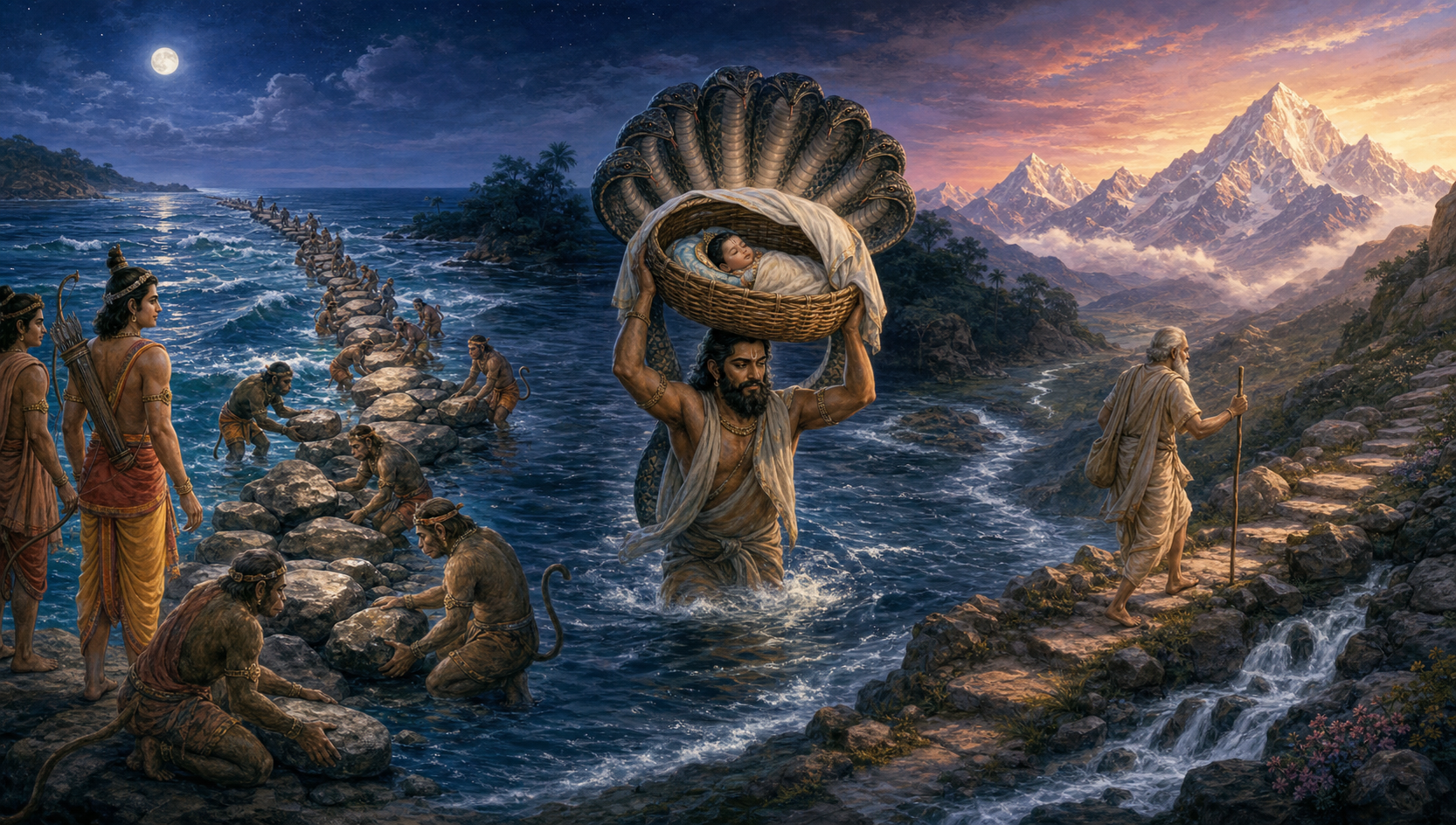
A sacred narrative becomes more useful when you ask what kind of danger it depicts and what form of faithfulness answers that danger. Kṛṣṇa, Manu, Rāma and Karṇa all meet water at a threshold, but their passages do not offer one generic lesson.
Kṛṣṇa’s Yamunā crossing puts protection before certainty
In the Bhāgavata Purāṇa’s tenth skandha, the infant Kṛṣṇa must be carried away from Kaṃsa’s violence. Vasudeva enters the Yamunā at midnight while Śeṣa spreads his hood against the storm. Retellings present the river as yielding to the child or rising in reverence toward his feet. Nature is not merely scenery here. The river and cosmic serpent participate in the protection of vulnerable life through which dharmic order will be restored.
Three thresholds coincide. The time is midnight, neither one day nor the next. The travellers are in midstream, belonging to neither bank. The divine appears in the dependent body of an infant. Power is present, but it does not arrive in the form worldly power expects.
If your transition places another person in your care, this scene establishes an order of responsibility. Secure the carrier, the shelter, the route and the next safe place before turning the event into a grand interpretation. Vasudeva’s trust is active: he lifts the child and walks. The scene does not promise that every danger will miraculously part. It shows devotion acting under protection without demanding control of the whole river.
Manu’s passage asks what must survive disruption
In the deluge narrative, Manu’s boat is fastened to the horn of Matsya, the divine Fish, and carried through waters of dissolution toward a renewed world. The scale is civilizational rather than private. The central concern is continuity when the familiar order can no longer provide safety.
Use this pattern when a transition is fundamentally about preservation. Do not begin by asking how to keep everything unchanged; that is impossible in a true deluge. Ask what must remain available on the other side for a dharmic life to resume. It may be an obligation you will not abandon, a daily practice that steadies judgment, a relationship that deserves protection or knowledge that must be transmitted. Distinguishing the essential from the merely familiar is the work of boarding the boat.
Rāma’s river crossings make relinquishment visible
Rāma’s crossings of the Gaṅgā and Yamunā during vanavāsa mark his movement out of royal comfort and into the restraints of exile. Guha’s assistance, the boat journey and the presence of sages give physical form to an ethical decision already accepted: duty will be honoured even when it costs status, security and ease.
This is the right pattern when your passage requires renunciation rather than rescue. Ask what cannot be taken across if the new commitment is to be credible. Keeping every privilege of the old bank while claiming the discipline of the new one turns passage into theatre. Rāma’s crossing matters because the changed circumstances are actually inhabited.
Karṇa’s basket separates survival from belonging
The newborn Karṇa is placed in a basket and carried by the river toward another household and another social location. Water mediates between concealed origin and later recognition. The passage preserves a life, but it does not dissolve the questions of identity, kinship and fate that follow him.
That distinction matters in adoption, migration, estrangement and other changes of belonging. A safe arrival is real, but it may not settle the meaning of one’s origins. Do not romanticize displacement simply because survival followed it, and do not assume that hardship proves a special destiny. Make room for gratitude, unresolved truth and eventual recognition to exist together.
Ritual makes the crossing visible, communal and accountable
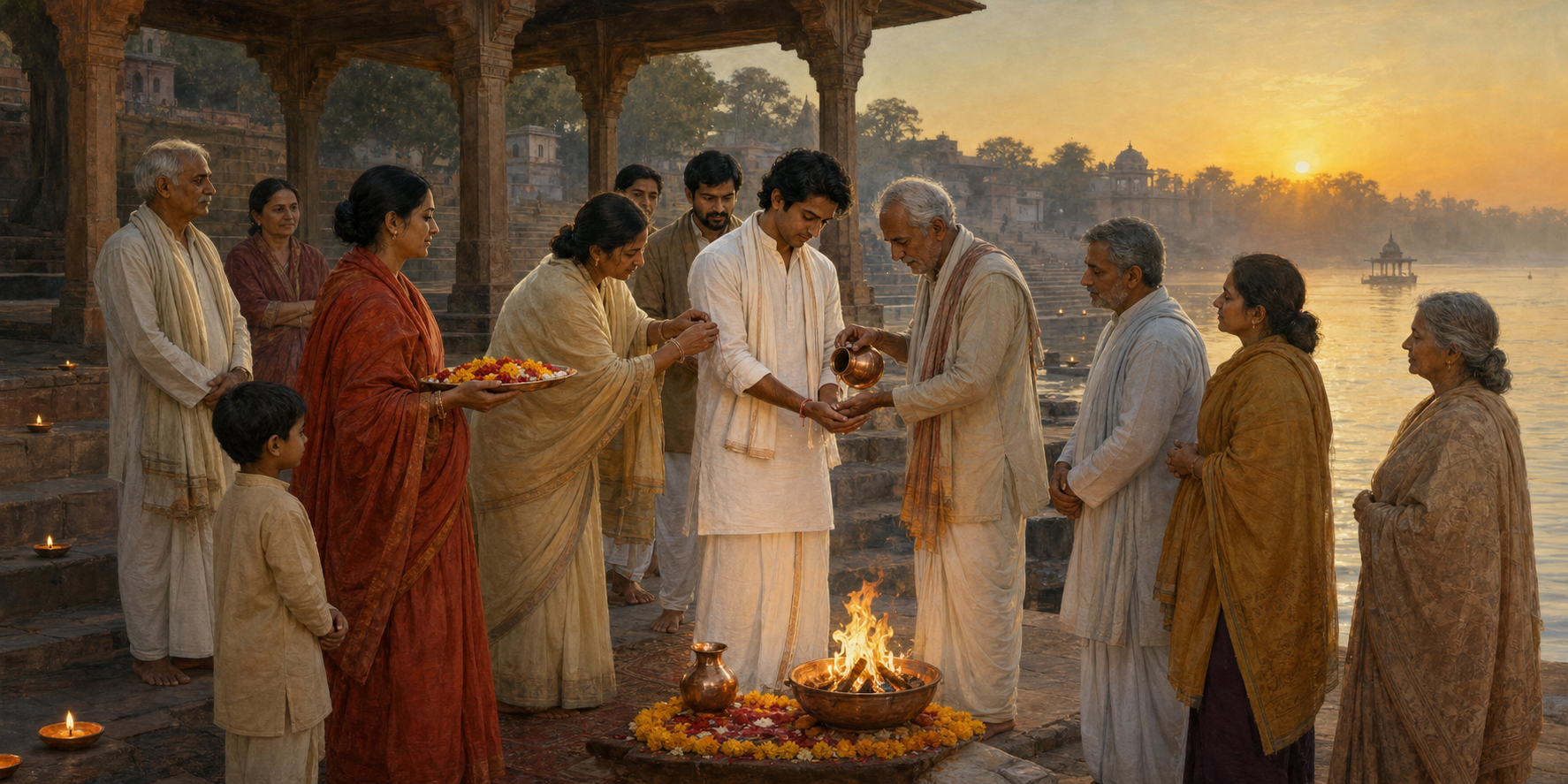
Dharmic traditions do not leave crossing imagery inside texts. Boat festivals, processions, pilgrimage and sacred bathing place bodies, deities and communities within the pattern. Nauka-vihāra and teppotsavam carry festival deities across water, allowing worshippers to see protection, movement and divine companionship enacted rather than merely described.
In Vṛndāvana’s Boat Festival, the festival forms of Rādhā and Kṛṣṇa move over water amid devotional singing. During Puri’s Chandan Yatra, Jagannātha and companion deities take ceremonial boat rides associated with cooling and seasonal renewal. Sacred tanks and pushkariṇīs extend the same grammar into temple architecture: steps descend, water intervenes, processions move and worshippers gather around a bounded sacred crossing.
You can read such an observance through four questions:
- Where is the threshold? Identify the departure point, water, vessel and return. The movement itself may carry meaning.
- Who is being carried? A deity crossing with the community expresses something different from an individual attempting a private spiritual feat.
- What discipline accompanies the movement? Attend to kīrtan, remembrance, vows, sevā, restraint or other practices that prevent the event from becoming spectacle alone.
- What should be different afterward? Look for renewal of duty, devotion, community bonds or resolve. Without incorporation into conduct, the ritual remains unfinished in the participant’s life.
The Kumbh Mela gathers these layers at a civilizational scale. Snāna at the Triveṇī Saṅgam joins pilgrimage, sacred confluence and renewed resolve. Its meaning cannot be reduced to water physically washing away a moral life. The outward act calls for an inward reordering; purification becomes credible through what the pilgrim does with the life that continues after the bath.
Iconography offers another way to practise attentive seeing. Śeṣa’s hood signals cosmic shelter. The travelling infant joins destiny to vulnerability. A river goddess bearing a kalaśa or associated with a makara evokes life, abundance and purifying water. A boat, basket or canopy identifies the means of safe passage. When you encounter these forms in a temple or image, identify each element before interpreting the whole scene. Symbols become legible through their relationships, not through isolated labels.
Turn the crossing grammar into a disciplined next step

You do not need to invent a private ceremony or declare an ordinary inconvenience a cosmic trial. The metaphor is working when it clarifies responsibility. Use the following process for a genuine threshold in your life.
- Name both banks with verbs. Write, I am leaving, followed by the old pattern, and I am beginning, followed by the conduct required on the other side. Becoming more spiritual is too vague; resuming daily remembrance or accepting a defined duty can be observed.
- Describe the current without turning it into fate. Separate external conditions from your own reactivity. A job loss, relocation or bereavement is a condition. Panic, resentment, craving or avoidance may intensify the current, but they are not the whole river and need not determine its destination.
- Choose one dependable vessel. Select a practice accountable to the tradition you actually follow: remembrance of Nāam, meditation and discernment, a vow shaped by ahiṃsā and restraint, scriptural reflection, devotional worship, sevā or the steady performance of duty. Do not collect practices merely to feel equipped. A vessel has to be entered and used.
- Name a guide and companions. Write down who can teach, correct or steady you. Depending on the path, this may be a Guru, ācārya, monastic teacher, saṅgha, saṅgat, elder or mature practitioner. Choose someone responsible to a living discipline, not simply someone who confirms every impulse.
- Protect the vulnerable cargo. Identify what cannot absorb avoidable turbulence: a child, elder, dependent, livelihood, promise, relationship or fragile daily practice. Build the passage around that responsibility before pursuing an impressive story about your own transformation.
- Define an arrival marker. Choose an observable act that will show incorporation into the new life: a duty consistently resumed, a vow kept, regular sevā begun, restitution made or reconciliation attempted where it is safe and appropriate. Arrival is a pattern of conduct, not a passing feeling of relief.
- Release temporary supports when their work is complete. The Buddhist raft image is especially sharp here. Do not turn a coping arrangement, transitional identity or method into permanent cargo merely because it once saved you. Keep the ethical discipline; loosen attachment to the instrument that no longer serves its purpose.
Then test the plan against one harder question: does your proposed far shore depend on controlling, humiliating or abandoning another person? If it does, the plan needs correction. Dharmic language should expose self-deception, not decorate it. A passage oriented toward liberation cannot be made trustworthy through avoidable adharma.
Key takeaways
- A sacred crossing joins a threshold, a dangerous current, a trustworthy means and a morally meaningful direction.
- Hindu, Buddhist, Jain and Sikh traditions share crossing imagery without teaching an identical path or destination.
- Grace and guidance do not cancel effort: the carrier walks, the pilgrim practises, the seeker exercises restraint and the community serves.
- Different Hindu narratives answer different transitions: Kṛṣṇa emphasizes protection, Manu continuity, Rāma relinquishment and Karṇa the unresolved meaning of belonging.
- Ritual crossing reaches completion in changed conduct, not in movement, emotion or sacred bathing alone.
- Your next useful step is to name the two banks, choose one vessel and identify what must be protected in midstream.
Before you leave this page, complete three sentences: I am leaving; I am crossing by means of; I must protect. Keep the answers close enough to guide your next decision. You do not need the whole river to disappear. You need a dharmic direction and a vessel you will actually use.