

You may be deciding whether a spiritual teaching deserves trust, whether questioning a guru is disrespectful, or whether an intense personal experience counts as knowledge. Hindu thought does not force you to choose between reverence and examination. It asks you to make the examination disciplined.
That distinction matters. A question can remove confusion, merely entertain the mind, or become a weapon for defeating someone else. The useful question clarifies what is being claimed, identifies how it could be known, survives an honest objection, and changes how you understand or practice. Hindu traditions developed precise methods for doing all four.
Key takeaways
- Questioning becomes a spiritual discipline when its aim is freedom from ignorance, not intellectual display.
- Before accepting or rejecting a claim, identify the relevant pramāṇa, or valid means of knowledge.
- Perception, inference, analogy, testimony, postulation, and non-cognition answer different kinds of questions. They are not interchangeable.
- A trustworthy teacher should help you refine a question, while a serious student must listen, reflect, practice, and revise.
- An honest provisional conclusion is better than certainty borrowed from a teacher, a crowd, or your own preferences.
Before asking whether it is true, ask how it could be known
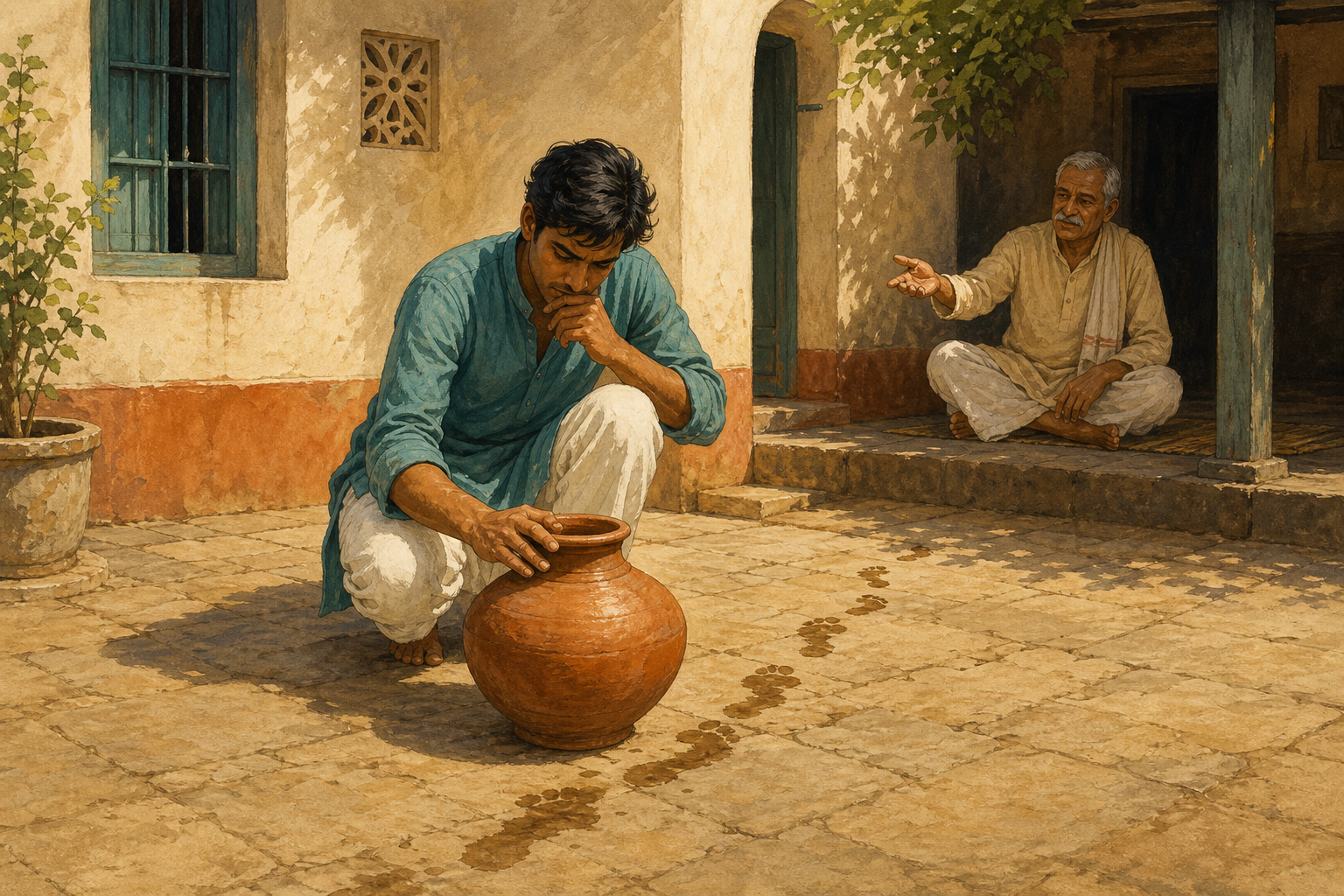
The desire to know is not treated as an embarrassment at the doorway of Hindu philosophy. The Vedānta Sūtra’s athāto brahmajijñāsā places inquiry into Brahman at the beginning of the undertaking. Yet jijñāsā, the desire to know, must mature into vicāra, sustained examination. Wanting an answer is only the start; learning what could justify that answer is the real work.
A pramāṇa is a valid means by which knowledge arises. It is not simply a piece of evidence. It is the route connecting a knower with what is known. The classical schools disagree about how many irreducible routes there are, but that disagreement itself teaches an important lesson: you should not demand sensory proof for every claim, treat every inference as observation, or promote every respected person’s statement into unquestionable truth.
| Pramāṇa | What it contributes | What you should check |
|---|---|---|
| Pratyakṣa: perception | Knowledge arising through direct perception. | Were the conditions adequate? Did expectation, distance, distraction, memory, or interpretation get mixed into what was actually perceived? |
| Anumāna: inference | A conclusion reached from a reason and a dependable relation between facts. | Is the reason genuinely present in the case? Is the claimed relation, or vyāpti, reliable? Can you name a counterexample? |
| Upamāna: analogy | Understanding something unfamiliar through a relevant similarity. | Which property is actually shared? A useful resemblance does not establish that two things are alike in every respect. |
| Śabda: trustworthy testimony | Knowledge communicated by a competent and reliable knower. | Is the speaker qualified in this domain? Was the teaching transmitted accurately? Does stronger evidence contradict the claim? |
| Arthāpatti: postulation | A necessary explanatory supposition when accepted facts otherwise do not fit together. | Is the postulate actually needed, or is it only an attractive story? Prefer the explanation that resolves the conflict without adding unsupported claims. |
| Anupalabdhi: non-cognition | Knowledge of absence when something that should be perceptible is not perceived. | Were you in the right place, at the right time, with adequate conditions for detecting it? Failure to look properly is not knowledge of absence. |
Nyāya classically accepts perception, inference, analogy, and testimony, while Mīmāṃsā and Advaita Vedānta also employ postulation and non-cognition; Bhāṭṭa Mīmāṃsā explicitly treats non-cognition as a distinct means. This is not a contest in which the school with the longest list automatically wins. The real question is whether a proposed means of knowledge can be reduced to another one and whether it operates reliably in its proper domain.
Consider a report of a vision during meditation. The experience may be direct perception for the person who had it. Their account is testimony for you. Any conclusion about what caused the vision is an inference. A comparison with a scriptural image is an analogy. These may support one another, but they do not become the same kind of knowledge merely because the experience was powerful.
The same discipline protects you online. Before forwarding a claim about a scripture, teacher, community, or historical event, use this sequence:
- Write the exact claim in one sentence. Remove emotional labels that do not alter its factual content.
- Separate what was directly observed from what was inferred, remembered, repeated, or assumed.
- If an inference carries the claim, state its premises and look deliberately for one counterexample.
- If testimony carries it, check the competence of the speaker and whether independent, reliable testimony corroborates it.
- If the argument depends on missing evidence, ask whether the evidence should have been detectable under the actual conditions.
- Mark the conclusion as supported, provisional, unsupported, or unresolved. Do not force a verdict when the appropriate answer is unresolved.
This small act of classification prevents a common mistake: treating confidence as though it were a pramāṇa. Confidence describes the state of a person. It does not establish the truth of the person’s claim.
Use the Upanishadic method: question the answer as well as the claim
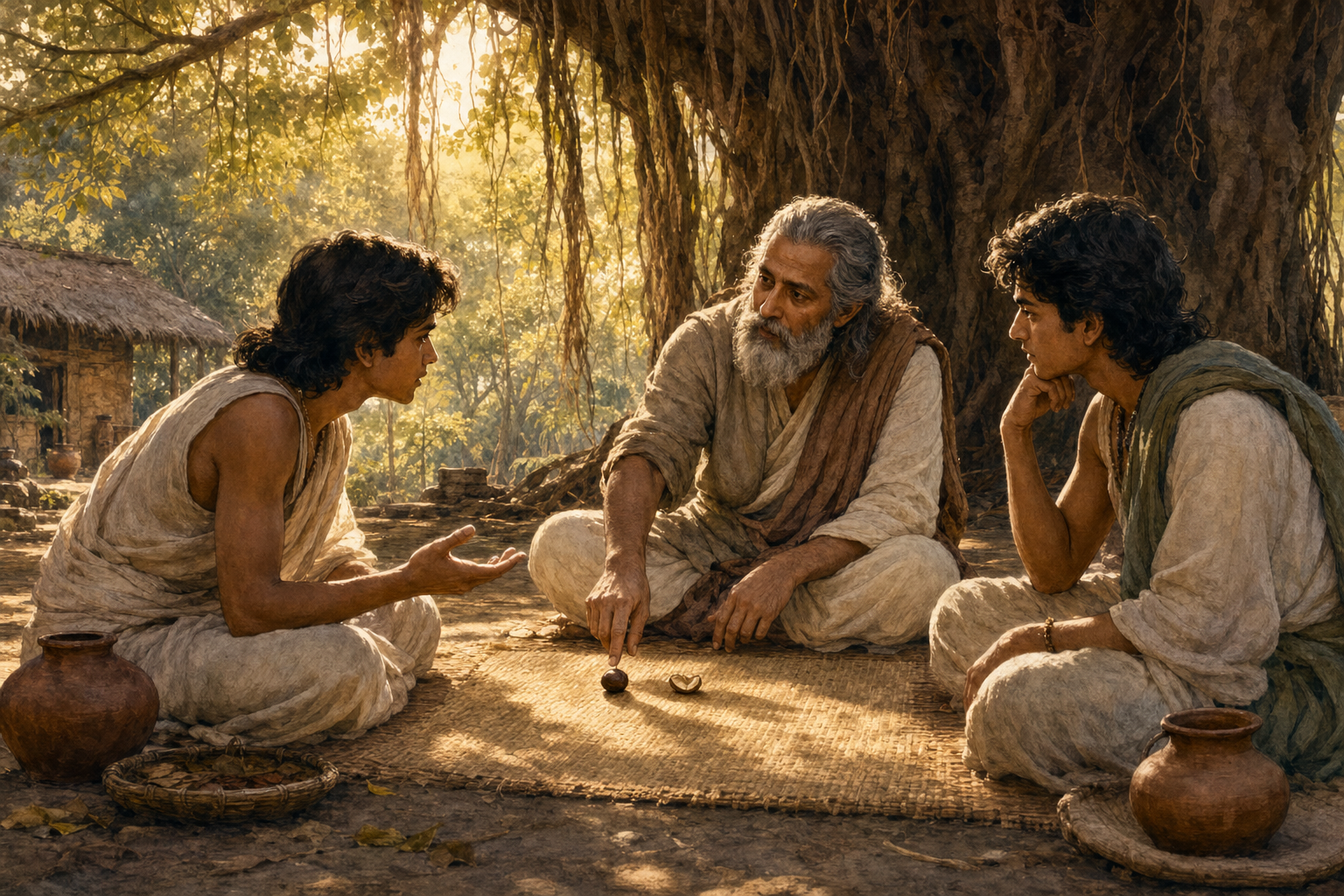
Hindu inquiry does more than verify facts about external objects. It also turns toward the one who claims to know. Gārgī Vācaknavī presses Yājñavalkya with fearless questions in the Bṛhadāraṇyaka Upaniṣad. Naciketā persists in his inquiry before Yama in the Kaṭha Upaniṣad. Śvetaketu’s education in the Chāndogya Upaniṣad culminates in tat tvam asi. These conversations move from a visible fact toward its ground, and then toward the identity of the knower.
You can use that movement without pretending to have settled every metaphysical dispute. Take one question through three passes:
- The object: What exactly am I examining? Is it a sensation, thought, memory, doctrine, action, or inference?
- The knower: How is this object known? Which capacities, assumptions, and conditions make the knowledge possible?
- The identification: Am I mistaking something observed and changeable for the whole of the observer?
The third pass is central to Advaita Vedānta. The method of neti neti, or not this, not this, removes inadequate identifications one at a time. If a bodily sensation is observed, it is an object of awareness. If a thought comes and goes while being known, that thought also becomes an object of awareness. The inquiry then asks whether any changing object can exhaust the identity of the knower.
This is not a command to deny the body, emotions, duties, or world. Nor does the mere repetition of neti neti prove the Advaita conclusion. It is a structured investigation within Advaita: identify what has been superimposed upon the Self, examine whether the identification holds, and negate what cannot be ultimate. The related method of adhyāropa-apavāda first employs a provisional explanation and later withdraws it when its teaching purpose has been served.
Advaita keeps this investigation from becoming private improvisation through a three-part discipline:
- Śravaṇa: Hear or study the teaching accurately. Before agreeing or objecting, make sure you can state what it claims in its own terms.
- Manana: Reflect critically. Raise contradictions, test the reasoning, compare interpretations, and find the precise point at which your doubt arises.
- Nididhyāsana: Assimilate the clarified teaching through sustained contemplation so that it is not left as verbal knowledge alone.
Skipping the first stage makes you argue against a teaching you may not understand. Skipping the second turns listening into passive acceptance. Skipping the third lets a sound conclusion remain detached from the habits that govern your life. Keep the order intact even when you revisit the stages many times.
Match the question to a darśana, then keep the dialogue ethical

Hindu thought contains multiple darśanas, or disciplined viewpoints, because not every confusion has the same structure. Recognition of an iṣṭa and of paths such as jñāna, bhakti, karma, and rāja-yoga also acknowledges that seekers do not begin with identical temperaments. Plurality does not mean that all propositions are equally true. It means you should understand the purpose, vocabulary, and standards of a path before judging it.
Choose the lens that fits the problem
| Darśana | Question it is equipped to clarify | Method you can apply |
|---|---|---|
| Nyāya | Does this conclusion actually follow from the evidence? | Identify the subject or pakṣa, the reason or hetu, and the dependable relation or vyāpti. Search for fallacies and counterexamples before accepting the inference. |
| Mīmāṃsā | What does a difficult scriptural passage or injunction mean? | Examine opening and conclusion, repetition, novelty, stated result, explanatory praise, and reasoned justification. Do not isolate one phrase from the textual work around it. |
| Advaita Vedānta | What is the Self, and which identities have been superimposed upon it? | Proceed through śravaṇa, manana, and nididhyāsana; use discrimination and negation without treating a provisional concept as the final reality. |
| Sāṅkhya | Am I confusing consciousness with the processes and products of nature? | Study the 25 tattvas and discriminate Puruṣa from Prakṛti, including through patterns of co-presence and absence associated with anvaya-vyatireka. |
| Yoga | Is the instrument of knowing steady enough to see clearly? | Distinguish valid cognition, error, conceptual construction, sleep, and memory as mental fluctuations. Use practice and dispassion, abhyāsa and vairāgya, to reduce agitation. |
Do not mix these systems too early. First state your question in the chosen school’s vocabulary. Apply its method consistently. Only then compare how another school frames the same problem. Otherwise, you can unknowingly define the Self through one system, demand proof through another, and reject the answer for failing a test it never claimed to meet.
Make dialogue answerable to dharma
The Bhagavad Gītā 4.34 places paripraśna, sustained inquiry, beside praṇipāta, humility, and sevā, service. The three belong together because the quality of a question depends partly on the seeker’s intention and preparation. Humility means being willing to discover that your present view is inadequate. It does not require surrendering discernment. Service prevents inquiry from becoming a transaction in which you demand wisdom without undertaking the discipline that could make it intelligible.
Nyāya sharpens the ethical distinction through three forms of disputation. Vāda is dialogue ordered toward truth. Jalpa is contest aimed at victory. Vitaṇḍā attacks another position without accepting the burden of presenting or defending an alternative. Before entering a discussion, ask yourself three direct questions: What claim am I prepared to defend? What evidence could change my mind? Can I state the other position in a form its adherent would recognize? If any answer is missing, you probably need more inquiry before more argument.
Ahiṃsā applies to reasoning and speech as well as physical conduct. It does not forbid a firm objection. It forbids using humiliation, distortion, and hostility as substitutes for an objection. Śraddhā, meanwhile, is not immunity from testing; it is enough trust to listen and practice before issuing a premature verdict. Together they protect you from the two easiest failures: credulity that never examines and cynicism that never learns.
This also clarifies the guru-śiṣya relationship. A teacher functioning as an āpta, a trustworthy knower, should be competent in the domain being taught and able to clarify the path of reasoning or practice. A student should bring a precise doubt, listen to the answer in context, and test what can properly be tested. Respect does not turn every statement by a teacher into expertise on every subject. Questioning does not excuse inattentiveness or repeated objection without practice.
Related Dharmic traditions preserve distinct but compatible disciplines of inquiry. Buddhist teaching invites examination in lived experience; Jain Anekāntavāda, Syādvāda, and Nayavāda qualify claims by standpoint; Sikh vichaar joins reflection on the Śabad with service and remembrance. These are not interchangeable doctrines. Their family resemblance lies in refusing to separate knowledge from character, practice, and liberation. In a disagreement, the Jain reminder is especially useful: identify the standpoint from which a statement may be valid before declaring it simply meaningless or absolute.
Build a repeatable practice around one live question

Inquiry becomes useful when it is attached to a question that affects how you see or act. Do not begin with ten vast questions. Choose one claim from a teaching, a conversation, or your own self-understanding, and give it a single inquiry page.
- State the claim. Write one complete sentence. If you cannot do this, you do not yet know what you are examining.
- Name the stakes. Record what would change in your conduct or understanding if the claim were true, false, or unresolved.
- Build a pramāṇa ledger. Put each reason under perception, inference, analogy, testimony, postulation, or non-cognition. Do not count the same reason twice under different names.
- Form the strongest objection. Use an objection that challenges the claim itself, not a weak version invented for easy defeat.
- Ask a precise question. Bring the exact gap to a teacher, commentary, or knowledgeable practitioner. Replace broad requests for an explanation with the premise or term you cannot justify.
- Test what is testable. If the teaching prescribes contemplation, ethical action, service, or attention, undertake the relevant practice. Do not pretend that a private feeling alone proves every philosophical interpretation of it.
- Record a proportionate verdict. Use supported, provisional, unsupported, or unresolved. Add the observation, argument, or clarification that would justify revising it.
Suppose your question is whether you are identical with every thought and feeling that appears. Within an Advaita inquiry, begin with perception: thoughts, sensations, and moods are experienced and they change. Move to inference: each changing mental state is known as it appears and disappears. Bring in testimony only as testimony: teachings such as neti neti or tat tvam asi direct the inquiry but should not be mislabeled as your own realization. Then sit quietly and notice whether each thought can be recognized as an object of awareness. The appropriate first result may be no more than a sharper question about the relation between awareness and its objects. That is progress if it replaces a vague identity claim with something you can examine.
You will know the practice has stalled when you keep repeating the same question without trying the answer, change your standard of evidence whenever a preferred belief is threatened, collect Sanskrit terms without defining them, cite authority outside its field, or leave every conversation more concerned with victory than clarity. When that happens, reduce the inquiry again. Return to one proposition, one relevant pramāṇa, one serious objection, and one next act of study or practice.
Take the question that is presently shaping your conduct and give it that treatment. You do not need borrowed certainty by the end of the page. You need to know what you know, how you know it, where the doubt remains, and what disciplined step comes next.