
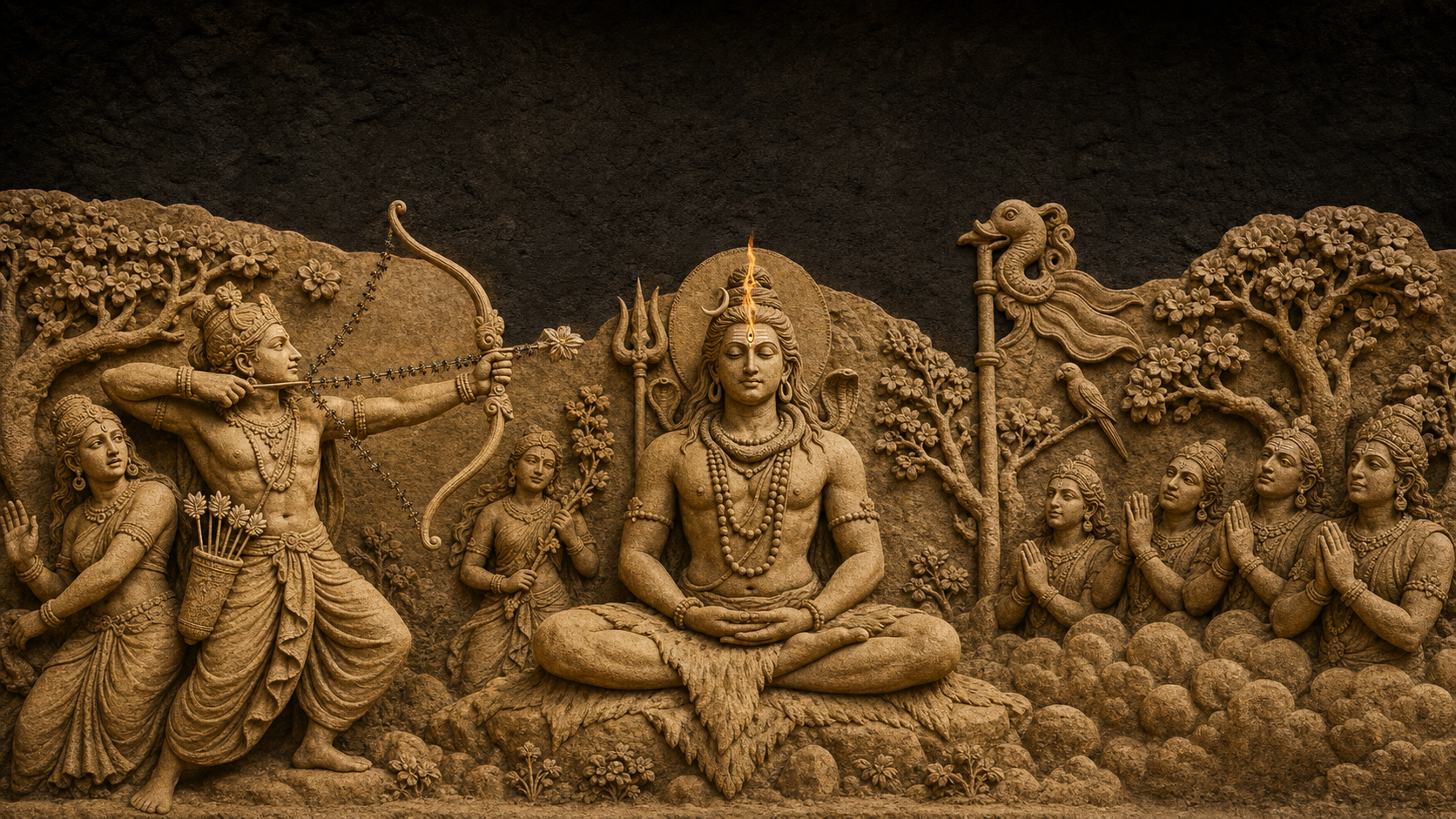
You are standing before a crowded Shaiva relief. One figure carries a bow, a woman recoils in distress, celestial witnesses gather, and Shiva remains strangely composed at the centre. The label is missing or unhelpful. How can you tell whether you are looking at Kamantaka rather than another episode from Shiva’s mythology?
The reliable method is to read the image as a chain of actions. Find Kama’s unusual weapons, confirm Rati and the signs of spring, then follow the visual line toward Shiva’s third eye. Once that sequence is visible, the sculpture becomes more than an image of destruction. It shows the moment when desire loses its power to command consciousness.
Start with Kama, not with Shiva
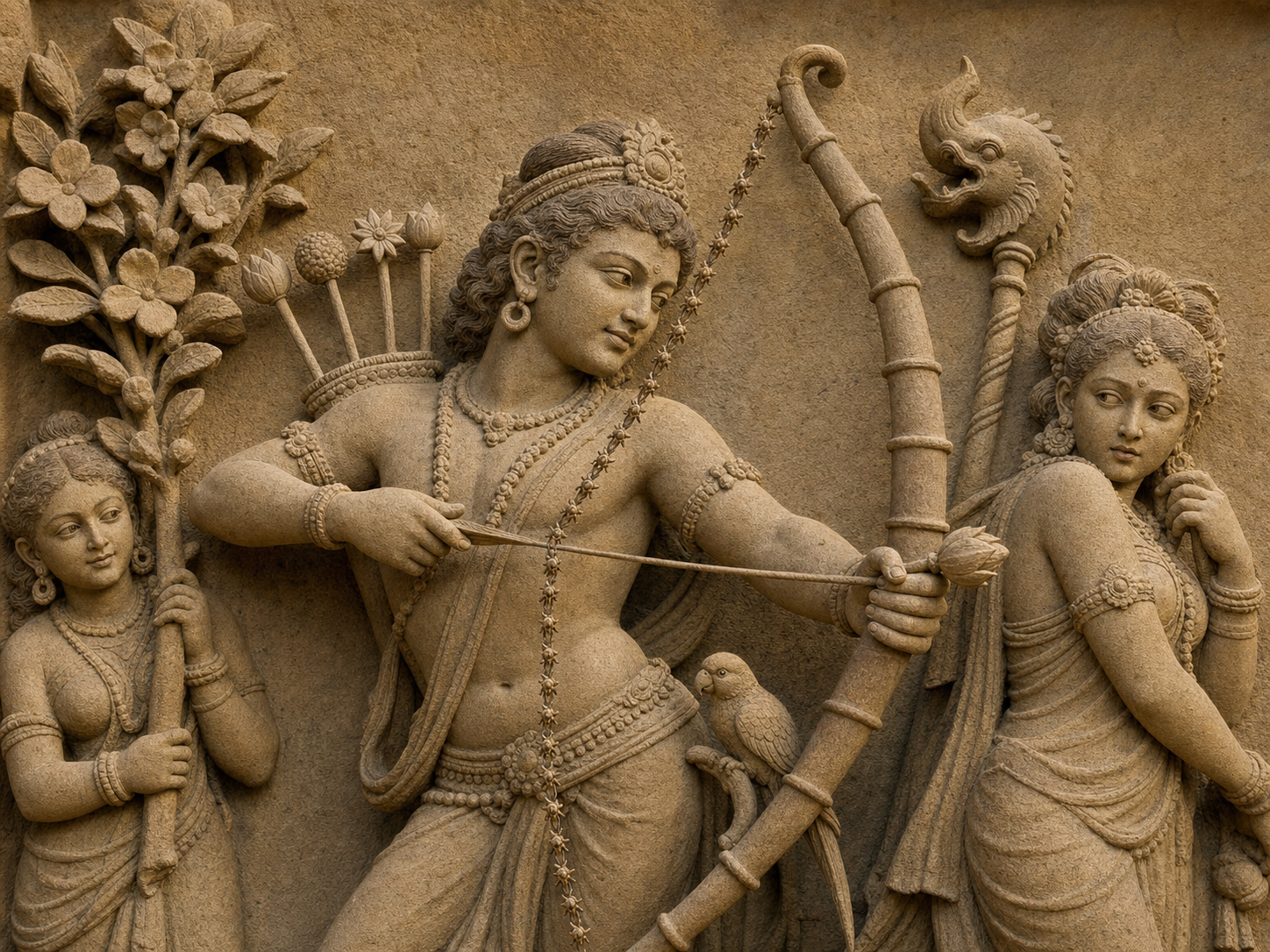
Shiva’s crescent moon, matted locks, serpent ornaments, trident and third eye appear in many Shaiva forms. They can identify Shiva, but they cannot by themselves identify Kamantaka. The most episode-specific evidence usually stands opposite him: Kama as an archer.
- Find the unconventional bow. Kama carries a sugarcane bow, a string associated with buzzing bees, and five flower-arrows. The blossoms may include ashoka, mango, jasmine, and blue and white lotuses. In a damaged relief, the bow’s long curved form may survive even when the smaller flowers and bees do not.
- Look for Rati. Kama’s consort is commonly shown in distress as the attack turns against him. Her position and emotion help distinguish the scene from an ordinary encounter between Shiva and an archer.
- Inspect the setting for an artificial spring. Mango clusters, abundant flowers, bees and luxuriant foliage are not merely decoration here. The gods have arranged a season of fragrance, fertility and attraction to disturb Shiva’s meditation.
- Move your eye from the bow toward Shiva’s forehead. The third eye may be enlarged, sharply incised or accompanied by a flame. That directional relationship – Kama aims, Shiva perceives, fire answers – is the narrative core.
- Check the surrounding figures. Indra and other devas may appear as witnesses. Their astonishment tells you that the central event has cosmic consequences rather than being a private quarrel.
A single clue should produce a tentative identification, not a final one. A third eye confirms Shiva but not Kamantaka. Flowers may be ornamental. A bow may belong to another figure. When the archer’s unusual weapons, Rati’s reaction, spring imagery and the activated third eye occur together, the identification becomes much stronger.
Key takeaways
- The sugarcane bow and flower-arrows are more diagnostic than Shiva’s trident or matted hair.
- Rati, spring vegetation and celestial witnesses turn separate attributes into a recognisable narrative.
- The fire belongs primarily to Shiva’s third eye, even when a sculptor also places a small flame in one of his hands.
- The number of Shiva’s arms and the exact stance can vary, so neither should be used as an exclusion test.
- The episode concerns mastery and transformation of desire, not a permanent rejection of love or relationship.
Read the panel as a sequence, not a frozen fight
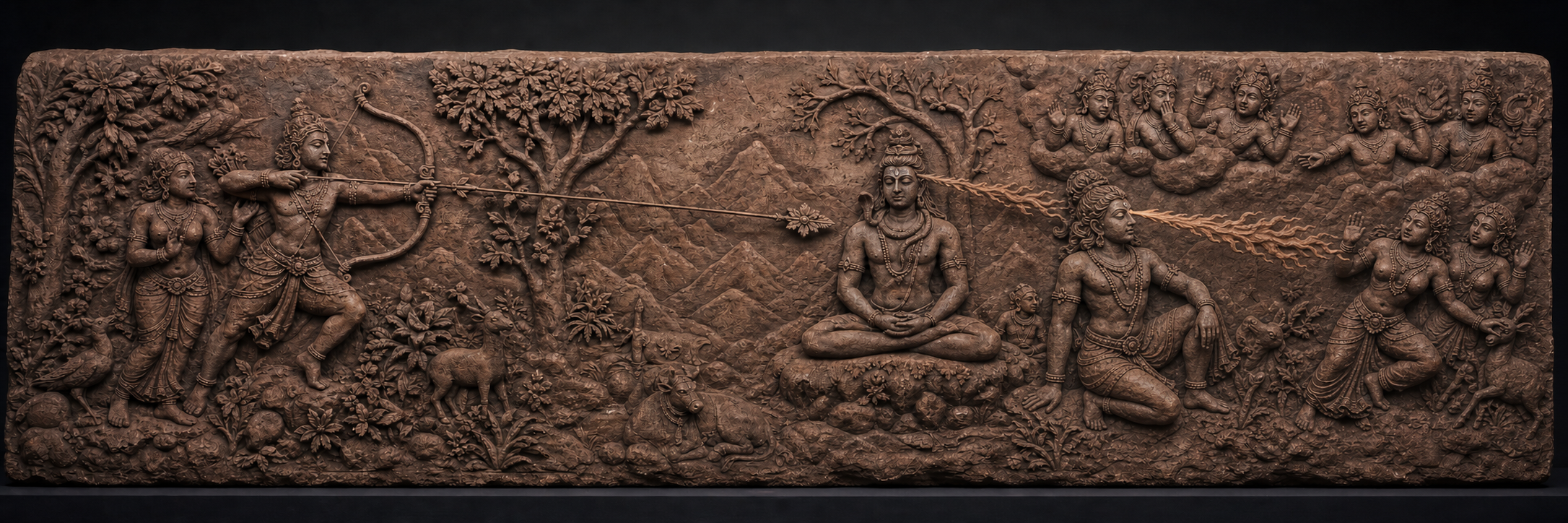
Kamantaka belongs to a larger cosmic problem. Shiva is absorbed in meditation, while the gods require his eventual union with Parvati and the birth of Kumara, or Skanda, to restore order. Kama is sent to awaken desire in the yogi. Spring becomes his accomplice: blossoms open, bees gather, fragrant breezes move, and the whole environment is made persuasive.
Kama draws his bow and releases the provocation. Shiva responds by opening the third eye. The resulting jñāna-agni, the fire of knowledge, reduces Kama to ash. Rati grieves, while the devas confront the unexpected force of an awareness that cannot be manipulated from outside.
To follow that sequence on stone, begin at Kama’s hands. Trace the implied line of the arrow toward Shiva. Then look at the forehead, any flame motif, Kama’s collapsing or endangered body, Rati’s response, and finally the witnesses. Even when erosion has erased part of the action, this causal route can reveal what isolated attributes cannot.
Pay particular attention to Shiva’s expression. The scene carries raudra, the forceful or wrathful mood, but Shiva need not look agitated. His composure is essential. An uncontrolled outburst would make him another captive of reaction; Kamantaka instead presents fierce power held within yogic sovereignty. The most successful compositions preserve that paradox: everything around Shiva moves, yet Shiva’s awareness remains unshaken.
The narrative does not end with the ashes. Shiva later accepts union with Parvati, and Skanda is born. In several tellings, Kama also continues as Ananga, the bodiless one. Desire has lost its gross form and coercive authority, but attraction, devotion and generative love have not vanished. That later movement is indispensable to a responsible reading of the image.
Separate decisive clues from supporting attributes
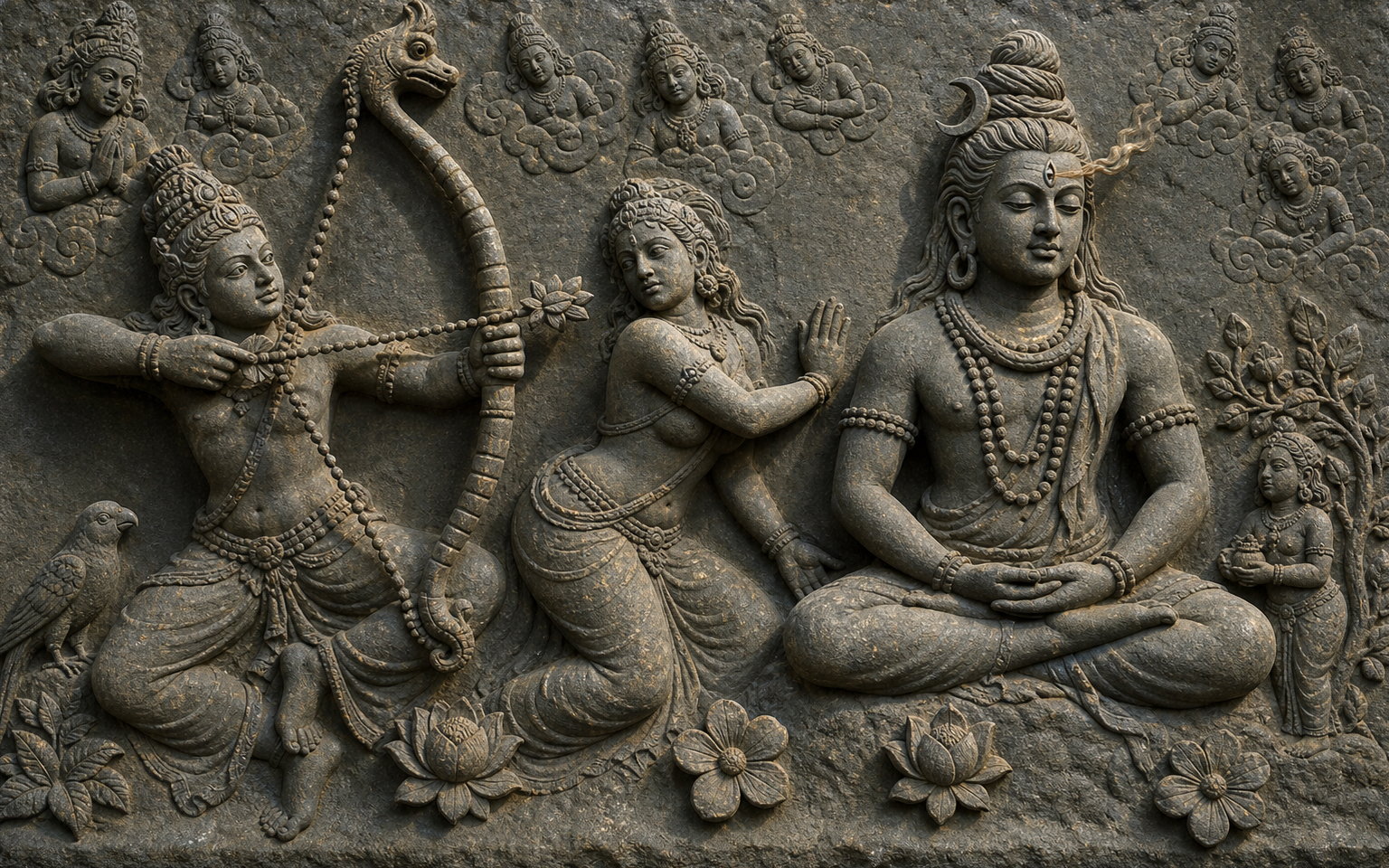
Kamantaka images do not follow one rigid template. Shiva can have two, four or more arms. He may stand in sama-bhanga or assume the more curved tri-bhanga. Some works compress the episode into a few figures; others spread it across a narrative field. Use the following hierarchy when cataloguing a sculpture or checking a museum label.
| Visible detail | What it establishes | How to use it |
|---|---|---|
| Sugarcane bow, bee-string or flower-arrows | Identifies the archer as Kama | Treat this as the strongest single clue, especially when more than one unusual weapon survives. |
| Rati in distress beside the archer | Supports the Madana Dahana episode | Combine her reaction with Kama’s weapons; distress alone is not enough. |
| Emphatic third eye or flame directed at Kama | Shows Shiva’s destructive insight in action | Confirm that the visual direction connects Shiva to the archer. |
| Mango, flowers, bees and abundant foliage | Establishes the spring setting created to arouse Shiva | Use as contextual support, since floral ornament can occur in unrelated scenes. |
| Jata-mukuta, Ganga, crescent, serpents or tiger skin | Identifies Shiva and his ascetic sovereignty | Do not mistake general Shaiva attributes for proof of this particular episode. |
| Trishula, damaru, axe or antelope | Belongs to Shiva’s wider iconographic vocabulary | Record these attributes, but give them little weight when naming the narrative. |
| Small flame held in a hand | May reinforce the symbolism of jñāna-agni | Do not conclude that the hand replaces the third eye; the narrative fire issues from the forehead. |
| Number of arms or exact stance | Reflects iconographic and regional variation | Never reject a plausible Kamantaka identification solely because these differ from another example. |
Regional style can sharpen your reading, but only after the narrative markers fit. The eighth-century Madana Dahana relief at the Virupaksha Temple in Pattadakal uses the compact dramatic language associated with early Chalukya art. Dynamic diagonals can carry your eye from Kama’s poised bow toward Shiva’s gaze. The eighth-century Kailasanatha complex at Ellora, Cave 16, supplies another major point of comparison for the episode.
At the twelfth-century Hoysaleswara Temple in Halebidu, dense foliage and ornament intensify the very world of sensory attraction that Shiva overcomes. The detail is meaningful, but it can also mislead: an ornate Hoysala frame is not automatically a spring scene, so return to the bow, Rati and the third eye before assigning the name Kamantaka.
South Indian bronzes often shift the emphasis from crowded narrative to embodied presence. A slight curve in Shiva’s torso or controlled tension in his glance can carry the event without the same abundance of surrounding figures. When fewer clues are present, describe the identification as probable rather than certain unless the surviving attributes establish the episode.
The fire destroys compulsion, not the capacity to love
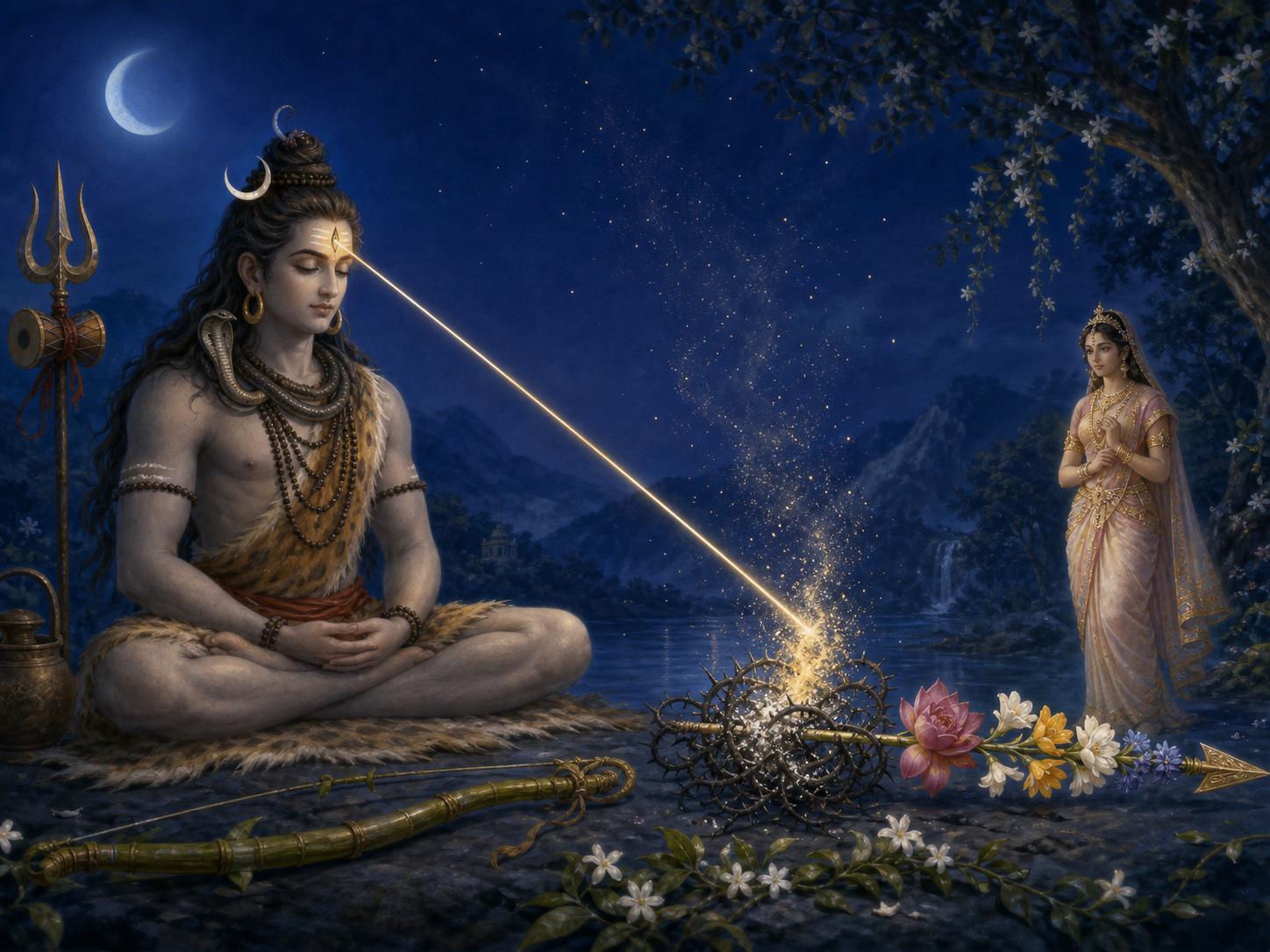
The easiest mistake is to turn Kamantaka into a slogan against desire. That reading does not survive the full narrative. Shiva burns the force that attempts to seize his attention, yet he subsequently enters a freely accepted union with Parvati. The contrast is between compulsion and conscious relationship, not between hatred and love.
The third eye therefore signifies more than supernatural aggression. It is an awakened mode of perception in which attention, understanding and action align. Its fire is jñāna-agni because clear knowledge exposes what the immediate attraction conceals. Ash, or bhasma, marks the end of the desire’s former authority. Sacred ash on the brow can recall the same inner work: whatever appears irresistible can be seen, understood and deprived of its power to rule.
This interpretation also explains why Shiva’s stillness matters more than spectacular flames. Kama engineers favourable conditions, chooses the moment and aims directly at the senses. Shiva’s victory occurs because the stimulus does not dictate his response. If a modern reproduction makes the fire enormous but renders Shiva merely furious, it may preserve the action while weakening the philosophical centre.
The textual traditions illuminate different parts of this visual grammar. The Shiva Purana, particularly the Rudra-samhita’s Kumara-khanda, provides the narrative of Kama’s incineration, while the Matsya and Padma Puranas preserve parallel tellings. Kalidasa’s Kumarasambhavam develops the dramatic and psychological tension between spring’s allure and Shiva’s tapas. Agamic works such as the Kamikagama and Suprabhedagama belong to the prescriptive background through which sculptors received rules for sacred form. If you are researching an image, use the Puranic and poetic materials to explain the event, and the Agamic materials to investigate how the murti was formally constructed.
The Bhagavad Gita 2.62-63 traces a progression from fixation on objects through attachment and desire toward anger, confusion and the loss of discernment. Bhagavad Gita 3.37 also treats desire as a consuming adversary when it is ungoverned. Yoga Sutra 1.12 gives the practical pair of abhyasa, sustained practice, and vairagya, dispassion. Kamantaka turns this psychology into a scene you can recognise before you can recite its terminology.
Related Dharmic traditions should be compared with care rather than collapsed into a single doctrine. Buddhism identifies tanha, craving, as a cause of dukkha and cultivates mindfulness and wisdom. Jainism directs the aspirant against the kashayas of anger, pride, deceit and greed. Sikh teaching names kama among the five thieves, alongside krodh, lobh, moh and ahankar, and answers them through remembrance of the Divine and righteous conduct. Their metaphysical frameworks and disciplines differ. Their limited but valuable point of convergence is that freedom requires a changed relationship to impulse, not mere obedience to it.
Use Kamantaka as a practical discipline of attention
The old spring campaign has a familiar modern form. Continuous novelty, alerts, recommendations and images can arrange your environment so that attention is repeatedly pulled before judgement has time to enter. Kamantaka offers a usable sequence for that moment. It does not ask you to pretend that the attraction is absent. It asks you to see the machinery of attraction before acting.
- Name the bow. Identify the immediate stimulus: a purchase, an argument, a notification, praise, food, entertainment or another person’s approval. Keep the description concrete.
- Name the promised sweetness. Kama’s weapons look pleasurable rather than brutal. Ask what reward the impulse is offering and whether that reward is likely to last beyond the first reaction.
- Open the third eye of consequence. Widen the frame. Consider what the action will do to your attention, duty, relationship or peace after the attractive moment has passed.
- Create a pause. Take a conscious breath before responding. A Shaiva practitioner may use the pause for japa of Om Namah Shivaya. The purpose is not theatrical suppression; it is to restore the space in which a choice can be made.
- Review the result in the evening. Distinguish desires that supported duty, devotion, creativity or care from those that scattered attention or produced regret. This keeps vairagya from becoming hostility toward ordinary human affection.
Kama Dahana observances preserve the episode as living festival memory, but its discipline need not remain confined to a ritual date. Each interruption presents the same question in miniature: is desire supplying energy to a chosen good, or has it quietly taken command?
The next time you encounter a Kamantaka panel, do not begin by counting Shiva’s arms. Find Kama’s bow, follow its aim, and notice the still point from which Shiva answers. Then carry that viewing order into one decision of your own: stimulus, promise, consequence, pause, choice.