
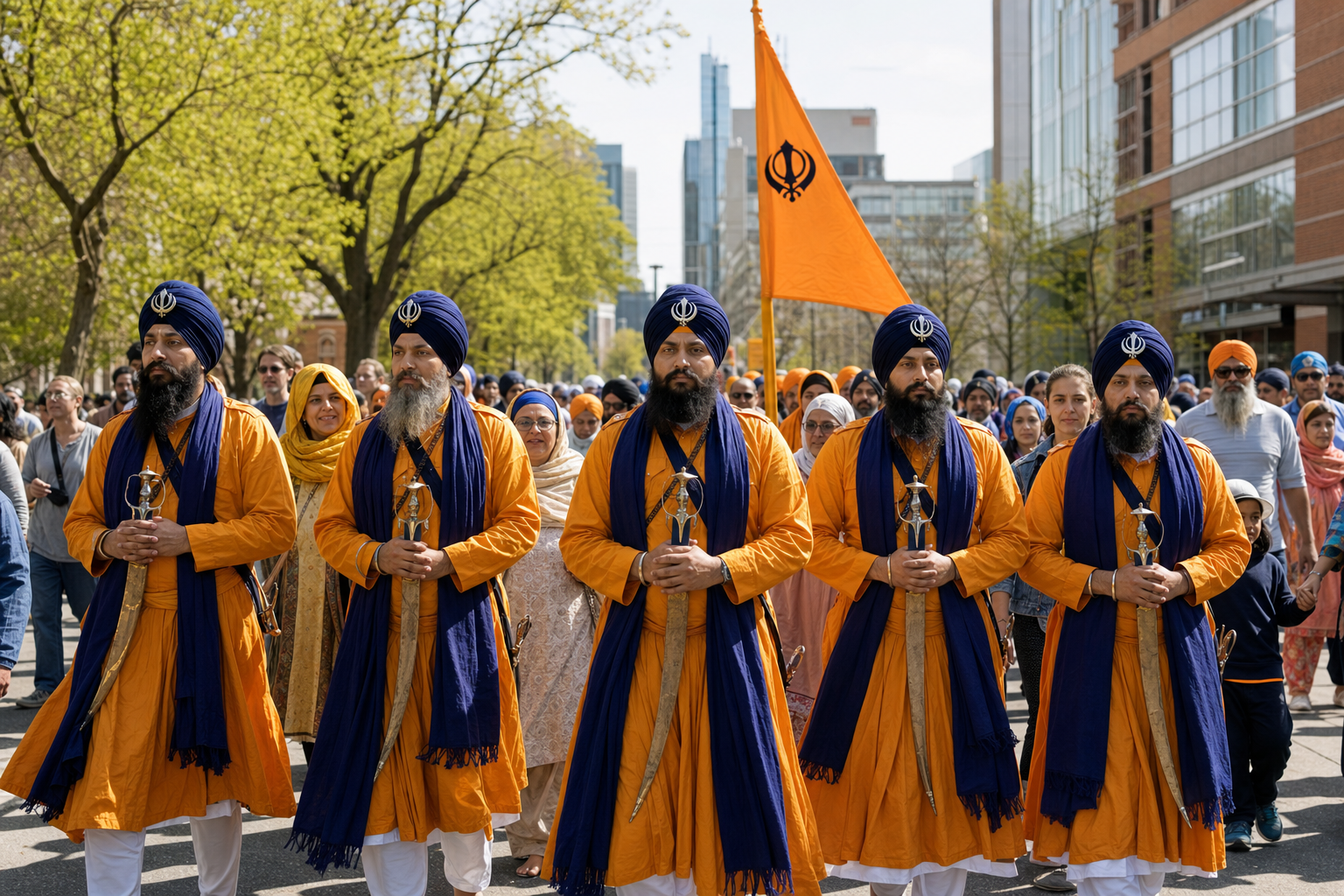
If Baisakhi reaches you first through a city parade, a school bhangra performance, or an invitation to a gurdwara, you may wonder what joins these scenes. The answer is not Punjabi culture alone. The day carries the gratitude of a harvest festival, but its Sikh center is Khalsa Sirjana Diwas: the remembrance of the Khalsa’s creation.
That distinction changes how you participate. Once you know what to notice, kirtan, the Panj Pyare, the Nishan Sahib, gatka, and langar stop looking like separate festival features. They become expressions of one moral vision: devotion made visible through equality, courage, restraint, discipline, and service.
Key takeaways
- Baisakhi has two connected dimensions: gratitude for the harvest and remembrance of the Khalsa’s founding. In a Sikh observance, the Khalsa is not a decorative addition to a seasonal festival.
- The Khalsa is best understood as a disciplined fellowship formed for spiritual elevation and righteous defense, not merely as an ethnic label or martial image.
- The Panj Pyare, Five Ks, Amrit Sanchar, Nishan Sahib, Nagar Kirtan, gatka, and langar belong to the same ethical structure. Each joins personal discipline to responsibility for others.
- Global celebrations remain rooted in Anandpur Sahib, Punjab’s agrarian life, the Takhts, and a sacred geography extending across modern borders.
- If you attend as a guest, cover your head, remove your footwear, follow local directions, receive karah prashad respectfully, and make seva part of your participation.
The founding of 1699 gives Baisakhi its Khalsa meaning
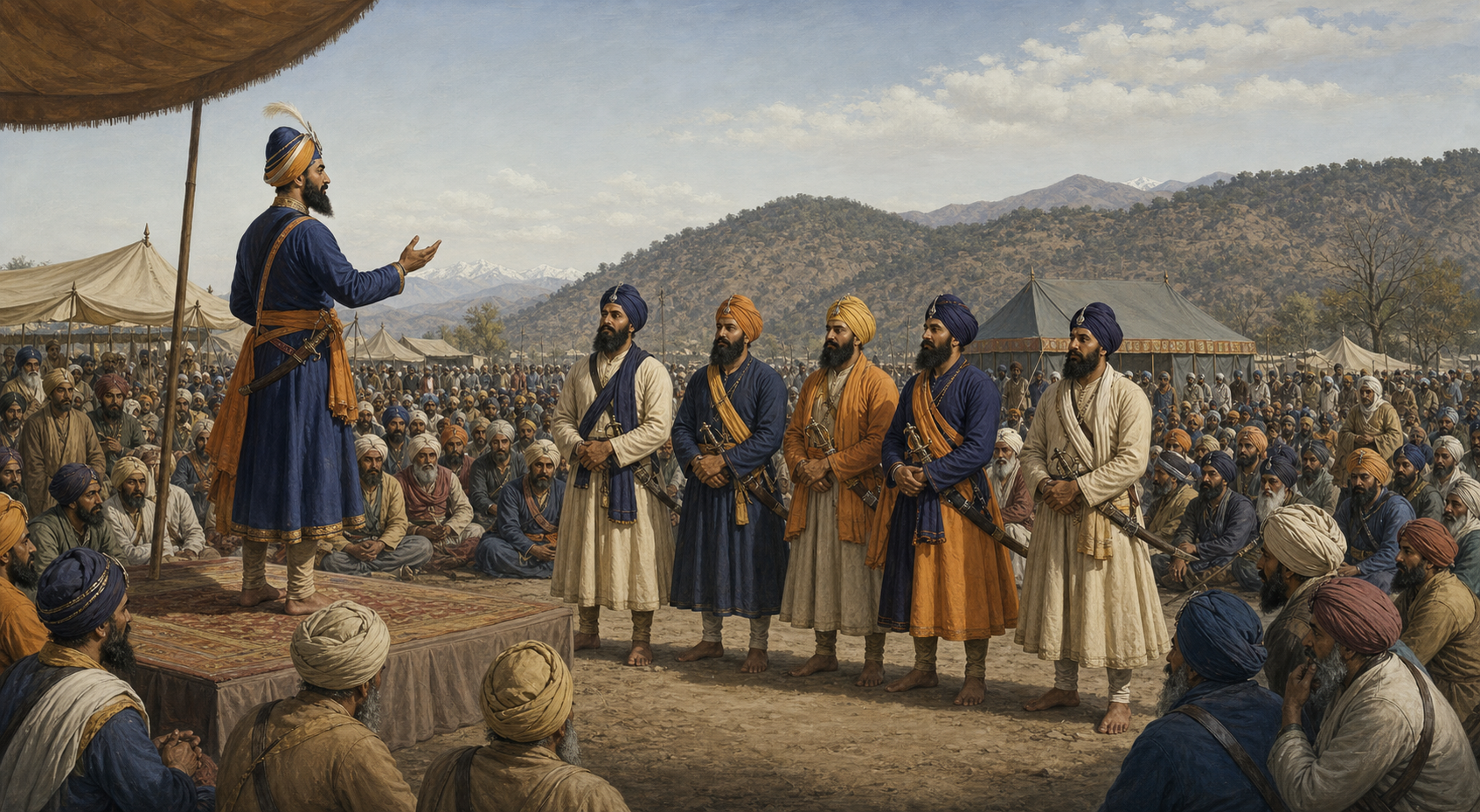
On 1 Vaisakh in 1699, Guru Gobind Singh instituted the Khalsa at Anandpur Sahib. This was not simply the announcement of another association. It formed a disciplined fellowship committed to spiritual growth, moral integrity, and the defense of righteousness and the vulnerable.
The Panj Pyare, or Five Beloved Ones, stand at the heart of that event: Bhai Daya Singh, Bhai Dharam Singh, Bhai Himmat Singh, Bhai Mohkam Singh, and Bhai Sahib Singh. Learn their names rather than referring vaguely to five volunteers. Their collective identity expresses radical equality, courage, and shared responsibility. Courage is not left to a solitary hero; it becomes a duty carried by the community.
The Five Ks give that duty a visible, daily form: kesh, kangha, kara, kachera, and kirpan. Reducing them to a costume checklist misses their purpose. Together they codify an ethical and disciplined way of life. If you are explaining them to a child or newcomer, begin with the commitment behind the articles of faith: Khalsa identity asks a person to carry responsibility beyond the prayer hall and into ordinary conduct.
Baisakhi’s martial dimension should also be read carefully. The relevant ideal is dharamyudh, or righteous defense, rather than force for its own sake. This is why gatka can be a public demonstration and a lesson in self-restraint at the same time. Skill, readiness, and courage remain answerable to an ethical purpose.
The harvest dimension does not compete with this sacred history. Baisakhi arrives with the solar month of Vaisakh, usually in mid-April, when rabi crops move toward Punjab’s mandis. Thanksgiving for land and labor therefore meets the Khalsa’s demand for responsible action. When you describe the day, keep both clauses together: Baisakhi gives thanks for the harvest, and Sikh Baisakhi commemorates the creation of the Khalsa.
Read the celebration from inner discipline to public service
The clearest way to understand Baisakhi observances is to follow their movement from personal commitment to collective responsibility. The rites, symbols, procession, and meal are not unrelated items on a festival program.
Amrit Sanchar, also called Khande di Pahul, makes the Khalsa commitment explicit. The Panj Pyare prepare Amrit with a double-edged khanda while five banis are recited: Japji Sahib, Jaap Sahib, Tav-Prasad Savaiye, Chaupai Sahib, and Anand Sahib. Those initiated accept the Khalsa rehat and its disciplines of integrity, seva, and courage. The affirmation “Waheguru Ji Ka Khalsa, Waheguru Ji Ki Fateh” places individual commitment within the identity and destiny of the Khalsa.
If you encounter an initiation ceremony, treat it as a vow rather than a performance. Follow the directions of the gurdwara and allow the ceremony’s gravity to set your behavior. You do not need to understand every liturgical detail before showing reverence.
Congregational worship builds another part of the day’s arc. An Akhand Path, special kirtan diwan, collective Ardas, and the Hukamnama move the sangat from sustained attention toward prayer and scriptural guidance. If you are new to the gurdwara, do not assume the musical portion is the whole service. Remaining attentive through Ardas and the Hukamnama will give you a more complete sense of what the congregation is doing together.
The Nishan Sahib carries this public commitment outside in a different form. Many gurdwaras renew its chola, clean or refurbish the mast, and rededicate it under Ardas. The saffron standard represents sovereignty joined to service. When a child asks why the flag matters, begin there: it marks a community that is prepared to serve and to uphold righteousness.
Nagar Kirtan takes the same religious grammar into the street. The Panj Pyare lead; shabad kirtan accompanies the procession; children carry saffron flags; and volunteers manage order, cleanliness, water, and the route. Gatka demonstrates disciplined readiness. The procession is festive, but it is also a moving lesson in how devotion should occupy civic space: visibly, confidently, and with responsibility for everyone affected by the gathering.
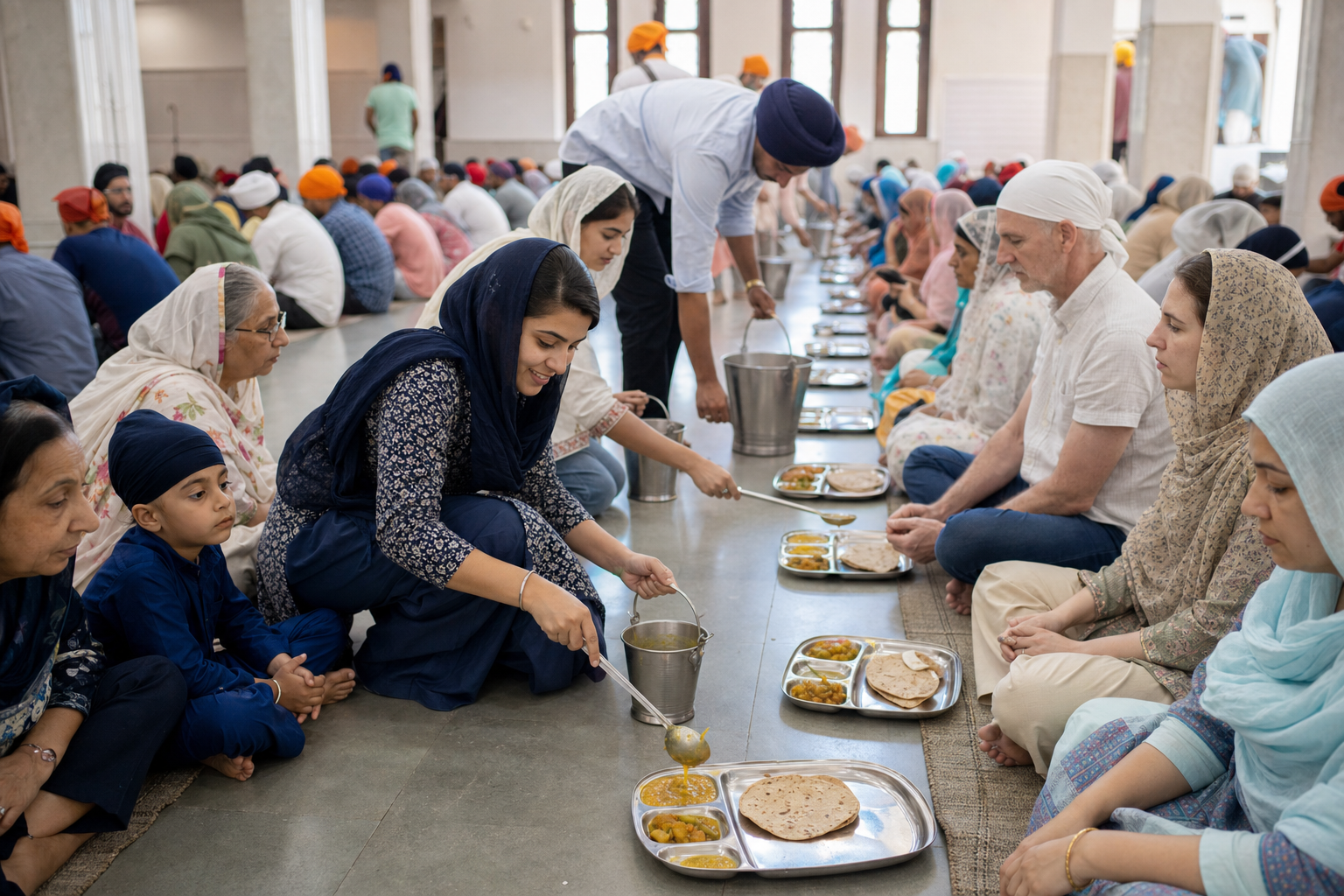
Langar is the social heart of that lesson. The meal is vegetarian, free, and open to all. Its hospitality does more than feed a crowd; it makes equality tangible. Host, volunteer, regular congregant, and first-time visitor all enter the same practice of receiving and serving. Cooking, distributing water, washing, sorting waste, and maintaining hygiene are therefore not peripheral jobs. They are among the clearest ways Baisakhi turns principle into action.
Blood-donation drives, health camps, environmental work, and public-cleanliness initiatives extend that action beyond the langar hall. Their importance lies in the mechanism: a large religious gathering already has volunteers, kitchens, trust, and organizational capacity. Directing some of that capacity toward public needs turns celebration into community resilience.
Global Baisakhi keeps both a sacred and an agrarian map
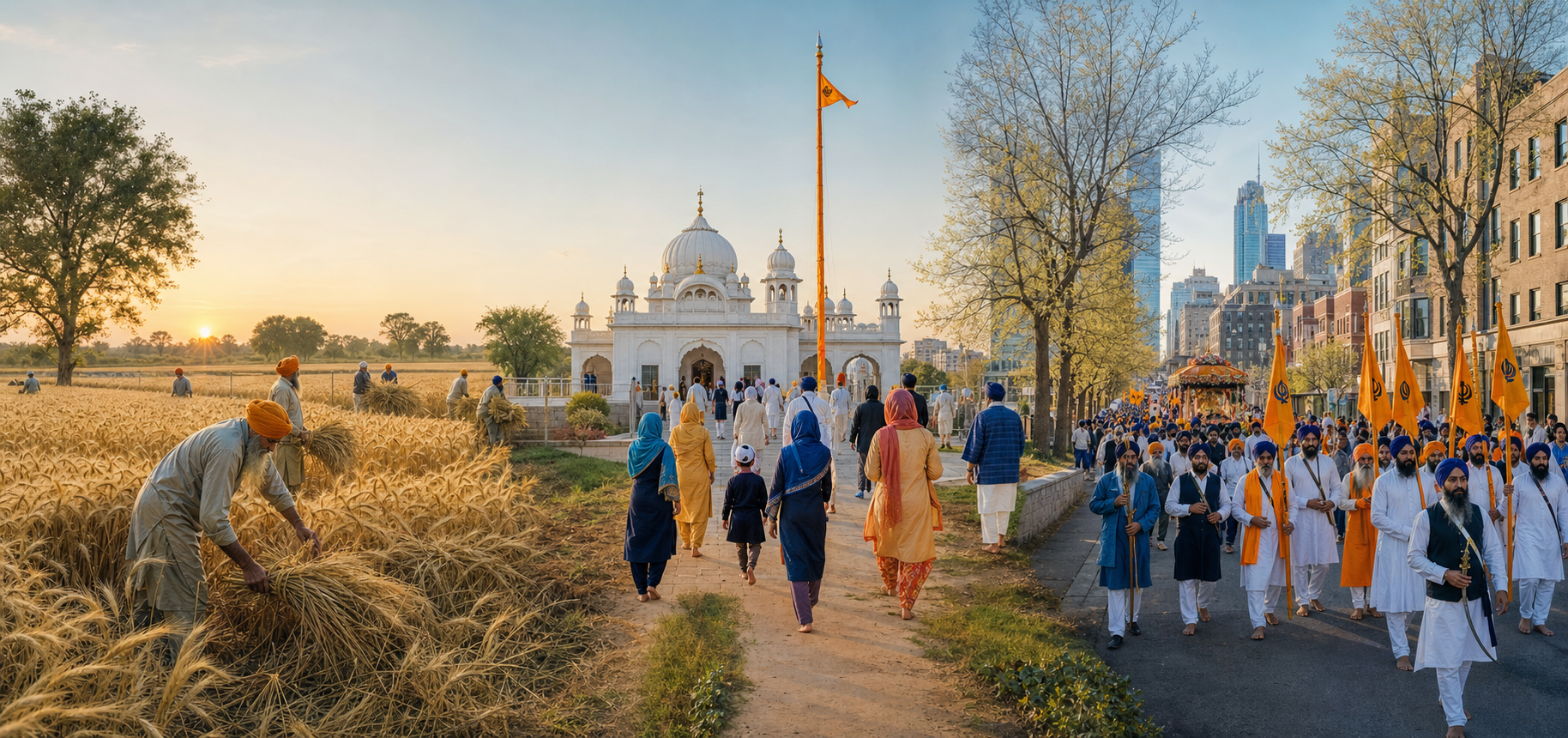
Global does not mean placeless. Baisakhi travels well because communities reproduce a recognizable pattern of kirtan, Ardas, seva, langar, and procession. Yet that pattern continues to point toward particular places and histories.
The sacred map begins at Anandpur Sahib and includes major centers such as the Akal Takht and Harmandir Sahib in Amritsar, Takht Sri Damdama Sahib at Talwandi Sabo, Takht Sri Patna Sahib, and Takht Sri Hazur Sahib at Nanded. Reverence also crosses the modern India-Pakistan border through Sri Panja Sahib at Hasan Abdal. These places keep global remembrance connected to the institutional and historical landscape of the Sikh tradition.
The civic map now includes Khalsa Day and Baisakhi gatherings across North America, the United Kingdom, Southeast Asia, and Oceania. When the Panj Pyare lead a Nagar Kirtan through a diaspora city, the community is not merely reproducing Punjab as cultural nostalgia. It is carrying the Khalsa’s religious vocabulary into a new public setting and accepting the responsibilities that visibility brings.
Do not be surprised if local dates or schedules differ. Baisakhi usually falls in mid-April, but communities may use Nanakshahi or Bikrami reckoning. Check the local gurdwara’s calendar instead of assuming that every observance will occur on the same civil date. A scheduling difference does not erase the shared remembrance.
The agrarian map matters just as much. In Punjab and adjoining regions, the festival coincides with the culmination of a season’s work and the movement of rabi produce into markets. Farming families bring thanksgiving together with practical concerns about water security, fair markets, and sustainable agriculture. If you help organize a diaspora program, do not leave this dimension trapped in decorative wheat sheaves or dance. A conversation about farmers, land stewardship, food, or responsible use of water carries the harvest meaning into present life.
Digital participation can preserve connection when travel, distance, mobility, or crowd size makes attendance difficult. Many gurdwaras broadcast proceedings, linking students, professionals, elders, and overseas families to the same ceremonies. If you join remotely, choose a full kirtan diwan, Ardas, or Hukamnama broadcast when possible. A sequence of parade highlights can show the scale of a celebration, but it rarely communicates its devotional structure.
Families can make that structure memorable without turning the day into a lecture. Ask an elder to tell the story of the Panj Pyare. Give children one concrete seva task, such as helping prepare langar or keeping a shared space clean. Then ask one question at home: what would courage joined to service require from us where we live? That question carries Baisakhi farther than a performance alone can.
Participate respectfully without flattening Sikh meaning
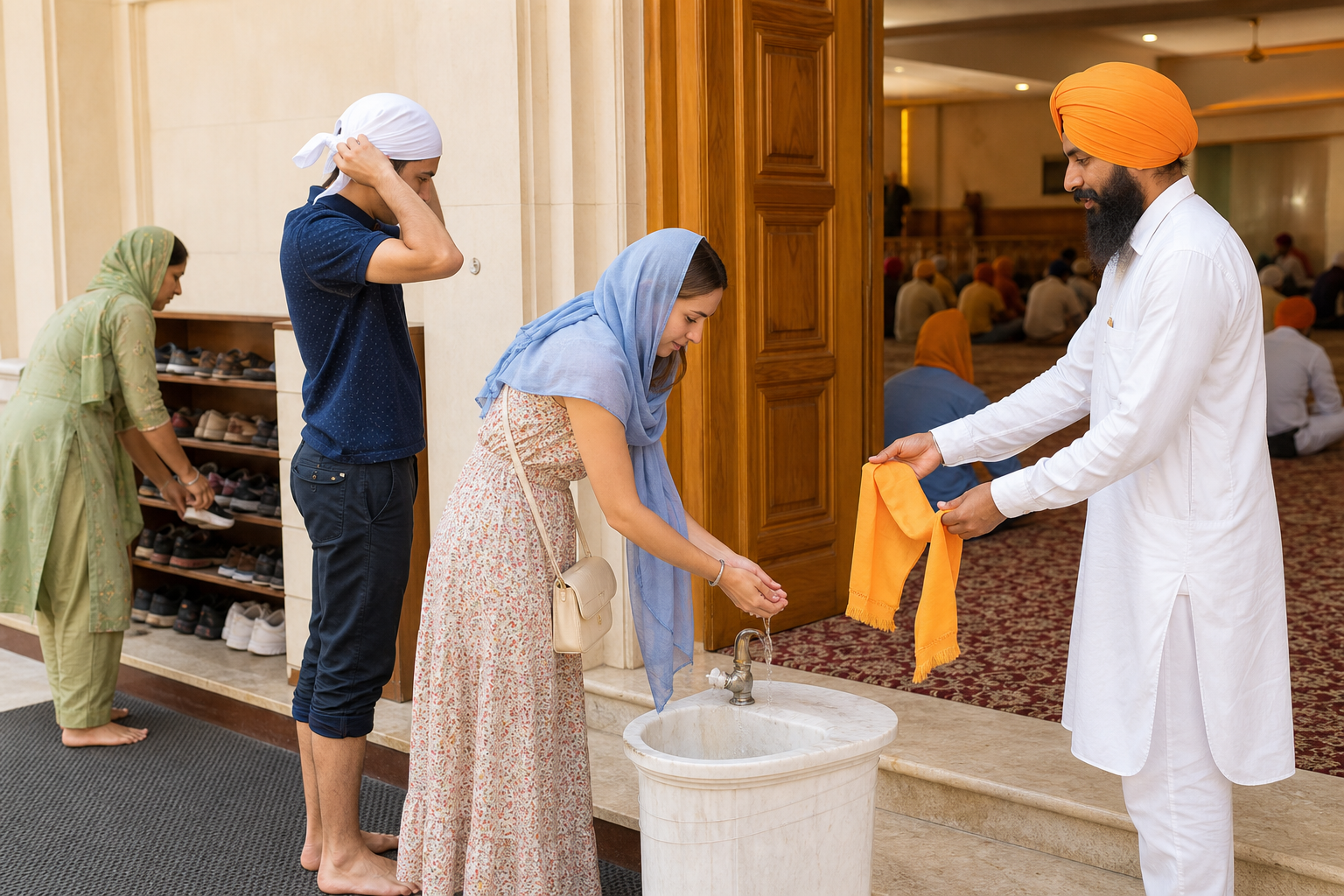
You do not need to be Sikh to attend a public Baisakhi celebration or enter a gurdwara, but good participation begins with attention. These steps will help you move from being a spectator to being a respectful guest.
- Identify the setting before you arrive. A kirtan diwan, Amrit Sanchar, langar, and Nagar Kirtan do not ask the same thing of an attendee. Check the local schedule and decide whether you are coming primarily for worship, the procession, seva, or a combination of them.
- Follow gurdwara etiquette. Cover your head, remove your footwear, observe queue discipline, and follow the guidance of sevadars. Receive karah prashad with reverence. These are simple acts, but they prevent a sacred space from being treated as an exhibition.
- Learn what the central symbols are doing. Recognize the Panj Pyare at the head of the procession, the Nishan Sahib above the gurdwara, and langar as an enactment of equality. Knowing even these three things will help you read the gathering more accurately.
- Put seva into your visit. Ask where help is needed rather than choosing the most visible role. Preparing food, distributing water, cleaning, managing waste, or assisting under volunteer direction may be more useful than standing near the front of the event.
- Plan for the physical conditions. Large gatherings in mid-April can require hydration points, first-aid stations, traffic controls, and accessible facilities. If you are accompanying an elder, a child, or someone with limited mobility, locate these services before entering a crowded route.
- Carry one commitment beyond the day. Seva loses its force if it exists only during the festival. Choose a modest continuation that your household can actually sustain: a recurring community task, responsible food use, environmental care, or support for a properly organized public-service initiative.
For Hindu, Buddhist, or Jain visitors, the wider Dharmic setting offers real points of relationship. Vaisakh is honored across Indic calendars, although dates and ritual emphases differ. Compassion, or karuna; truth, or satya; service, or seva; and concern for the welfare of all expressed as Sarbatt da Bhala create a vocabulary for solidarity.
That solidarity becomes weaker when it claims that all traditions are interchangeable. Baisakhi’s Sikh meaning depends on Guru Gobind Singh, Anandpur Sahib, the Panj Pyare, Amrit, rehat, and the Khalsa. Honor those particulars first. Dharmic unity is most credible when it allows each tradition to speak in its own sacred language while communities cooperate around truth, compassion, service, and protection of the vulnerable.
Before the next Baisakhi gathering near you, learn the names of the Panj Pyare, check the local gurdwara’s schedule, and choose one seva role. Then the saffron procession will meet you not as passing scenery, but as an invitation to join memory with disciplined service.