
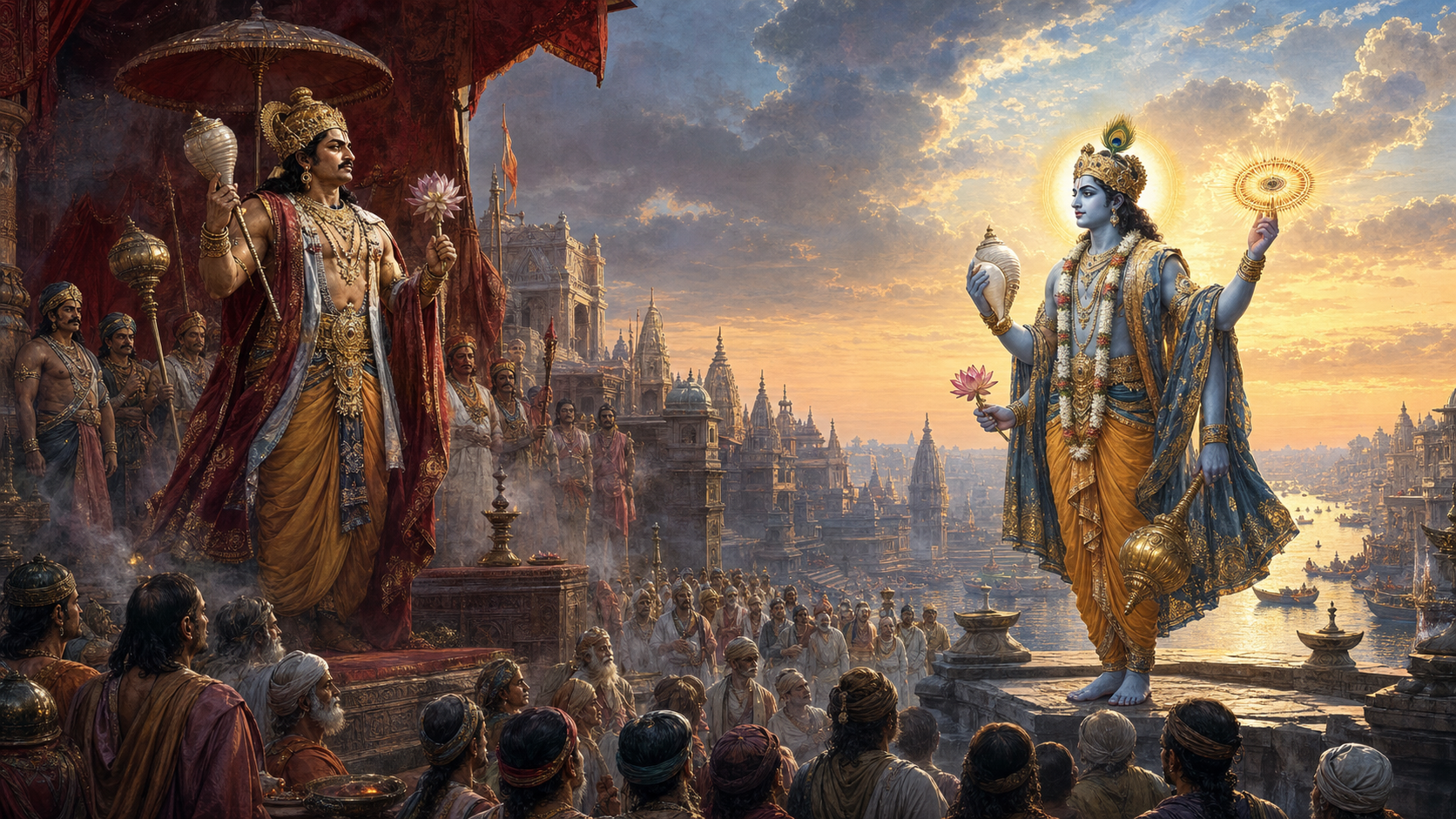
If the story of Paundraka leaves you wondering whether it is merely a contest between one supernatural weapon and another, look again. Its harder question is about authority: what happens when a ruler mistakes sacred appearance for spiritual reality, then uses ritual expertise to settle a political grievance?
The answer matters whenever religious language is used to justify humiliation, retaliation, or coercion. The Bhāgavata does not ask you to fear ritual power. It asks you to examine the intention directing power, the means chosen to exercise it, and the people made to bear its consequences.
The chain of failure begins before Kāśī burns
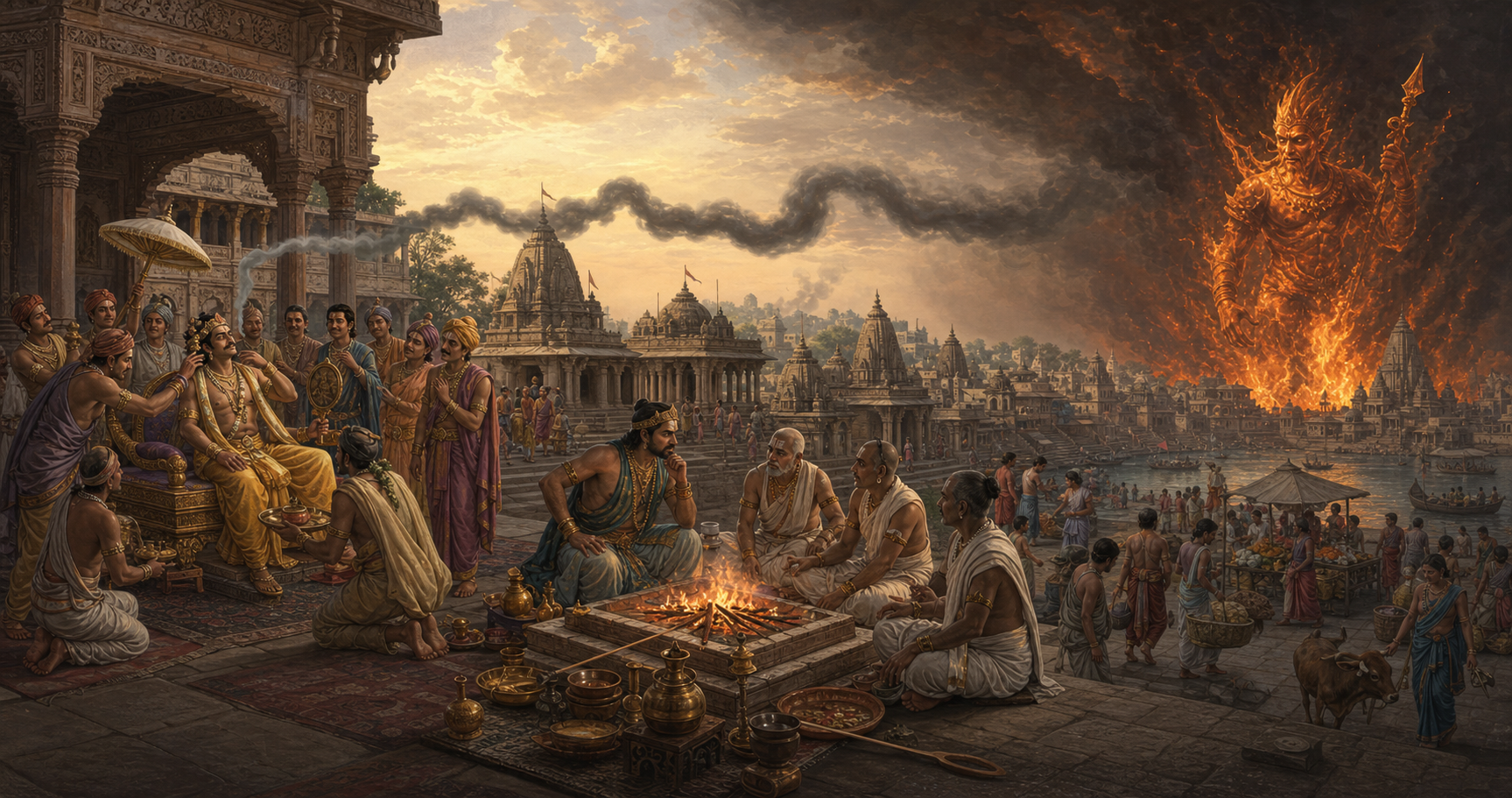
Within Bhāgavata Purāṇa 10.66, Paundraka publicly claims the identity of Vāsudeva and adopts sacred insignia associated with Krishna. His defeat is followed by the death of his political ally in Kāśī. The royal successor then converts grief into vengeance: he employs ritual specialists, an abhicāra rite produces a destructive kṛtyā, and that agency is sent toward Dvārakā. Sudarśana neutralizes the attack, reverses its direction, and the violence returns to the city from which it was commissioned.
The sequence matters. Kāśī’s conflagration is not an isolated punishment dropped into the narrative without cause. It is the final stage of a progression:
- Identity is inflated. Paundraka treats the signs of divinity as though possessing the signs establishes the reality.
- Contradiction becomes intolerable. Once a public claim is fused with ego, a challenge to the claim feels like an attack on the self.
- Defeat becomes humiliation. Loss is no longer information that should correct judgment; it becomes an injury that must be avenged.
- Sacred competence is recruited by anger. Ritual knowledge becomes an instrument of hostility rather than an aid to truth, worship, or welfare.
- The cost spreads beyond the decision-maker. A ruler’s retaliatory choice exposes the wider polity to destruction.
This is why the story begins morally with Paundraka’s imposture, not physically with the fire. The first dangerous act is the refusal to distinguish a role from the reality that should justify it. External emblems can announce a responsibility, but they cannot manufacture the inner substance, or svarūpa, that the responsibility requires.
You can recognize the same pattern without accusing every confident leader of being another Paundraka. Look for a tighter combination: a grand claim unsupported by conduct, dependence on symbols or slogans, hostility toward correction, and escalation after the claim is exposed. The warning sign is not visibility or authority by itself. It is authority that treats its own assertion as proof.
Ritual efficacy does not create moral legitimacy

Abhicāra refers here to ritual action deliberately oriented toward harm. Its presence in a sacred narrative is descriptive, not prescriptive. A text can portray a practice in order to disclose its motive and consequences; portrayal does not amount to permission. That distinction is essential whenever you read accounts of curses, destructive rites, warfare, or coercive power in śāstra.
The successor in Kāśī makes a category error. He has access to a method and therefore behaves as if he has acquired the moral right to use it. Yet technical capacity answers only one question: can an act be attempted? Dharma requires several more:
- Intention: Is the act directed by protection and justice, or by hatred, wounded pride, and the wish to make another suffer?
- Means: Does the method itself depend on deceit, intimidation, indiscriminate harm, or the corruption of a sacred trust?
- Authority: Is the person acting within a genuine duty, or using status to sanctify a private grievance?
- Consequence: Who will carry the risk if the decision fails, spreads, or returns?
- Correctability: Can counsel, contrary evidence, or a change of heart still interrupt the act?
On each point, the kṛtyā fails the dharmic test. It is born from retaliatory hostility, directed at Dvārakā, and commissioned through political authority. The sacred form of the act does not cleanse the intention behind it. On the contrary, attaching ritual solemnity to vengeance can make vengeance harder to question because dissent is then portrayed as impiety.
This gives you a reliable rule for evaluating claims about spiritual power: never infer goodness from potency. A mantra, office, lineage, institution, majority, weapon, or advanced technique does not become dharmic merely because it is effective. Ask what it serves. Ask what restraints govern it. Ask whether its custodians accept accountability when challenged.
The same rule also prevents an opposite mistake. The episode is not a condemnation of ritual as such. It distinguishes ritual aligned with truth and welfare from ritual deliberately bent toward injury. Rejecting every sacred practice because one can be abused would be as careless as accepting every practice because it is called sacred.
Sudarśana offers a practical discipline of right-seeing

Sudarśana operates on three distinguishable levels. In the narrative, it is Krishna’s divine discus protecting Dvārakā and overcoming the kṛtyā. Symbolically, su-darśana means good vision or right-seeing: the discernment that reveals a false claim and restores order. Contemplatively, it evokes viveka and vairāgya, discrimination and dispassion, which allow a practitioner to see clearly without making every decision a servant of attachment.
The first level belongs to the action of the story. The symbolic and contemplative levels show how its instruction can enter your own sādhana. Sudarśana is not simply stronger force. It represents clarity that exposes the original confusion: Paundraka is not what his costume claims, vengeance is not justice, and ritualized hatred is not sanctified duty.
Use that insight before a punitive, public, or difficult-to-reverse decision. A short right-seeing audit can interrupt the movement from injury to retaliation:
- State the event without a title or accusation. Write what actually happened before calling anyone disloyal, evil, fraudulent, or disrespectful. This separates observation from the identity-story growing around it.
- Name the injury being defended. Was there a real threat to another person’s welfare, or was your status, image, faction, or expectation contradicted?
- Identify the desired result. Protection, truthful correction, restitution, deterrence, humiliation, and revenge are not interchangeable aims.
- Inspect the means independently. Ask whether you would still call the method righteous if an opponent used it against your own community.
- Locate the transferred cost. Note who may suffer despite having had no part in the original wrong. Kāśī makes this question impossible to dismiss.
- Invite one honest correction. Consult someone permitted to disagree with you. If your course depends on silencing every objection, the decision is already being governed by ahaṅkāra.
This audit does not demand passivity. Dharmic protection may require firm action. Right-seeing changes the quality of that action: it clarifies the duty, limits the means, separates justice from self-display, and keeps correction possible. Dispassion does not mean indifference to wrongdoing; it means refusing to let personal craving or hatred impersonate principle.
The warning applies to both rulers and practitioners
Paundraka’s error can be described as attachment to liṅga without realization of svarūpa: possession of an outward sign without the inner truth it signifies. That makes the episode especially relevant wherever sacred identity also conveys social authority. Clothing, vocabulary, institutional office, ancestry, initiation, public devotion, or political sponsorship may support a legitimate role. None of them eliminates the need for truthfulness, restraint, service, and accountable conduct.
For a ruler or institutional leader, apply four tests. First, what evidence supports the claim beyond the claimant’s symbols? Second, who has permission to contradict the leader without being treated as an enemy? Third, are sacred resources serving lokasaṅgraha, the welfare and cohesion of the world, or protecting a factional ego? Fourth, who pays when the leadership’s private grievance becomes public policy?
The destruction of Kāśī should sharpen the fourth test. The narrative places a ruler’s retaliatory decision beside a city’s suffering. That does not license you to treat every inhabitant as equally guilty. It reveals a recurring danger of adharma in governance: leaders can externalize the consequences of pride onto people who did not choose the escalation. Political spectacle looks very different once the burden on households, communities, and sacred places is counted.
For a practitioner, the correction begins closer to home. Different Dharmic traditions preserve their own doctrines and disciplines; they should not be collapsed into a single theology. Yet several practices converge on the need to loosen ego, inspect intention, and turn power toward service:
- Bhakti traditions: use japa or kīrtana to steady the reactive mind, seva to move attention from prestige to service, and śāstra-reflection to test whether devotion is producing truthful conduct.
- Buddhist practice: use sati, mindfulness, to notice anger before it hardens into action; examine cetanā, volition; and let anattā challenge the rigid identity that must always win.
- Jain discipline: use pratikramaṇa for concrete ethical review, ahiṃsā to expose the harm hidden by righteous language, aparigraha to loosen possessiveness, and anekāntavāda to resist treating one perspective as exhaustive.
- Sikh practice: join simran to remembrance, seva to responsibility, nimratā to humility, and kirat karni to honest work rather than spiritual display.
You do not need to assemble these into an improvised mixture. Stay rooted in the discipline you actually follow. The comparison is useful because it exposes a shared failure mode: sacred identity becomes dangerous when remembrance, ethical restraint, humility, and service are replaced by performance.
For seven days, add three lines to your evening practice. Record the role or image you felt compelled to defend, the emotion that appeared when it was challenged, and one repair you can make within the next day. The exercise is small enough to complete and precise enough to show whether Paundraka’s pattern exists in ordinary form: exaggerating a claim, rejecting correction, or recruiting sacred language to protect pride.
Key takeaways
- Paundraka’s downfall begins with false identification: he treats sacred insignia as proof of sacred reality.
- Kāśī’s successor turns grief into abhicāra, showing how wounded authority can recruit ritual expertise for revenge.
- A rite’s inclusion in scripture does not make it a recommended practice; intention, means, authority, and consequence still require judgment.
- Sudarśana signifies protection in the narrative and right-seeing in spiritual application: clarity exposes both imposture and sanctified hostility.
- Leaders must count the public cost of private grievance, while practitioners must test whether sacred identity is producing humility, truth, and service.
The next time someone joins a grand spiritual claim to a demand for retaliation, do not be overawed by the symbols. Examine the claim, motive, method, accountability, and transferred cost. Then apply the same scrutiny inward. That is where Sudarśana becomes more than an image of protection: it becomes the discipline of seeing clearly before anger acquires sacred clothing.