
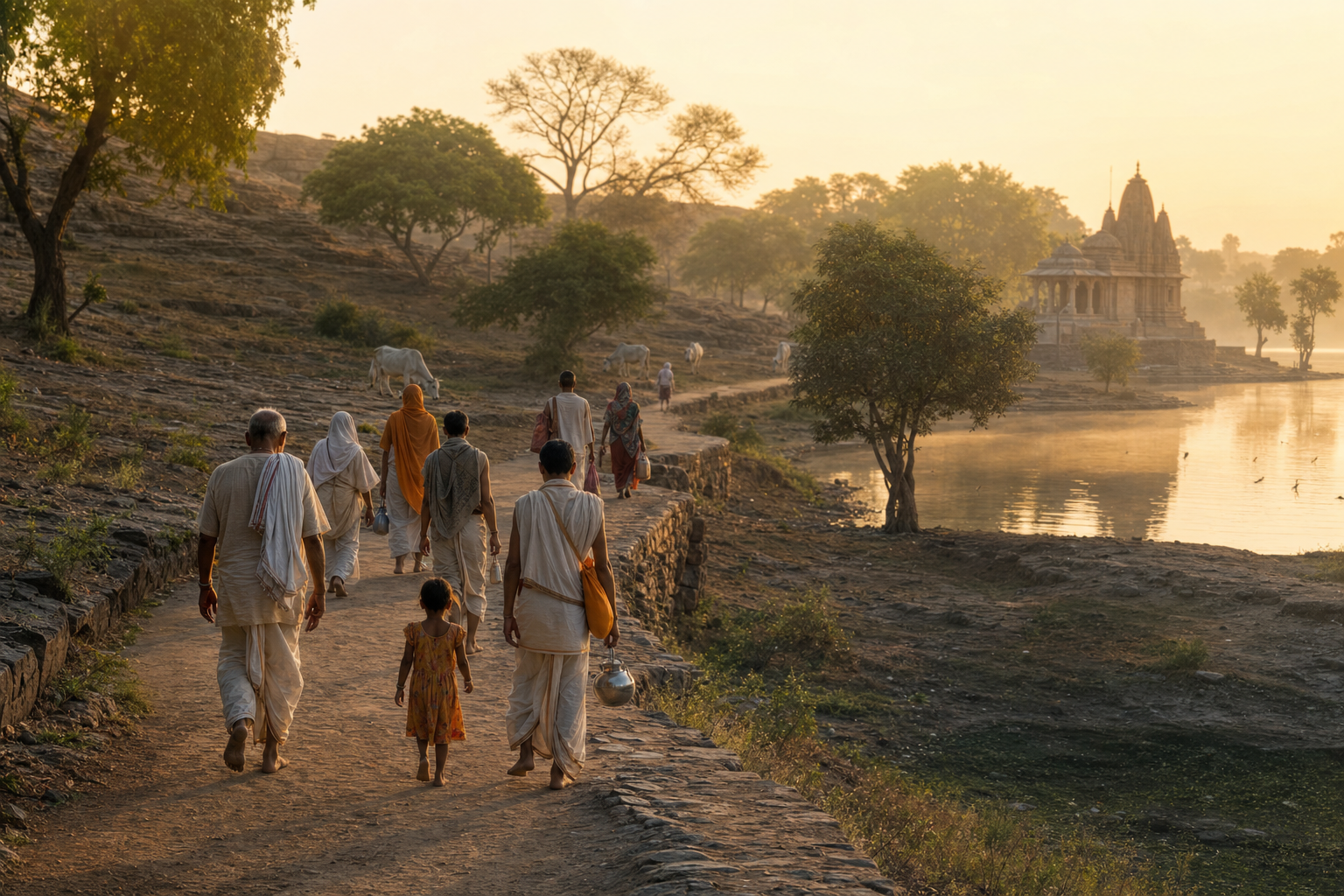
You may know the names – Vrindavan, Govardhan, Nandgaon and Barsana – yet still be unsure how to turn them into a coherent yatra. The common mistake is to build only a list of temples. In Braj, the paths between shrines, hills, villages and remembered lilas are part of what you have come to encounter.
A meaningful first pilgrimage needs three decisions before it needs a crowded itinerary: which sacred relationship will anchor the journey, which practice you will sustain while walking, and what you are willing to leave unseen. Those decisions make the difference between collecting locations and learning to inhabit sacred geography.
Begin with the right kind of map
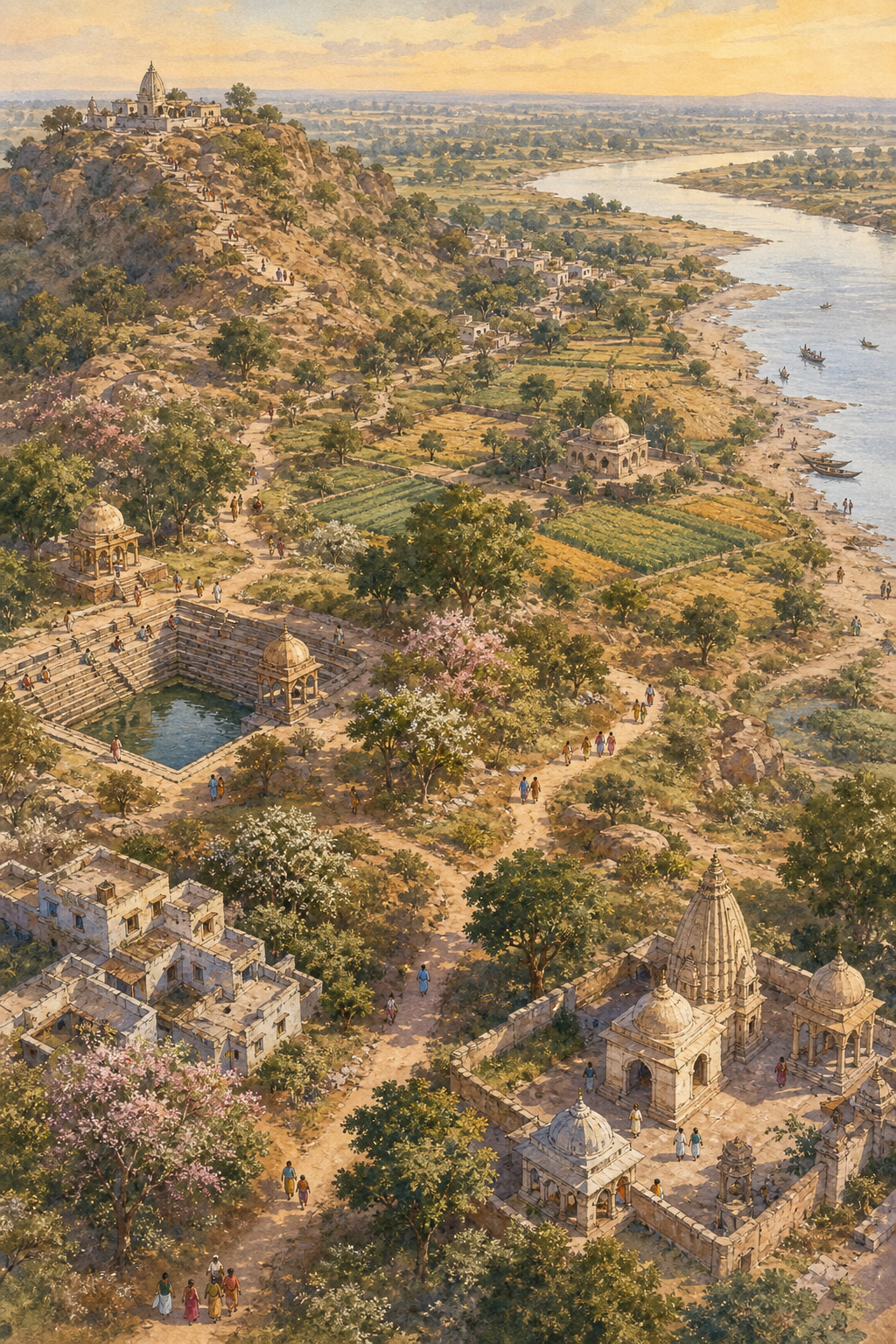
Braj asks you to read place in more than one way. A dhama is approached as an enduring abode of divine presence; a tirtha is a crossing between ordinary and sacred life; a kshetra is a consecrated field; and parikrama is the embodied act of moving around a sacred center. These words overlap, but they are not interchangeable.
The distinction changes how you behave. If you see only a destination, you ask what there is to photograph. If you approach a dhama, you ask whose presence is being honored. At a tirtha, you ask what in you is meant to cross over. Within a kshetra, you notice how shrines, paths, water, trees, settlements and customary conduct belong to one sacred field. During parikrama, you let your own movement acknowledge that you are not the center.
This is especially important in Braj because its places illuminate one another. Barsana belongs to an integrated devotional landscape that includes Nandgaon, Govardhan and Vrindavan. Treating each as an isolated attraction removes the relationships that give the landscape its meaning.
Prepare two maps before you go. The first is practical: routes, walking demands, current access, rest points and where your day begins and ends. The second is devotional: the deity or lila associated with each place, the practice you intend to perform there, and the relationship between that place and your next stop. The practical map prevents confusion. The devotional map prevents the practical one from becoming the whole pilgrimage.
- At each place, ask: whose presence am I approaching?
- Ask which lila or sacred memory gives this terrain its character.
- Identify the fitting action: darshan, parikrama, japa, kirtan, prayer, service or quiet attention.
- Observe local conduct before assuming that a general temple habit applies everywhere.
- Notice what can only be understood by walking between places rather than arriving at each one by vehicle.
For a devotee, a lila-sthala is not a religious backdrop added to ordinary land. It is approached as a place of encounter. You do not have to manufacture an emotion to honor that conviction. Attention, restraint and willingness to learn are already serious forms of reverence.
Build the yatra around a relationship, not a site count
A full schedule can look impressive before departure and feel spiritually thin by the end. Every additional stop creates another transition, another queue, another calculation about time and another temptation to hurry darshan. The better question is not, “How much of Braj can I complete?” It is, “What relationship am I trying to deepen here?”
- Write a simple sankalpa. Name the quality you are seeking – steadier remembrance, humility, gratitude, service or deeper attention to Radha-Krishna lila. Keep it short enough to recall while tired.
- Choose one devotional center. If your heart is drawn to Srimati Radharani, Barsana can anchor the journey. Other Braj places can then be approached in relation to that center rather than added as unrelated stops.
- Select one repeatable practice. Use a consistent nama invocation, japa or kirtan refrain while walking. Constantly changing practices makes it harder for rhythm and place to work upon your attention.
- Move from orientation to immersion. Begin with an unhurried darshan, dedicate your main walking period to one parikrama, visit a related Braj place, and then return to your anchor before leaving the region if circumstances permit.
- Leave unscheduled margin. Temple access, group movement, festival conditions and the pace of a hill ascent can change the day. Do not make a promise that can be kept only by rushing through worship.
This is a framework, not a claim that Braj has one mandatory itinerary. A sampradaya, guru or established local tradition may give you a particular sequence, set of prayers or discipline. Follow that guidance where it applies. What you should avoid is inventing a supposedly universal route from a collection of map pins.
It also helps to define what “enough” means before setting out. Enough may mean completing one parikrama without abandoning your mantra. It may mean receiving darshan and retaining enough quiet to reflect afterward. It may mean learning the relationship between two places rather than briefly entering ten. Once that standard is clear, leaving something for a future yatra no longer feels like failure.
Read Barsana from hill to shrine
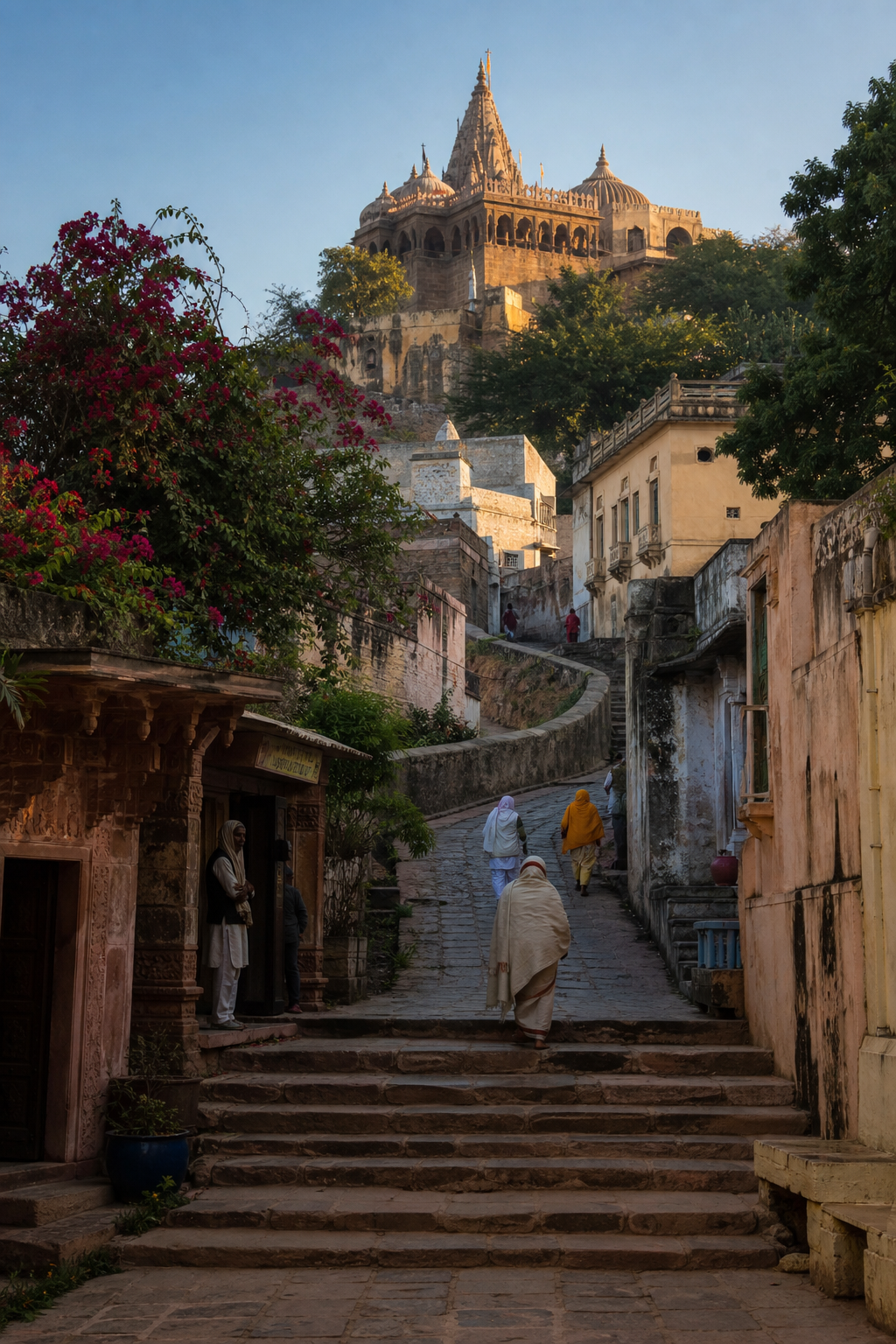
Barsana, also rendered Varsana, offers a clear education in Braj sacred geography. It is traditionally honored as the homeland of Srimati Radharani. The surrounding elevations are not anonymous scenery: Maan Garh, Dan Garh, Vilas Garh and Brahmachal carry names associated with remembered lilas of Radha and Krishna. The terrain itself helps organize devotional memory.
Within Gaudiya Vaishnava practice, Barsana directs attention toward Radharani’s compassion and sovereignty and toward the inseparability of Radha and Krishna. That emphasis should shape your pace. You have not come merely to locate Krishna stories on a hill. You have come into a landscape in which Radharani is approached as the devotional center.
The ascent: turn effort into attention
The approach to the principal temple of Srimati Radharani includes stepped paths, stone terraces and broad views across the Braj countryside. Those features make the ascent part of the practice rather than dead time before darshan.
- Begin your chosen invocation before the climb, not only when the temple comes into view.
- Walk at a pace that lets you keep the mantra intelligible. If exertion reduces japa to hurried noise, slow down.
- Use pauses to recover attention as well as breath. Look across the countryside without immediately turning the view into a photograph.
- On reaching the temple, observe the local flow before entering. Let regular worshippers and temple servants show you where shoes, queues and photography belong.
- After darshan, resist the reflex to leave at once. A short, quiet pause helps the encounter settle before the next movement.
If sustained climbing is difficult for you, shorten the circuit and center the visit on darshan rather than converting physical strain into a test of devotion. Confirm current access arrangements locally. The purpose of the ascent is attention and remembrance, not proving that your body can match somebody else’s pace.
Jaipur Mandir: let architecture slow you down
Jaipur Mandir rewards a different kind of attention. Its stonework, substantial pillars, foliated arches and latticed screens preserve a North Indian temple vocabulary shaped by remembered royal patronage. Do not reduce that architecture to an ornamental stop between more famous locations.
Watch how a threshold changes your movement. Notice how pillars establish rhythm, how a screen filters sight, and how a courtyard prepares the transition from public movement toward worship. Temple architecture does not merely contain ritual; it disciplines approach. Walk through it slowly enough to feel that change.
If you are visiting with children or people new to Hindu architecture, give them one observation rather than a lecture: choose a pillar, arch, screen or passage and ask what it makes the body do. That question turns carved stone from decoration into an intelligible part of pilgrimage.
Dan Garh: preserve the seriousness of sacred play
Dan Garh recalls the dan-lila in which Sri Krishna playfully demands a toll from Radharani and the sakhis. The episode is light in manner, but that does not make it spiritually trivial. Braj repeatedly teaches through intimacy, humor, reversal and loving contest rather than through solemnity alone.
Pause here long enough to hold both registers together. Hear the playfulness without turning the lila into a casual joke. Notice the deeper movement of bhakti: the ego that wants to pass freely and possess everything is stopped at a threshold. Love asks for surrender, but in Braj even that demand can arrive through sweetness.
The principal temple, Jaipur Mandir and Dan Garh provide a useful first orientation, but they do not exhaust Barsana. The named hills alone should warn you against treating a short route as a completed understanding of the place. When a local teacher or guide explains a site, ask three precise questions: which lila is remembered here, which tradition preserves that telling, and what conduct is customary at this spot? Those questions produce more reliable learning than pressing every local account into one uniform version.
Let your body, voice and conduct join the pilgrimage
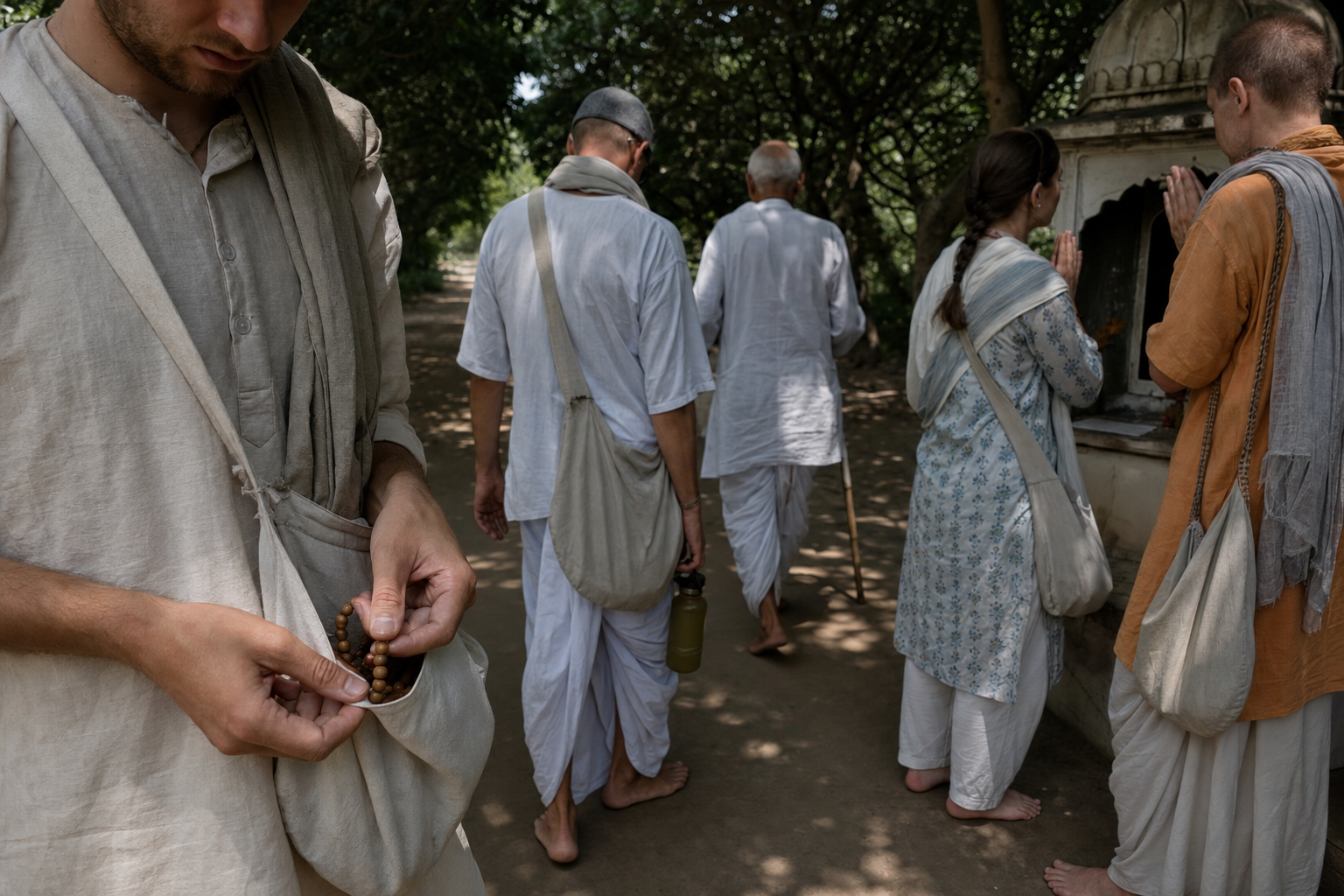
Parikrama is not sightseeing performed on foot. The sacred center remains central while you move around it. Repetition gradually exposes impatience, distraction, competitiveness and fatigue; the practice lies partly in how you respond when those habits appear.
The wider ritual grammar of yatra includes sankalpa, darshan, pradakshina, japa, dana and temple seva. You do not need to perform every available observance at every stop. Choose practices that fit the place, your lineage and your actual capacity, then perform them deliberately.
- Pause before entering the sacred precinct and recall your sankalpa.
- Observe local rules concerning shoes, entry, queues and photography.
- Receive darshan without placing the phone between yourself and the deity.
- Perform pradakshina or follow the local parikrama flow where it is customary.
- Offer one prayer connected to the place rather than reciting everything you know.
- Leave without obstructing the next pilgrim’s darshan.
Use sound as a discipline, not background entertainment
In Braj, responsive kirtan, the cadence of japa and temple bells help bind gait, breath and remembrance. This is one reason walking matters. The body receives a rhythm that a vehicle-bound sequence of arrivals cannot reproduce in the same way.
If you walk with a kirtan group, keep a pace at which you can hear and answer rather than racing ahead. If you walk quietly, settle on one invocation before beginning. Avoid filling every interval with recorded commentary. Explanation has its place, but silence lets the name, terrain and physical act of walking meet without constant interruption.
Circumambulation also belongs to a broader Dharmic grammar. Hindu pradakshina, Buddhist kora, Jain pradakshina and Sikh parkarma each place reverent movement around a sacred center within disciplined practice. Their theologies should not be collapsed into sameness, but the shared bodily insight is worth noticing: truth is not honored by thought alone. Posture, direction, repetition and humility matter.
Plan for heat, wet stone and festival crowds
Devotional intention does not remove practical limits. Early morning and late-afternoon ascents are generally preferred over midday heat, monsoon conditions require care on damp stone, and the period before Holi brings greater color, music and crowd density. Choose the atmosphere you seek and prepare for its demands.
- Carry drinking water and use shaded pauses before fatigue makes your decisions careless.
- Wear modest clothing and footwear suited to the walking surface, while remaining ready to remove shoes wherever worship requires it.
- Keep your hands free on steps and ridges. A photograph is not worth unstable footing.
- Agree on a meeting point before a group enters a dense lane or crowded temple approach.
- During monsoon conditions, shorten your stride and give wet stone more time; do not let a group timetable force unsafe speed.
- Ask before photographing inside a sanctum or people engaged in worship. When the custom is unclear, put the camera away.
- Carry away what you bring. Sacred geography is dishonored when devotional movement leaves waste behind.
Small courtesies are not separate from sadhana. Waiting without pushing, making room for elders and slower walkers, speaking quietly near worship, and accepting that you may not receive the view or photograph you wanted all discipline the same possessive impulse that parikrama is meant to loosen.
Key takeaways for your first Braj parikrama
- Map sacred relationships as carefully as roads. A list of locations cannot explain why one Braj place leads meaningfully to another.
- Choose one devotional anchor, one sustainable walking practice and one principal parikrama instead of measuring success by the number of stops.
- In Barsana, read the ascent, temple architecture, hills and lila sites as parts of one field centered on Srimati Radharani.
- Use japa or kirtan to give your walking a steady cadence. Let pauses recover attention, not merely physical energy.
- Follow local customs for shoes, entry, pradakshina and photography rather than assuming every shrine works alike.
- Plan honestly for heat, rain, steps and crowds. Shortening a route is better than turning exhaustion or unsafe haste into a badge of devotion.
- Leave something unseen. A sacred landscape should call you back into relationship, not appear exhausted by one itinerary.
Before arranging the details, write down the one Braj place you most need to approach, the name you will repeat while walking, and the conduct you want the yatra to change. Build outward from those three commitments.
When you return, keep one discipline the pilgrimage clarified – steadier nama-japa, more attentive temple conduct, service to a sacred place, or greater care for the land beneath your feet. That is how Braj remains more than somewhere you visited. Begin with one relationship, and let the geography teach you how to walk it.
References
- DharmaRenaissance Blog – Dhama in Hinduism: Unveiling India’s Sacred Geography and Transformative Char Dham Yatras
- Dandavats – Varsana Parikrama: Ascending Srimati Radharani’s Hill via Jaipur Mandir and Dan Garh