
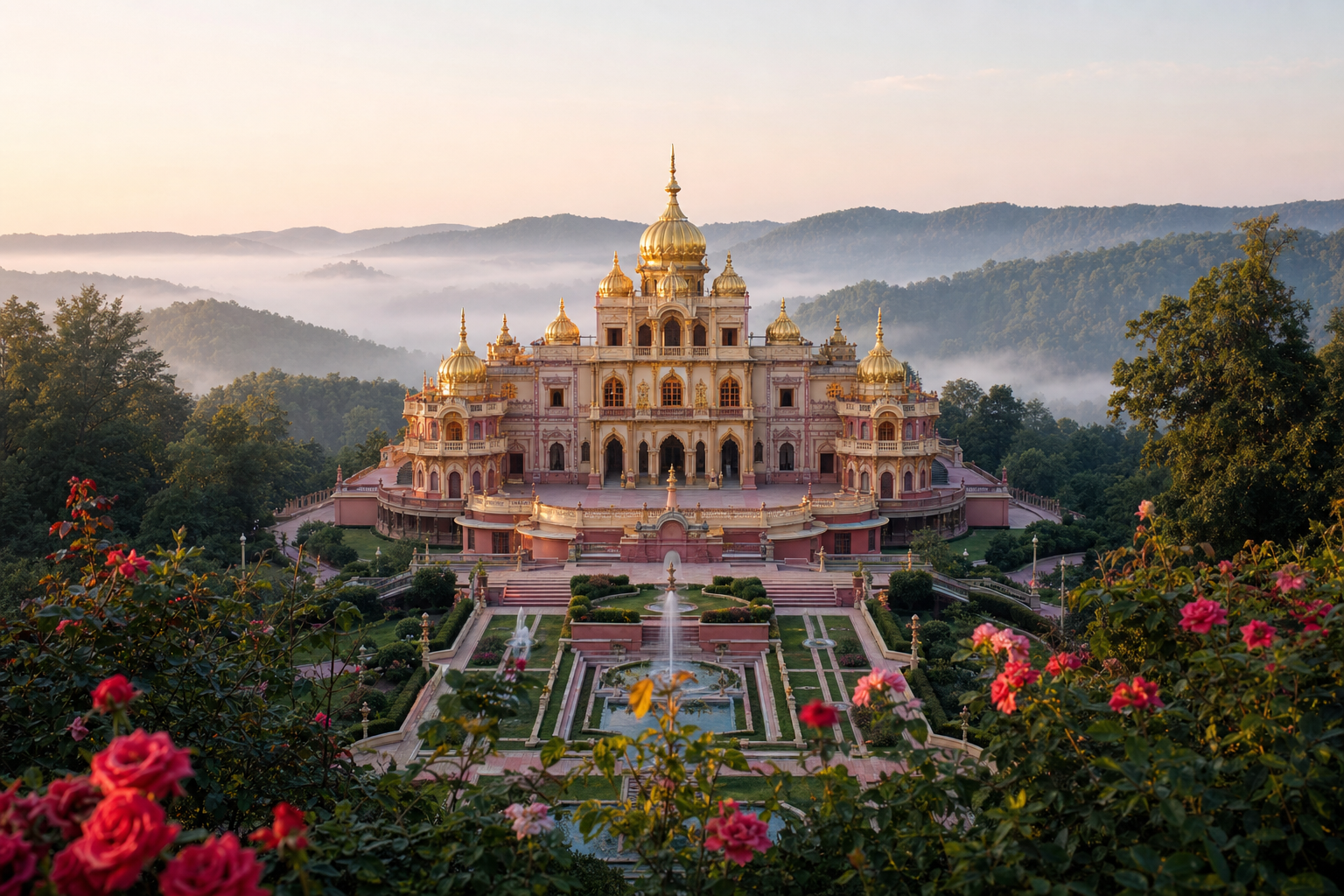
You may come to New Vrindaban expecting an unusual monument, a famous photo stop, or a fragment of India set down in the hills of West Virginia. Those impressions aren’t wrong, but they don’t tell you what the Palace of Gold is asking you to see.
Start with the work behind the beauty. The palace makes the most sense when you read it as bhakti given architectural form: remembrance shaped into a shrine, service developed into craftsmanship, and a distinctly Gaudiya Vaishnava vision made accessible to people far beyond its founding community.
Key takeaways
- The palace was conceived as a modest residence in the early 1970s and became a memorial shrine after 1977, so remembrance is central to its design.
- Much of its significance lies in how resident devotees learned demanding building and decorative trades while constructing it.
- Its ornament isn’t merely visual. Light, acoustics, ventilation, movement, and garden design support contemplation and congregational worship.
- The palace is specifically rooted in Gaudiya Vaishnavism and ISKCON, even as its discipline, humility, compassion, and pursuit of truth speak across Dharmic traditions.
- Conservation is part of the palace’s continuing life because both the original workmanship and the devotional purpose must remain intelligible.
Begin with the building’s change of purpose
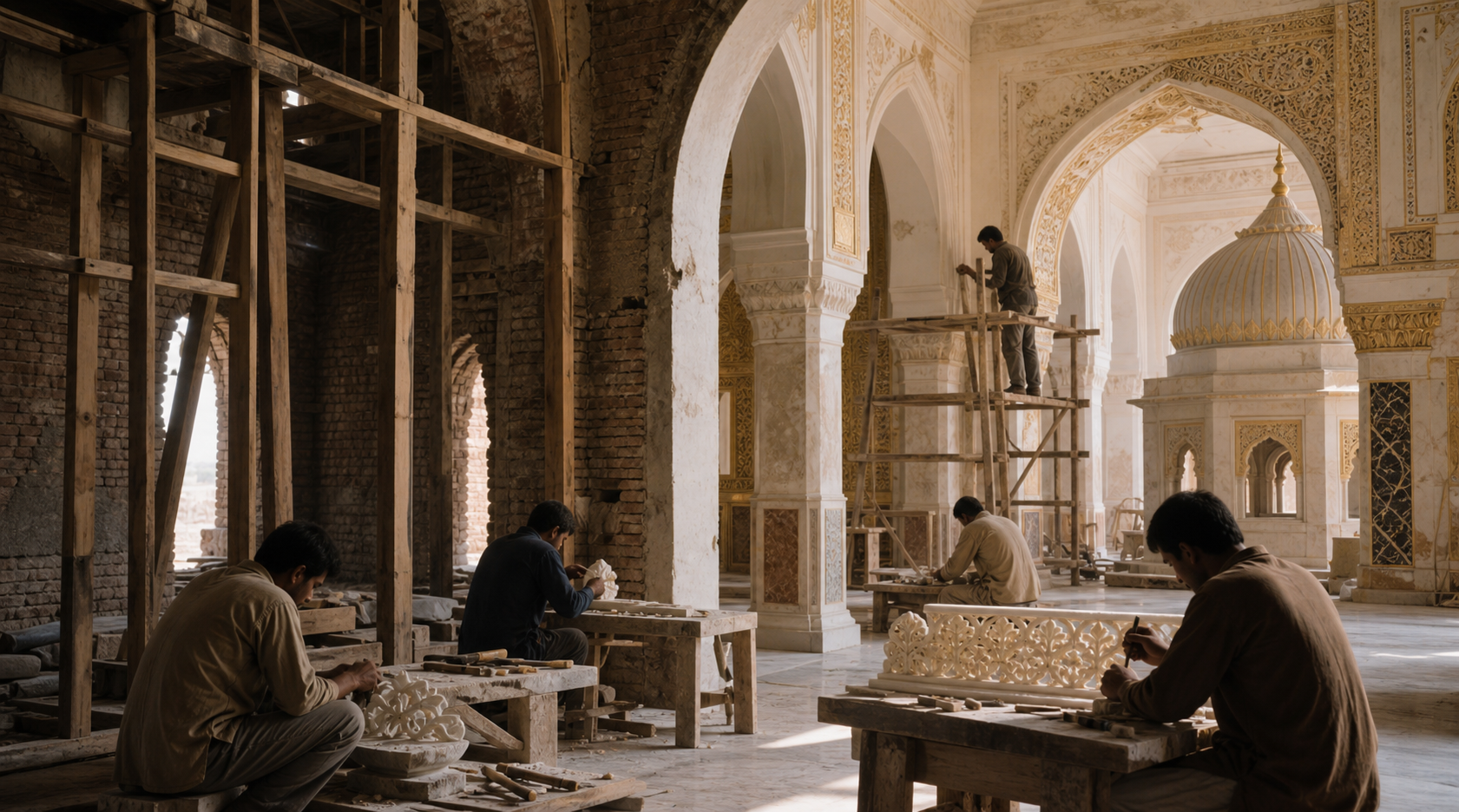
The most important fact about the Palace of Gold isn’t the amount of ornament on its surfaces. It is the change in purpose that occurred during its making. Conceived under the guidance of Srila Prabhupada in the early 1970s, it began as a relatively modest residence. After 1977, it developed into a memorial shrine honoring his life and teachings.
That history prevents two common misreadings. This isn’t an ancient Indian palace transported intact to America, and it isn’t simply a luxurious building that later acquired religious associations. It is a modern North American work of sacred architecture whose final identity emerged through remembrance.
When you enter or study the palace, therefore, don’t begin with the question, “How expensive does this look?” Ask instead: “What kind of life did this community want to remember, and why did it choose beauty as the language of remembrance?” That question changes how you see the gold leaf, carved wood, stone, mosaics, and repeated arches. They become offerings of attention rather than signs of private status.
This distinction is essential to understanding bhakti. Devotion isn’t only an inward feeling. It can organize time, labor, materials, and relationships. A memorial shrine makes that organization visible. The building teaches through the effort concentrated in it: the honored teacher is remembered not only by inscriptions or images, but by the quality of service his followers attempted to offer.
You can carry that insight beyond this particular site. Whenever you encounter sacred abundance, ask who or what the beauty is meant to serve. The same ornament can communicate prestige in one setting and self-offering in another. Purpose, practice, and ownership tell you which meaning is present.
See the handwork as a record of seva
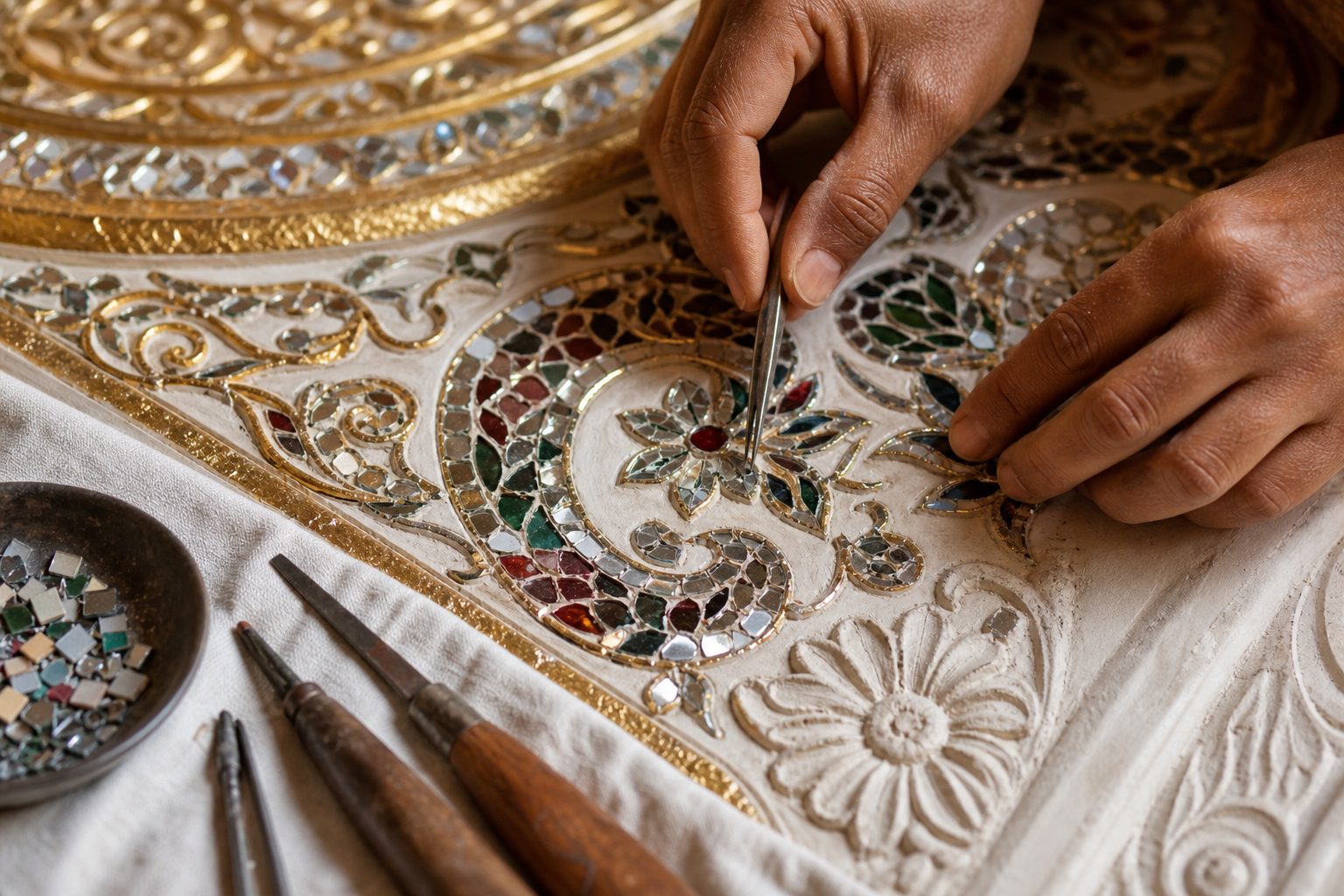
The palace’s polished appearance can hide its most instructive story. Many of the resident devotees who built it arrived with little or no formal preparation in architecture or the construction trades. They learned masonry, carpentry, glasswork, carving, and decorative work on site, teaching one another and solving problems as the project advanced.
That doesn’t mean enthusiasm replaced standards. Seva does not make weak workmanship acceptable merely because the intention is sincere. The builders joined devotional purpose to process discipline. Repeated motifs were controlled with templates and jigs. Lime-based plasters allowed fine modeling. Cold-applied leafing helped limit waste. On-site glass, metal, and carving studios allowed beginners to become increasingly capable artisans.
Look closely at four kinds of evidence:
- Repetition: Arches, cornices, and jaali-like screens reveal how templates brought coherence to work performed by many hands.
- Material transitions: Hand-cut marble, inlaid stone, carved wood, glass mosaics, plaster, and selective gold leaf required different tools and kinds of patience.
- Control of detail: Crisp edges, fitted pieces, and aligned motifs show where devotional aspiration had to become measurable craft.
- Signs of the hand: Small variations need not be treated as defects. They can preserve the difference between workshop production and anonymous factory repetition.
The useful lesson is not that formal training is unnecessary. It is that a community can build real competence when learning, production, correction, and purpose occur together. A novice receives a bounded task. A repeatable method turns that task into practice. Peer instruction spreads the method. A shared standard makes correction possible. Devotional intention gives people a reason to persist through repetition.
If you are responsible for a temple, cultural organization, or community project, this is the part worth adapting. Break the vision into teachable units, create reliable patterns for recurring work, and let experienced hands review what beginners produce. Then preserve the names, methods, templates, and workshop records. The finished object matters, but so does the capacity formed while making it.
Follow the route from light to sound to garden
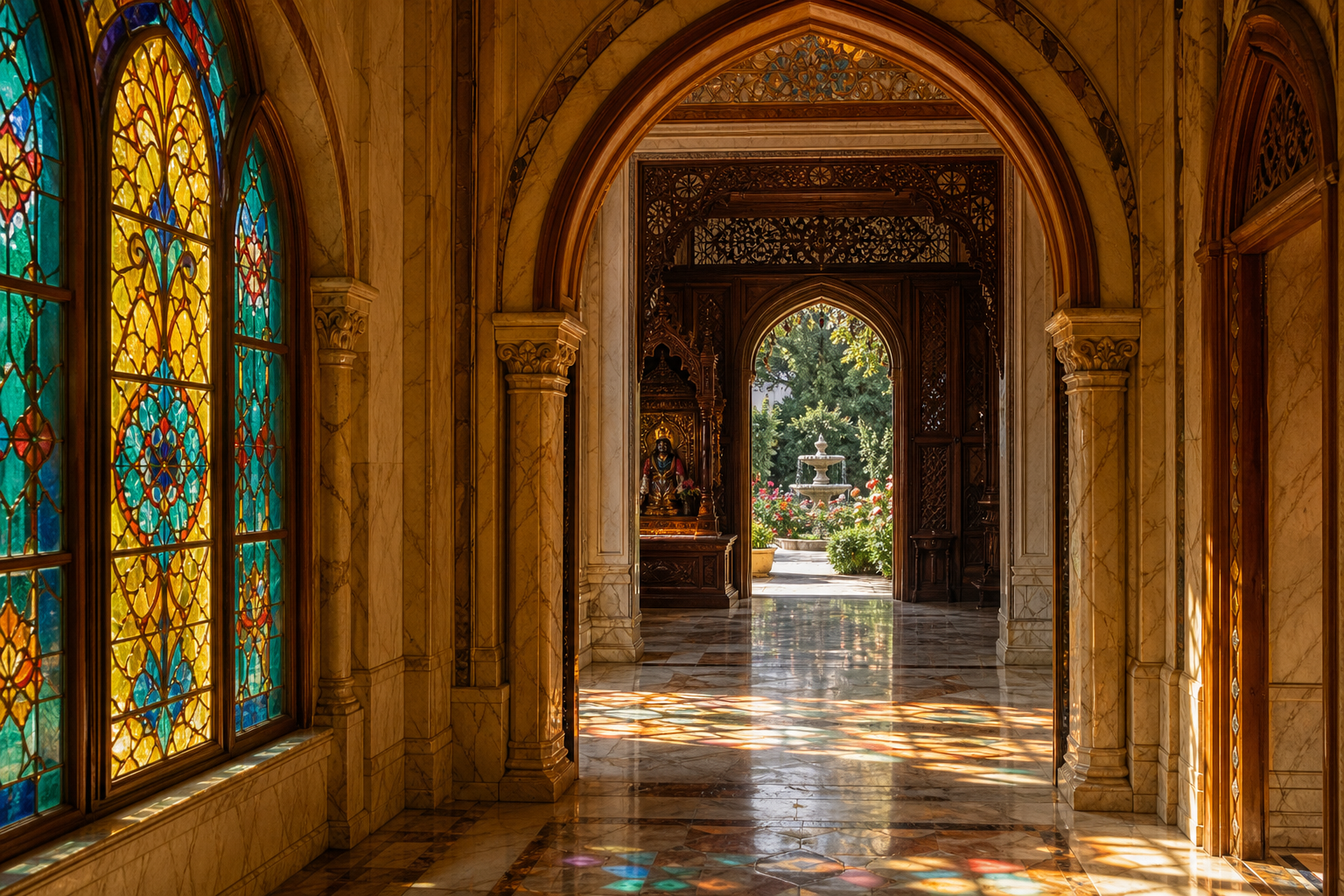
Sacred architecture is read with the body, not only with the eyes. At the Palace of Gold, ornament participates in a sequence of approach, illumination, gathering, sound, and release into the landscape. You will understand more if you slow down and follow that sequence deliberately.
- Begin with the Appalachian setting. Notice the distance between the surrounding hills and the North Indian palatial vocabulary of the building. The contrast is part of the meaning: Gaudiya Vaishnava sacred aesthetics have been translated into a North American place rather than confined to the geography of their origin.
- Watch how the light changes. The palace uses cardinal orientation, clerestory openings, and mirrored inlays to manage sunlight, glare, and interior brightness. Ask which surfaces receive direct light and which appear to glow by reflection. Gold leaf and glass become instruments for moving light through the room.
- Examine the main hall as a gathering space. Coffered ceilings and dense plaster help shape its acoustics. These choices support congregational kirtan with limited dependence on electronic amplification. The ceiling is therefore doing practical work even while it appears ornamental.
- Listen from more than one position. If kirtan is taking place, pause near the edge and then nearer the center. Attend to how voice and response occupy the room. This reveals why sacred acoustics cannot be separated from sacred practice.
- Finish in the gardens. Rose beds, water features, terraced paths, reflective pools, and axial views extend the contemplative order outdoors. The garden isn’t leftover space around the shrine. It slows movement, frames views, and gives the intensity of the interior somewhere to settle.
These features work together because bhakti engages attention through more than explanation. Stone provides weight, mirrors redirect light, gilding intensifies it, ceilings hold collective sound, and water returns the sky to your field of vision. The palace becomes most legible when you notice those relationships instead of collecting isolated decorative details.
Try making one circuit without using your camera. Choose one repeated motif and follow it from exterior to interior. Stand still long enough to notice where light originates and where it is reflected. Then take photographs after you understand the sequence. You will bring home a more accurate record because the images will correspond to the building’s logic, not merely its most glittering surfaces.
Keep Gaudiya Vaishnava identity in focus
The Palace of Gold can welcome people from many traditions without becoming religiously generic. It belongs to New Vrindaban’s Hare Krishna community and to the history of ISKCON. Its North Indian palatial forms are joined to Gaudiya Vaishnava iconography, remembrance of Srila Prabhupada, kirtan, and an understanding of beauty offered in devotional service.
Specificity is what makes genuine dialogue possible. If you erase the names, teachings, and practices that produced the palace, “Dharmic unity” becomes a vague aesthetic label. If you preserve them, you can then recognize values that resonate more widely. The construction story makes discipline, humility, compassion, and the pursuit of truth visible through action, values honored in different ways within Hindu, Buddhist, Jain, and Sikh traditions.
Use a two-pass method when you interpret the site. On the first pass, name what is particular: the Gaudiya Vaishnava lineage, Srila Prabhupada, ISKCON, bhakti, seva, and kirtan. On the second, ask what another Dharmic community can recognize without pretending its doctrines are identical. Shared ethical discipline is a stronger basis for unity than blurred religious identity.
This also improves how you describe the palace to someone else. Avoid calling it an ancient temple, a building made entirely of gold, or generic “Indian decor.” A more accurate description is: a modern Gaudiya Vaishnava memorial at New Vrindaban, developed from a residence begun in the early 1970s and transformed after 1977, with extensive volunteer craftsmanship and selective gold-leaf gilding.
That description preserves three truths at once. The palace is rooted in a particular lineage. It is a landmark of the Indian spiritual diaspora in North America. And it can introduce visitors outside that lineage to a Bharatiya understanding of beauty as a vehicle for disciplined service. Cultural confidence doesn’t require exaggeration; accurate names and an honest account of the work are more persuasive.
Treat preservation as part of the spiritual work
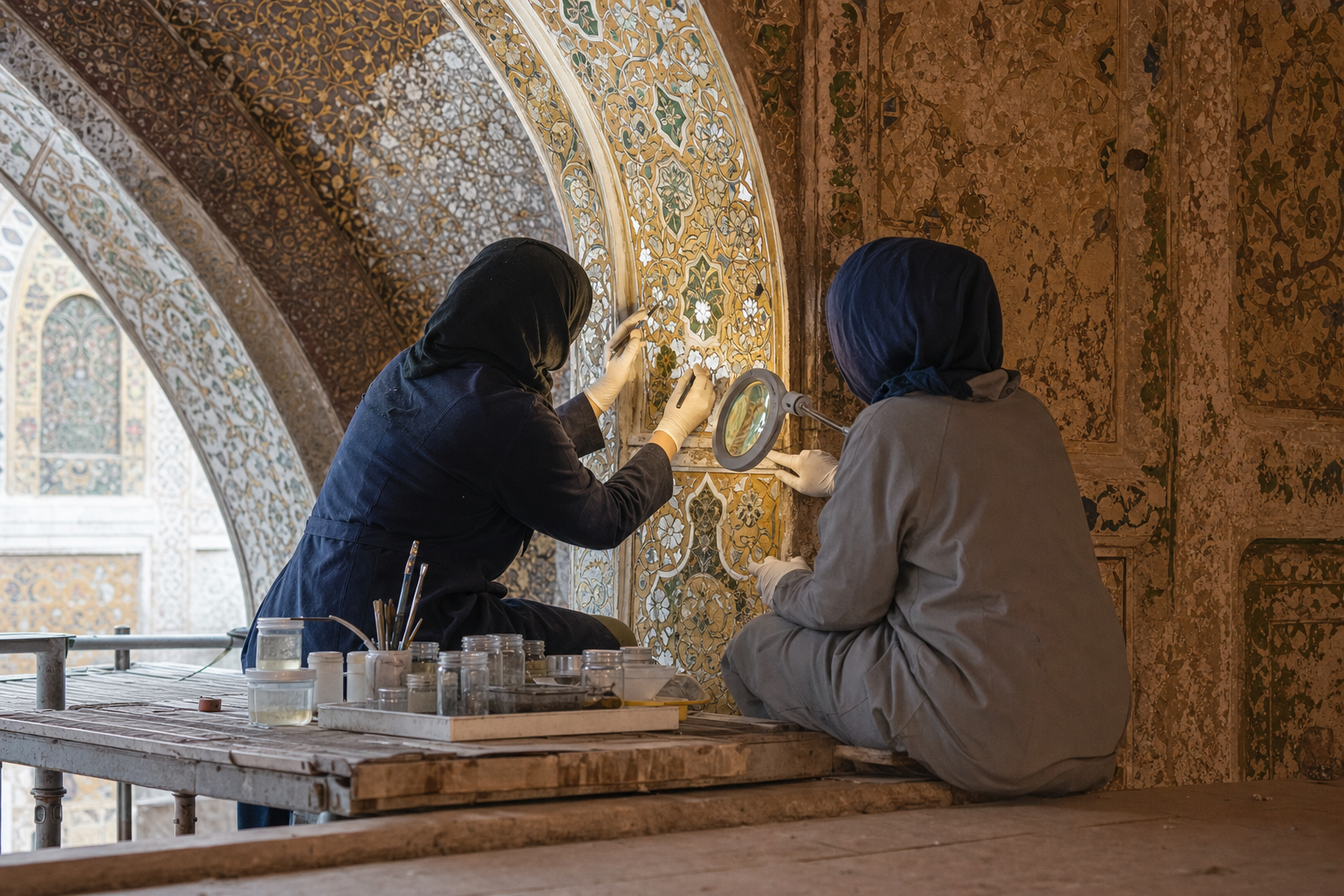
Rich surfaces are vulnerable surfaces. Weather, moisture, roof performance, drainage, aging plaster, and mechanical systems all affect whether the original artistry remains visible. Preservation at the palace has therefore included selective re-gilding, roof and drainage improvements, plaster consolidation, and mechanical upgrades.
There are two forms of continuity to protect. The first is material: original workmanship should remain identifiable instead of being erased by incompatible repairs. The second is devotional: the palace must continue to function as a place of remembrance, encounter, and living practice. A perfectly preserved shell without its community would lose part of its meaning; an active shrine whose historic fabric is carelessly replaced would lose another part.
That is why compatibility, reversibility, and documentation matter. A compatible repair behaves properly beside the older material. A reversible intervention leaves future conservators options. Documentation records what changed, where it changed, and why. These principles allow restoration to remain distinguishable from the original work without turning every repair into a visual interruption.
If you are evaluating or supporting conservation at any sacred site, ask practical questions. Has water entry been addressed before decorative surfaces are renewed? Were repair materials chosen to work with the existing plaster, stone, wood, or metal? Can the intervention be undone without destroying original fabric? Were the condition and treatment recorded? Who is learning the specialized craft needed for the next repair cycle?
Those questions treat conservation as stewardship rather than cosmetic improvement. They also honor the palace’s founding method. The first generation learned by doing; preservation should ensure that technical knowledge can pass to another generation instead of ending with a single campaign.
If you visit, give the palace one unhurried circuit. Begin with its changed purpose, trace the evidence of learned craft, stand still for the movement of light and sound, and finish in the gardens. Then carry home a demanding question: what could your own community build, restore, or teach if beauty, skill, and service were treated as one responsibility?
References
- Dandavats – New Vrindaban’s Palace of Gold: A Living Testament to Devotion, Craft, and Dharmic Unity