
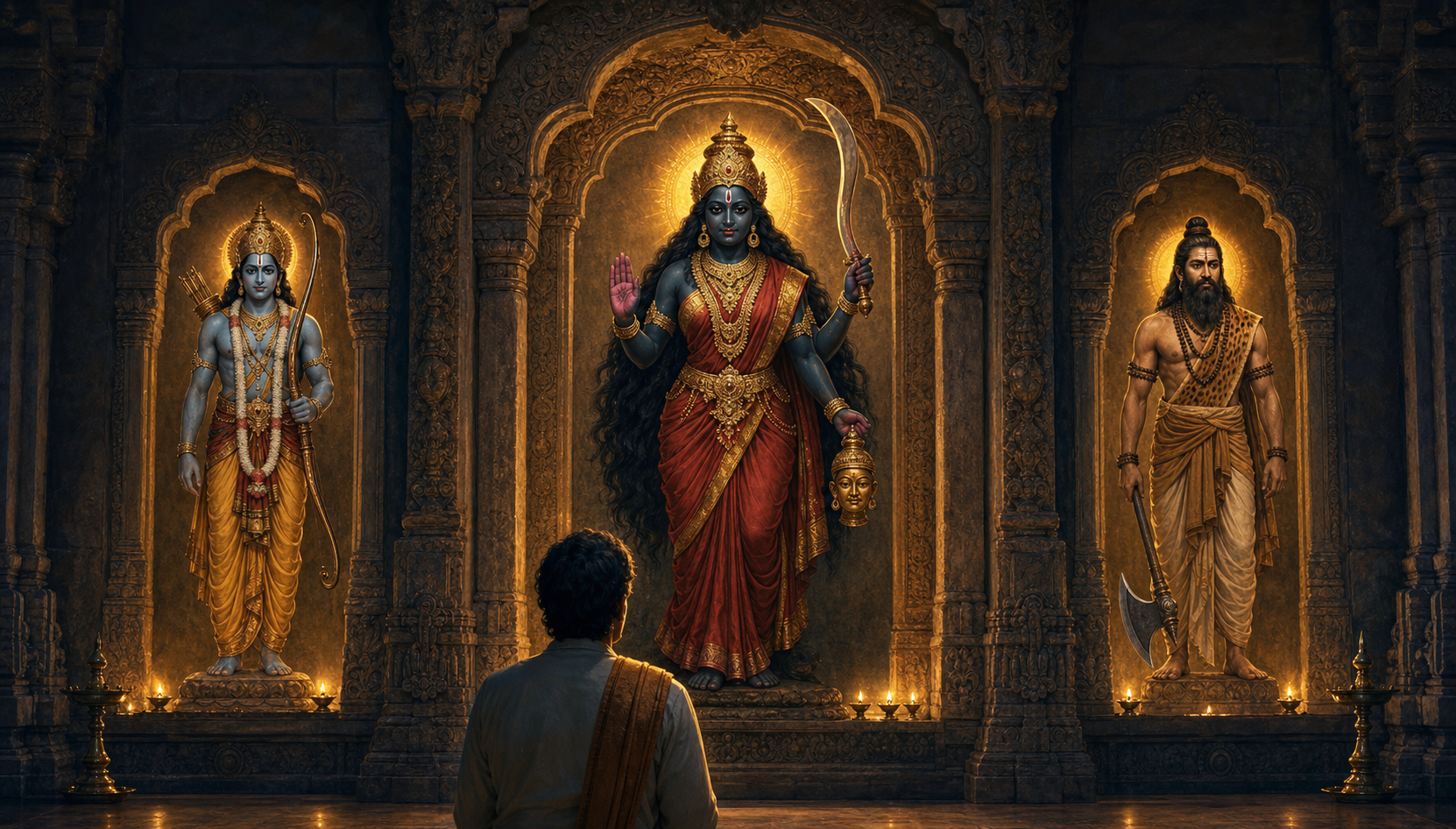
You pause before Kali holding a sword and severed head, Chamunda carrying a skull-staff, Parashurama gripping an axe, or Rama standing with his bow. Is the image teaching protection, glorifying violence, or turning a difficult myth into a spiritual metaphor?
You cannot answer from the weapon alone. Begin with the wielder, then examine the implement’s action, its target, the restraints placed upon its use, and the condition it is meant to restore. That sequence turns a disturbing collection of objects into a legible language of power, mortality, discipline, and liberation.
Begin with the wielder, not the weapon
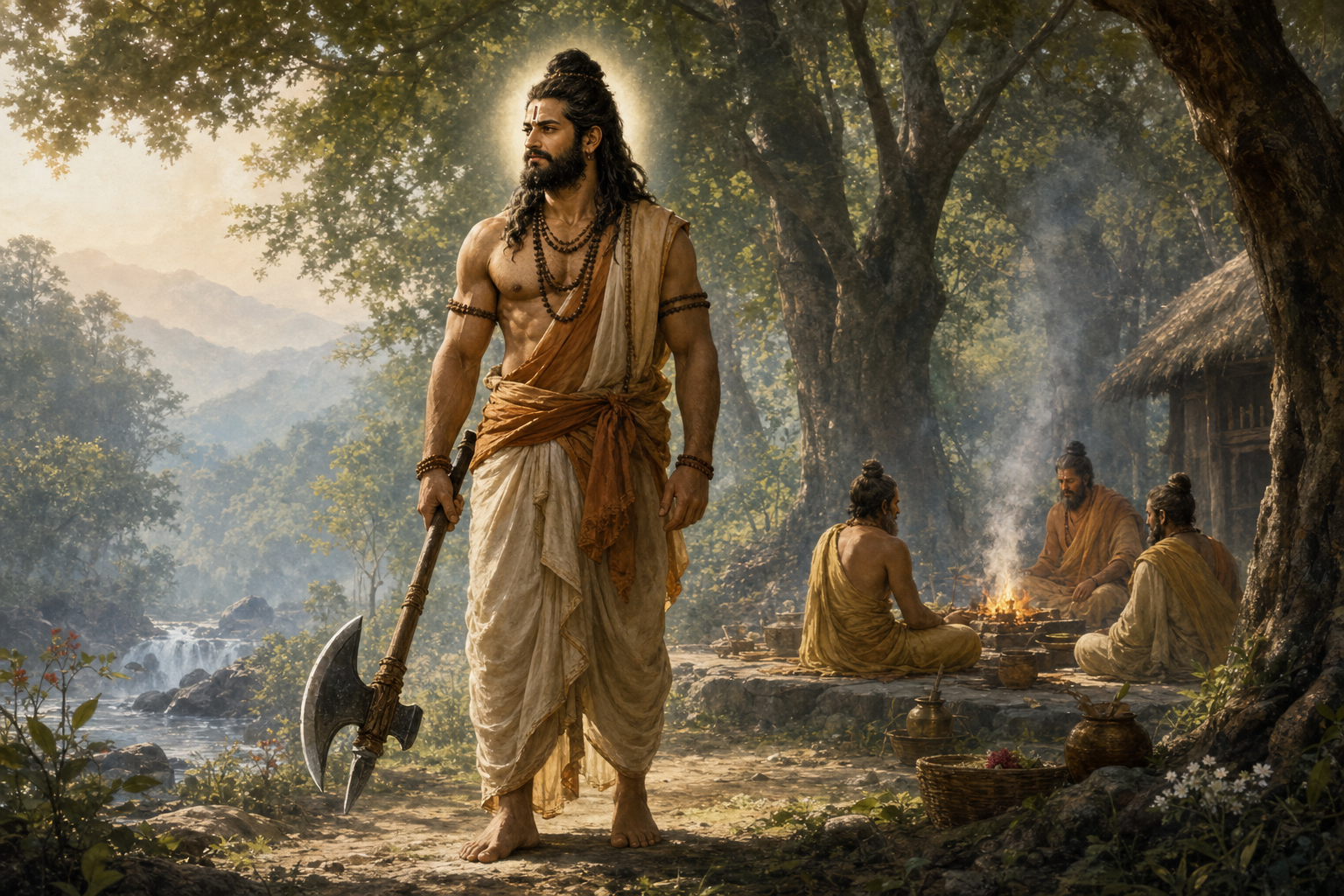
A sacred image works more like a sentence than a box of symbols. The deity is the subject. The object in the deity’s hand acts like a verb. The adversary or obstruction is the object of that verb. Posture, facial expression, attendants, mounts, gestures, and surrounding figures tell you how the action is being performed and why.
This is why no responsible reading begins with a universal formula such as weapon equals violence or skull equals evil. The same parashu can express Parashurama’s severe correction, Shiva’s removal of decay, or Ganesha’s trimming of obstacles. Its cutting action remains recognizable, but the wielder gives that action a distinct purpose.
The khatvanga presents the same challenge. It appears with Chamunda, Kali, Bhairava, tantric practitioners, and figures in Vajrayana Buddhism. The resemblance points to a shared Indic vocabulary, but it does not make every theology interchangeable. A Vajrayana figure may carry the staff as a sign of inseparable wisdom and skillful means, while Chamunda’s skull-staff emphasizes her mastery of decay, dread, and death. Identification must come before interpretation.
Start by describing what you can actually see. Record the deity’s name or form if it is known, which hand holds the object, whether that object is raised or resting, what the other hands are doing, and what appears underfoot. Distinguish a skull-bowl, or kapala, from a severed head; distinguish a khatvanga from an ordinary club; and do not call every blade a sword when an axe or another implement is clearly depicted. If a museum label or temple tradition identifies the image, let that local identification outrank a generic symbolism chart.
An image can operate at several levels at once. It may recall a narrative battle, define a deity’s cosmic function, prescribe a contemplative attitude, and encode a ritual lineage. Do not force those levels into a choice between literal history and pure psychology. First establish the form and setting. Only then ask whether an inner reading is warranted.
Read each implement as an action, not a decoration
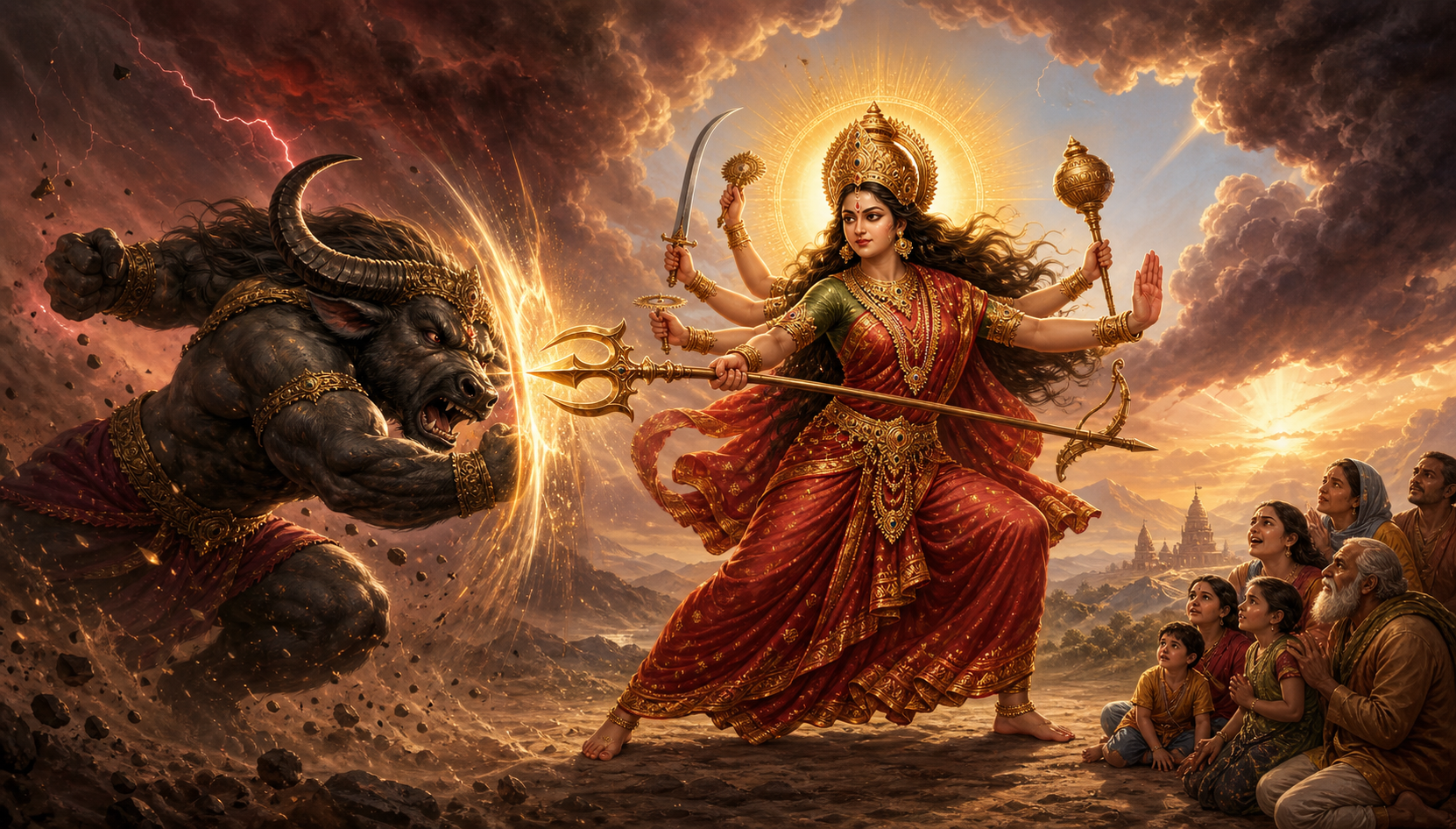
The most useful question is not simply, What does this object mean? Ask, What does it do? Cutting, aiming, piercing, holding, and supporting are different actions. Each produces a different moral and contemplative emphasis.
| Object | Literal action or form | What to examine | Common misreading |
|---|---|---|---|
| Parashu, or axe | Cuts, clears, and removes hardened material | What has become obstructive, excessive, or entrenched? | Any anger or destruction is divinely approved |
| Dhanus or Kodanda, the bow associated with Rama | Stores force, creates distance, and releases toward a selected target | What disciplines aim, timing, proportion, and release? | Righteous purpose makes restraint unnecessary |
| Astra | A specialized missile invoked through knowledge and mantra | Who possesses the discipline to invoke it, and under what conditions? | Greater sacred power means permission for indiscriminate use |
| Khadga, or sword | Severs through a direct stroke | What must be decisively separated or brought to an end? | The image celebrates cruelty for its own sake |
| Khatvanga, or skull-staff | Holds one or more skulls upon an upright staff | How are mortality, steadiness, fear, and transformed impurity related? | It is merely a grotesque battle weapon |
| Kapala, or skull-bowl | Receives and contains | What is being faced and integrated rather than denied? | Skull imagery expresses contempt for embodied life |
The axe removes; the bow calibrates
Parashurama’s axe belongs to a form of correction that is close, forceful, and uncompromising. He receives the parashu from Shiva, joining martial capacity to an authority associated with dissolution and renewal. As a Brahmin-warrior, Parashurama also embodies brahma-kshatra: knowledge and protective force held in one figure rather than treated as unrelated domains.
The recurrence of Parashurama’s campaign twenty-one times is best handled carefully. Within a symbolic reading, repetition emphasizes the recurring need to audit political power and remove entrenched excess. It is not a timetable, a modern political program, or permission to imitate vengeance. The axe clears so that order can be re-established; endless destruction would defeat its stated purpose.
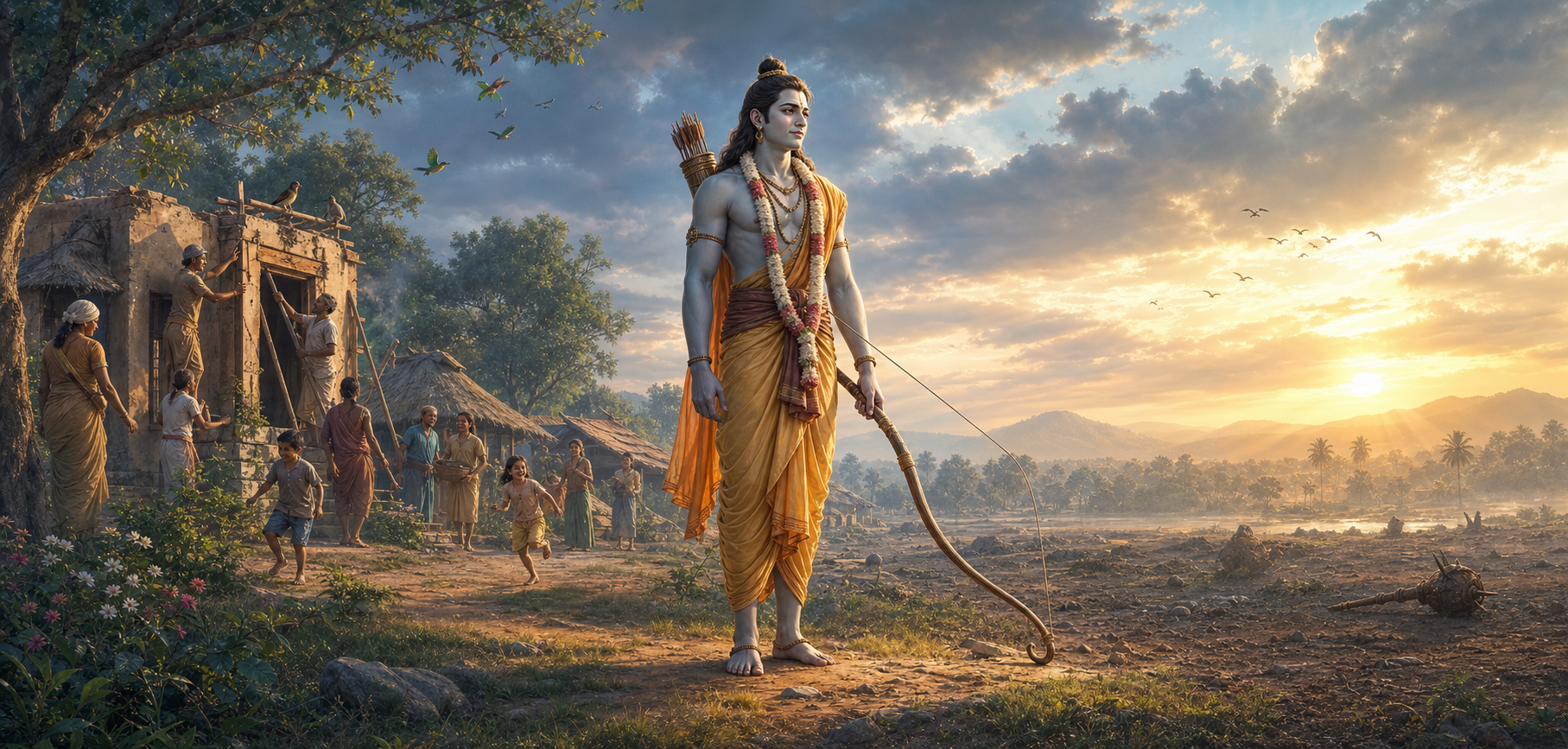
Rama’s bow presents a different discipline. A bow must be held under tension before its stored force is released. The archer has an interval in which to see, aim, assess distance, and decide. That physical structure makes the bow a fitting emblem of maryada: measure, boundary, and conduct governed by obligation.
The contrast between Parashurama and Rama can therefore be read as a movement from urgent rectification toward sustained, rule-bound protection. This is an interpretive civilizational arc, not a claim that technology mechanically produced morality. A bow does not make its owner virtuous. Its symbolism places a sharper demand on the wielder: power must pass through attention before it becomes action.
Rama’s repertoire also includes astras such as the Brahmastra, Agneyastra, and Aindrastra. Their invocation depends upon mantra-vidya, correct knowledge, and interior discipline. The lesson is not that sacred missiles are ancient versions of unrestricted superweapons. It is that increased capacity creates an increased burden of sobriety.
Om is the bow, the self is the arrow, and Brahman is the target.
Mundaka Upanishad
This inward use of archery language does not erase Rama’s duties as a protector. It shows how the same grammar can govern contemplation: prepare the instrument, steady the self, identify the true aim, and do not release attention carelessly. The outer weapon becomes intelligible through the inner discipline expected of its bearer.
The sword severs; the skull-staff makes mortality visible
Kali’s khadga expresses decisive separation. The sword is commonly paired with a severed head and read as the cutting of avidya, or ignorance. The head keeps the result of the stroke visible: what binds consciousness is not politely rearranged but brought to an end. That does not make every severed head a generic symbol of ego, however. Narrative identity, the deity’s specific form, and the surrounding composition still matter.
The khatvanga works differently. It is classically represented as a skull mounted upon a staff associated with bone, sometimes with a three-skull finial, a trident, damaru, banner, bells, or other ornaments. The skull is not concealed. It is lifted into the field of vision and held upright. Impermanence becomes something the practitioner must face without collapsing into either denial or despair.
When three heads or skulls appear, do not pile every available interpretation onto them. Shakta readings may relate the triad to will, knowledge, and action; to sattva, rajas, and tamas; or to past, present, and future. Vajrayana interpretation can relate a similar triad to the three kayas. These are lineage-sensitive alternatives, not interchangeable labels that must all be present in every sculpture.
A yogic interpretation treats the upright staff as the sushumna nadi, the central axis of ascent, with the skull at its summit associated with the opening of sahasrara. A damaru can evoke cosmic vibration, while a banner can suggest the movement of prana. Use this reading when the composition or lineage supports it. Do not assume that every artist intended a complete diagram of yogic anatomy.
Some historical ascetic settings used human bone, but temple and monastic representations are commonly made from wood or metal. That distinction matters. A consecrated tantric implement belongs to a disciplined ritual context; it is not an instruction for casual imitation or the collection of human remains. You can engage the image’s teaching without reproducing its material form.
Fierce does not mean cruel
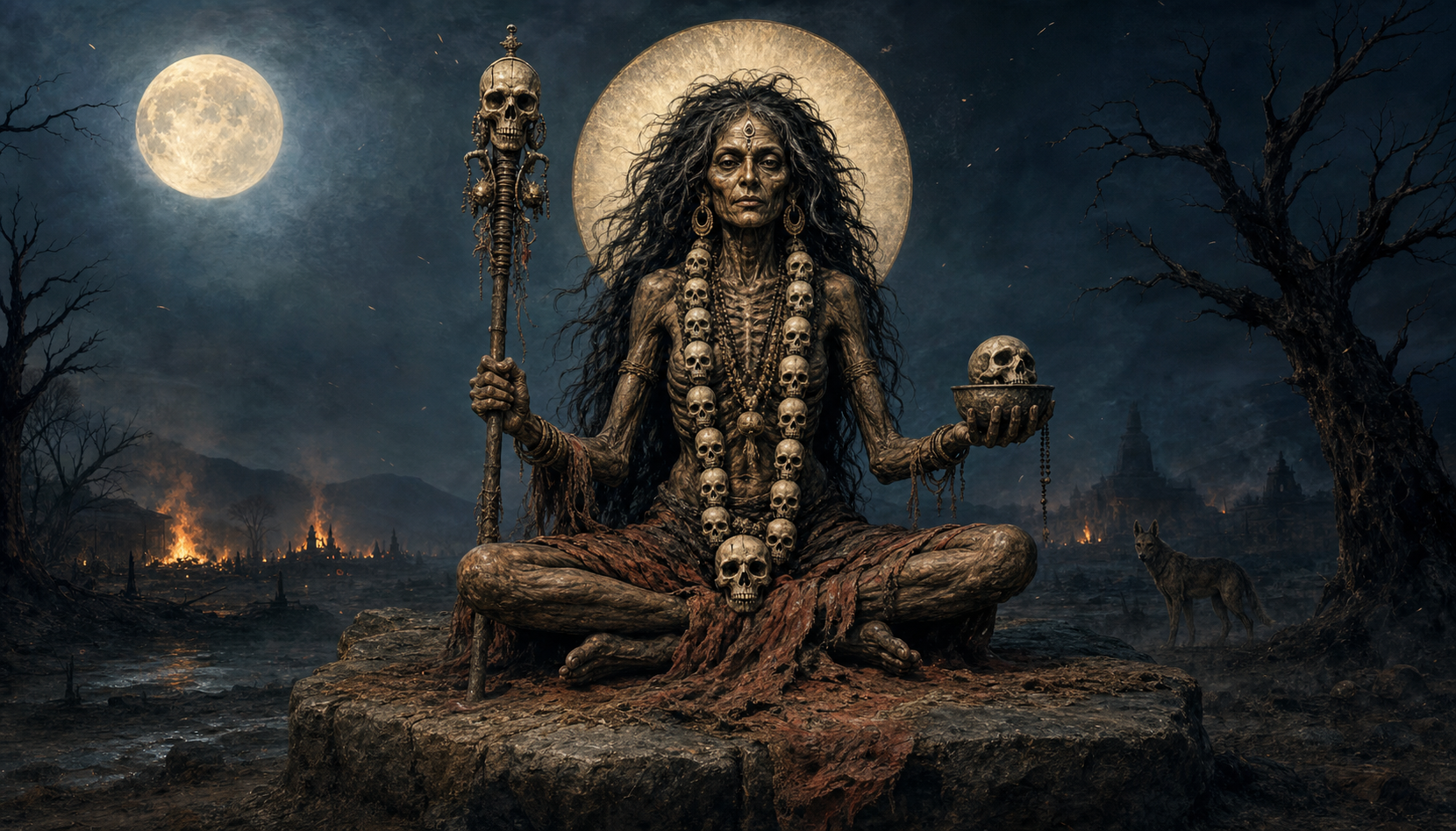
Fierceness describes a mode of presence: direct, unsoftened, and capable of confronting what ordinary consciousness avoids. Cruelty is different. Cruelty takes suffering as an end or pleasure. Fierce Hindu iconography usually asks whether destructive capacity is subordinated to protection, truth, liberation, or restored order.
Chamunda makes this distinction difficult to ignore. She may appear emaciated, garlanded with skulls, accompanied by jackals, carrying a khatvanga, and seated upon a corpse or panchamundi asana. Nothing in the composition lets the viewer hide from bodily decline. Yet death has changed position: it is borne as an emblem, occupied as a seat, or placed under the goddess’s authority. She is not consumed by the condition she reveals.
Cremation-ground imagery performs a similar reversal. The place most closely associated with endings becomes a field of awakening. Objects conventionally treated as impure are not introduced for shock alone; they are drawn into a discipline that confronts fear and attachment. The theological claim is not that death is pleasant. It is that truth cannot liberate you while mortality remains something you refuse to see.
You need not pretend that such an image is aesthetically comfortable. Discomfort is often useful evidence about where to look. Name the exact feature that disturbs you: the exposed teeth, emaciated body, blood, corpse, skulls, or severed head. Then notice what the deity does with it. Is it held, worn, contained, stood upon, or transformed into a seat? The relationship carries more meaning than the frightening object by itself.
Two shortcuts should be resisted. The first concludes that an armed or skull-bearing deity simply celebrates bloodshed. The second sanitizes every battle, corpse, and weapon into a harmless metaphor for self-improvement. Hindu sacred images can preserve actual narrative conflict while also speaking about ignorance, fear, pride, time, and attachment. The symbolic reading deepens the narrative; it need not delete it.
This is where fierce compassion becomes more than a comforting phrase. Compassion that merely preserves every existing condition would also preserve exploitation, delusion, and fear. Fierce iconography asks whether love can remove what is destroying life without learning to love destruction itself. That is a harder moral problem than either pacifist sentiment or martial enthusiasm admits.
The decisive test is whether force bows to dharma
A weapon in a divine hand signifies capacity. It does not signify that force is always required, that every wielder is righteous, or that a sacred goal excuses every method. Kshatra Dharma concerns protection and the ethics of power. Its central question is not whether strength exists, but whether strength remains governable when action becomes necessary.
Purpose provides the first constraint. Parashurama’s axe removes an obstruction so that dharmic order can again become possible. Rama’s bow protects an order whose guardian also submits to maryada. Read together, the two forms distinguish force used to correct a breakdown from force disciplined by continuing responsibility. Neither form makes private anger sacred merely because the angry person claims a just cause.
Discrimination provides the second constraint. The warfare ideals associated with the Ramayana prohibit attacks upon the unarmed, the sleeping, and non-combatants, while recognizing surrender. The epic world also contains breaches, disputes, censure, and consequences. That complexity is important: dharma is not proved by attaching a noble label to a side. Conduct remains open to judgement.
Self-command provides the third constraint. The greater the astra, the greater the required mastery of knowledge, invocation, timing, and consequence. The bow’s distance can create room for deliberation, but distance alone does not produce virtue. Ethical value comes from the wielder’s capacity to see clearly and withhold release when release is not justified.
A stopping point provides the fourth constraint. Dharmic force is directed toward protection or restored balance, not perpetual punishment. Once surrender is offered or the threat has ended, continued destruction changes the character of the action. An interpretation that celebrates limitless violence, hatred of a population, or domination for its own sake has severed the weapon from the dharma that is supposed to govern it.
This framework also clarifies the relationship between ahimsa and protection. Ahimsa cannot be reduced to passivity, but neither can protection become a slogan that empties non-violence of force. Distinct Dharmic traditions resolve the tension differently: Buddhism elevates dhamma-vijaya, Jainism places radical weight upon ahimsa and self-discipline, and Sikh dharma joins spiritual character with protective courage through the sant-sipahi ideal. These are related ethical responses to power, restraint, and responsibility, not proof that all Dharmic doctrines are identical.
Sacred iconography therefore cannot serve as a shortcut around law, legitimate authority, careful judgement, or personal restraint. Its demand moves in the opposite direction. If you invoke a divine weapon as a moral symbol, you also inherit the limits placed upon its wielder: a protective end, a discriminating target, disciplined means, and a clear point at which force must cease.
Key takeaways: five questions to ask before interpreting
- Who holds the object? Identify the deity, the particular form, and the relevant temple, textual, regional, or tantric lineage before assigning a meaning.
- What does the object physically do? An axe removes, a sword severs, a bow stores and directs force, an astra specializes it, a bowl contains, and a staff holds something upright.
- What is the target? Distinguish a named narrative adversary from cosmic disorder and from an inner obstruction such as avidya, pride, greed, attachment, or fear. More than one level may be active, but none should be assumed without context.
- What restrains the power? Look for aim, posture, mantra, discipline, codes of combat, acceptance of surrender, and the wielder’s emotional composure. Power without a limiting principle is not the full iconographic message.
- What condition is restored? Ask what becomes possible after the cutting, confrontation, or victory: protection, right order, clear perception, fearlessness, or liberation. If no restorative end can be identified, reconsider the interpretation.
Apply the method to Rama and the bow becomes more than a royal weapon. Its stored tension asks about deliberation; its aim asks about discrimination; Rama’s identity as Maryada Purushottama asks whether the protector is himself governed by limits. If the bow rests rather than being drawn, do not impose combat upon a scene that may instead communicate readiness.
Apply it to Parashurama and the axe communicates severe removal. Its edge asks what has become too entrenched for gentler correction. His connection with knowledge and kshatra asks who is qualified to judge and act. The clearing must make room for dharma; otherwise severity has decayed into vengeance.
Apply it to Chamunda and the skull-staff no longer looks like random horror. The skull identifies mortality, the upright staff introduces steadiness, and the corpse or cremation-ground setting shows what the goddess has brought under her dominion. The viewer is being asked to face fear without being ruled by it.
At your next darshana, museum visit, or encounter with a sacred image, give the form one uninterrupted minute before decoding it. Name the holder, object, action, target, restraint, and restored condition. If two interpretations remain possible, keep both provisional and check the local tradition. You do not need to make a fierce image comfortable. You need to see whether its power is disciplined enough to serve dharma.
References
- DharmaRenaissance Blog — From Axe to Bow: Parashurama and Rama’s Weapons across India’s Civilizational Evolution
- DharmaRenaissance Blog — Decoding the Khatvanga: Skull Staff of Chamunda & Kali—Fearlessness, Tantra, and Transcendence