You may know the deity’s name, recognize the episode, and still feel that an Indian sculpture or classical performance is withholding its meaning. The figure is richly adorned, the dancer’s gestures are precise, yet the beauty can look like decoration surrounding a story you have not learned to read.
You do not need to memorize an encyclopedia of symbols before you can look intelligently. Begin with relationships: how the hair contains or releases energy, how the body carries weight, where the gaze travels, what costume amplifies, and which emotional atmosphere gathers around those choices. This method will let you form a careful interpretation within a few passes while leaving room for regional, sectarian, and artistic variation.
Sacred beauty is a mode of knowledge, not surface decoration
In much of Indian sacred art, beauty does not sit on top of meaning. It makes meaning perceptible. A sculptor does not merely give a goddess an attractive coiffure, jewelry, stance, and expression. These elements work together to disclose a quality of presence: composed, maternal, sovereign, playful, heroic, contemplative, fierce, or world-shaking.
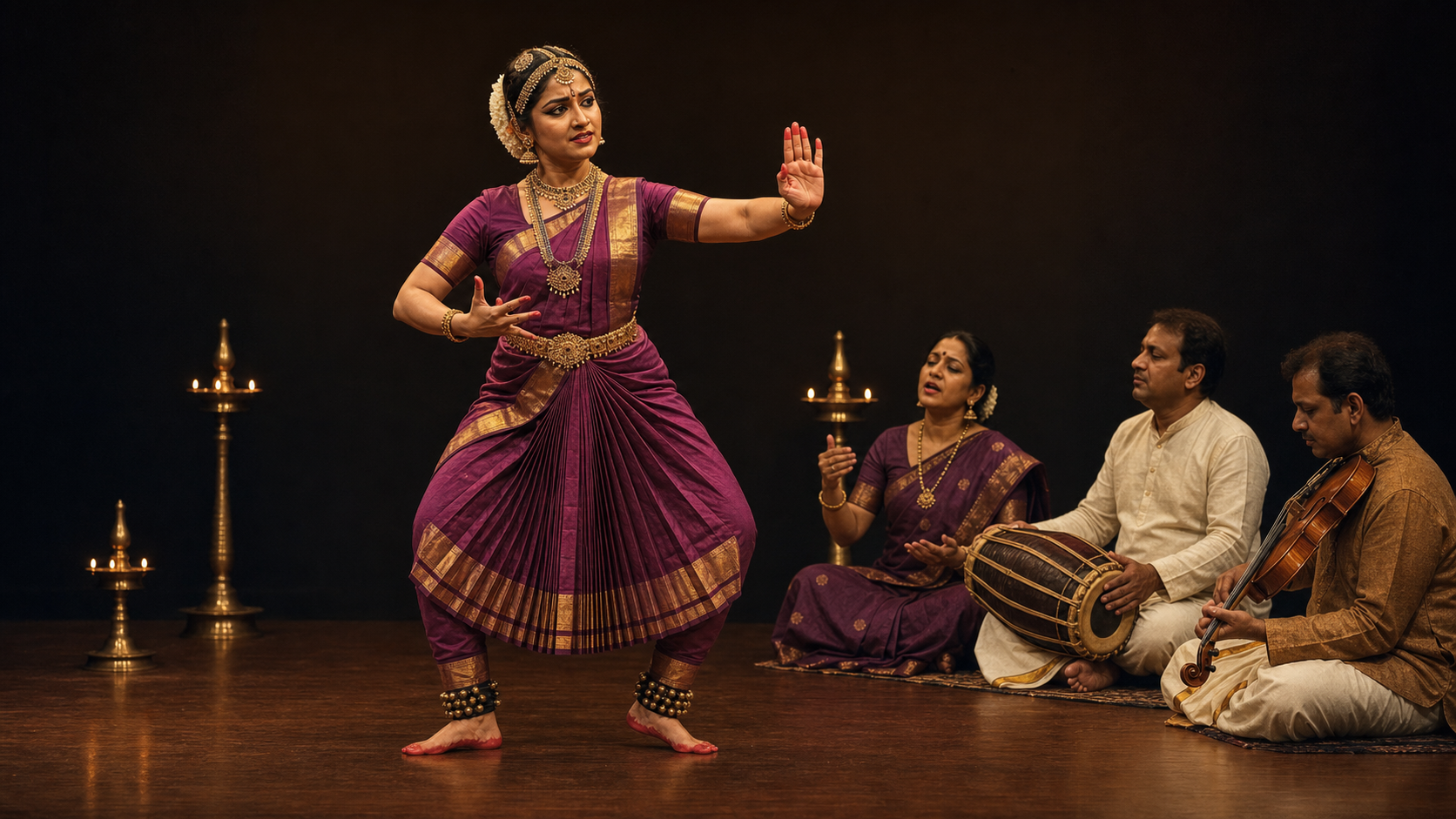
The same principle governs performance. A dancer’s glance is not an isolated signal, and costume is not a frame around the real action. Posture, movement, voice, music, dress, and psychophysical intensity cooperate in abhinaya, the carrying of meaning toward the spectator. The sacred and aesthetic dimensions meet when disciplined form alters the quality of your attention.
This changes the first question you should ask. Do not begin with, What does this single ornament mean? Ask instead, What mode of being do all these choices produce together? A compact hair-knot may suggest composure, but its force becomes clearer when the face, body axis, hands, ornaments, and narrative setting support that reading. One sign gives you a possibility. Converging signs give you an interpretation.
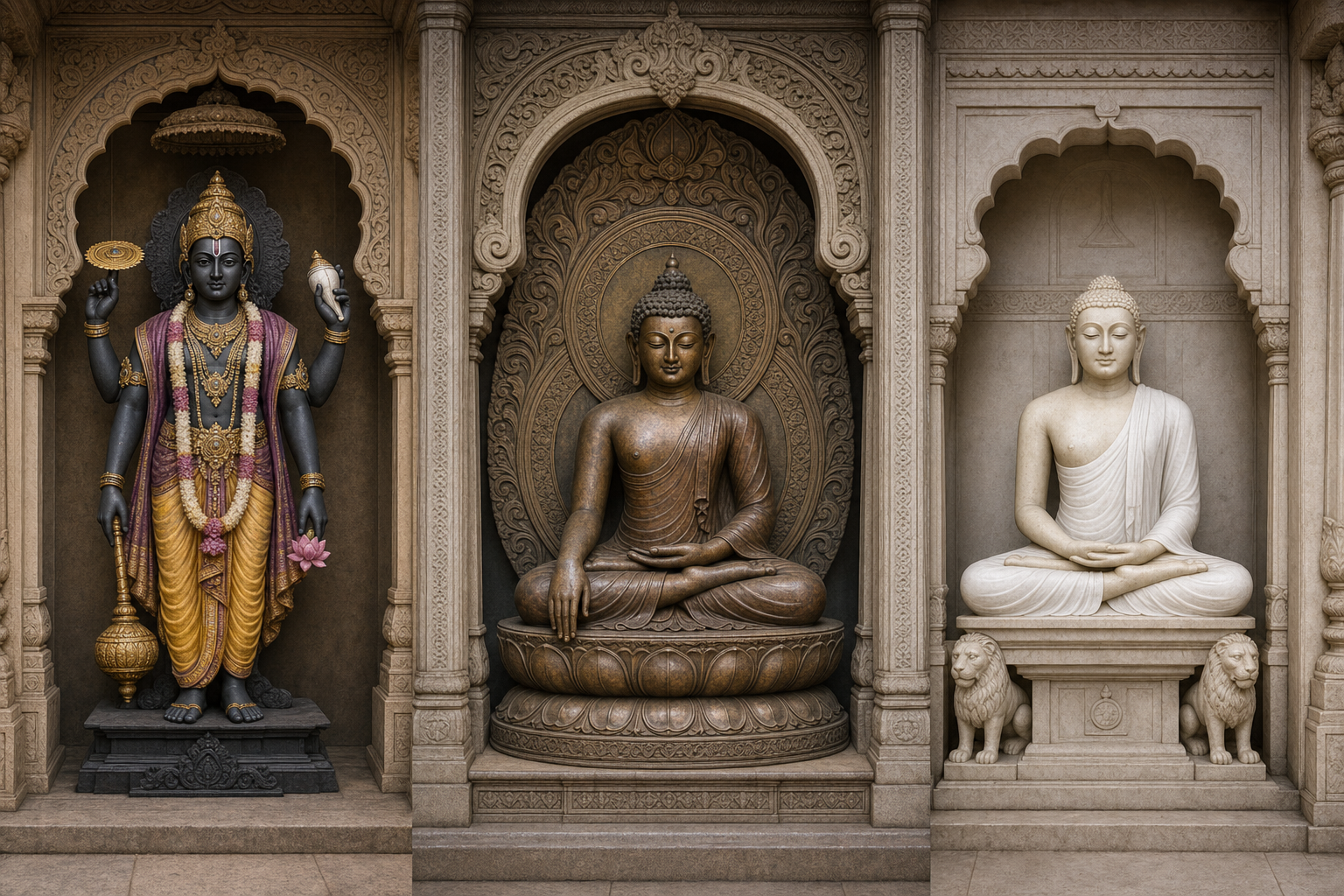
This also protects you from the symbol-dictionary mistake. Indian sacred aesthetics has recognizable conventions, but it is not a mechanical code in which one feature always yields one identity. Workshop style, period, material, ritual use, and the deity’s particular manifestation all matter. Read the whole form before naming it.
Begin with the coordinated visual grammar
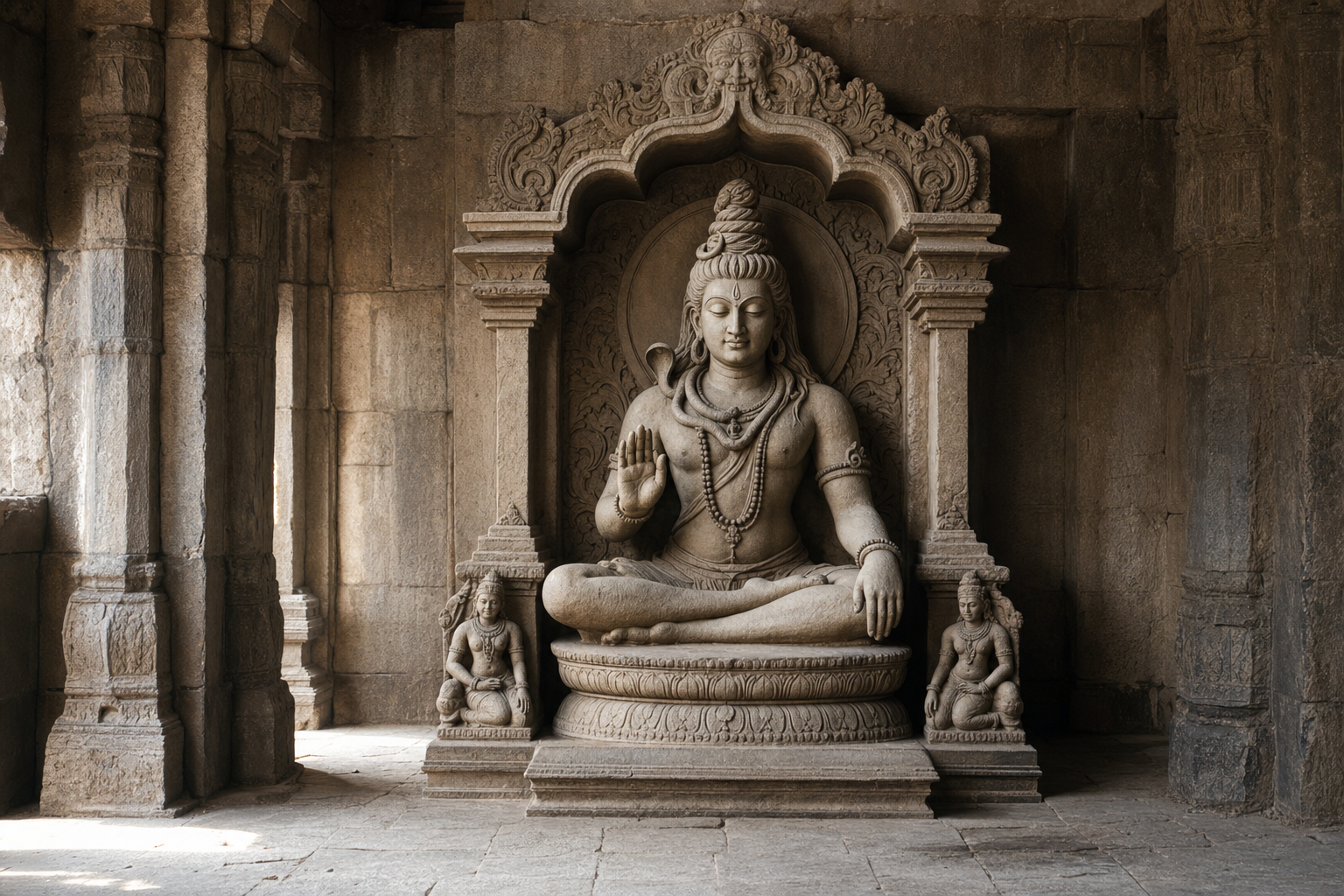
Hair is often the quickest point of entry because it shows whether energy has been gathered, disciplined, crowned, loosened, or made ascetic. A dhammilla, broadly understood as a tied and coiled hair-knot, commonly gathers centrally parted hair into a compact bun at the back or slightly above the crown. Flowers, jeweled clasps, fine curls, and a calm hairline can reinforce its association with auspicious and benevolent presence. This grammar of contained hair appears in goddess, yakshi, Buddhist, and Jain imagery, although its exact shape changes across regions and periods.
In benign forms of Lakshmi and Parvati, the gathered knot often supports a reading of ordered, sovereign grace. In Tamil traditions, related arrangements are remembered as kondai; the side-placed Andal Kondai is especially recognizable in iconography and dance costuming. A floral rim, rakodi disc, or hair-chain does more than increase opulence. It makes the gathering of the hair visually decisive.
Loosened hair, or muktakeshi, points in another direction. It can make divine power appear expansive, turbulent, protective, or beyond ordinary social containment. Fierce forms such as Kali frequently employ this vocabulary. That does not make loose hair untidy, nor does it make tied hair passive. The contrast is between different conditions of shakti: force concentrated into an auspicious center and force released into overwhelming action.
Keep hair distinct from crown architecture. A mukuta may cover, incorporate, or rise above an underlying knot. Jata-based arrangements carry their own ascetic and energetic associations. If you treat every projection behind the head as a crown, or every crown as hair, you can misread the figure before reaching the face.
| What you observe | What to examine | What you may provisionally infer |
|---|---|---|
| Hair and head arrangement | Parting, containment, knot position, loose strands, flowers, jewels, crown, or jata | Whether the figure’s energy is composed, expansive, regal, ascetic, or fierce |
| Body axis | Balance, weight shift, lifted chest, bent limbs, directional pull, and relation to the pedestal | Stillness, readiness, grace, effort, command, or movement held at a charged instant |
| Hands and gaze | Where they point, whom they address, and whether they agree with each other | Blessing, protection, invitation, refusal, narration, contemplation, or dramatic response |
| Adornment and costume | Density, symmetry, floral elements, weapons, attributes, textiles, makeup, and head ornaments | Role, status, ritual mode, emotional register, and the aspects the artist wants the eye to notice first |
| Surface and material | Incised lines, drilled recesses, polished planes, bronze contours, and the way light catches them | How technique intensifies softness, radiance, containment, motion, or awe |
Use the final column as a set of hypotheses, not verdicts. If the hair seems serene but the stance, attributes, and surrounding figures communicate battle, the narrative context outranks your first impression. Matrika imagery is a useful reminder: tied, partly loosened, and more forceful arrangements may appear according to the manifestation and scene.
Regional style also calibrates the code. Early figures associated with Mathura and the Bharhut-Sanchi orbit may use more voluminous buns. Gupta and post-Gupta sculpture often turns the knot into a compact center of visual order. Chola and later Nayaka bronzes integrate tied hair with flowers and jewelry, while Hoysala stone carvers render strands and ridges with almost textile-like precision. Vijayanagara and Nayaka ornament can become abundant without displacing the bun as the compositional anchor. Identify the broad relationship between containment and mood first; investigate the regional name and date afterward.
Material changes how this language reaches you. Stone can separate coils through parallel incisions, shallow drilling, and finely pecked texture. Lost-wax bronze permits soft spirals and subtle relief, sharpened after casting through chasing. If viewing conditions allow, shift your position slightly and notice what raking light reveals. A hairline that looks flat from the front may become the quiet boundary around which the entire head is organized.
Let sculpture move and performance hold still
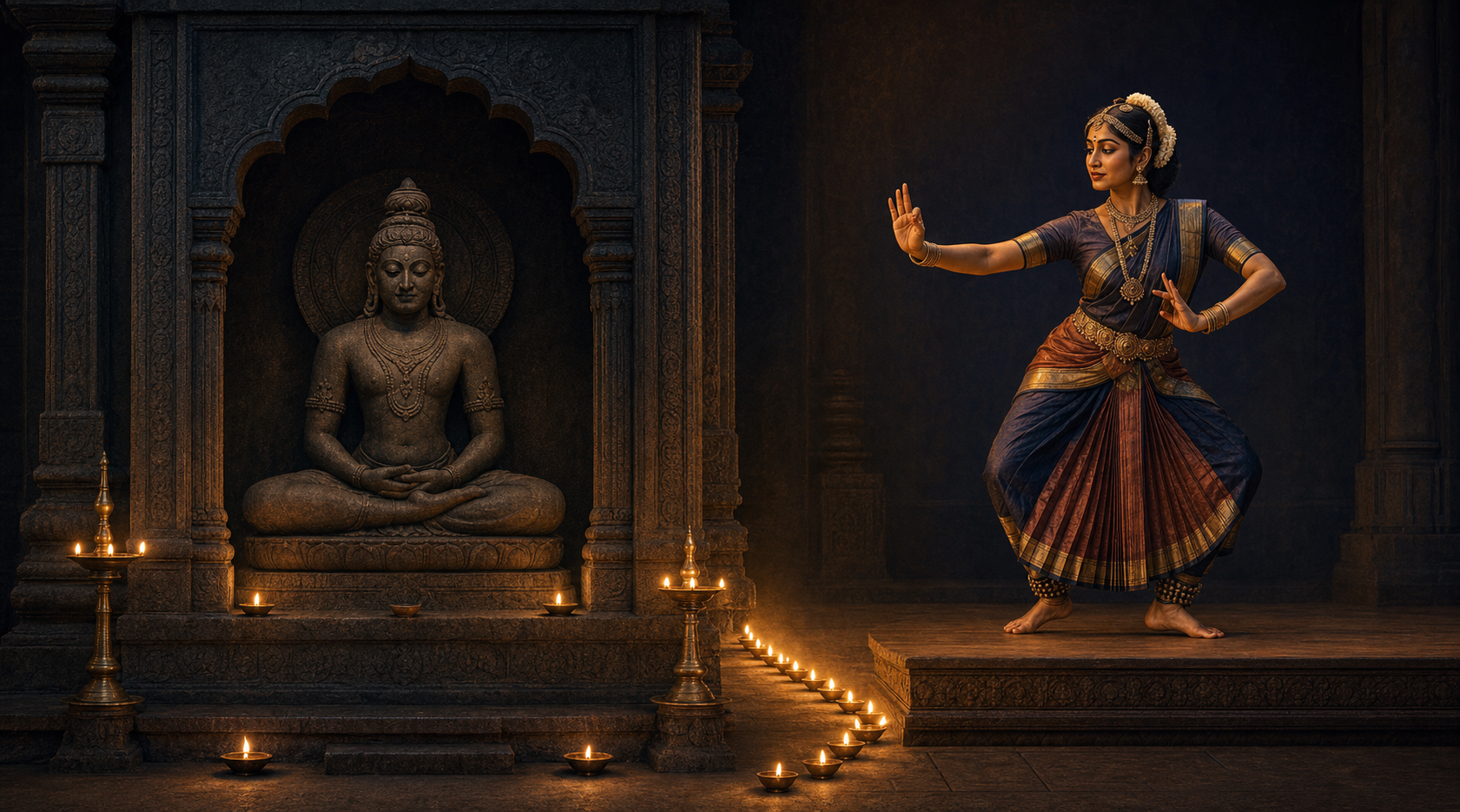
Indian sculpture and performance become easier to understand when you let each illuminate the other. Sculpture is not always static in conception. A bent knee, turning waist, raised arm, or sideways glance can preserve the pressure of movement before or after the moment shown. Performance, conversely, becomes legible when you mentally hold a phrase still and inspect how its parts cooperate.
The Natyashastra’s four modes of abhinaya provide a practical bridge:
- Angika is bodily expression: posture, gait, limbs, hands, face, and glance.
- Vachika is verbal and vocal expression: speech, diction, prosody, and intonation.
- Aharya is the constructed visible world: costume, ornaments, makeup, scenic elements, and stage appearance.
- Sattvika is the intense psychophysical register in which an inner state becomes perceptible through signs such as tears, horripilation, pallor, or a choked voice.
A sculpture gives you the strongest direct evidence for angika and aharya. Its face and bodily tension may suggest sattvika intensity, but you should be cautious about treating a carved expression as proof of an involuntary state. Vachika belongs to the performed or remembered narrative rather than to the material object itself. A label, inscription, recited story, or ritual setting may restore that missing dimension.
When watching dance, make three passes. During the first, follow the body’s axis, the direction of the gaze, and the route of the hands without trying to decode every gesture. During the second, notice how costume, music, rhythm, and vocal material change the same movement. During the third, ask what situation has been established and what response the performer is making visible. This sequence prevents a familiar error: translating individual hand gestures while missing the sentence formed by the whole body.
The distinction among nritta, nritya, and natya helps refine those passes. Nritta foregrounds patterned movement and rhythmic form. Nritya joins movement to expressive communication. Natya develops dramatic representation through character, situation, and action. A performance may move among these registers, so do not demand narrative information from every rhythmic passage or reduce every expressive passage to decorative movement.
The connection becomes especially visible in the 108 karanas memorialized in temple sculpture. They show how a carved configuration can hold bodily action rather than merely pose for inspection. This does not mean that every dancing figure is a literal notation that can be reconstructed without context. It means you should look for kinetic logic: where the weight came from, where it is going, and what counter-movement keeps the composition alive.
Try the reverse exercise with a live or recorded performance. When a movement phrase completes, remember one instant as if it were a bronze or relief. Examine the head, hands, torso, hips, legs, costume, and gaze as one composition. Then let the movement resume in your mind. You will begin to see why temple sculpture can appear rhythmically active and why a dancer can produce sculptural clarity without becoming rigid.
Read rasa without flattening religious difference
Rasa is often reduced to a list of facial expressions. That shortcut misses the mechanism. An expression becomes aesthetically meaningful only within a situation, through visible consequences, passing emotional shades, and the spectator’s capacity to receive them as something more than one person’s private feeling.
The Natyashastra organizes this process through several connected terms. Vibhavas are the determinants that establish the situation: the person, object, environment, or event capable of awakening an emotion. Anubhavas are the outward consequences through which that emotion becomes perceptible. Vyabhichari- or sanchari-bhavas are transitory states that support, complicate, and color the more durable sthayibhava. Rasa emerges through their coordination rather than from any one component in isolation.
Abhinavagupta’s decisive move was to locate rasa in the spectator’s universalized aesthetic relish rather than in the actor’s private emotion. Through sadharanikarana, the represented state is loosened from ordinary egoic ownership. You can experience grief, love, courage, terror, or wonder intensely without confusing the staged situation with a personal emergency.
The familiar range includes shringara or love, hasya or the comic, karuna or pathos, raudra or fury, vira or the heroic, bhayanaka or fear, bibhatsa or disgust, adbhuta or wonder, and shanta or tranquility. In Abhinavagupta’s account, shanta has a culminating importance because tranquility can harmonize the other aesthetic experiences. Yet a calm mouth or lowered eyelid does not automatically establish shanta. You still need the situation, bodily language, surrounding figures, and overall direction of attention.
Before assigning a rasa to a sculpture or scene, ask five questions:
<!– wp:list {