
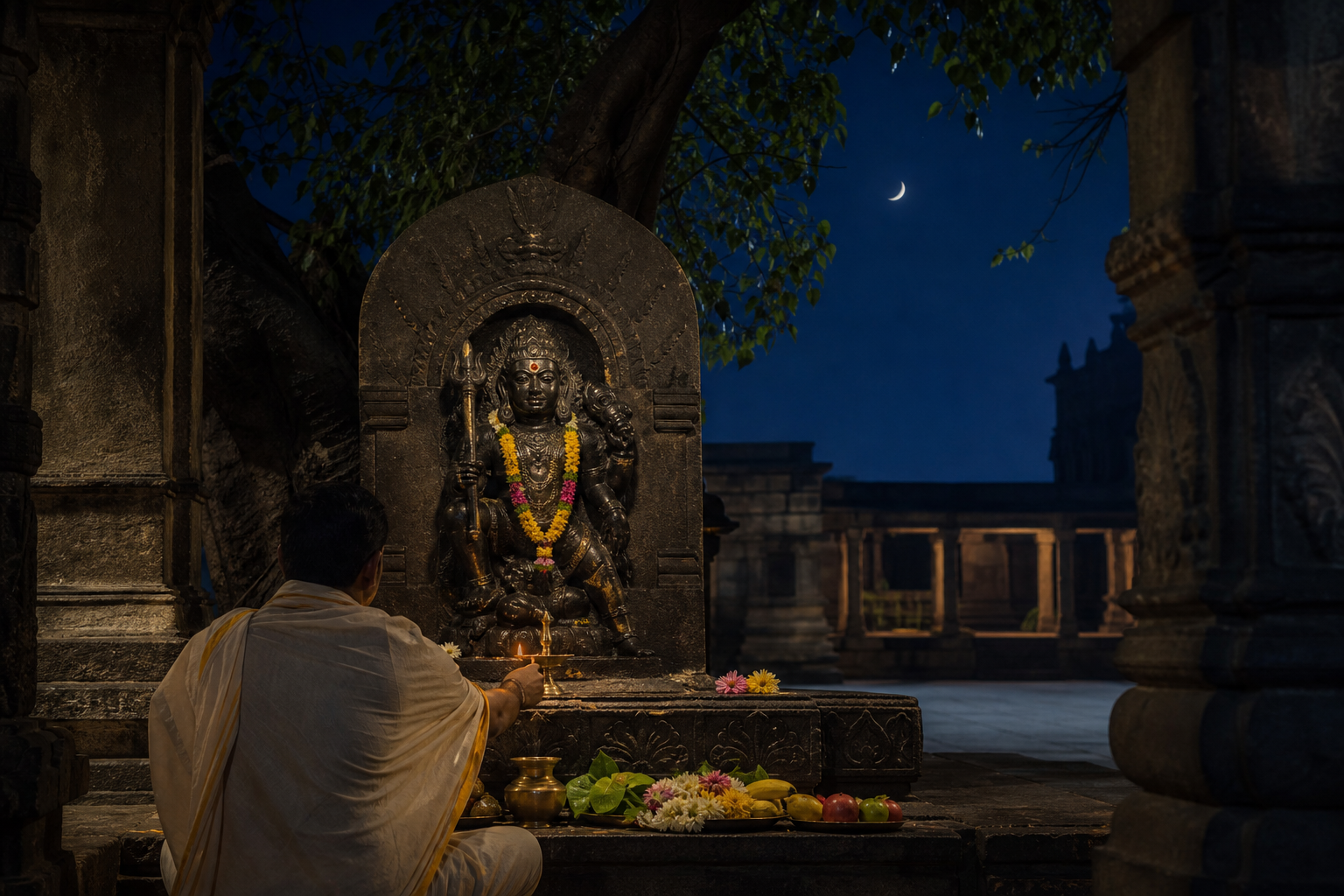
If you are trying to decide when to observe Kalashtami on Sunday, June 7, 2026, the civil date alone will mislead you. The day begins under Krishna Paksha Saptami, while Krishna Paksha Ashtami arrives only late at night. That boundary determines when Ashtami-specific sankalpa and Kalabhairava worship properly begin.
The practical answer is that Saptami prevails until approximately 10:12 PM in most regions, followed by Ashtami. Treat 10:12 PM as a planning marker, however, rather than a universal time for every location. Confirm the transition in a Panchang calculated for your city before beginning the vrata.
Key takeaways for June 7
- Krishna Paksha Saptami is the sunrise tithi on June 7, 2026.
- Krishna Paksha Ashtami begins at about 10:12 PM in most regions, subject to local calculation.
- Prepare for Kalashtami during the day, but begin the Ashtami-specific sankalpa and worship only after your local Panchang shows that Ashtami has started.
- A full fast is not the only possible observance. A partial fast, simple puja, stotra recitation, and dana can form a coherent vrata when health or responsibilities limit you.
- The Ashtami starting time is not automatically the time to break a fast. Follow your regional calendar or family parampara for parana.
Why June 7 contains two different tithis
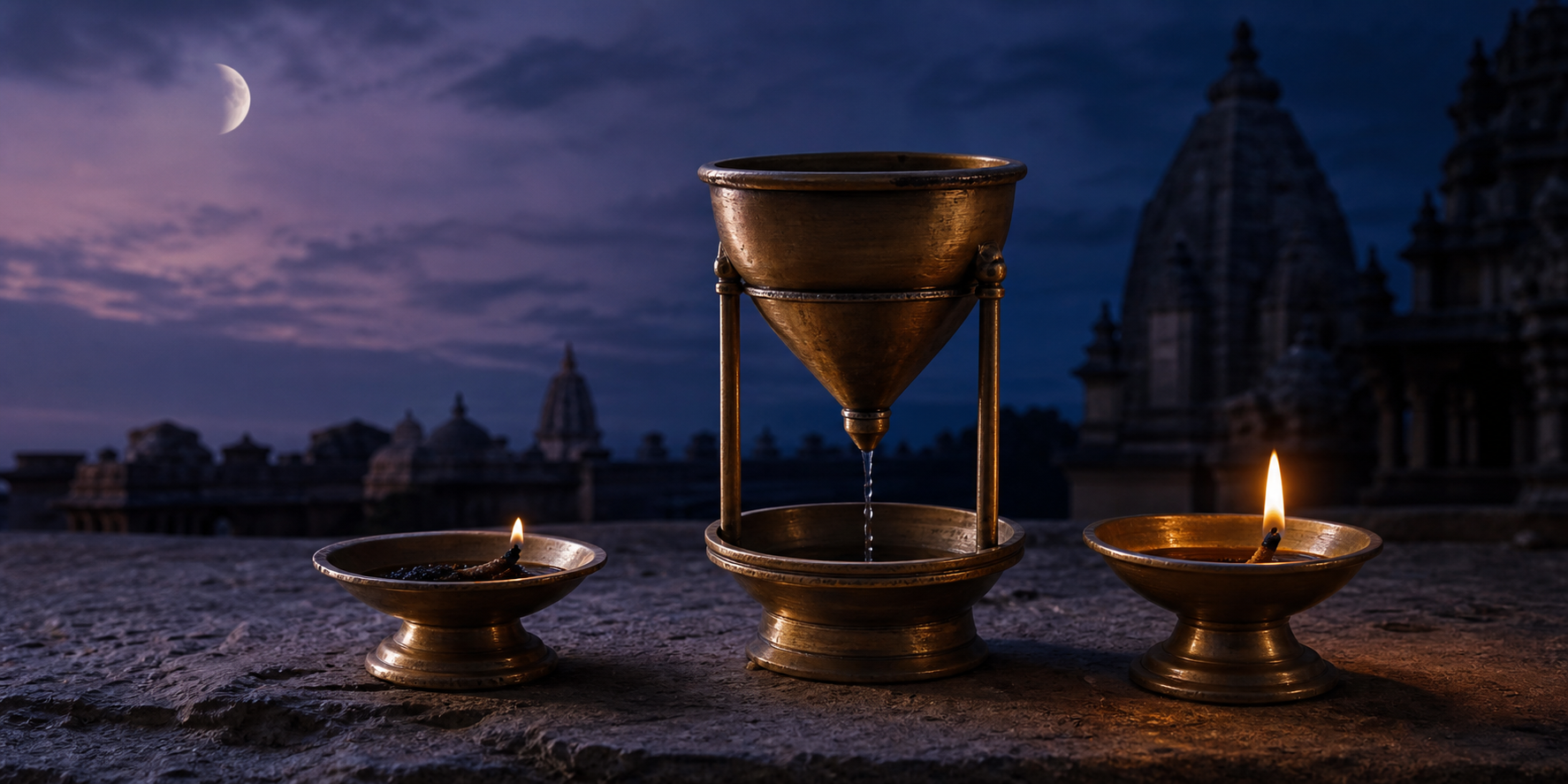
A tithi is not a fixed 24-hour date. It is determined by the changing angular distance between the Moon and the Sun. Each tithi covers 12 degrees of relative lunar-solar longitude, producing 30 tithis during a synodic lunar month. Because the Moon does not move at a perfectly uniform speed, a tithi can begin or end at almost any civil-clock time.
This is why Sunday cannot simply be labelled either “Saptami” or “Ashtami” for all purposes. At sunrise on June 7, Krishna Paksha Saptami is prevailing. That makes Saptami the udaya tithi, the lunar day present at sunrise. At approximately 10:12 PM, the tithi changes, and the remainder of the night falls under Krishna Paksha Ashtami.
Udaya tithi is important in many festival decisions, but it is not a universal rule applied identically to every vrata. Some observances depend on the tithi at a particular part of the day or night. Kalashtami is connected with Krishna Paksha Ashtami and Kalabhairava worship, so the late-night transition matters directly. If your intention is to perform Ashtami-specific worship on June 7, wait until Ashtami actually begins in your location.
This distinction also explains why two calendars may appear to disagree. One may identify June 7 primarily by its sunrise tithi and therefore print Saptami prominently. Another may highlight the late-night commencement of Kalashtami. Before concluding that either calendar is wrong, check whether it is naming the civil day, the sunrise tithi, the beginning of the vrata, or the principal worship period.
A workable schedule for the day
You do not need to leave every preparation until 10:12 PM. The useful distinction is between preparing for the observance and formally beginning the Ashtami-aligned portion of it.
- Confirm the local transition. Look up the Panchang for the city where you will perform the worship. Verify the displayed location, time zone, sunrise, and Krishna Paksha Ashtami starting time. Do not copy a clock time calculated for another city.
- Choose the form of vrata in advance. Decide whether you will keep a full fast, a partial fast, a restrained sattvic diet, or worship without fasting. Your health, medication schedule, work, caregiving duties, and family custom should shape this decision.
- Use the Saptami hours deliberately. Complete any Saptami-aligned sankalpa or rite before the local transition. The daytime can also be used for scriptural reading, inward reflection, preparing the puja place, arranging the lamp, and setting aside dana.
- Begin the Kalashtami sankalpa after Ashtami starts. If your local Panchang agrees with the approximately 10:12 PM transition, start after that time rather than moving the worship earlier merely for convenience.
- Keep the late-night observance proportionate. A short, attentive puja performed under Ashtami is more accurately aligned than an elaborate Ashtami-specific ceremony completed while Saptami is still prevailing.
- Obtain the parana rule separately. The beginning of Ashtami tells you when its worship can start; it does not by itself establish when every form of fasting should end. Use the parana instruction given by your local Panchang, temple, or family tradition.
If you are following a household or lineage calendar that assigns the principal vrata to a different civil date, retain that practice unless you have a sound reason to change it. Panchang observance is not improved by combining the festival date from one system, the tithi time from another, and the parana rule from a third.
A simple Kalashtami observance after Ashtami begins
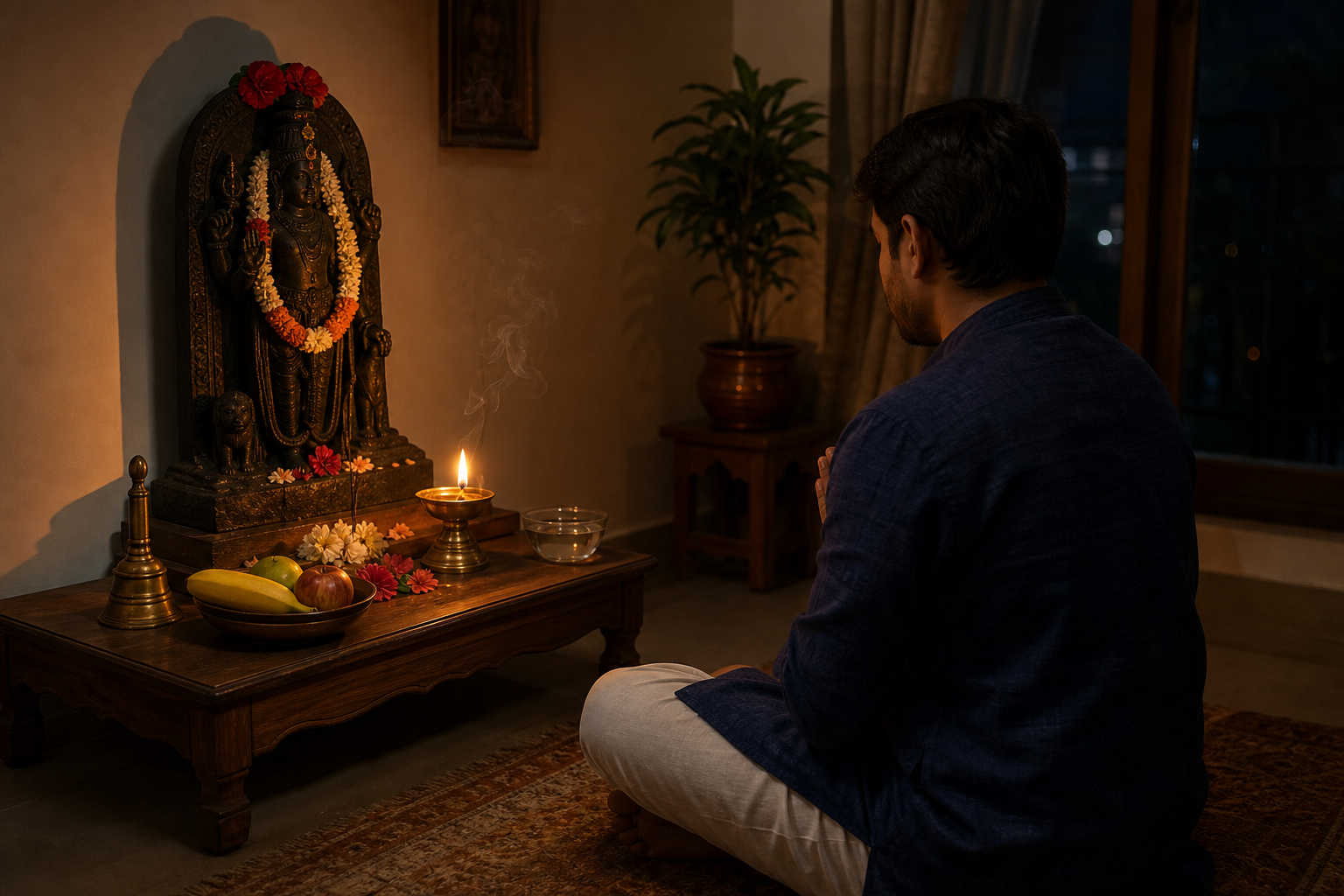
Kalashtami is a monthly occasion for devotion to Shiva in the form of Kalabhairava. You can observe it without turning the night into an exercise in ritual complexity. Where the following practices accord with your family tradition, a simple sequence is enough:
- Bathe and prepare a clean worship space before the tithi transition so that you are ready when Ashtami begins.
- After the verified local starting time, make a clear sankalpa for Kalashtami and Kalabhairava worship.
- Offer a simple abhishekam to Shiva or Kalabhairava if you have an appropriate murti or linga and this is part of your customary practice.
- Light a mustard-oil deepa, placing it on a stable, fire-safe surface where it will not be left unattended.
- Recite the Kalabhairava Ashtakam or another familiar Kalabhairava stotra. If a long recitation is impractical at that hour, choose a shorter period of focused japa or silent remembrance.
- Conclude with pranam and a resolve to carry greater discipline, truthfulness, and restraint into the coming days.
- Offer dana according to your means. Charity keeps the vrata connected to compassion rather than reducing it to private austerity.
- When your tradition permits the fast to end, take simple sattvic nourishment instead of treating the conclusion as a return to excess.
Both partial and full fasting are found in household Kalashtami practice. Do not choose the stricter option merely because it appears more devout. If fasting conflicts with a medical condition, medication, pregnancy, or another health need, avoid a strict fast unless appropriate clinical guidance supports it. Puja, recitation, self-restraint, and dana remain available even when abstaining from food is unsuitable.
It is also worth separating the substance of the vrata from its accessories. A particular lamp oil, a long sequence of offerings, or an elaborate altar cannot compensate for beginning the Ashtami sankalpa while Saptami is still in force. Get the tithi right first. Then follow the ritual form that you understand and can perform with attention.
How to use the local Panchang without false precision
A complete Panchang has five limbs: vara, or weekday; tithi, or lunar day; nakshatra, or lunar mansion; yoga; and karana. The Moon’s rashi is also commonly consulted. For June 7, knowing that the vara is Sunday and that Saptami changes to Ashtami gives you the broad structure, but it does not supply every muhurta needed for every activity.
Before relying on a displayed time, check four things:
- Location: The Panchang should be calculated for your city or a genuinely nearby location, not merely for your country.
- Sunrise and sunset: These determine locally calculated divisions such as Rahu Kalam, Yamaganda, Gulika Kalam, and the daytime or nighttime Choghadiya.
- Tithi transition: Confirm the exact local end of Saptami and beginning of Ashtami. This is the controlling entry for the late-night Kalashtami worship discussed here.
- Calendar convention: Note whether the almanac uses drik or vakyam calculation and whether the lunar month is reckoned by the amanta or purnimanta system.
Brahma Muhurta, the pre-dawn period, can support meditation and japa. Abhijit Muhurta, centered on local solar noon, is often consulted for decisive undertakings. Choghadiya offers further auspicious and inauspicious divisions. None of these general windows changes the fact that pre-dawn and midday on June 7 remain under Saptami. They may be suitable for their customary purposes, but they do not move the start of Krishna Paksha Ashtami to an earlier hour.
The same caution applies if you are planning travel, a housewarming, a learning initiation, or a commercial opening. The Kalashtami timing does not automatically make the entire date auspicious or inauspicious for another undertaking. Check the local nakshatra, yoga, karana, relevant Choghadiya, and the relationship to the intended act. For a major samskara, include the person’s janma nakshatra and seek guidance within the applicable parampara.
Regional month names can differ even when the tithi transition is substantially the same. Northern calendars may foreground Vikram Samvat, southern calendars may use Shalivahana Shaka or temple-specific reckoning, and amanta and purnimanta calendars divide lunar months differently. Some 2026 almanacs also recognize Adhik Jyeshta Maas. Ask which convention a calendar follows before treating a different month label as a contradiction.
Your next step is concrete: open the Panchang for the place where you will worship, verify the local Ashtami onset, and prepare everything while Saptami is still running. Begin the Kalashtami sankalpa only after the confirmed transition, then let your own parampara determine the appropriate fast and parana.