
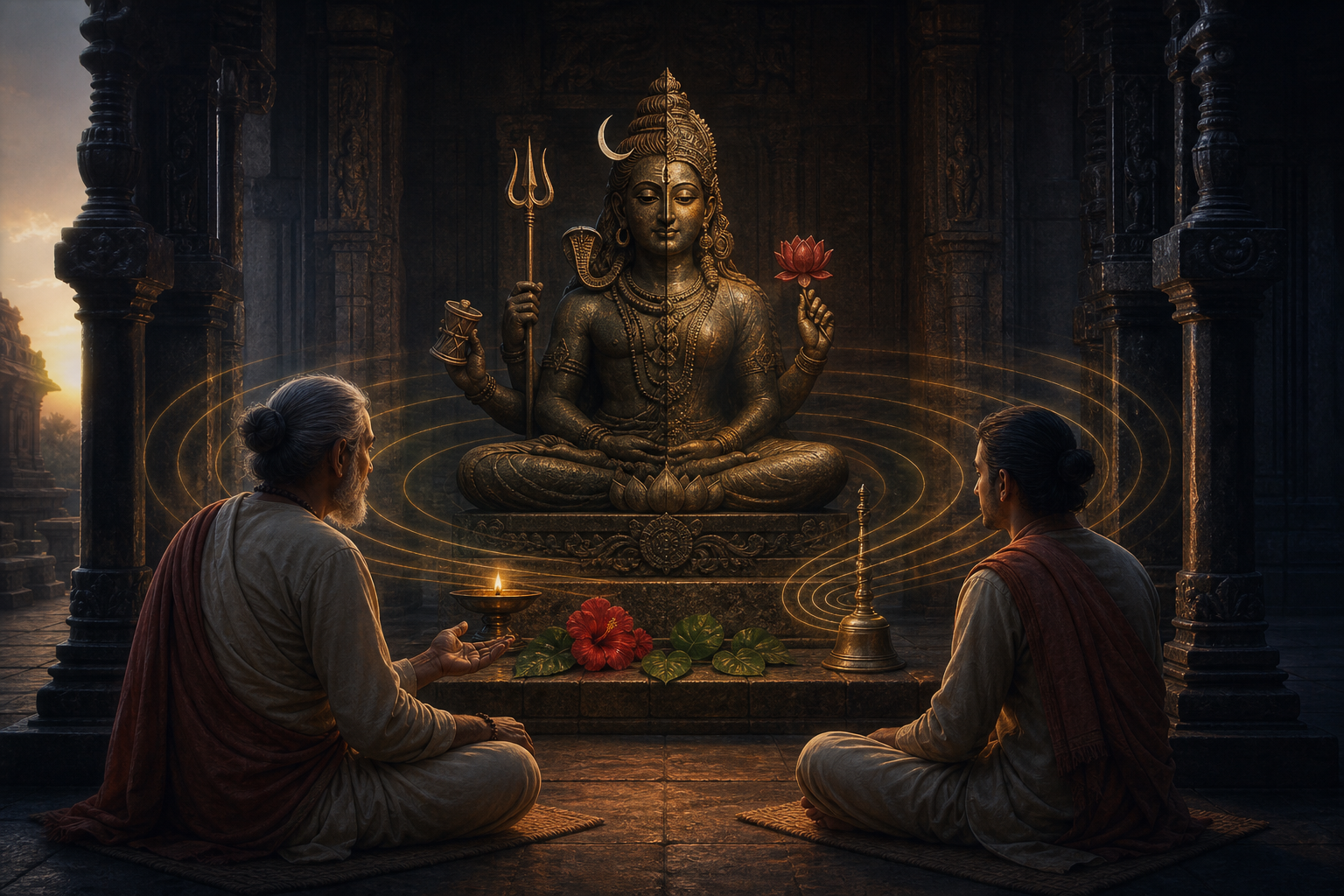
You may have found the Mahamrityunjaya mantra in a family prayer book, met a serene many-armed Shiva in a temple, or heard that a Devi practice belongs to one of six amnayas. These can look like separate subjects. They are better approached through one practical question: how do sacred sound, sacred form, and living transmission tell you what a practice is?
That question helps you avoid reducing a mantra to an affirmation, identifying a deity from one object, or treating lineage as an optional label. It also shows you where careful personal study is enough and where a teacher, priest, or initiated practitioner becomes necessary.
Key takeaways: use a three-part test
- Read sound, image, and transmission together. A translation tells you something about a mantra, an icon reveals the invoked form, and a lineage establishes how the practice is used.
- Do not identify a murti from a trident, skull, rosary, or lotus alone. Begin with the whole composition, including posture, expression, accompanying figures, gestures, and ritual context.
- Do not turn the six amnayas into one universal chart. Directional assignments vary among Shaiva-Shakta texts, regions, and lineages.
- Online availability does not establish ritual permission. Ask whether the mantra is open devotional recitation, guided liturgy, or initiated sadhana.
- When a mantra is used during illness or grief, let it support courage, attention, and solidarity. It must not replace medical treatment, emergency care, or psychological support.
Read a mantra before you repeat it
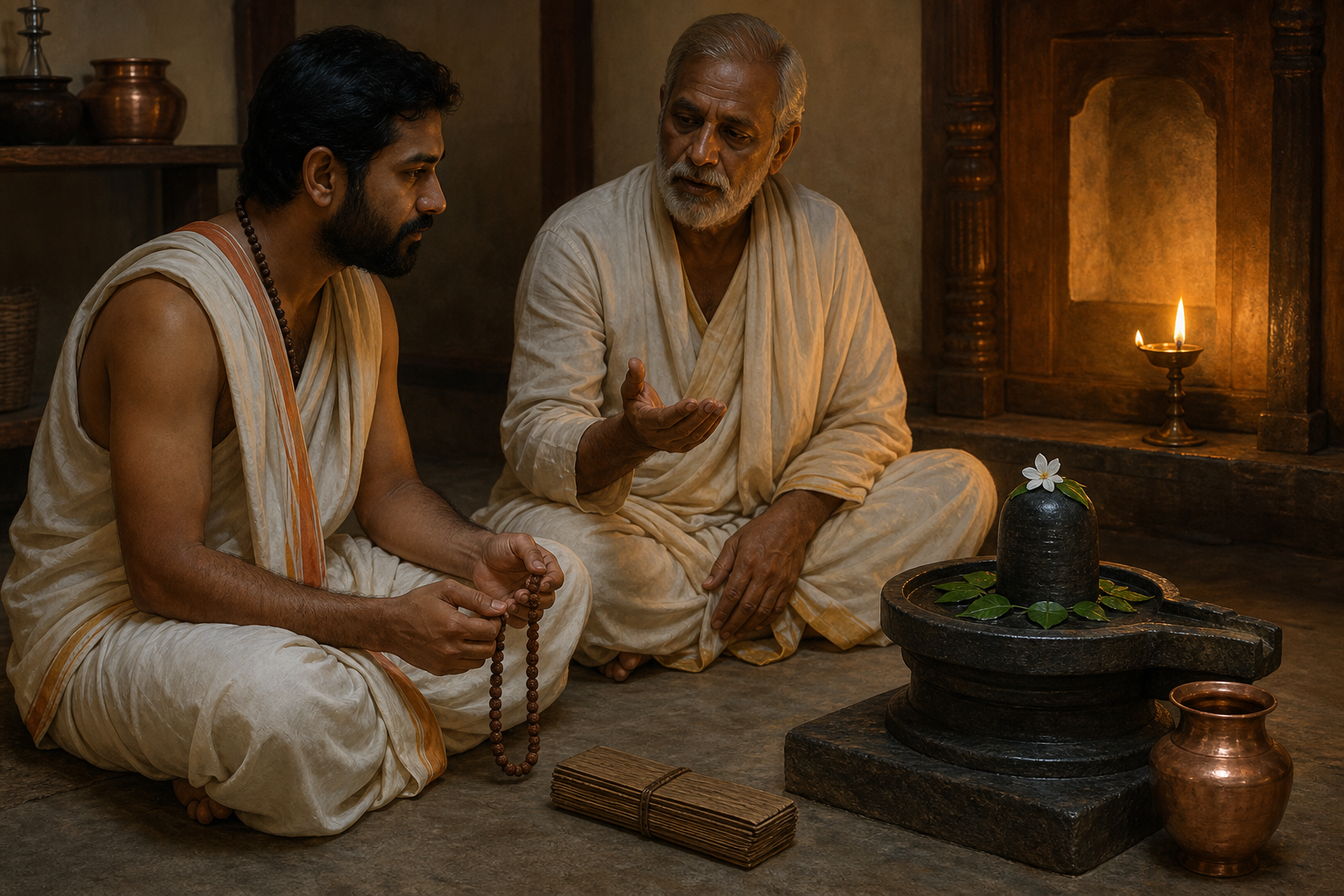
A mantra may carry intelligible language, sacred sound, deity-presence, and a precise ritual function at the same time. Translation therefore matters, but translation is not the entire practice. The difference becomes especially clear when you compare a complete Vedic verse with a bija, or seed syllable.
The Mahamrityunjaya mantra is a useful example because its words, invoked form, and ritual life remain visibly connected. The verse occurs in Rig Veda 7.59.12 and is echoed in Taittiriya Samhita 1.8.6 and Vajasaneyi Samhita 3.60:
Tryambakaṁ yajāmahe sugandhiṁ puṣṭivardhanam | urvārukamiva bandhanān mṛtyormukṣīya mā’mṛtāt ||
Rig Veda 7.59.12
Tryambaka invokes the three-eyed Shiva. Sugandhim evokes a presence that spreads like fragrance and nourishes life. The image of a ripened cucumber separating from its vine gives the petition its decisive movement: release from the bonds of death, but not separation from immortality. The aim is larger than postponing physical death. In Shaiva interpretation, death can also signify fear, constricted awareness, and forgetfulness of one’s deeper nature.
This distinction should govern how you hear the mantra. It is not a guarantee that every illness will end in recovery, nor is it a rejection of embodied life. It places mortality within a movement toward amritatva: freedom approached through knowledge, devotion, disciplined practice, and grace.
Bijas require a different kind of attention. Syllables commonly transliterated as aim, hrim, srim, krim, and hum function as concentrated carriers of deity, cosmology, and method. They are not abbreviations that can be decoded with an ordinary dictionary. In Sri Vidya, the fifteen-syllable Pancadasi and sixteen-syllable Shodasi architectures align mantra, subtle body, and cosmic order. Knowing that description does not amount to receiving the practice.
Ritual mode matters just as much as wording. Japa repeats a mantra in disciplined remembrance. Rudrabhisheka joins recitation to libations such as water, milk, or pancamrita over a linga. Homa coordinates recitation with offerings into fire. Nyasa ritually establishes deity-consciousness at bodily loci, while antaryaga internalizes offering. These modes cannot be treated as interchangeable merely because they contain the same syllables.
Daily Mahamrityunjaya japa is commonly organized in rounds of 108, while an elaborate homa may use 1008 repetitions or offerings. Mondays, Pradosha, Shravana, and Maha Shivaratri are also favored occasions. These are recognizable ritual patterns, not mechanical thresholds at which a mantra suddenly begins to work. Follow the count and timing given by the temple or lineage guiding the observance; if none has been given, do not invent an obligation from a number encountered online.
Before adopting a mantra, work through this sequence:
- Name it precisely. Determine whether you have a complete verse, a deity-name, a bija, a compound mantra, or part of a longer liturgy.
- Locate its setting. Ask which Vedic recension, Agama, Tantra, deity tradition, or guru-parampara gives the practice its form.
- Clarify its intended use. Simple remembrance, counted japa, puja, nyasa, homa, chakra-puja, and subtle-body practice require different preparation.
- Learn the sound from a competent practitioner. Roman letters do not reliably communicate every Sanskrit vowel, consonant, aspiration, or nasal sound.
- Confirm the initiation boundary. Do not assume that a mantra is unrestricted because its letters have been printed or posted publicly.
- Ask about niyamas. Ethical restraint, consistency, purity rules, and the way the practice is concluded are part of the method rather than decorative additions.
If you cannot answer the first three questions, remain in study until you can. If you cannot answer the last three, seek guidance before moving from appreciation into formal sadhana.
Identify the deity before interpreting the attributes
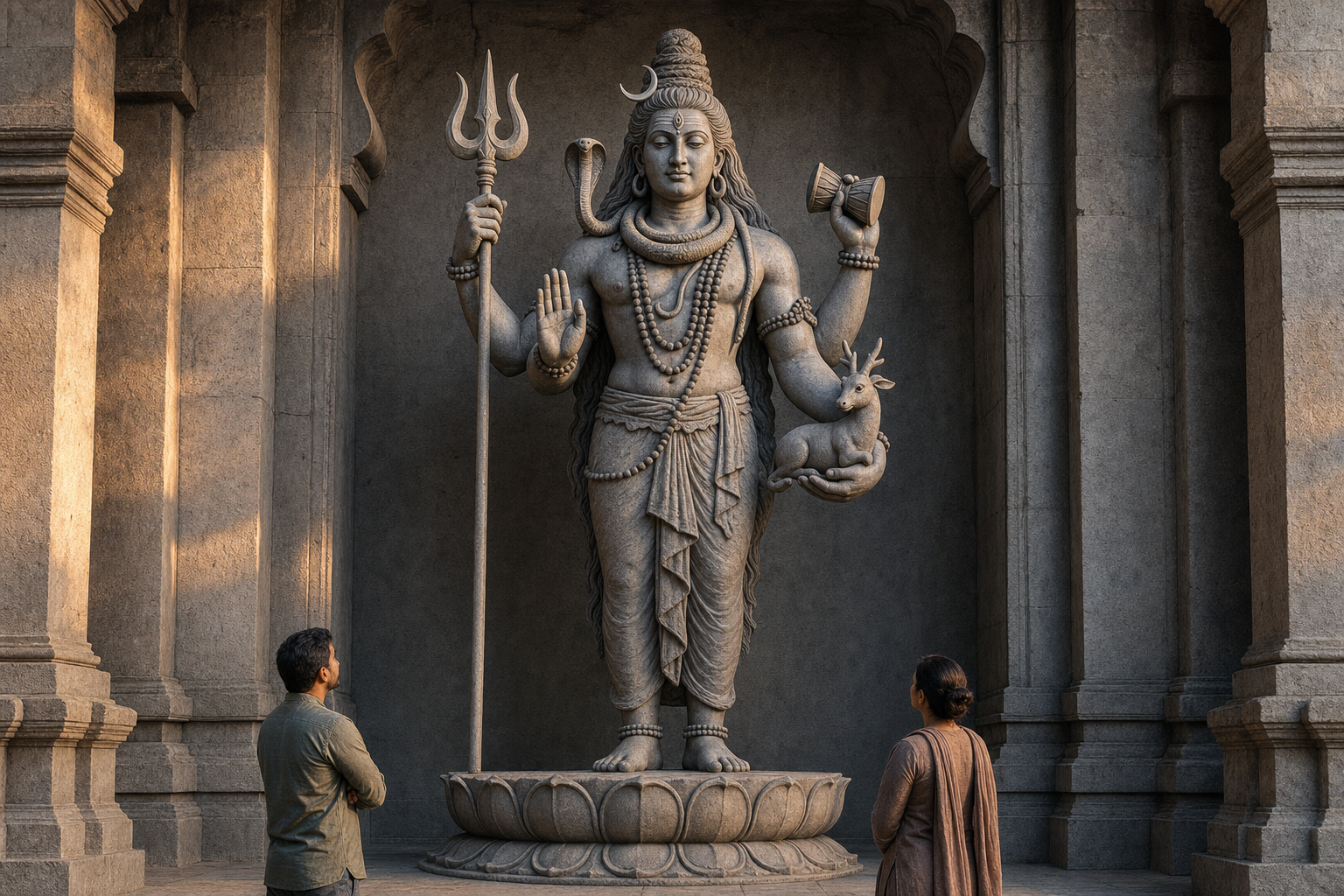
Sacred iconography gives the mantra a visible theological setting. Yet the objects held by a deity do not operate like isolated labels. A trident may establish a Shaiva field without distinguishing Mrityunjaya from several other Shiva forms. A rosary may suggest japa or mastery of time, but it cannot settle the identification by itself.
Begin with the action of the entire image. Is Shiva seated in yogic equipoise, dancing, teaching beneath a tree, joined with Shakti, granting refuge, or intervening against Yama? Next inspect expression and posture. Only then should you use weapons, vessels, ornaments, gestures, subsidiary figures, and the pedestal to refine the identification.
Mrityunjaya or Kalantaka?
Mrityunjaya is commonly four-armed, though forms with additional arms occur. Look for the third eye, piled matted locks, crescent moon, Ganga emerging from the hair, serpent ornaments, and an ascetic garment such as tiger skin. The face is generally composed rather than wrathful. An amrita-kalasha, rosary, abhaya gesture, or varada gesture strengthens the identification because these elements present immortality, disciplined remembrance, fearlessness, and divine generosity.
Kalantaka belongs to the same theological world but stages a different moment. When Shiva subdues or tramples Yama while the young devotee Markandeya clings to a linga, the composition emphasizes intervention against approaching death. When nectar, benediction, serenity, or yogic stillness governs the image, Mrityunjaya is the stronger identification.
The principal attributes can then sharpen your reading:
- Trishula: mastery over triads such as the three gunas and the three dimensions of time.
- Damaru: the generative pulse of sound, creation, and mantra.
- Akshamala: continuous japa and time transformed through remembrance.
- Amrita-kalasha: the gift of immortality or liberation beyond the ordinary fear of death.
- Pasha and ankusha: restraint and guidance, including discipline of the senses.
- Abhaya and varada: freedom from fear and the conferral of a boon.
Use those meanings after you have established the form, not before. The same object can participate in more than one theological pattern.
Canonical proportions also matter, although they do not erase regional variation. Shilpa-shastra works such as Mayamata and Manasara, together with Shaiva Agamas including Kamikagama and Suprabhedagama, provide systems for bodily measurement, coiffure, ornament, and posture. Mrityunjaya commonly follows a balanced, medium proportion suited to equipoise rather than ferocity. Artisan lineages may differ in arm count, attribute placement, or ornamental detail while preserving the form’s essential visual grammar.
If you are identifying an unlabeled temple or museum image, record observation before interpretation. A useful note might read: calm three-eyed Shiva; matted crown with crescent; seated posture; rosary; nectar vessel; abhaya hand; no Yama. That evidence supports a probable Mrityunjaya identification. By contrast, a linga-embracing devotee and a subdued Yama support Kalantaka. Writing down the visible evidence prevents a familiar name from controlling what you think you see.
Treat the six amnayas as a lineage map, not a ranking
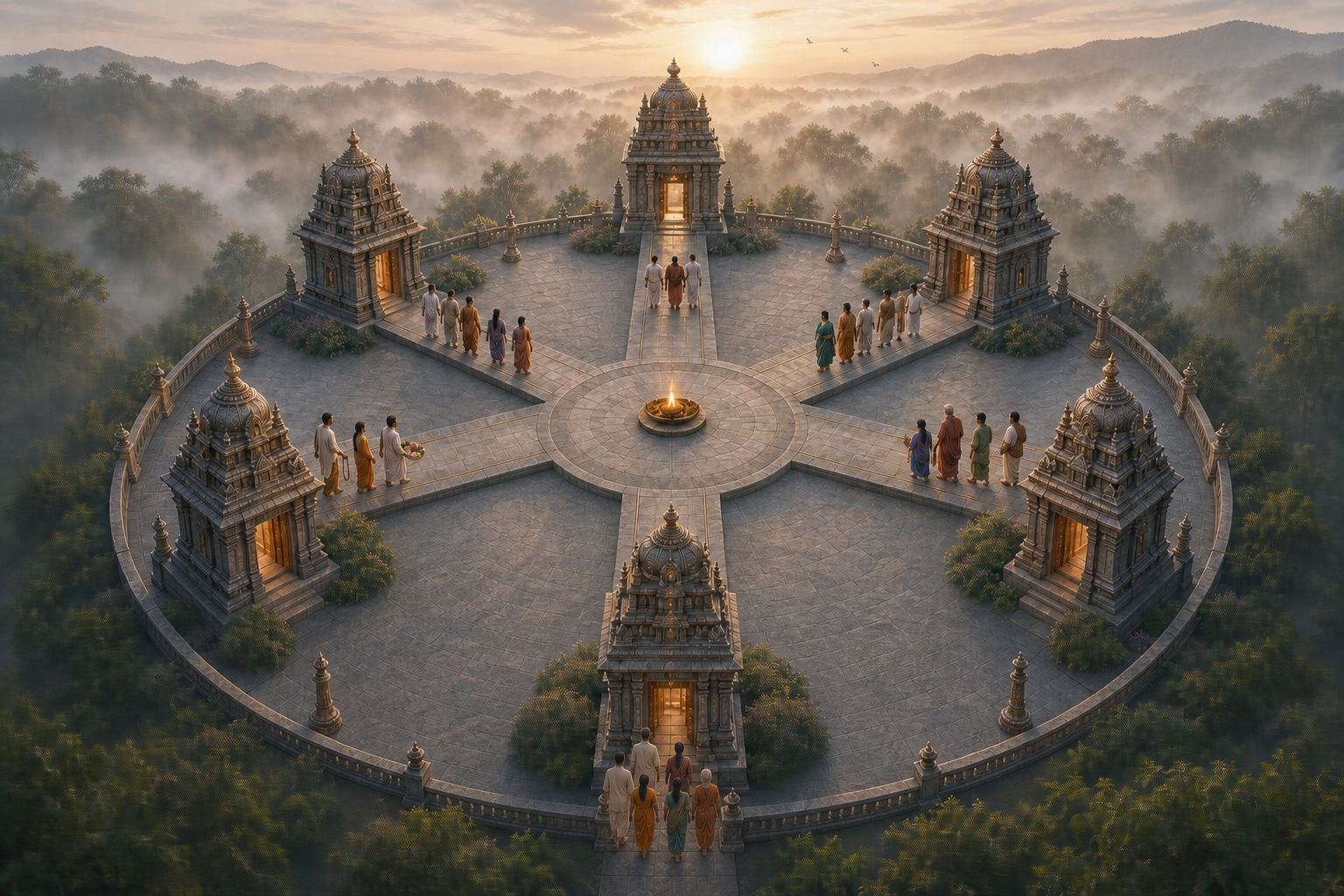
Amnaya means a handed-down canonical transmission or lineage-recitation. Shadamnaya places such transmission within a sixfold directional field attributed to Shiva’s revelatory faces. The directions can be geographical, ritual, and metaphysical at once. They organize bodies of mantra, deity traditions, sacred places, methods, and teacher-disciple inheritance; they are not merely compass points.
The following map is useful only if you keep its qualifications attached:
| Amnaya | Common associations | What you should not assume |
|---|---|---|
| Purva, east | Kamarupa, Srikula, Tripurasundari, Sri Chakra, and Pancadasi or Shodasi mantra architecture | Not every lineage places all Sri Vidya transmission exclusively in the east. |
| Dakshina, south | Post-medieval Sri Vidya in peninsular Bharat, especially currents associated with Kanchipuram; sometimes a bridge between Shaiva and Shakta liturgy | Some classifications retain Sri Vidya under the eastern stream, so the two assignments cannot be flattened into one rule. |
| Pashchima, west | Kaula transmission, yogini circuits, Bhairava-Bhairavi worship, mantra, and chakra-puja | Historical ritual vocabulary, including pancamakara, is not a license for self-directed imitation; contemporary lineages may use interiorized or sattvic substitutions. |
| Uttara, north | Kashmir’s Trika and Krama currents, Pratyabhijna, and related Kaula expressions; Kubjika transmission is prominent in another northern configuration connected with the Nepal Valley | The northern stream is not one uniform school or one fixed list of texts and deities. |
| Urdhva, upper | Kundalini ascent, transformation of speech, bija, nyasa, pranayama, the sahasrara, and internal offering | Upper does not mean ethically or spiritually superior to embodied and communal practice. |
| Adho or Anuttara, lower or unexcelled | Grounding realization in earth, food, community, and ethical action; alternatively, the unsurpassed current pervading all streams | Lower does not mean debased, and some systems replace the term with Anuttara rather than treating both names as identical in every context. |
Several textual worlds stand behind these variations. Malinivijayottara and Svacchandatantra belong to the rigorous metaphysical and ritual environment associated with northern Shaivism. Kubjikamata Tantra gives Kubjika a pronounced northern setting. Kularnava Tantra addresses Kaula initiation, ethics, and ritual discipline. Sri Vidya currents refine both external and internal worship through texts and commentarial lineages associated with Tripurasundari and the Sri Chakra.
A different chart is therefore not automatically a mistake. The precise assignments change with school, place, capacity, and ritual context. The stable principle is that revelation moves through distinct but related transmissions rather than through an anonymous collection of techniques.
When two teachers or books give you different mappings, ask four questions before choosing between them:
- Which Tantra, commentary, or guru-parampara supplies each map?
- Is the direction being used geographically, as a ritual orientation, as a deity-family, or as a subtle-body axis?
- Does the sixfold count end with Adho-amnaya or use Anuttara-amnaya as its completion?
- Are the maps describing the same region and period, or different developments within the wider Shaiva-Shakta field?
This approach preserves real differences without declaring every difference a contradiction. It also prevents a lineage-specific diagram from being promoted into a universal taxonomy.
Choose a practice that matches your level of transmission
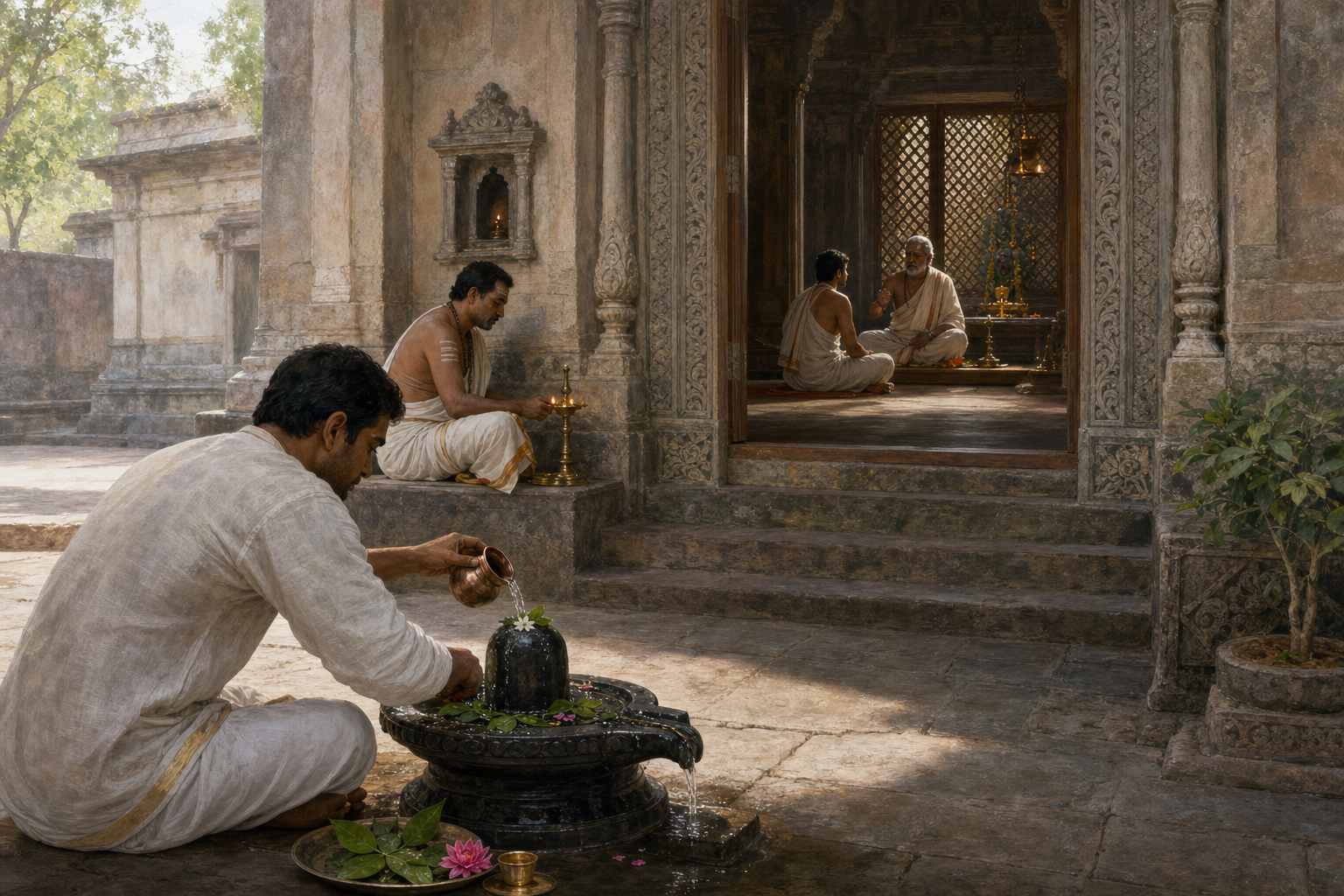
Diksha is not a ceremonial extra attached after the real method has been learned. It is the hinge connecting mantra, teacher, practitioner, ethical discipline, and the lineage’s understanding of the deity. Guru-shishya transmission also provides correction: how a mantra is voiced, where it belongs in a ritual, which nyasas accompany it, what restraints apply, and how its effects are integrated into ordinary conduct.
Use these questions when evaluating instruction:
- Can the teacher state the lineage or textual setting of the practice without claiming that every Shaiva-Shakta school is identical?
- Is the boundary between open devotion and initiated practice stated clearly?
- Are pronunciation, sequence, preparation, and conclusion taught with the mantra rather than left to guesswork?
- Do ahimsa, yama-niyama, discernment, accountability, and gradual assimilation remain part of the discipline?
- If older ritual forms are adapted, are substitutions and their symbolic purpose explained honestly?
- Is intense subtle-body work treated as a staged discipline rather than a shortcut to dramatic experiences?
A claim of secrecy by itself does not prove authenticity, just as public visibility does not prove openness. What matters is accountable continuity: a recognizable transmission, a coherent practice, ethical safeguards, and instruction appropriate to the student’s capacity.
You can then choose among four practical levels:
- Study and visual contemplation. Learn the deity’s name, narrative, mantra meaning, iconographic markers, and lineage setting. This lets you approach an image intelligently without pretending to possess its full ritual method.
- Open devotional participation. Join temple or community recitation that the responsible tradition explicitly presents as open. Follow its pronunciation, pace, and stated observances.
- Guided liturgy. Participate in abhisheka, puja, or homa under a competent priest or teacher rather than reconstructing the procedure from fragments.
- Initiated sadhana. Undertake lineage-specific bijas, mantra sequences, nyasa, chakra-puja, kundalini methods, or antaryaga only within the preparation and limits established at initiation.
Illness and grief require an additional boundary. Mahamrityunjaya recitation at a bedside can become a discipline of courage, loving presence, and release from fear. Families may pair it with seva, counseling, and collective prayer. It is not a medical intervention and must never delay professional evaluation, emergency treatment, medication, or other necessary care. A customary count such as 108 or 1008 is not a health threshold; the ill person’s consent, rest, and treatment needs take priority over completing a ritual number.
Your next step can be small and verifiable. Choose one mantra or one icon. Write down its exact name, invoked form, purpose, visible markers, textual or lineage setting, and initiation status. Confirm whatever is missing with the temple or teacher responsible for that tradition. If those answers remain unclear, stay with study and explicitly open devotion instead of imitating an advanced rite. That restraint is itself part of receiving a living inheritance responsibly.
References
- DharmaRenaissance Blog — Mrityunjaya Murti of Shiva: Timeless, Death-Conquering Iconography, Vedic Mantra, and Rituals
- DharmaRenaissance Blog — Shatprakara (Shadamnaya) Explained: Six Shakta Streams Powering Tantra’s Living Unity