
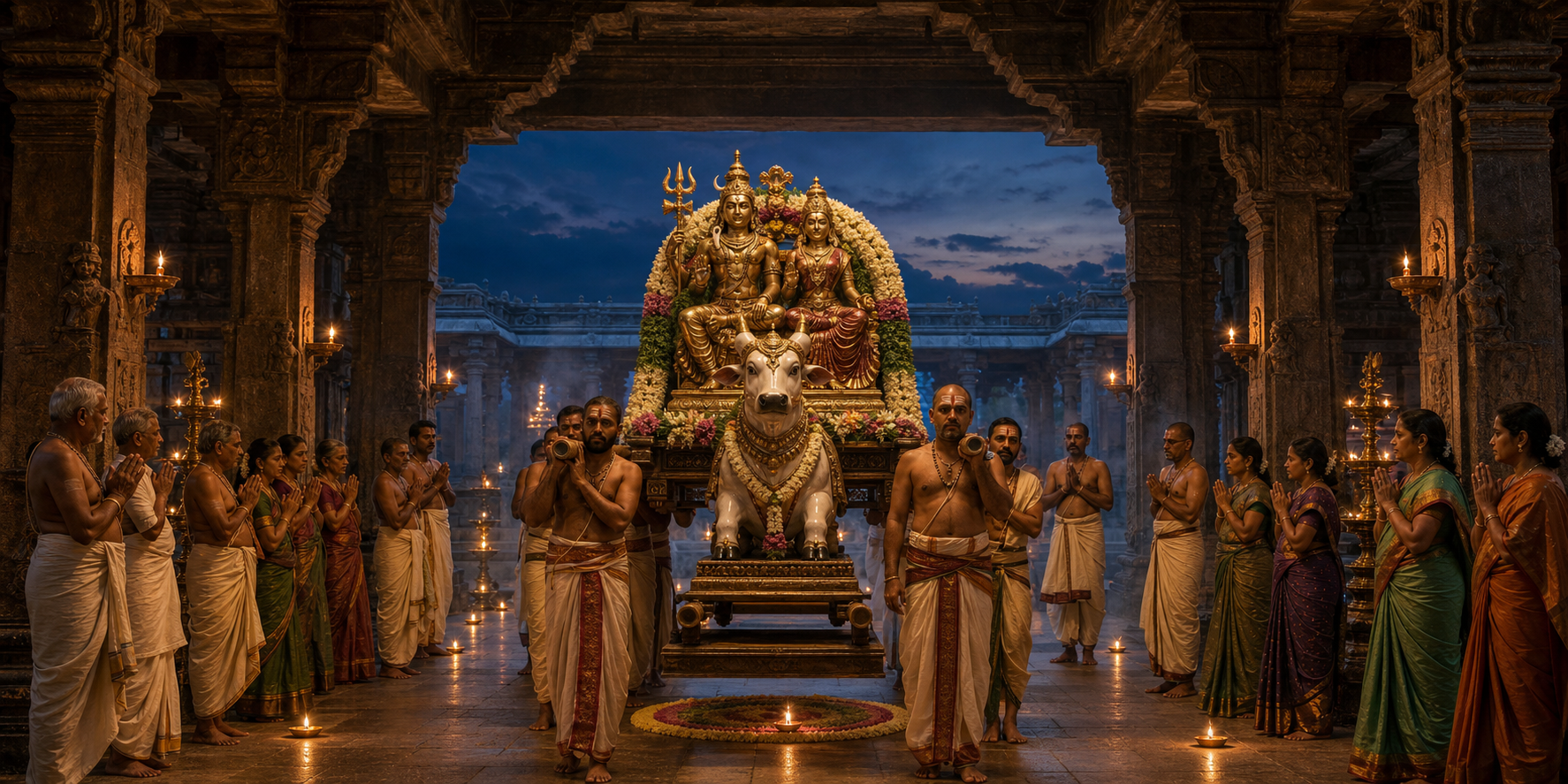
You are in a Shiva temple near dusk, the lamps are being prepared, and a bronze of Shiva and Parvati on Nandi appears for procession. If you have wondered what makes this form specifically Pradosha, where to direct your attention, or how to participate without merely copying the people around you, the icon itself gives you a clear path.
Begin with three anchors: the divine couple, the bull, and the hour of transition. Once you hold them together, the sculpture stops looking like a collection of ornaments. It becomes a practical teaching about meeting change with steadiness.
Recognize the Pradosha form before reading its details
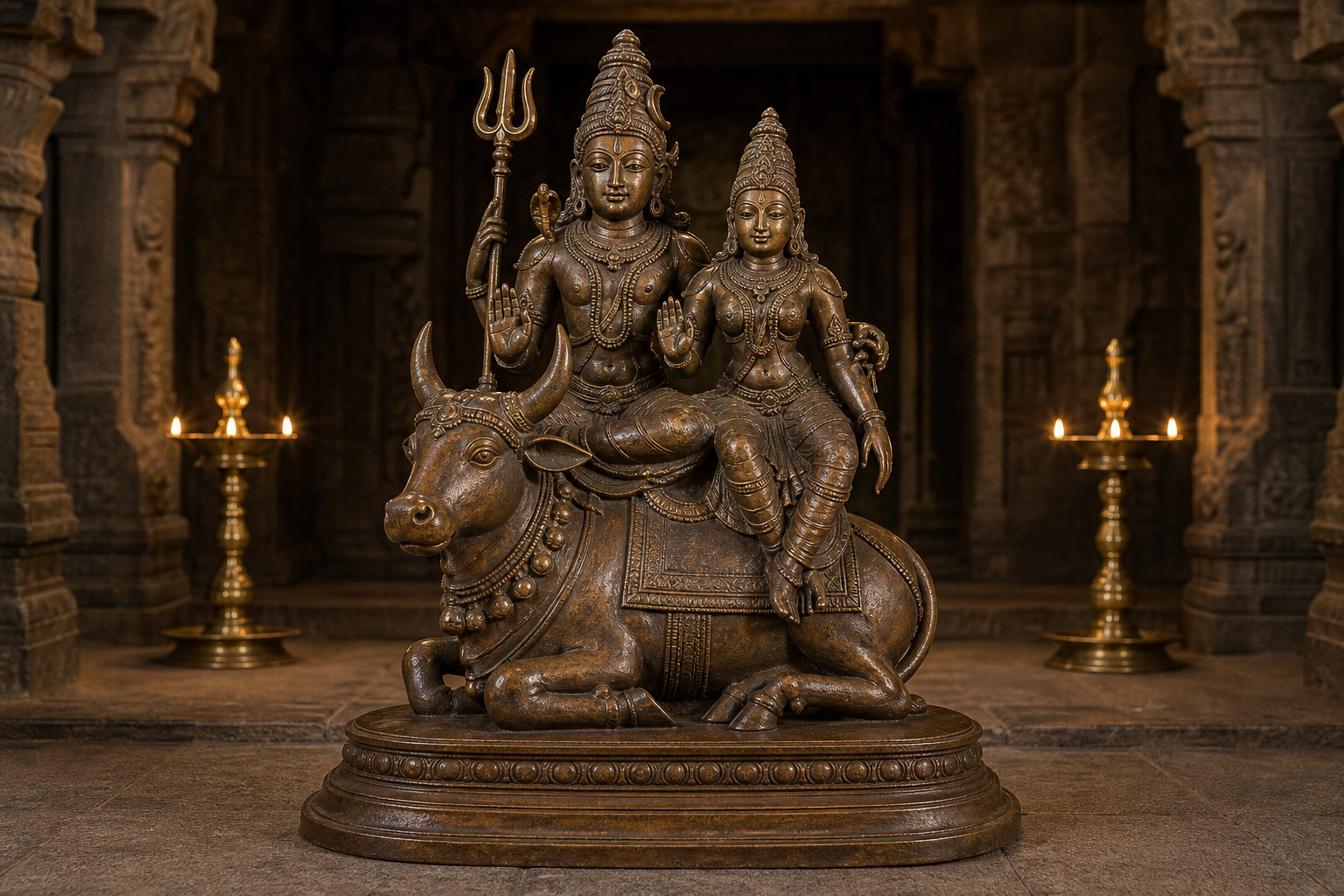
Pradosha names the twilight junction between day and night. Vrishabharuda, from vrishabha and arudha, means mounted upon the bull. The Pradosha Murti therefore joins sacred time and sacred form: Shiva and Parvati seated upon Nandi at twilight. The identity of the image rests in that complete relationship, not in any one weapon, gesture, or decorative feature.
If you encounter the murti in a temple, museum, book, or family shrine, examine it in this order:
- Find Nandi first. He may be standing with a lifted head and powerful shoulders, or resting in a composed posture. Bells, harness-like ornaments, and a flowing tail may emphasize his consecrated service.
- Look for Shiva and Parvati together. They may be seated or enthroned upon the bull. Their calm bearing matters more than apparent physical movement: the form presents command without agitation.
- Read Shiva’s hands without demanding one fixed set. Shiva is often four-armed. Abhaya conveys freedom from fear, while varada communicates the granting of grace. Other hands may carry the trishula, damaru, parashu, or mriga.
- Notice Parvati’s contribution to the composition. She may hold a lotus or use kataka-hasta. Her presence is not secondary decoration. She supplies the image’s visible dimension of Shakti, benevolence, and auspicious power.
- Read the frame last. A prabhavali may surround the pair with stylized flames, while a makara-torana may establish an architectural arch. Ganas, musicians, celestial figures, Ganesha, or Skanda can enlarge the sacred company without changing the central identity.
Do not reject an image merely because Shiva carries an axe instead of a drum, or because Nandi reclines rather than stands. Agamic prescriptions and regional lineages permit variations in attributes, attendants, posture, and ornament. The dependable test is coherence: Shiva and Parvati, Nandi, controlled composure, and a visual language of assurance must work as one.
Regional style affects what your eye notices. Chola bronzes may draw attention to balanced anatomy, finely worked jewellery, and elegant flames. Hoysala reliefs often make textile patterns, curves, light, and shadow more prominent. Kerala forms may favor restrained gravity and an especially calm gaze. Style changes the accent, not the theological sentence.
Why Nandi and twilight carry the meaning
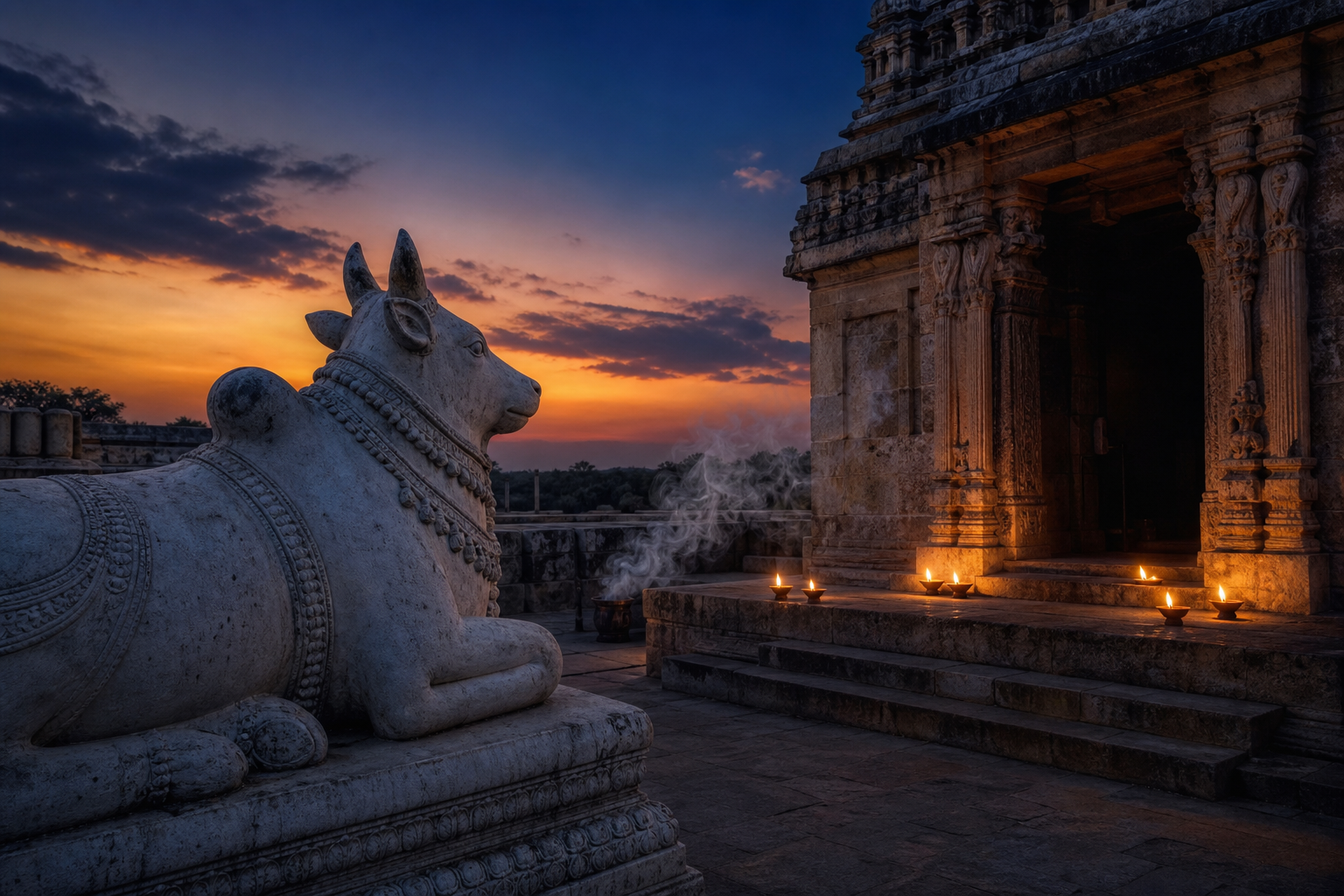
Nandi is not simply transportation for a deity. His stability represents dharma, patient service, and a mind held steadily toward its highest aim. Shiva signifies pure awareness; Parvati embodies the energy through which life, action, and manifestation unfold. Their shared seat upon Nandi brings the teaching into focus: awareness and energy become rightly ordered when they rest upon dharma.
This gives you a useful way to approach the image. Before asking what blessing you may receive, ask what in you needs to become steady enough to receive guidance. An unsettled decision, an angry reaction, or a difficult transition does not always require more activity. Pradosha directs you first toward composure, alignment, and disciplined attention.
Twilight strengthens that instruction. It is neither full day nor full night. Ordinary work is ending, but rest has not completely begun. The threshold can leave attention scattered: the body has carried the day’s momentum while the mind has already begun anticipating tomorrow. Pradosha turns that vulnerable interval into a deliberate return to Shiva.
A yogic interpretation compares this meeting of opposites with ida and pingala settling toward sushumna. You need not treat that image as a demand for advanced breath control. Its immediate practical meaning is balance: sit upright, let the breath remain natural, and allow competing impulses to quiet before worship.
Puranic memory gives the same pattern a cosmic scale. In different tellings, the devas approach Shiva at this hour, and Shiva’s presence or dance brings grace after calamity associated with events such as the churning of the ocean. The details need not be flattened into one uniform narrative. The ritual point is consistent: a dangerous transition can become an opening for restoration when it is met through dharma and devotion.
Other Dharmic traditions also give evening a disciplined role. Rehras Sahib steadies Sikh remembrance at sunset; Jaina pratikraman and samayika return attention to conduct and equanimity; Buddhist communities may close the day with chanting or meditation. These evening practices share respect for the transitional hour, but their liturgies and doctrines should not be treated as interchangeable. The comparison is most useful when it helps you preserve the rhythm of daily recollection while remaining faithful to your own lineage.
How to participate in Pradosha worship at a temple
Pradosha is observed on Trayodashi tithi in both the waxing and waning lunar fortnights. That generally creates two observances within a lunar month. Do not assume that the thirteenth date on a civil calendar is Trayodashi, or that every temple begins at the same clock time. Consult the local panchanga or the temple’s announced schedule, especially if you hope to attend abhishekam or a procession.
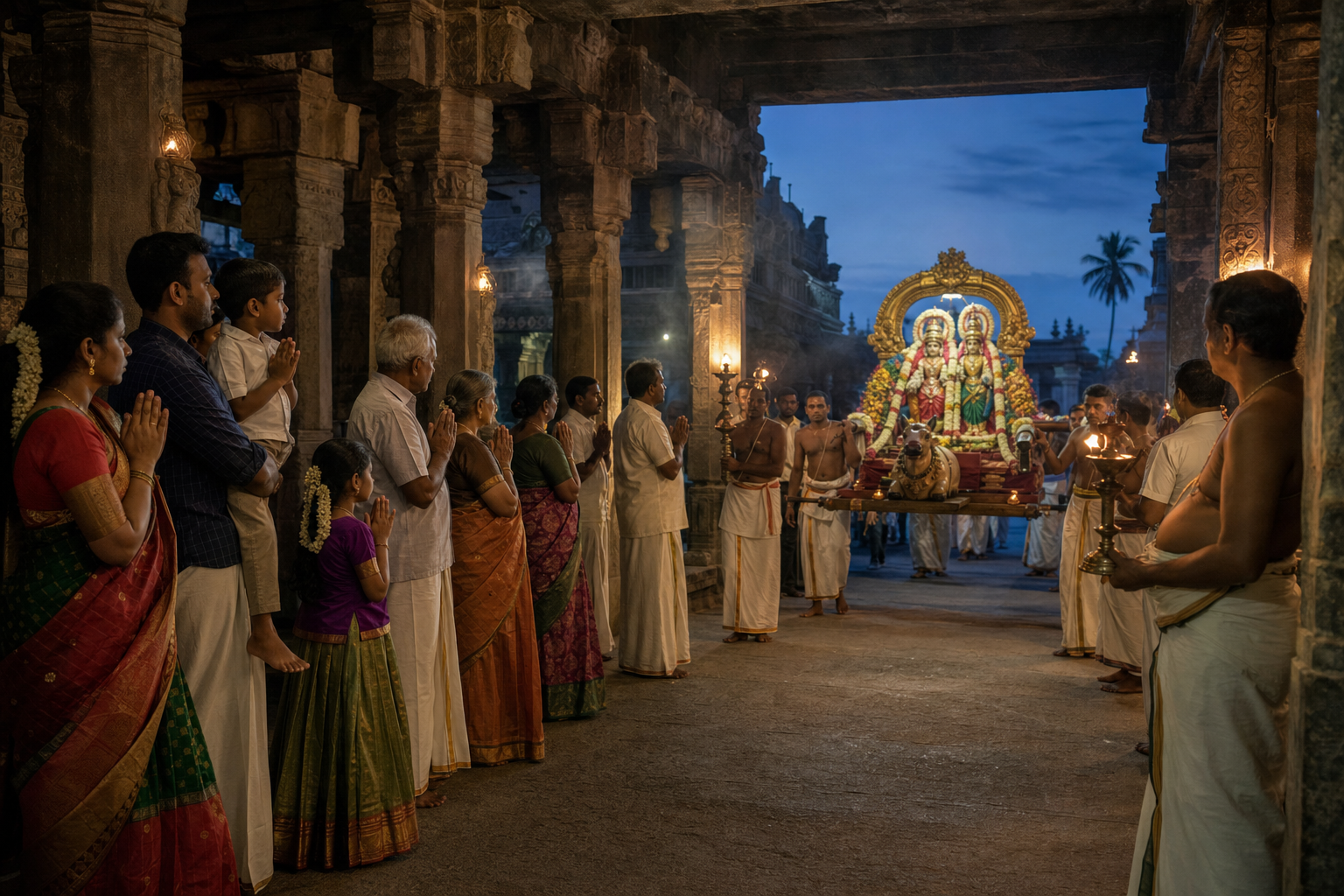
The principal worship remains directed toward Shiva. A temple observance may include abhishekam to the Shivalinga, alankara, nama-japa, deepa-arati, circumambulation, and a twilight procession of the Vrishabharuda Murti. In many South Indian temples, this procession is known as Vrishabha Vahana Seva. The sequence connects the still axis of the linga with the mobile, publicly visible grace of Shiva and Parvati upon Nandi.
A first visit becomes much easier if you use this practical sequence:
- Check the temple notice before leaving home. Confirm the Pradosha date, beginning time, offering arrangements, and whether a vahana procession is planned.
- Arrive before the announced worship begins. Use the extra time to settle rather than entering during deepa-arati or trying to move through a procession already under way.
- Let Nandi orient your darshan. In temples where it is customary, devotees sight the linga along Nandi’s devotional line, sometimes looking through the space near his ears. Follow the method shown by the temple rather than climbing, leaning upon, or rearranging anything around the image.
- Offer through the established channel. If bilva leaves or materials for abhishekam are accepted, hand them over where the priests or volunteers direct you. An offering that disrupts the liturgy does not become more devotional because it is spontaneous.
- Follow the temple’s circumambulation route. Local Shaiva customs govern where devotees walk, pause, and turn. Do not assume that a pattern learned at another shrine applies unchanged.
- During the procession, watch the controlled movement. The measured pace, moving lamps, conch calls, and recitation are part of the worship. Keep the route clear and allow the murti’s movement to gather your attention rather than treating it as a spectacle to chase.
The most revealing moment may be visually quiet. When the processional form faces the sanctum, notice how Nandi, the divine couple, and the linga become aligned. The arrangement teaches without requiring an explanation: the devotee faces the Lord, dharma bears Shakti and awareness, and movement returns to its center.
A simple home observance that keeps the temple logic
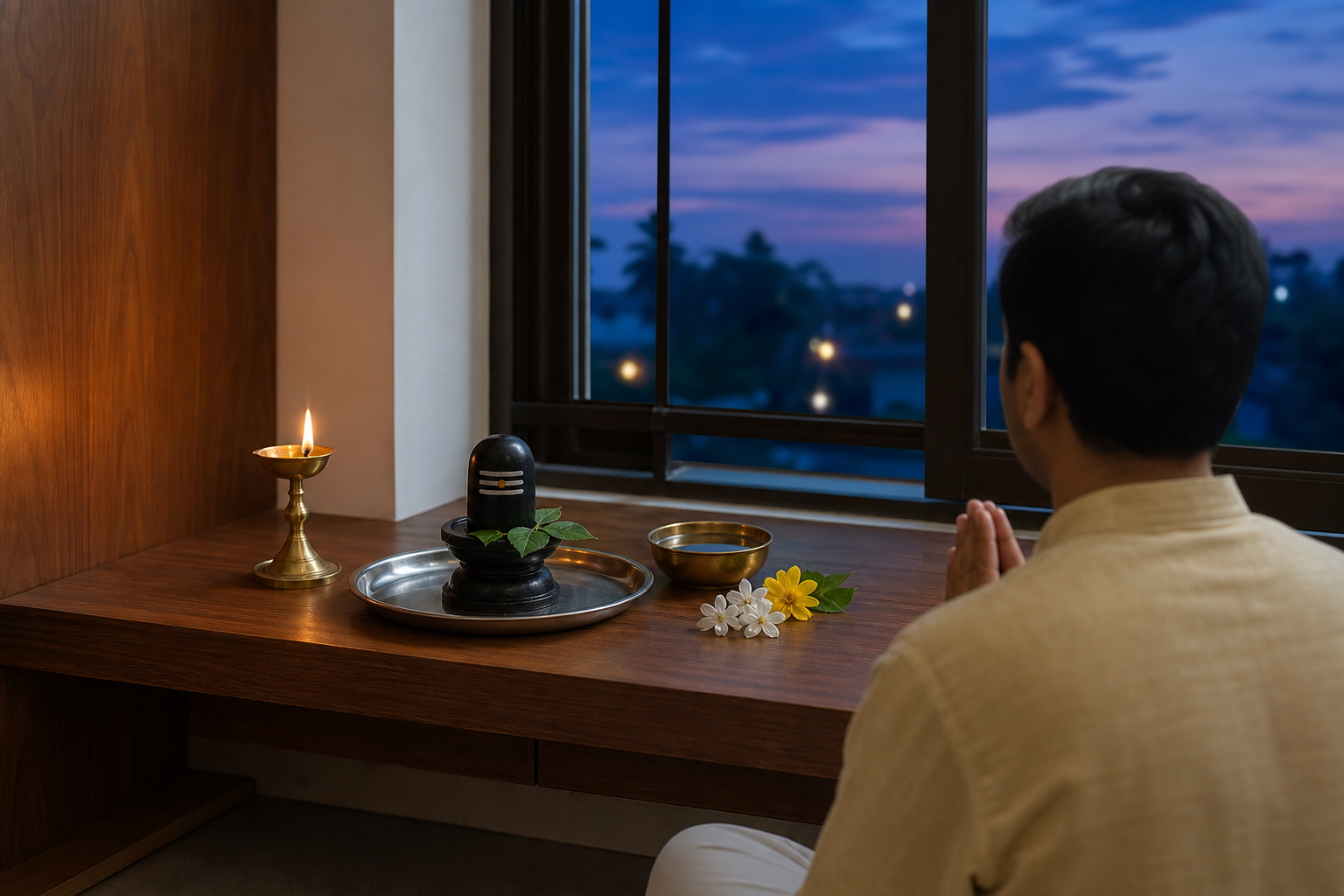
You do not need a processional bronze or an elaborate collection of ritual materials to observe Pradosha at home. Temple worship is communal and governed by a liturgical lineage; household worship can preserve its central movement from activity to stillness.
- Confirm the correct Trayodashi evening. Use the calendar followed by your family, sampradaya, or nearby temple. If two civil dates appear, ask which evening that community will observe rather than guessing from the printed date alone.
- Create a clear transition into worship. Finish avoidable tasks, silence unnecessary notifications, wash, and prepare a clean place before dusk. The point is to prevent the day’s momentum from occupying the entire observance.
- Light a lamp and establish your focus. Use the Shiva murti, image, or household linga you already worship. If you have none, remembrance through Shiva’s name is sufficient for a simple observance.
- Keep nama-japa stable. Repeat the Shiva nama given in your practice, or a familiar invocation such as Om Namah Shivaya. One mantra attended to carefully serves the hour better than a hurried collection of unfamiliar chants.
- Offer only what you can offer reverently. Bilva leaves are closely associated with Pradosha worship. If they are unavailable, do not replace attention with anxiety about materials. If you already maintain a household linga and know the appropriate method, you may perform your customary abhishekam; otherwise, retain the simpler lamp, prayer, and japa.
- Sit quietly after the outward acts. Let your breathing remain unforced. Bring one current transition to mind and ask what dharmic steadiness requires from you: restraint, truthful speech, patient service, a repaired duty, or the courage to stop an unworthy action.
- Carry one decision into the evening. Close the worship and act on the clearest obligation you identified. Pradosha loses much of its force if stillness ends without any refinement of conduct.
Do not measure the observance by the quantity of flowers, the length of recitation, or whether the home rite resembles a major temple. Its internal measure is alignment. Nandi supplies steadiness, Parvati supplies active power, and Shiva supplies lucid awareness. Your worship should help those three meanings meet in conduct.
Key takeaways for your next Pradosha
- Pradosha is the Trayodashi twilight of both lunar fortnights; confirm the applicable civil date and service time locally.
- Recognize the murti by the complete relationship of Shiva, Parvati, and Nandi, not by one compulsory weapon or ornament.
- Read Nandi as the foundation of the form: steady dharma makes divine awareness and power bearable in the world.
- At a temple, follow the established routes for offerings, darshan, circumambulation, and the Vrishabha Vahana procession.
- At home, a lamp, stable nama-japa, quiet attention, and one dharmic decision are more coherent than an elaborate improvised ritual.
- Regional differences in posture, attributes, attendants, and artistic style do not erase the form’s central theology.
For your next Pradosha, choose one discipline before the hour arrives: reach the temple early, keep one Shiva nama, or protect a quiet period at home. Then watch how the image orders your attention. Let Nandi steady it, let Parvati turn it toward worthy action, and let Shiva return it to clarity.