
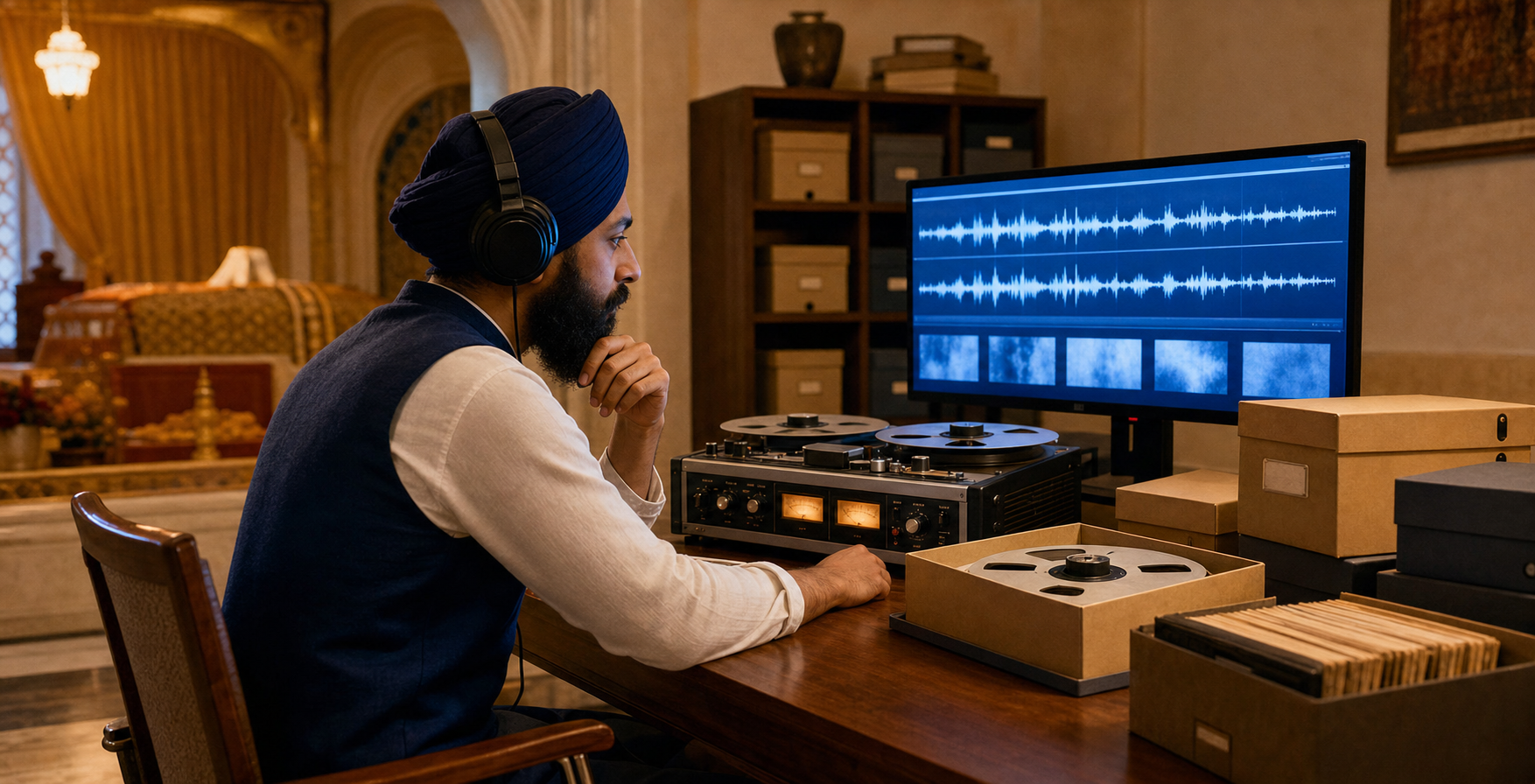
You remember a line of Gurbani or a melody heard in the gurdwara, but not the recording. A search brings back inconsistent spellings, incomplete titles, and many renditions with little context. The difficulty isn’t always access. It is finding a trustworthy path from memory to Bani.
You can make that path clearer. Search from the words outward, verify what you find through metadata, listen with a defined purpose, and preserve the recording only with its spiritual and musical context attached.
Search from the opening words outward

Begin with the opening words rather than a broad theme such as peace, courage, or devotion. If you know the Gurmukhi, paste the first line. If you know only its pronunciation, search the transliteration you remember. Remove uncertain words if the first attempt fails; spelling can vary across Roman-script catalogues.
Once you find a plausible match, add another identifying detail: the raag, the raagi or jatha, or the liturgical name. A digital collection with more than 1,000 newly curated Gurbani tracks becomes far more manageable when you move through that sequence. Opening words identify the Bani; raag and performer help identify the rendition.
Don’t treat a familiar tune as proof that you have found the intended Shabad. The same Shabad may be performed in different raags, and separate recordings may share a similar melodic treatment. Open the Gurmukhi text when it is available and match the words before saving or sharing the result.
Use metadata to verify identity, rendition, and provenance
Useful metadata answers three practical concerns. It tells you which Bani you have found, which performance you are hearing, and who should receive credit. Treat an empty field as uncertainty, not as permission to fill the gap from memory.
For textual identity, check the title, opening line, Gurmukhi text, and any transliteration or translation. An ang reference, when verified and available, gives you another route back to Sri Guru Granth Sahib. Translation can help you approach arth, but it should remain beside the original rather than replacing it.
For musical identity, look for the raag, taal, performer, and ensemble attribution. These fields let you distinguish a rendition in Asa from one in Sorath, or compare rhythmic treatment in teentaal and rupak. Notes about harmonium, tabla, jori, congregational response, and whether the recording is live or studio-based can further explain what you are hearing.
For provenance, retain the credited raagi, jatha, venue, collection, and catalogue link when known. Amritsar and Anandpur Sahib have nurtured important Kirtan lineages, but a stylistic resemblance does not establish a recording’s origin. If attribution cannot be verified, mark it as unknown rather than making a confident guess.
Separate devotional listening from analytical listening
Build a dependable rhythm for practice
Choose a stable listening anchor that fits your maryada and daily responsibilities. Traditional associations can help: Asa Di Vaar at dawn, Rehras Sahib at dusk, and Kirtan Sohila before rest. Anand Sahib or Sukhmani Sahib may accompany a quieter period of reflection. The purpose is not to consume more audio. It is to reduce searching and give sustained attention to Shabad and Naam.
Keep notifications and unrelated audio out of that period. Read the Gurmukhi as you listen if you can, then consult transliteration or translation where needed. A slower rendition may be especially useful while you are learning pronunciation or following the melodic placement of the words.
Hold the Shabad constant when you study Kirtan
For analytical listening, find another credited rendition of the same Shabad. Keep the Bani constant and notice what changes: the raag, melodic contour, alap, rhythmic cycle, articulation, call-and-response, or movement between sections. Time-stamped notes help you return to the exact musical or theological moment that caught your attention.
If you come to Sikh Kirtan through Hindu bhajan, Jain stavan, or a Buddhist chant tradition, the wider raag-tala vocabulary may feel familiar. Use that familiarity as an entry point, not as a reason to collapse distinct traditions. Shared Indic musical structures can support understanding while Gurbani’s authority, language, and maryada remain specifically Sikh.
Preserve the recording and its context together
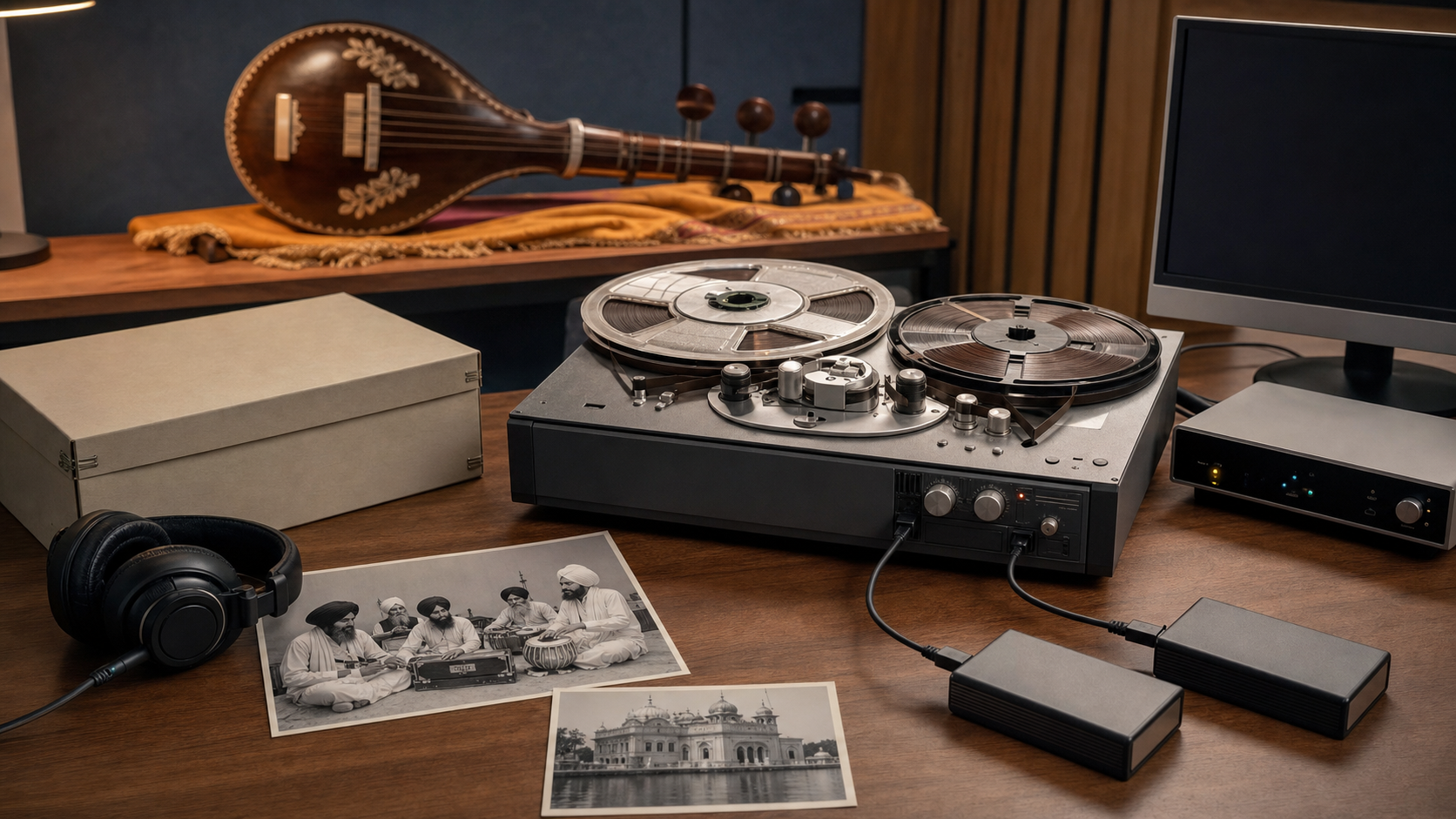
Preservation begins with permission. Keep recordings that are offered for download or that you are otherwise authorized to hold. A streaming link provides access; it does not automatically grant permission to copy, edit, or redistribute the audio.
Retain the original file unchanged. If you normalize loudness, trim silence, or prepare a listening copy, save that as a derivative. Converting compressed audio into a larger file does not restore sound already lost, so preserve the best authorized original you actually received.
Give the file a name that can survive separation from an app or playlist. A practical order is opening words, raag, performer, and recording context. Keep a companion record containing the full Gurmukhi line, transliteration, translation link, taal, credits, catalogue link, and any verified ang reference. This record can live in embedded metadata or a plain text file beside the audio.
Maintain redundant copies in separate places. A duplicate stored on the same phone or computer will not protect the collection if that device is lost or damaged. Check periodically that the backup still opens and that its descriptive record remains attached.
Credits should travel with the audio. Keep the raagi and jatha attribution whenever it is known, and don’t detach a sacred performance from its context for trivial reuse. Digital preservation succeeds only when it safeguards both the sound and the relationships that give the sound meaning.
Key takeaways
- Search first by the Shabad’s opening words, then narrow by raag, performer, or liturgical context.
- Verify the Gurmukhi text before relying on a familiar melody, transliteration, or translated theme.
- Use one listening mode for spiritual practice and another for comparing musical treatment.
- Preserve an authorized original file, a separate backup, and a descriptive record containing credits and context.
- Mark missing information as unknown; accurate uncertainty is better than invented attribution.
Start with a Shabad you already return to. Verify its words, save its context, and listen closely to another rendition. Repeating that small discipline will build an archive you can search, study, trust, and pass forward.