
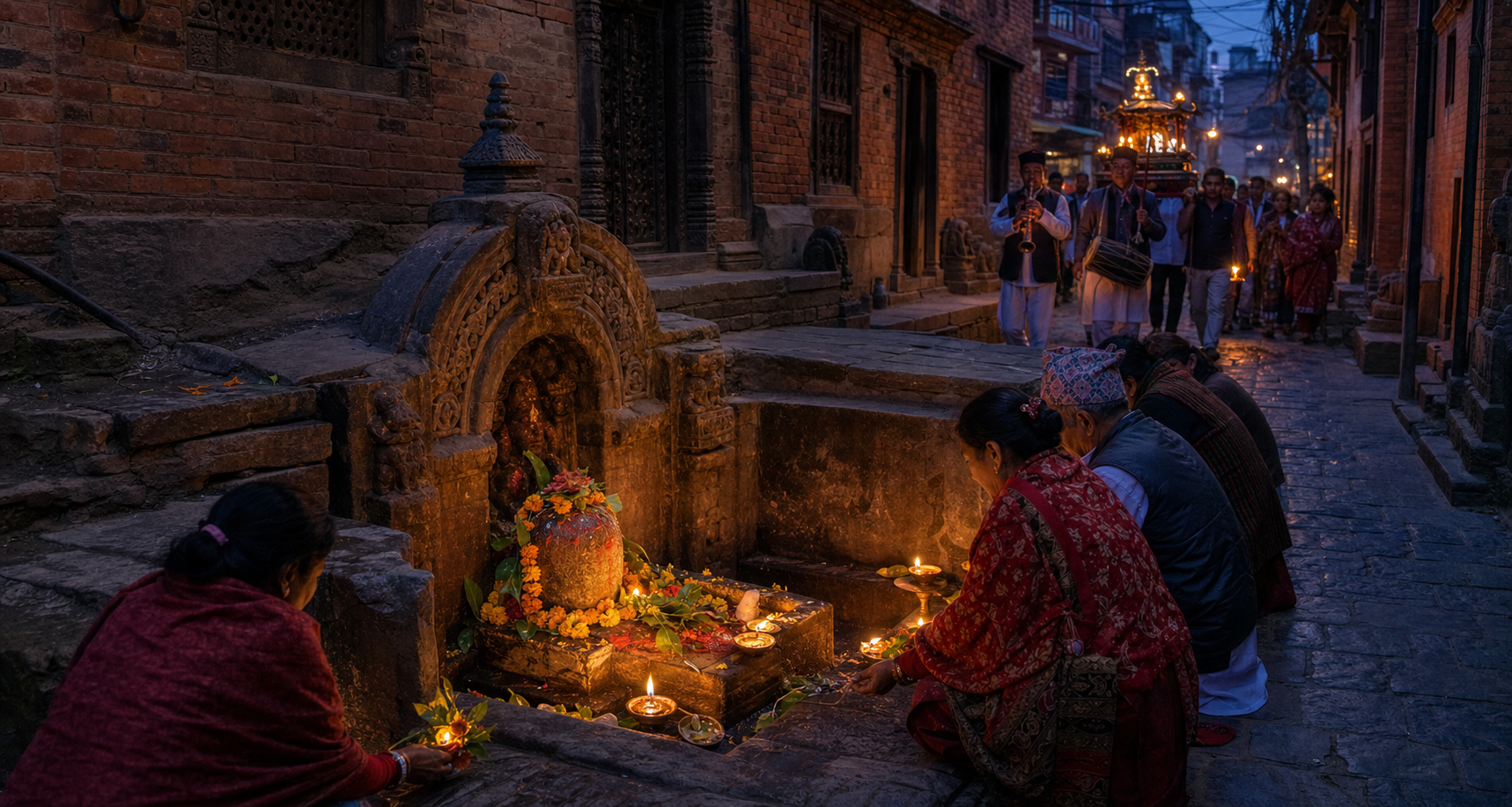
You may arrive in Kathmandu expecting Shiva to stand inside a prominent temple. During Newa Pahachare, you have to adjust your gaze. Luku Mahadyo may rest below street level, partly covered and quietly embedded in the lane where people live.
That modest shrine opens onto a much larger pattern. Across three days, worship moves from household guardianship to neighborhood processions and then to the protection of the city. Once you see that movement, Pahachare becomes more than a calendar event or public spectacle.
Follow the festival from the household outward
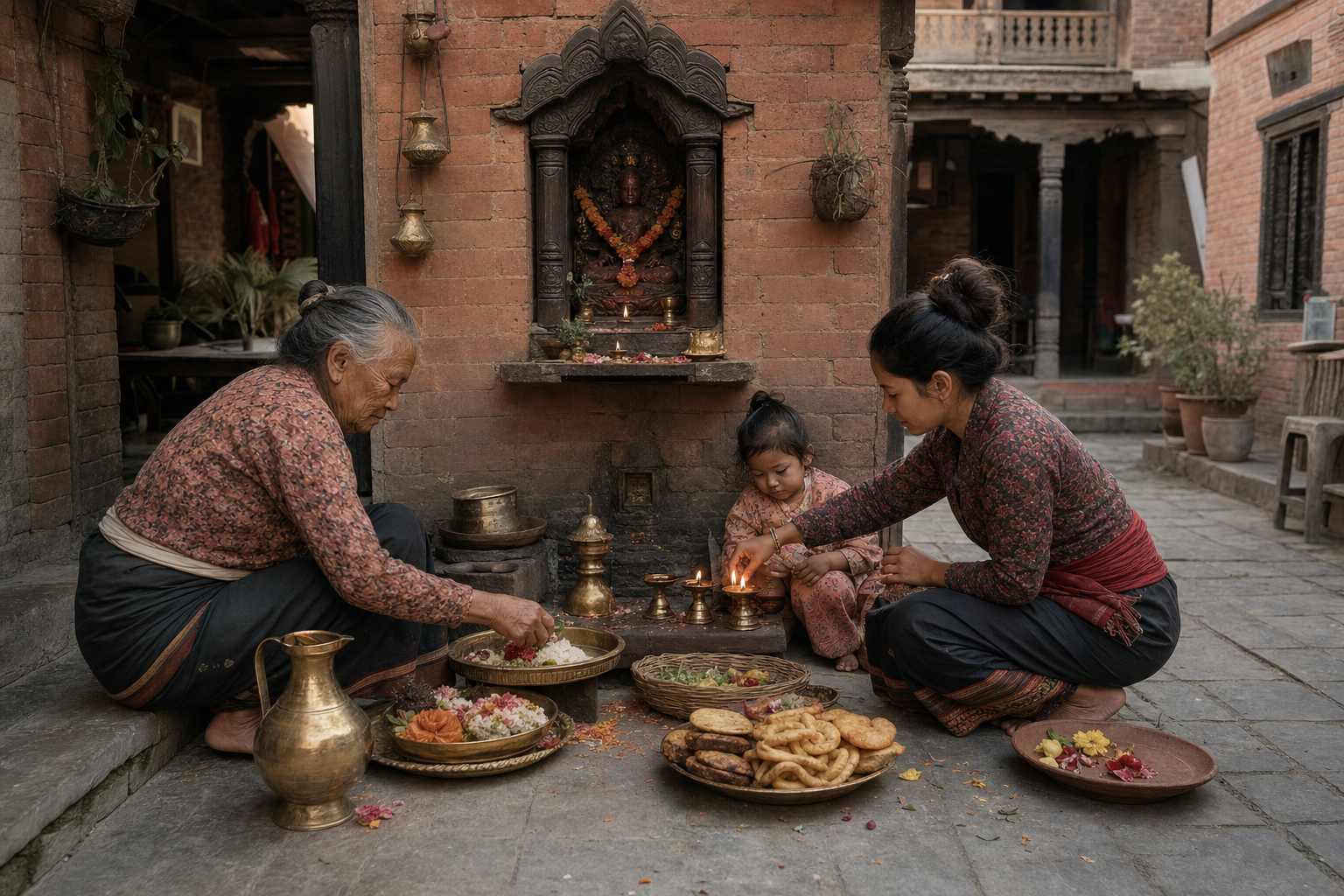
Pahachare, also written Pahan Charhe, generally falls in late March or April during the waning fortnight of Chaitra. Its exact date follows the local lunisolar calendar, so the Gregorian month alone is not enough for planning. The observance usually follows a three-day progression: Luku Mahadyo worship, the meeting of neighborhood goddesses, and Ghode Jatra.
Pay attention to the change of scale. The first day begins close to home. The second brings protective deities and their communities into shared streets and squares. The third reaches Tundikhel, where horses and martial ceremony turn protection into a civic act. The sequence reflects a Newa understanding of the city as nested circles: household, neighborhood and urban community.
If you are attending, do not treat the most crowded event as the whole festival. Ask which Luku shrine a family or lane tends, when its worship begins and where the local Ajima procession will pass. These details vary locally, and they reveal the relationships that give the public celebrations their meaning.
Look down to recognize the Hidden Shiva
Luku Mahadyo, also called Luku Mahadev, is an aniconic form of Shiva. Luku conveys hiddenness. His shrines are often sunken, recessed or placed discreetly near residential lanes, pipal trees, thresholds and other points where community life gathers.
Hidden does not mean absent, forgotten or powerless. The shrine’s position makes a theological point. Shiva need not tower over the neighborhood to sustain it. Sacred presence can remain close to foundations, roots and ordinary movement, supporting life without demanding constant attention.
On the first evening, families clean and refresh the shrine. A locally inflected rite may include a lamp, incense, water, flowers, vermilion, food and joined-hands prayer. Prasada is distributed at the end, and the shrine may be covered again. The return to hiddenness is part of the rhythm, not the withdrawal of the deity.
If you are a visitor, let the household or neighborhood custodians lead. Do not step across a recessed shrine, move its covering, rearrange offerings or place bags on its edge. Ask before taking a close photograph. A stone that appears unobtrusive to you may be the active sacred center of the lane.
Receive the feast without flattening Newa practice
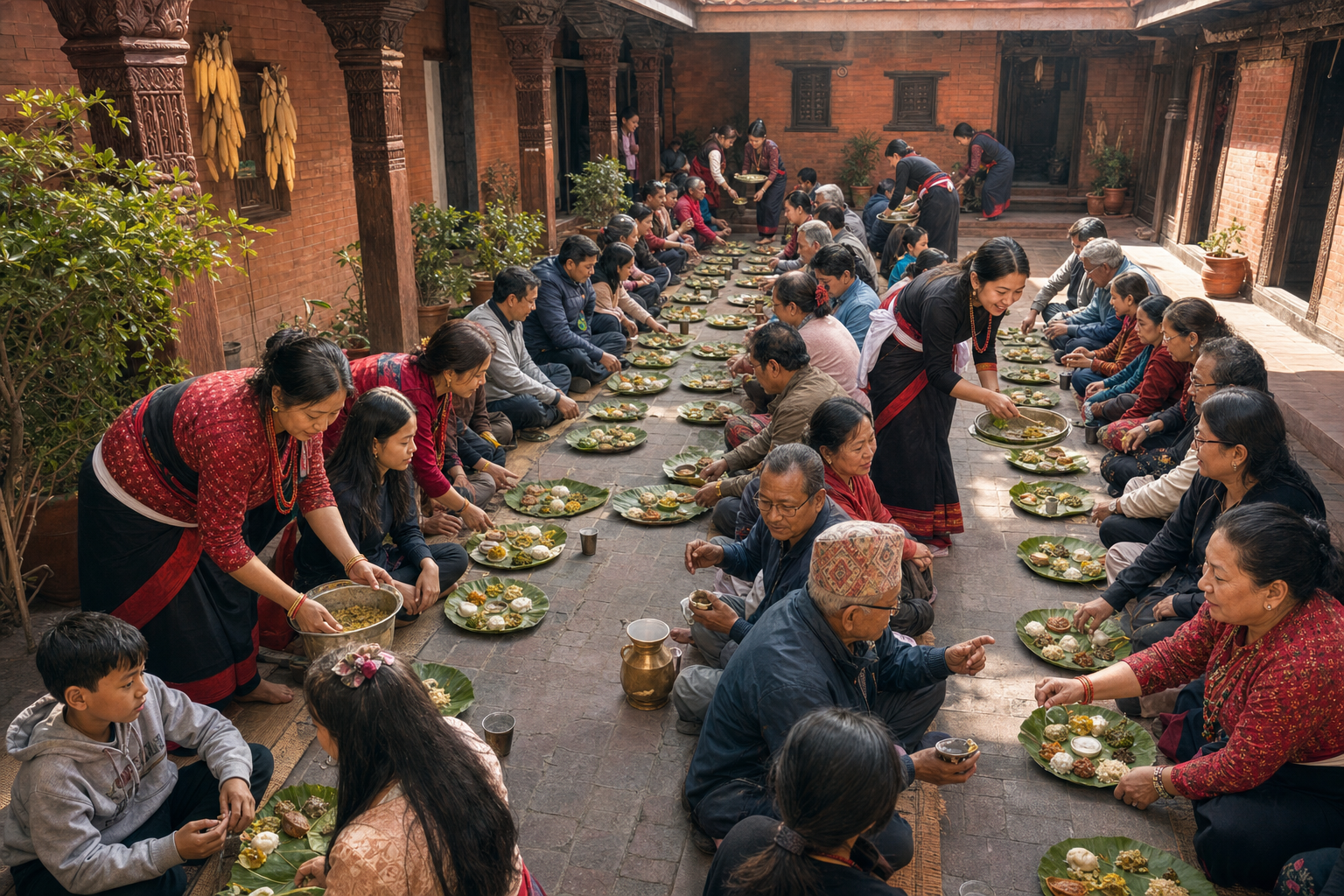
Pahan Charhe is widely understood as the time when guests come. Families invite relatives and friends, with particular attention to married daughters returning to their natal homes. Sharing a meal renews obligations that daily life and distance can loosen. Honoring the guest and honoring the deity belong to the same moral world.
Samay baji gives that hospitality a recognizable ceremonial form. The spread commonly brings together beaten rice, black soybeans, greens, pickles, ginger, egg, fried fish and spicy meat preparations such as choila. Thwon, a rice beer, or aila, a distilled spirit, may accompany it. The precise platter depends on household and local custom.
The offering to Luku Mahadyo may include meat. Within the Tantric ritual culture of the Valley, this is a disciplined form of naivedya rather than casual indulgence or a provocation. It should not be turned into a blanket statement about every Hindu household, every Shiva tradition or every Pahachare meal.
If you keep a vegetarian diet or abstain from alcohol, respect does not require you to abandon that discipline. Ask quietly what an item contains, accept only what accords with your practice and decline without condemning the host’s ritual norms. Likewise, do not assume that every family will make the same offerings. The household’s vow and lineage matter.
Watch protection travel through the city
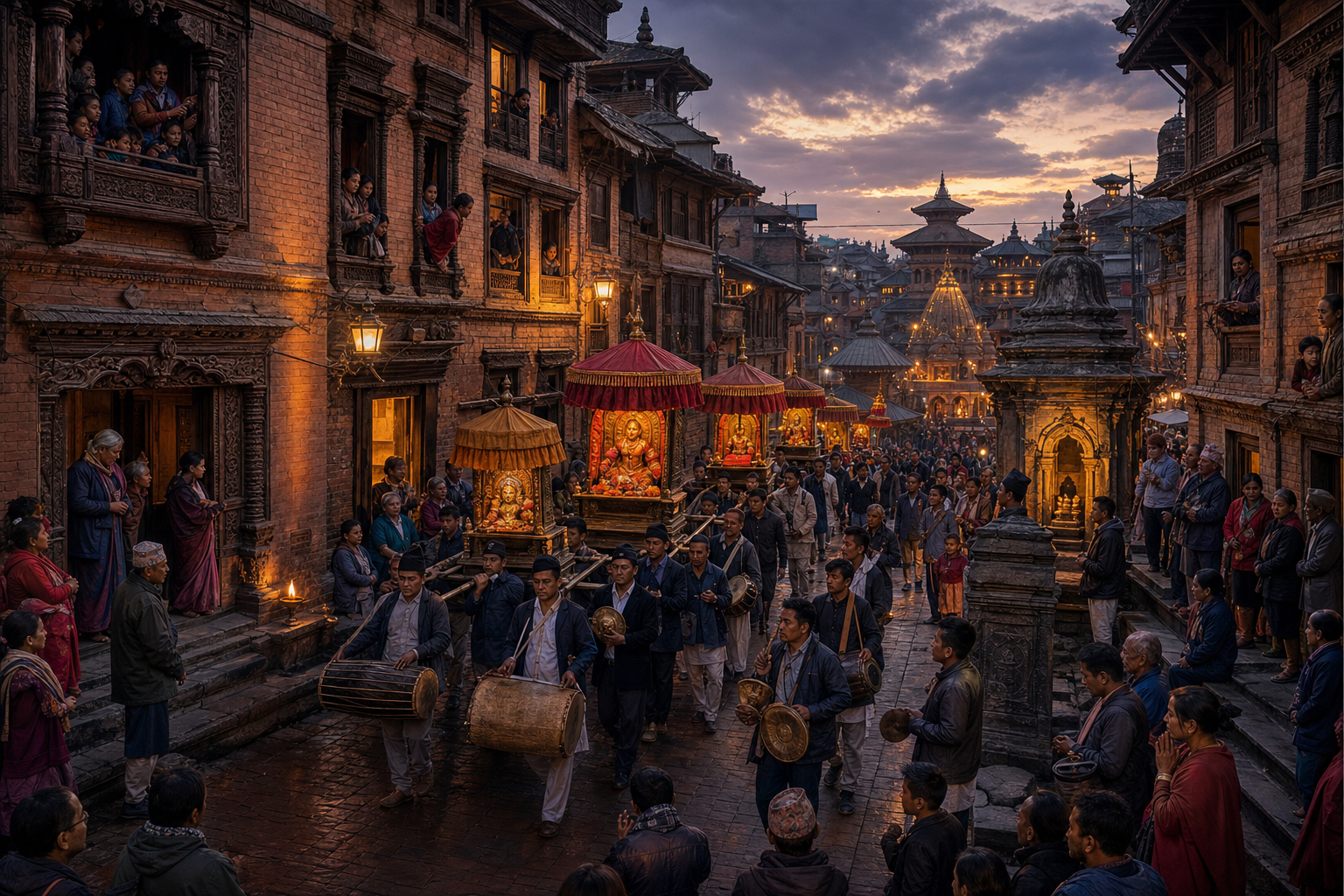
On the second day, the focus expands through Dyah Lwakegu, the meeting of the deities. Palanquins and portable forms of local Ajima mother goddesses move along neighborhood routes and gather at appointed places, including historic areas such as Asan and Indra Chowk. Do not expect one centralized procession. The web of converging routes is itself the point.
Ajima binds domestic well-being to the safety of the neighborhood. When two deity processions greet one another, their human communities also acknowledge a relationship. Bearers, devotees and musical ensembles make the city’s sacred geography visible and audible for a time.
The third day opens onto Ghode Jatra at Tundikhel. The horse parade has a state-facing and martial appearance, while the pounding hooves also carry a protective meaning: they ritually suppress harmful forces associated with the city. Seen within Pahachare, the horses continue work already begun at the hidden shrine and extended by the Ajima processions.
This sacred geography also resists a rigid Hindu-Buddhist boundary. A household that worships Luku Mahadyo may venerate Lokesvara, while Buddhist communities can participate in neighborhood goddess observances. Shared routes and protectors do not erase distinct lineages. They show how Newa religious life permits traditions to remain themselves while sustaining a common civic world.
Key takeaways for a respectful encounter
- Check the local Chaitra calendar and neighborhood timing; Pahachare does not have a fixed Gregorian date.
- Begin with the lane and household, not only the crowds at Tundikhel.
- Look carefully for recessed shrines and treat modest sacred spaces as active places of worship.
- Let local custodians determine whether you may approach, photograph or participate.
- Ask about food discreetly because meat, thwon or aila may be ritually offered, but practices differ by household.
- Read the three days as connected circles of protection: home, neighborhood and city.
Before you go, ask a local host which Luku Mahadyo their lane tends and when the nearby Ajima will pass. That answer will orient you better than starting with the largest crowd. It will place you where Pahachare places Shiva: close to the relationships that quietly hold the city together.