
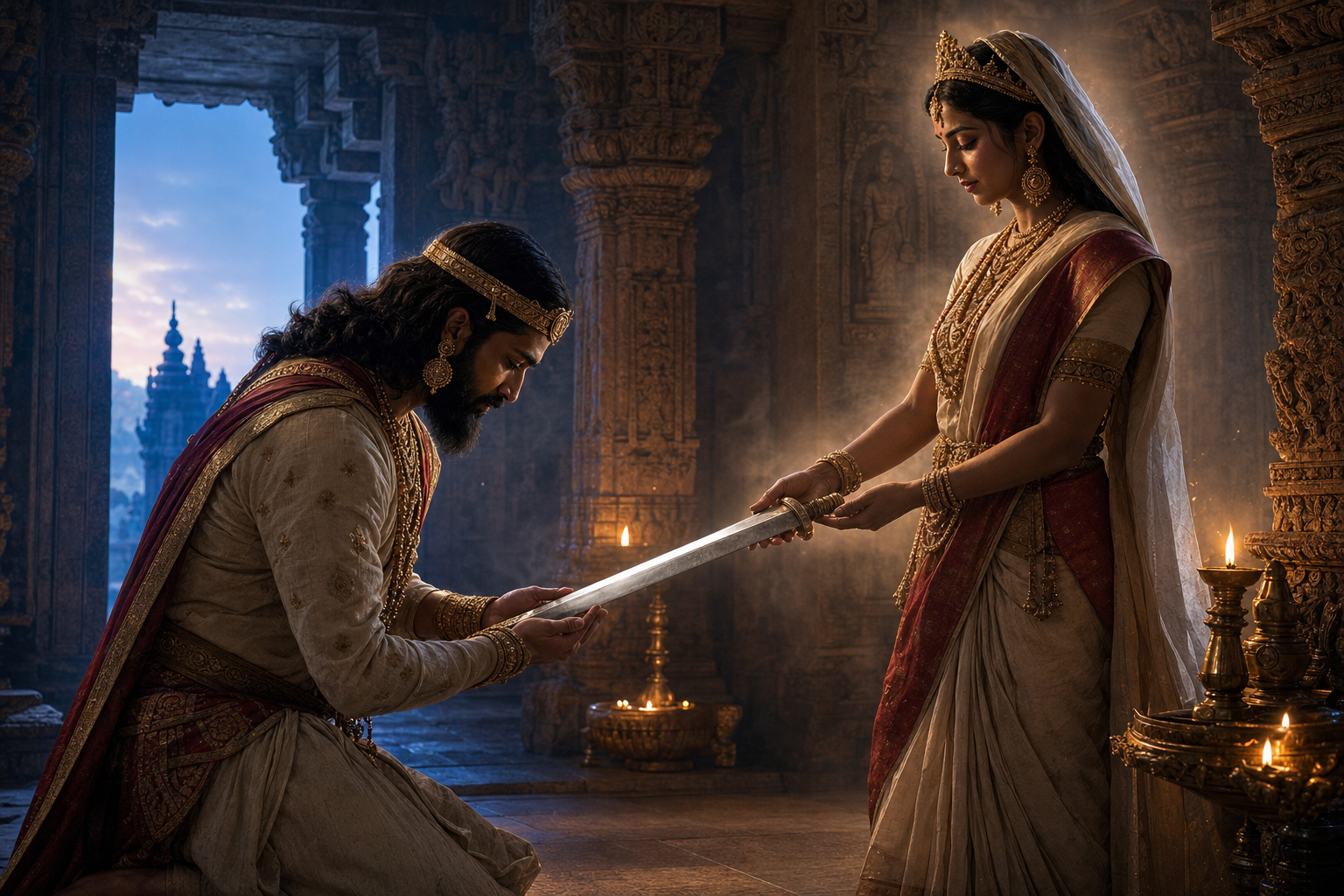
You may have arrived with a simple question: did King Vikramaditya really possess a sword given by Devi? The honest answer is narrower than either unquestioning belief or easy dismissal. No particular surviving weapon is securely established as his. Yet the image is not an empty fantasy. It joins royal memory, plausible Indian swordcraft, and a demanding rule for the exercise of power.
You can understand the sword without mistaking legend for an inventory record. Keep three questions separate: who Vikramaditya was, what kind of blade he could have carried, and why Dharmic memory made that blade divine. Each question has a different kind of answer.
First ask which Vikramaditya you mean
Vikramaditya was not necessarily one man’s personal name. It functioned as an honorific for an exemplary ruler. The legendary king of Ujjain is traditionally associated with the beginning of Vikrama Samvat in 57 BCE. The Gupta emperor Chandragupta II, who ruled around 375-415 CE, also bore the epithet Vikramaditya. The beloved sovereign of cultural memory therefore cannot be reduced automatically to one securely reconstructed biography.
This distinction matters whenever you encounter an image, temple claim, performance, or social-media caption about the divine sword. Ask whether Vikramaditya means the legendary ruler of Ujjain, a historically dated king who used the title, or the larger ideal of righteous sovereignty. A claim may be meaningful in one register and unproven in another.
The Simhasana Dvatrimsika and Vetala Panchavimshati cycles helped form that larger ideal. Their compilations span roughly the 11th through the 18th centuries, with the Vetala stories also circulating through the Kathasaritsagara tradition. These dates do not establish a weapon’s ownership. They do show how later generations remembered a fearless ruler: truthful, generous, learned, and answerable to rajadharma.
When evaluating a historical claim, label it at the right level. A dated ruler is a historical question. A blade compatible with the period is a question of material plausibility. A Goddess-bestowed weapon is a sacred narrative about authority. Confusion begins when evidence for one is presented as proof of all three.
What the legendary blade probably looked like
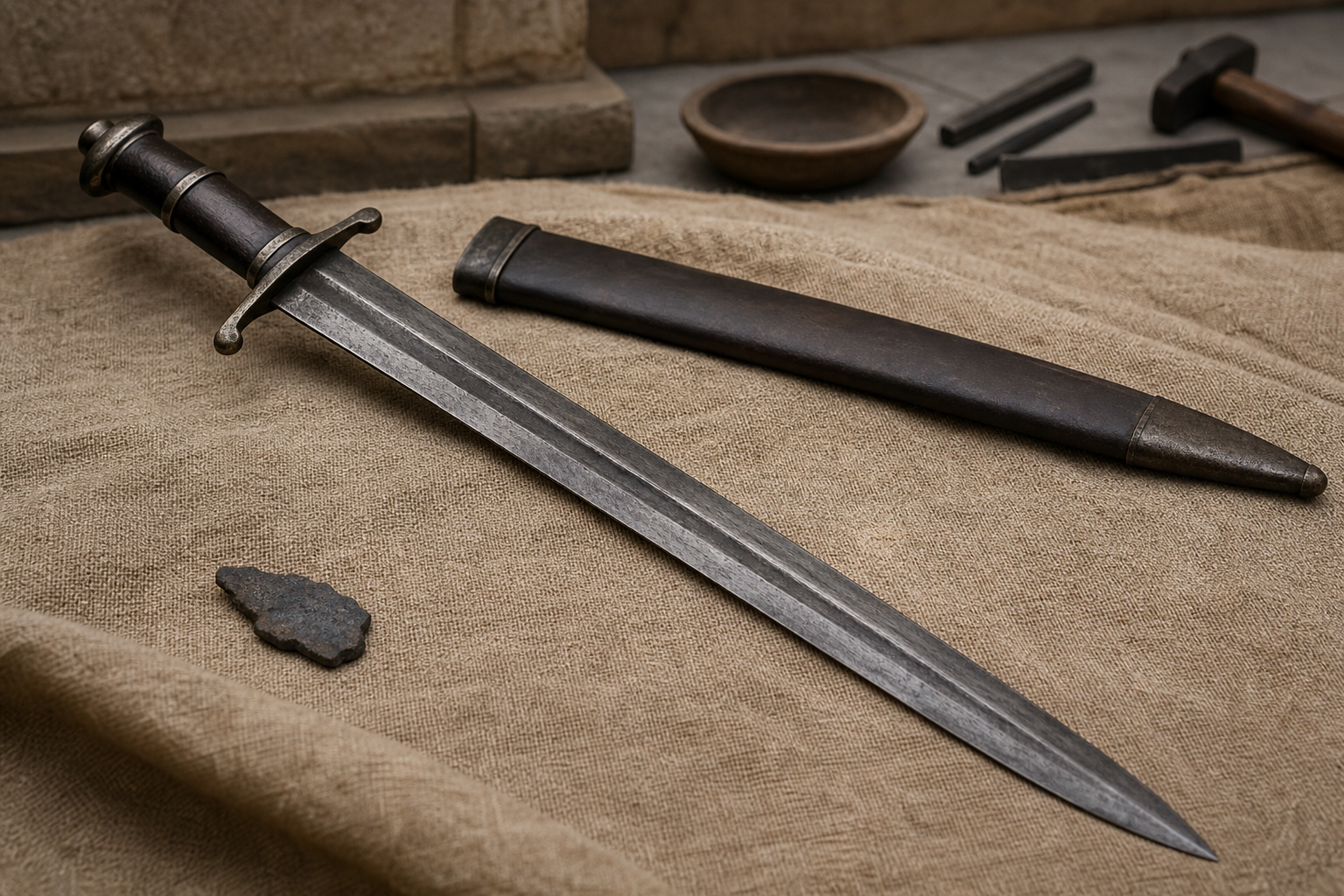
If you want a historically plausible picture, begin with the khadga or khanda rather than the later curved talwar. This classical Indian weapon has a straight, broad blade that widens toward the tip. A reinforced spine supports forceful cuts, while a robust hilt and guard can accommodate controlled use with two hands. Related forms appear in early iconography and temple sculpture.
That does not mean every modern depiction must be treated as a technical reconstruction. Artists use the sword to communicate sovereignty, protection, or divine favor. A curved blade in devotional art may belong to the artist’s own period or visual vocabulary. You should not date the underlying legend solely from the weapon an illustrator chose.
Indian metallurgy makes an exceptional royal blade materially credible. High-carbon crucible steel commonly called wootz originated in the southern peninsula during the early centuries BCE and travelled widely into West Asia, where it contributed to the tradition later associated with Damascus steel. Its carbide-rich structure could combine a hard, lasting edge with resilience. By the Gupta period, Indian iron and steel craftsmanship was already sophisticated.
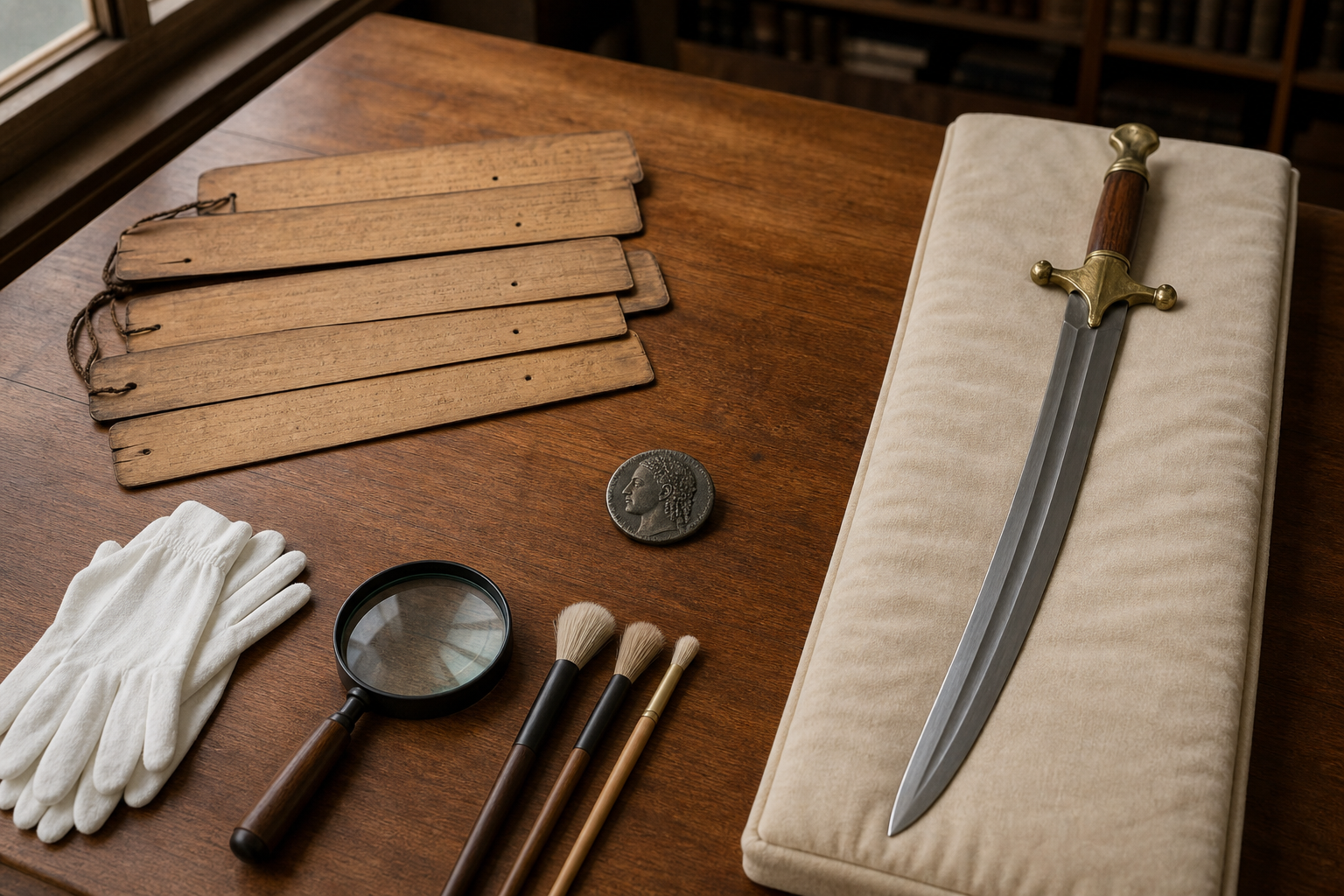
Material plausibility is not provenance. If someone identifies an object as Vikramaditya’s actual sword, ask for its findspot, proposed date, inscription, and documented history of ownership. Without that evidence, the object might illustrate an appropriate weapon type, but it cannot establish personal possession. Superior steel can explain why a blade inspired awe; it cannot by itself prove a divine origin or royal identity.
The divine gift restricts the king as much as it empowers him
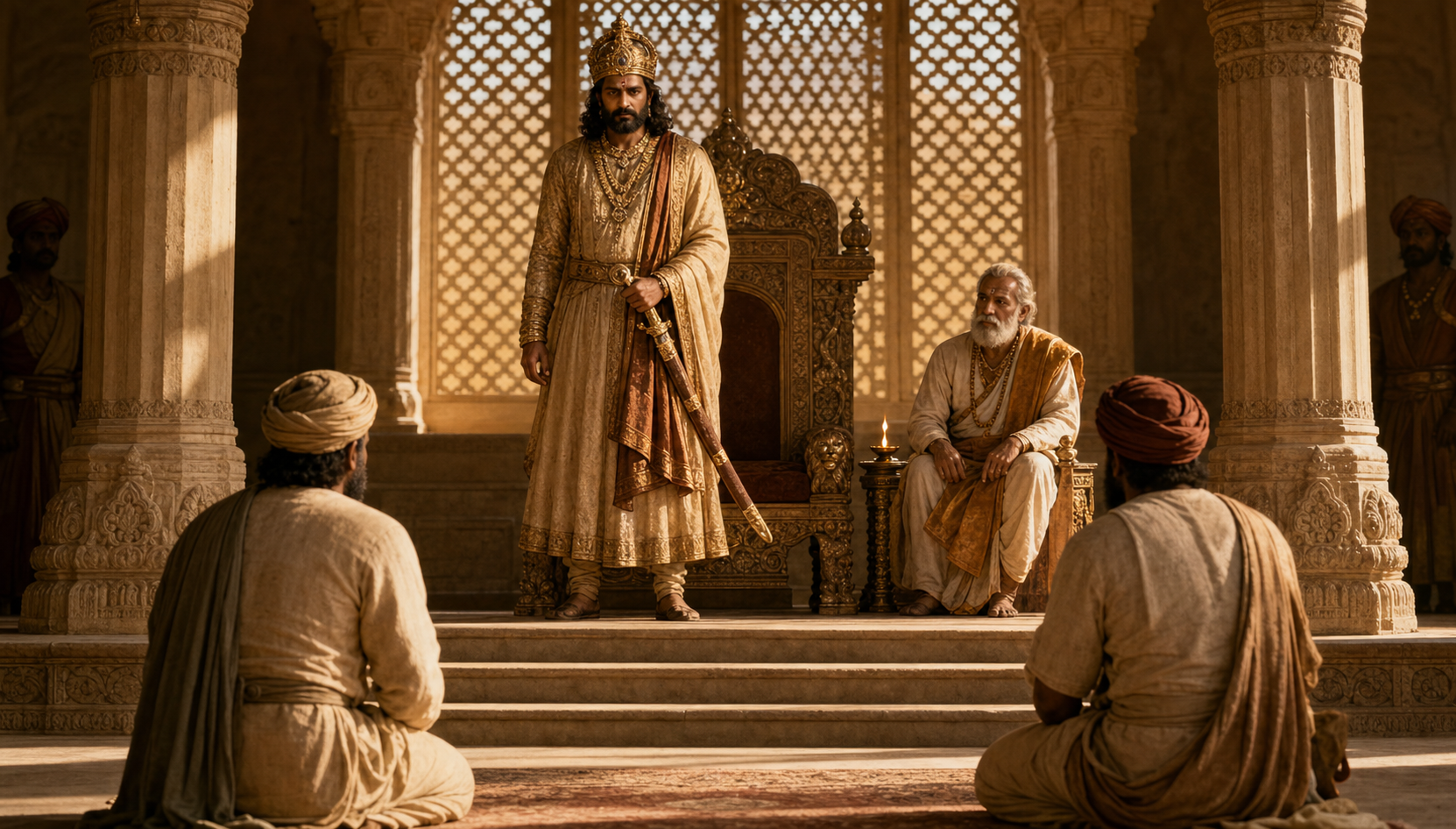
In the sacred geography of Ujjain, the sword is remembered as a boon of Devi in forms associated with Kalika, Harsiddhi, and other manifestations of the Goddess. Its divinity is best understood as a covenant. The king receives the capacity to confront adharma, but he also accepts an obligation to protect the vulnerable, preserve learning, and place social order above personal ambition.
This is why the weapon cannot be separated from Vikramaditya’s reputation as a scholar-king. Courtly tradition surrounds him with nine luminaries, or Navaratnas, often including Kalidasa and Varahamihira. The exact historical composition of that court remains debated. Its ethical point is clearer: strength becomes trustworthy only when knowledge, literature, and disciplined judgment guide it.
The Vetala encounters sharpen the same lesson. Vikramaditya repeatedly enters cremation grounds and haunted spaces, carries the elusive spirit, and faces riddles that test truthfulness and moral judgment. The sword is present, but combat does not solve the central problem. The king must think, speak truth, and accept the consequences of doing so. Courage without discernment would leave him unable to complete the task.
You can apply that standard to authority in a family, institution, community, or government. Before taking decisive action, ask what truth has not yet been faced, who will bear the cost, whether counsel and lawful remedies have been exhausted, and whether the proposed action protects someone or merely satisfies pride. If those questions remain unanswered, the symbolic sword should remain sheathed.
This is not a warrant for private violence. In ordinary life, the sword represents clear judgment, lawful protection, restraint, and the willingness to accept responsibility. Kshatra Dharma does not make aggression sacred. It binds strength to a protective purpose.
Dharmic traditions share the edge without becoming identical
The sword carries related ethical meanings across Dharmic traditions, but those meanings should not be flattened into a single doctrine. In Hindu iconography, Devi wields the khadga against adharma, while Vishnu’s Nandaka represents discriminative knowledge. The blade can therefore defeat an external threat or cut through internal confusion.
In Buddhism, Manjusri’s sword of prajna severs ignorance. Jain memory places righteous kingship beside the renunciant discipline of ahimsa: the ruler maintains order while the renunciant demonstrates the highest restraint. In Sikh tradition, the Khanda and kirpan express the saint-soldier ideal, joining spiritual depth to responsibility for the protection of others.
These parallels do not prove that every tradition is telling the same story, nor do they make Vikramaditya a figure belonging equally to every community. They reveal a shared ethical grammar: clarity must precede action, power must answer to duty, and strength becomes honorable when it restrains harm.
Civilizational overlap also survives through memory and timekeeping. Vikrama Samvat has long ordered Hindu festivals across much of North and Western India. Jain communities preserved narratives connecting Vikramaditya, Gardabhilla, and Ujjain. Sikh communities in the North and Northwest historically used the related Bikrami calendar alongside evolving community practices. You can speak of this shared civilizational inheritance without erasing real theological differences.
Key takeaways for reading the legend well
- Do not force a choice between literal history and meaningless fiction. The royal title, plausible weapon, and sacred symbolism are distinct layers.
- Date each claim carefully. The Ujjain king is associated with 57 BCE, Chandragupta II ruled around 375-415 CE, and major narrative compilations came centuries later.
- Picture a straight, broad khadga or khanda when seeking the most historically plausible blade, but do not treat artistic details as archaeological proof.
- Read divine authorization as accountability. Vikramaditya may act decisively only because wisdom, truthfulness, and protection govern his strength.
- Compare Dharmic sword symbols by their ethical function while preserving the distinct teachings of Hinduism, Buddhism, Jainism, and Sikhism.
Put the symbol to work today. Choose one difficult decision you have been postponing. Write down the truth you must acknowledge, the person who needs protection, the restraint you must observe, and the lawful next step. Revise any action that fails one of those tests. If it passes all four, carry it out without self-display. That is a fitting way to hold Vikramaditya’s sword.