
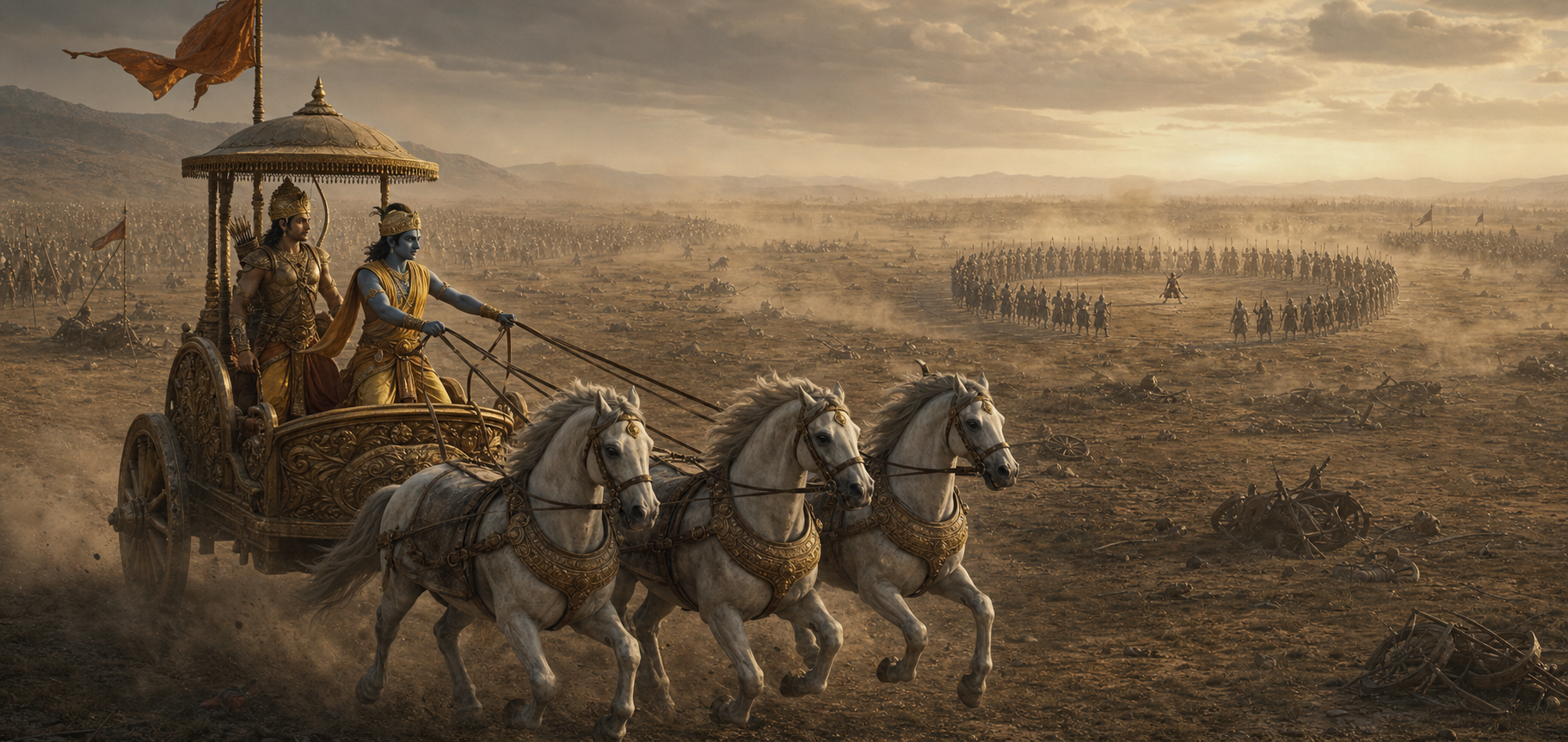
If Abhimanyu’s death makes you wonder whether divine protection is selective, do not defend Krishna by minimizing the killing. Do not condemn him as indifferent, either. Begin by separating three things: Krishna’s chosen role, Abhimanyu’s own agency, and the adharma of the warriors who surrounded him.
That separation gives you a clearer answer. Krishna’s restraint was not approval of Abhimanyu’s death. It preserved the moral weight of vows, choices, and consequences while leaving the guilt of the attackers fully visible.
Begin with the role Krishna chose
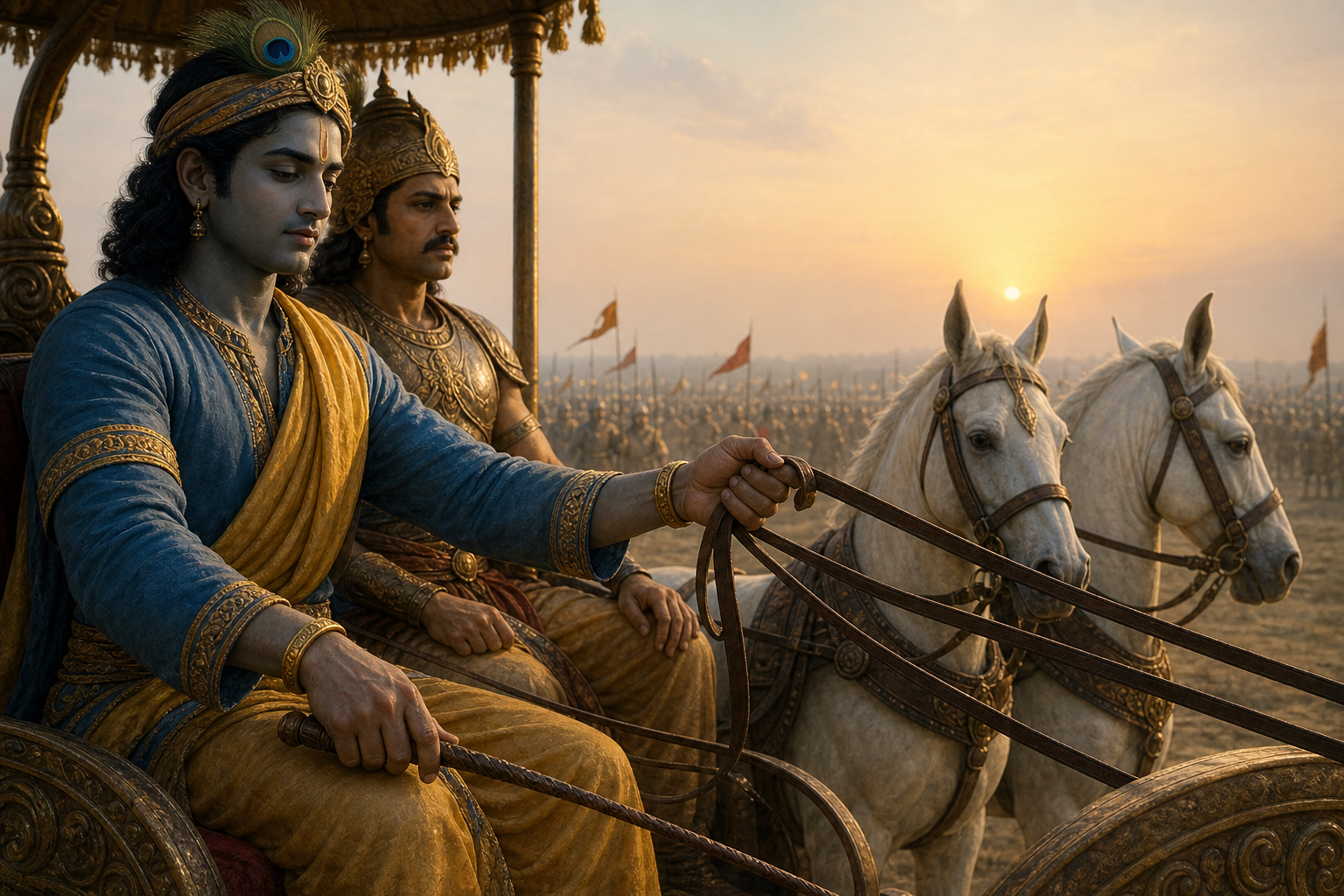
When you ask why Krishna did not intervene, distinguish divine capacity from a voluntarily accepted boundary. Krishna entered the war as Arjuna’s charioteer and counselor. He had declined to wield weapons, placing his action within a defined role.
This self-limitation is central to the meaning of his restraint. Krishna guides, warns, plans, and protects the larger possibility of dharma. He does not ordinarily erase every consequence produced by human decisions. If divine power cancelled the result whenever a righteous person faced mortal danger, courage would lose its cost, vows would lose their seriousness, and karma would become morally unintelligible.
The relevant idea is loka-sangraha: the maintenance of cosmic and social order. Krishna’s purpose is larger than securing a painless outcome for every individual on the dharmic side. When judging a possible intervention, ask not only whether it would save someone, but also whether it would preserve the framework within which human beings can choose and uphold dharma.
Abhimanyu was trapped by human choices
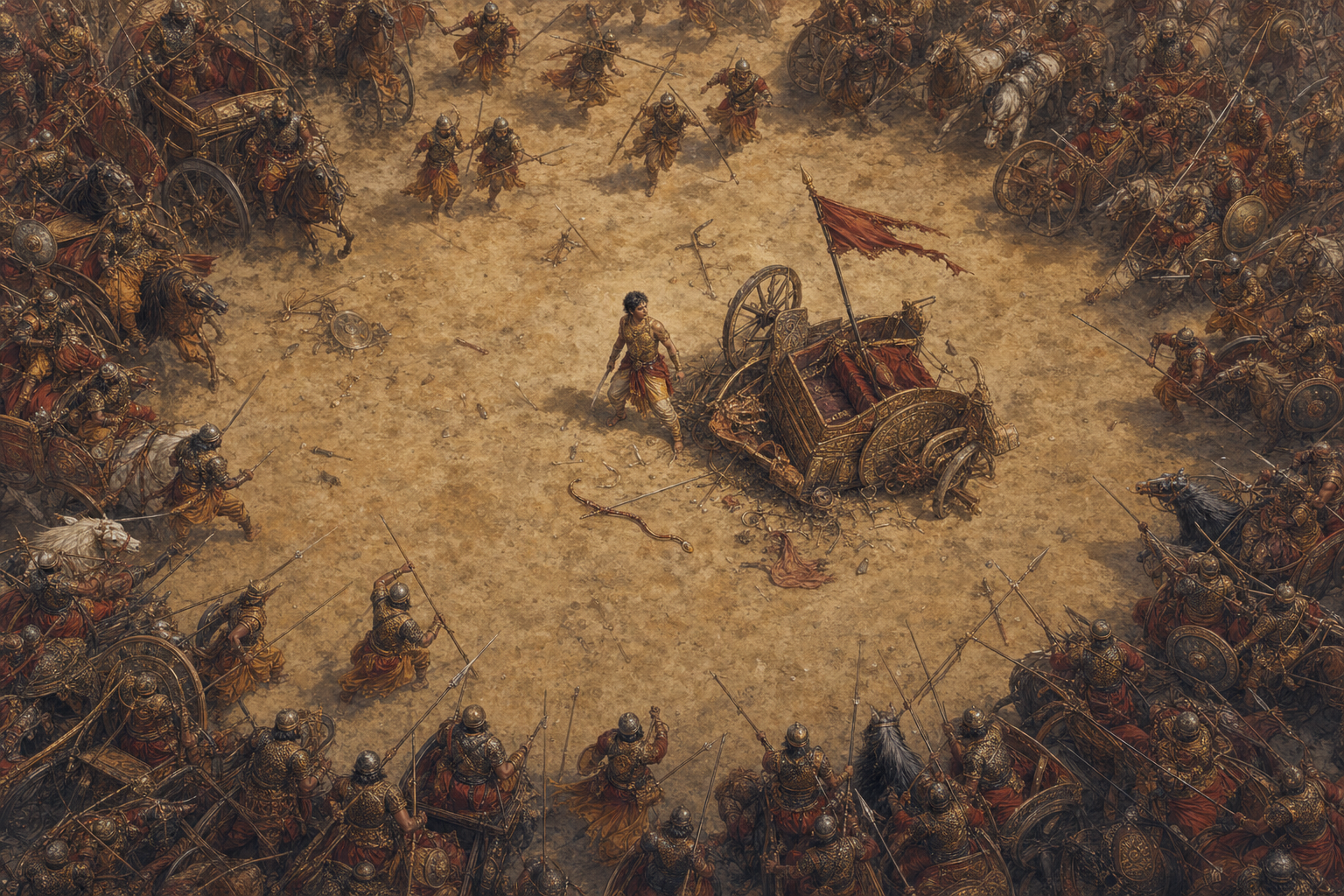
The battlefield sequence fixes responsibility where it belongs. On the thirteenth day, Drona arranged the Kaurava forces in the Chakravyuha to capture Yudhishthira. Arjuna and Krishna had been drawn away by the Samshaptakas. Abhimanyu accepted the dangerous task of breaking into the formation because the Pandavas needed an immediate response.
Popular tradition holds that Abhimanyu knew how to enter the Chakravyuha but did not possess complete knowledge of how to leave it. His decision was therefore not casual. He entered as a warrior confronting a known risk, with the expectation that the other Pandavas would follow through the opening he created.
Jayadratha prevented that support from reaching him. A boon enabled Jayadratha to hold back the four Pandavas other than Arjuna for that day. Once the breach closed, Abhimanyu stood isolated against experienced warriors including Drona, Karna, Kripa, Ashvatthama, and the forces around Duryodhana. They attacked the lone warrior collectively, violating the conventions of dharma-yuddha.
If you want to assign moral responsibility, follow that chain of decisions. Krishna’s non-intervention did not compel Drona’s plan, Jayadratha’s obstruction, or the unlawful assault. Those were human acts. Divine restraint does not transfer the attackers’ guilt to the one who refrained from cancelling their agency.
Restraint does not make adharma morally neutral
One of the most damaging readings of karma is that whatever happens must therefore be right. The Mahabharata permits no such shortcut here. Abhimanyu’s death was an outcome within a karmic world, but the manner of his killing remained adharma. Karma makes actions consequential; it does not turn cruelty into justice or prove that a victim deserved what happened.
The familiar comparison with Draupadi needs the same care. Devotional traditions celebrate Krishna’s protection of her dignity during the attempted disrobing. Abhimanyu, however, was an armed combatant acting within a war shaped by pledges, formations, commands, and martial duties. Protecting a defenseless person’s dignity and determining a warrior’s battlefield outcome involve different dharmic responsibilities. One intervention cannot be used as a mechanical rule for the other.
Krishna’s restraint also did not end with passive acceptance. Abhimanyu’s death moved Arjuna to vow that he would slay Jayadratha the next day. Krishna then used strategy around the setting sun to help Arjuna fulfil that pledge. Justice proceeded through disciplined action within a web of vows, not through a miracle that made the preceding choices disappear.
Key takeaways
- Krishna accepted a bounded role as charioteer and counselor; his restraint was chosen, not helplessness.
- Abhimanyu entered the formation as an acting kshatriya, not as an unknowing ritual sacrifice.
- The collective attack remained adharma even if karma or destiny formed part of the larger metaphysical setting.
- Krishna answered the wrong through guidance and strategy, preserving human responsibility instead of cancelling it.
Keep history, popular memory, and theology distinct

Three claims about Abhimanyu are often merged into one. You can avoid needless arguments by identifying which kind of claim you are making.
Popular memory: The widely repeated account says Abhimanyu learned how to enter the Chakravyuha while hearing Arjuna speak to Subhadra before his birth, but did not hear the complete method of exit. When teaching this detail, call it a popular tradition rather than presenting every feature as equally emphasized in every textual recension.
Metaphysical tradition: Some tellings associate Abhimanyu with Varchas, linked to Chandra or Soma, and give him a destined short stay on earth. This can illuminate niyati and prarabdha karma for a devotional reader. It should not be used to excuse the warriors who violated their martial obligations.
Ethical core: A courageous young warrior was isolated and overwhelmed by veterans acting together. That conclusion does not depend on accepting the prenatal-learning account or the Varchas tradition. The battlefield causality and broken martial codes are sufficient to expose the wrong.
This distinction is especially useful in family discussions, satsang, or study groups. Label a detail as narrative, popular, or theological before debating it. You can then disagree about destiny without losing sight of the episode’s unmistakable moral judgment.
Use the episode carefully when faith meets grief
Abhimanyu’s death offers a disciplined way to think about suffering, but it should never become a slogan aimed at someone who is grieving. Telling a bereaved person that an unbearable loss was simply karma confuses explanation with compassion. It may also imply knowledge of another person’s karmic history that you do not possess.
First name the wrong. Abhimanyu was killed through a breach of martial ethics. Moral clarity must come before metaphysical interpretation. Otherwise, ideas such as destiny and divine order can become shields for cruelty.
Then preserve agency without blaming the victim. Abhimanyu’s choice to enter danger reveals courage and kshatra-dharma. It does not make the unlawful conduct against him acceptable. Honoring someone’s bravery and condemning what was done to that person are compatible judgments.
Finally, turn grief toward the next duty. Arjuna’s response was not denial of sorrow. His vow gave sorrow a defined task, while Krishna supplied the intelligence needed to pursue it. The lesson for you is not to imitate battlefield vengeance. It is to choose a proportionate, dharmic action that remains available after a loss: protect someone exposed to the same wrong, uphold a neglected duty, or refuse to let injustice be renamed as fate.
On your next reading, mark every vow, choice, obstruction, and violation before asking where the divine was. That practice will keep Abhimanyu’s courage visible, the attackers’ responsibility intact, and Krishna’s restraint within the demanding moral world of dharma.