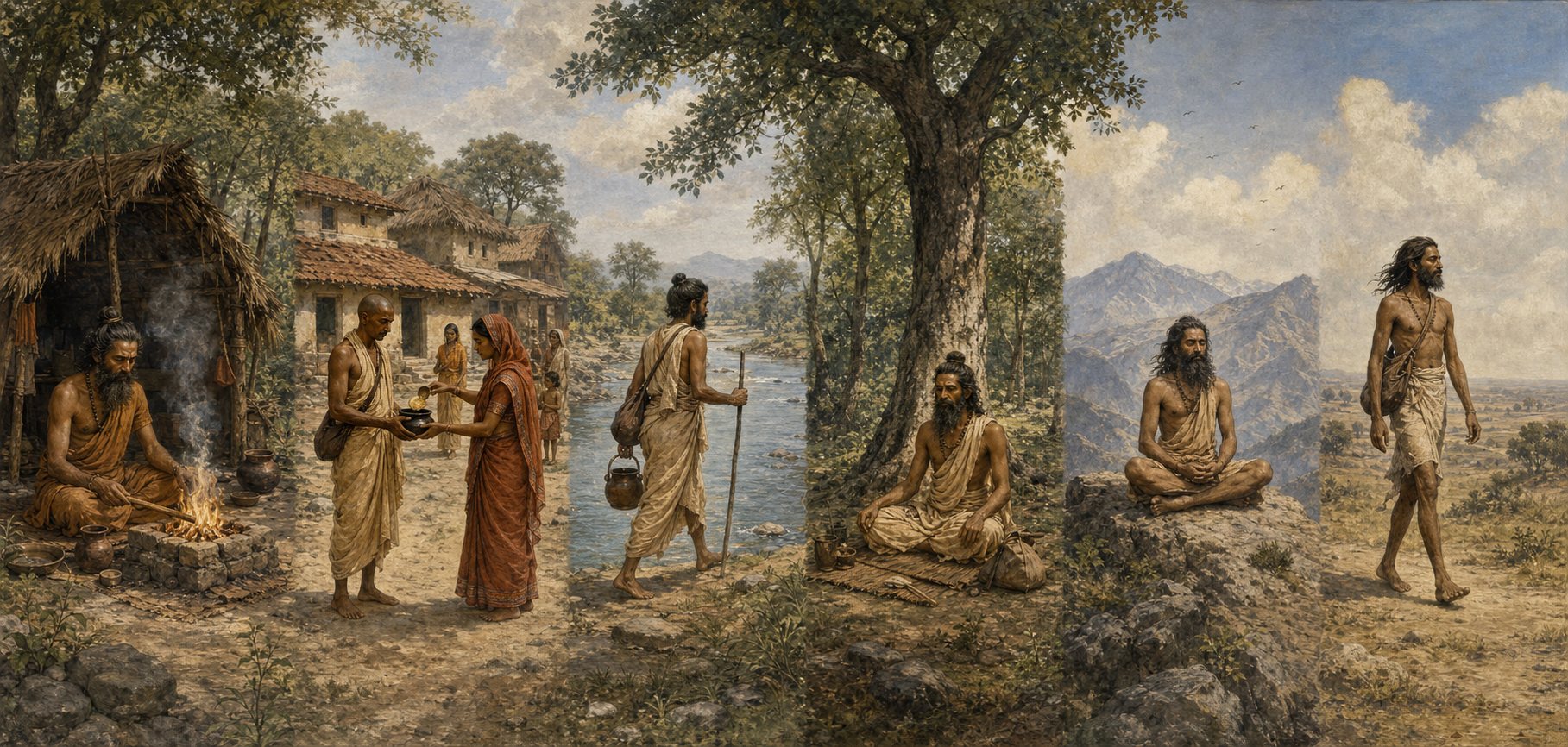
The six renunciate modes associated with the Nārada Parivrājaka Upanishad can initially look like a hierarchy of monastic ranks. The supplied DharmaRenaissance account presents something more useful: a map of how external supports may diminish as detachment and contemplative stability deepen.
Its practical value lies in distinguishing what changes across kuṭīcaka, bahūdaka, haṁsa, paramahaṁsa, turīyātīta, and avadhūta from what must remain constant. Residence, possessions, ritual forms, and public identity may change; non-harm, truthfulness, restraint, discernment, and freedom from grasping remain the tests of the path.
A gradient of supports, not a compulsory ladder
Within the classical āśrama model, sannyāsa is the renunciate vocation directed toward Self-knowledge and liberation. The source article emphasizes, however, that the six modes should be read as a descriptive typology rather than a sequence every renunciant must complete. Differences in temperament and readiness, expressed through the principle of adhikāra-bheda, help explain why distinct forms can serve the same ultimate aspiration.
The organizing movement is from greater reliance on visible structure toward increasingly interior freedom. A kuṭīcaka still benefits from a stable dwelling, a known community, and a regulated routine. A bahūdaka exchanges much of that stability for mobility and anonymity. The haṁsa concentrates more intensely on contemplative practice, while the paramahaṁsa is characterized by sustained nondual awareness rather than dependence on religious insignia.
Turīyātīta and avadhūta extend this interiorization to its furthest expression in the account. The former signifies awareness no longer confined to distinct periods of meditation; the latter represents radical freedom from possessions, social classification, and even the need to appear recognizably ascetic. These descriptions indicate diminishing supports, not promotions in status. The source also notes minor variations among manuscripts and related Sannyāsa Upanishads, reinforcing the need to treat the scheme as adaptive rather than mechanically uniform.
The six modes compared through practice and dependence
Viewed comparatively, the six paths differ most clearly in their relationship to place, livelihood, outward symbols, and contemplative continuity. The following table condenses the distinctions reported in the source without treating them as rigid boundaries.
| Mode | Reported outward pattern | Reported spiritual emphasis |
|---|---|---|
| Kuṭīcaka | Lives in a simple hut near a sacred place, teacher, or former home and receives food from a restricted circle. | Scriptural study, praṇava japa, appropriate ritual continuity, service, and a steady transition into detachment. |
| Bahūdaka | Travels farther, receives alms from numerous homes, and may carry ochre cloth, a water vessel, and a staff. | Purity, regulated mendicancy, restraint of speech, pilgrimage, and release from identities tied to locality, clan, or vocation. |
| Haṁsa | Keeps residence temporary, possessions light, alms simple, and periods of silence frequent. | Natural so’ham or haṁsa remembrance with the breath, prāṇāyāma, and discrimination between ātman and anātman. |
| Paramahaṁsa | Allows external marks to recede and may retain little more than basic cloth and a bowl. | Compassion, equipoise, stable contemplation, and sustained abidance in nondual awareness. |
| Turīyātīta | May appear outwardly unremarkable, like a quiet villager or pilgrim. | Effortless awareness across conditions rather than samādhi experienced only as a separate episode. |
| Avadhūta | May relinquish conventional symbols, fixed clothing, or possessions, although no single exterior is definitive. | Complete inward detachment, fearlessness, purity, and unwavering kindness beyond the impulse to construct a spiritual identity. |
The table reveals that mobility alone does not define advancement. A wanderer can remain inwardly dependent on recognition, while a hut-dweller can cultivate profound dispassion. The deeper axis is the seeker’s relationship to support: whether a form is being used responsibly as an aid or defended as part of a new identity.
Turīyātīta illustrates this distinction especially clearly. The name invokes the framework of waking, dreaming, deep sleep, and turīya, the fourth. In the source’s presentation, being “beyond the fourth” does not mean acquiring an exotic public role. It points to knowledge that has become continuous enough that ordinary conditions no longer stand outside contemplative awareness.
The ethical core that no form can replace
The outward diversity of the six modes rests on a common discipline. The source identifies ahiṁsā, satya, asteya, brahmacarya, and aparigraha – non-harm, truthfulness, non-stealing, disciplined sexuality, and non-possession – as shared foundations. Contentment, self-discipline, sacred study, mantra practice, and Vedāntic listening, reflection, and contemplation develop the character and attention required for deeper inquiry.
This common core prevents the later modes from being mistaken for permission to disregard ethics. The source explicitly distinguishes the freedom of a paramahaṁsa from antinomianism: compassion, evenness of mind, harmlessness, and stable awareness are signs of maturity, whereas eccentric behavior is not. The same caution applies more strongly to the avadhūta, whose striking exterior can be imitated much more easily than inward freedom.
Religious markers therefore have a limited but legitimate function. The article reports differences among traditions: some renunciants carry an ekadaṇḍa and others a tridaṇḍa; some shave their heads and others retain jaṭā; clothing may be white or ochre. Such forms can recall vows and preserve a lineage’s discipline, but they cannot substitute for realization. Their value depends on whether they support restraint rather than invite claims of rank.
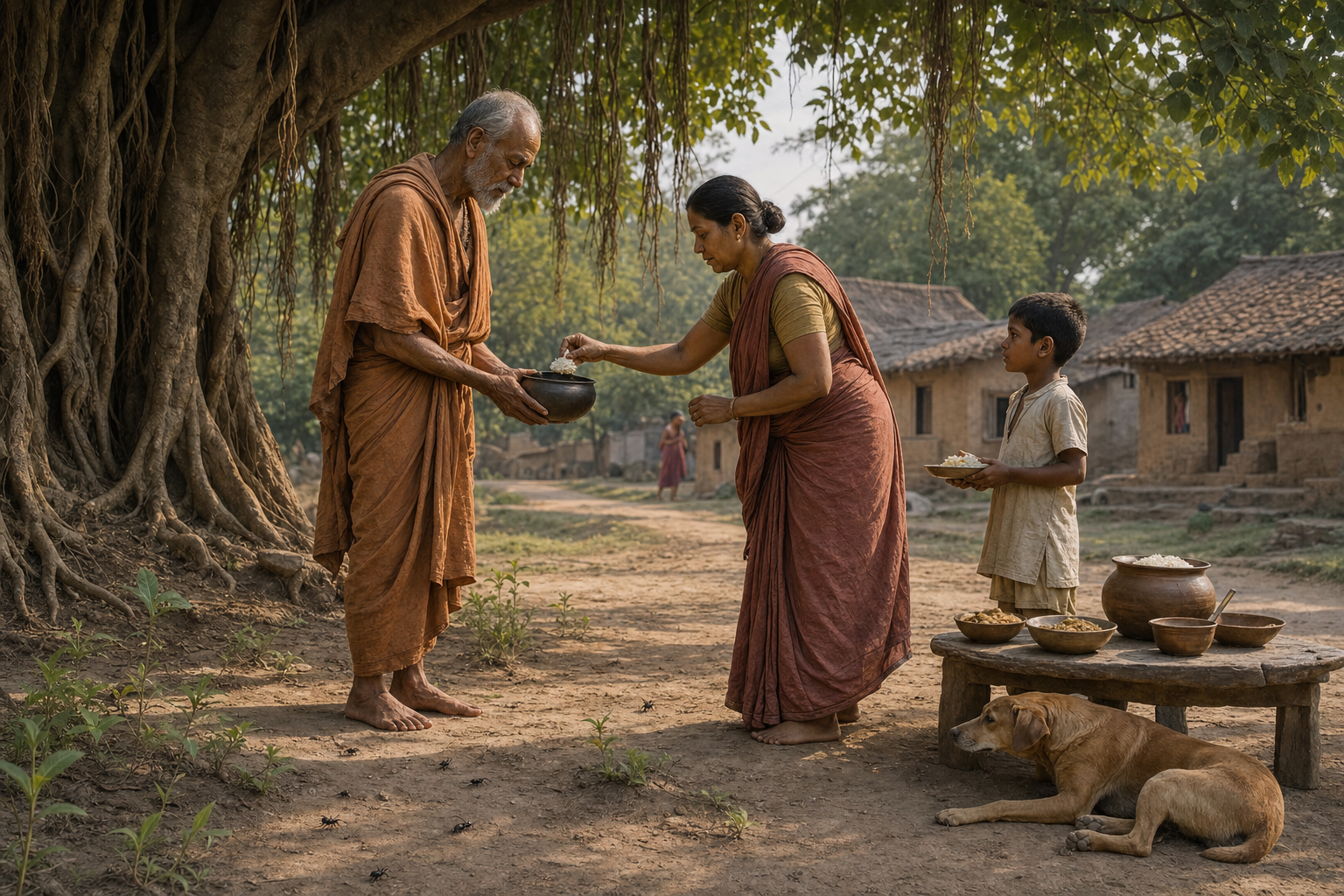
The source also gives renunciation a social dimension. It portrays the sannyāsi as an independent moral presence who consumes little, avoids harm, and may offer counsel or blessing without partisan attachment. Householders sustain that independence through respectful alms. The relationship is reciprocal but deliberately limited: material support should not turn the renunciate into a representative of household interests.
Applying the map without imitating monastic appearances
The account situates Hindu sannyāsa beside other dharmic renunciate currents, noting resonances with Buddhist pravrajyā, Jain commitments to ahiṁsā and aparigraha, and the learned simplicity and service associated with Sikh Udāsī and Nirmalā traditions. These parallels need not erase doctrinal differences. They instead show how disciplined non-acquisition can be understood as a contribution to the wider spiritual and social good.
For those without formal vows, the sixfold map is best translated into proportionate disciplines rather than borrowed costumes. Periods of silence can interrupt digital noise; modest consumption can expose habitual dependence; sustained study can replace scattered spiritual sampling; and ordinary kindness can weaken the possessive reflex expressed through “mine.” These practices do not turn household life into sannyāsa, but they allow its central insight to challenge unnecessary grasping.
Key takeaways
- Read the six paths as modes suited to differing readiness, not as a compulsory system of ranks.
- Use outward supports according to actual need and stability; relinquishing them prematurely is not the same as transcending them.
- Judge maturity through non-harm, truthfulness, restraint, compassion, and steadiness rather than clothing, possessions, or unusual behavior.
- In household life, apply the principle through measured consumption, intentional silence, serious study, and kindness without claiming a renunciate status.
The continuing usefulness of this map will depend on preserving that distinction between simplification and performance. When discipline is matched to readiness and ethical conduct remains non-negotiable, the six paths can orient future seekers toward freedom without turning freedom into another identity to possess.