The significance of the reported HJS engagement with Union Finance Minister Nirmala Sitharaman lies less in any announced scheme—none is identified in the supplied account—than in the civic model placed around it: dharmic ethics inspiring service, social cohesion supporting collective action, and accountable finance enabling welfare delivery.
That model deserves examination, but so do its evidentiary limits. Only one source article was supplied, and it says formal minutes of the meeting were not publicly available. The useful question is therefore not what the government committed to, but how the article’s four themes could form a coherent and testable civil-society agenda.
What the reported meeting establishes—and leaves open
The source reports that an HJS delegation briefed Sitharaman on nation-building, dharma awakening, social welfare and Hindu unity. It does not report an allocation, regulatory decision, formal partnership or ministerial endorsement of a particular programme. The meeting and the policy possibilities discussed around it should consequently be treated as separate layers of the account.
The first layer is the reported institutional engagement. The second is HJS’s broad thematic agenda as presented by the article. The third is the article’s own policy interpretation, which connects that agenda to charitable regulation, philanthropy, volunteer mobilisation, digital access, heritage, education, health awareness and other fields. Those connections offer a framework for evaluation; they are not evidence that every cited activity is already an HJS programme.
This distinction matters because access to a senior public official can open dialogue without predetermining its outcome. A credible assessment must wait for clearer information about proposed interventions, intended beneficiaries, operating arrangements and measurable objectives.
How four themes become one civic agenda
Read together, the four themes describe a possible chain from values to public benefit. Dharma supplies an ethical vocabulary; unity creates networks of trust and cooperation; welfare turns those resources into service; and nation-building describes the wider civic value that effective service may produce. This is more coherent than treating the themes as four unrelated aspirations.
The source interprets dharma through truthfulness, non-violence, compassion and selfless service. Under that interpretation, dharma awakening is not merely greater ritual participation. It becomes ethical literacy expressed through conduct, volunteering and community problem-solving. The practical test is whether professed values improve the fairness, reliability and accessibility of service.
The article similarly presents Hindu unity as cooperation amid internal diversity, not the erasure of distinct traditions. It extends this plural framing to Hindu, Buddhist, Jain and Sikh communities and associates it with shared service, heritage conservation and youth mentoring. Such unity can function as civic infrastructure when participation remains voluntary, differences are respected and public benefits are not restricted by identity.
Nation-building is the broadest and least measurable term in the set. It becomes analytically useful only when translated into outcomes such as stronger institutional trust, improved access to services, greater community resilience or reduced local friction. Without that translation, it remains an aspiration rather than an assessable result.
Turning dharmic ethics into inclusive welfare
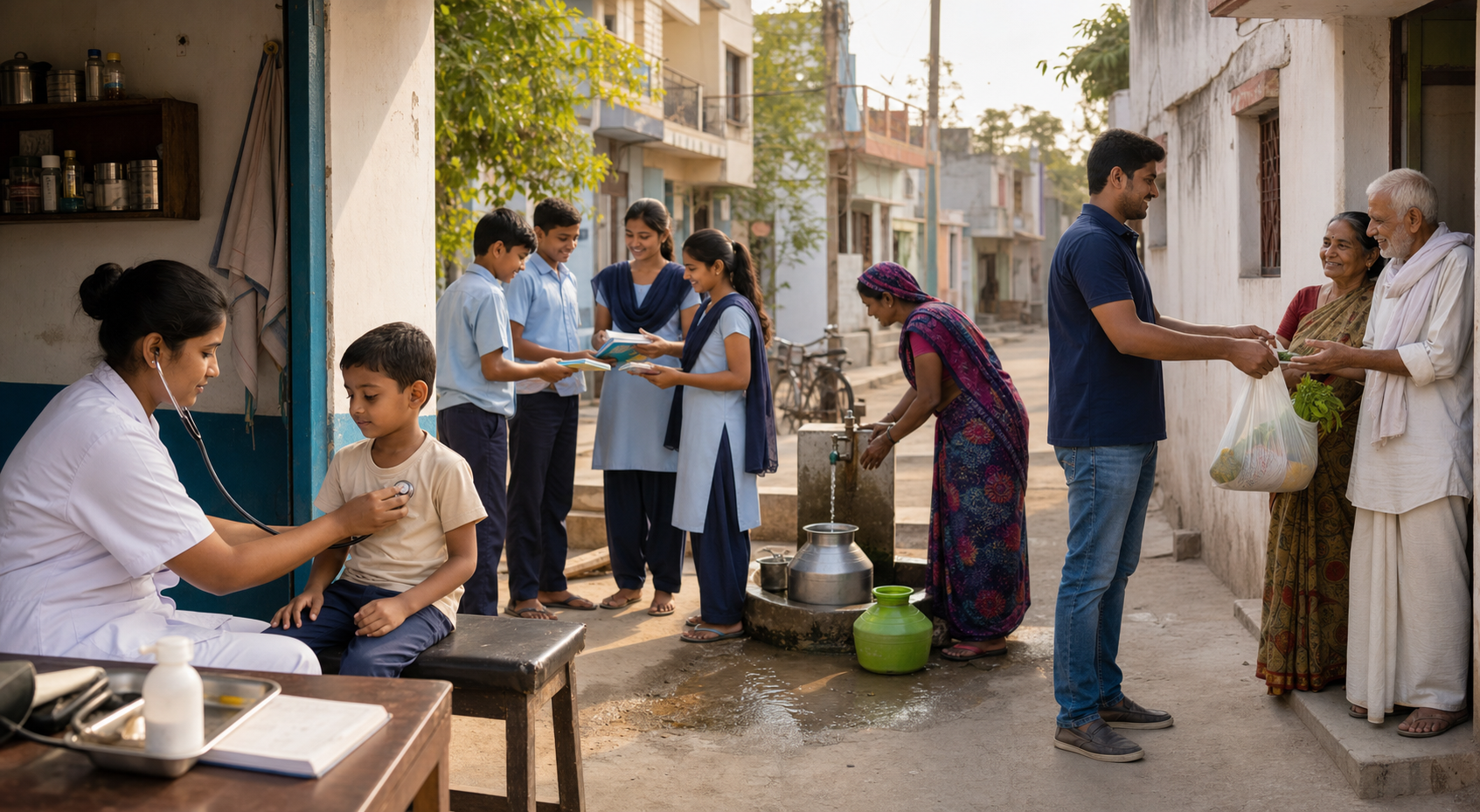
The source places health awareness, nutrition support, educational enrichment, skills, environmental stewardship and elder care within the possible welfare spectrum. It also highlights community libraries, remedial education and volunteer-led environmental work as examples of service formats. These examples illustrate the breadth of the proposed vision, but the account does not document their scale, locations or results.
A welfare agenda this broad needs more than goodwill. Each initiative requires a defined problem, transparent eligibility, accessible delivery and safeguards for participants. It also needs a way to hear complaints and correct failures. These mechanisms are where abstract commitments to compassion and dignity become observable institutional behaviour.
The source’s distinction between outputs, outcomes and long-term impact is especially important. A volunteer event, training session or awareness campaign is an output. A demonstrated change in knowledge, behaviour or service uptake is an outcome. Sustained improvement in well-being or livelihoods is an impact. Counting activity alone cannot show whether the intended public benefit occurred.
Local knowledge is nevertheless a genuine civil-society advantage in general terms. Volunteers can explain programmes in familiar language, identify barriers and maintain relationships beyond a single campaign. That advantage should complement professional standards rather than substitute for them: training, participant protection, record-keeping and evaluation remain essential.
Finance, compliance and measurement are enabling infrastructure
The article treats engagement with the Ministry of Finance as institutionally relevant because tax rules influence lawful charitable funding. It identifies Sections 12A/12AB and 80G of the Income Tax Act in connection with charitable registration and donor deductions. It separately notes that foreign contributions are governed through the FCRA under the Ministry of Home Affairs. These references explain why regulatory clarity matters, but the reported meeting should not be read as changing any requirement or conferring any status.
The source also situates welfare financing within corporate social responsibility programmes, individual donations and digital payments. Diverse funding channels can support continuity, yet they also increase the need for internal controls, timely filings, reliable documentation and clear separation of restricted funds. Financial compliance is therefore not peripheral administration; it protects both the mission and the confidence of donors and beneficiaries.
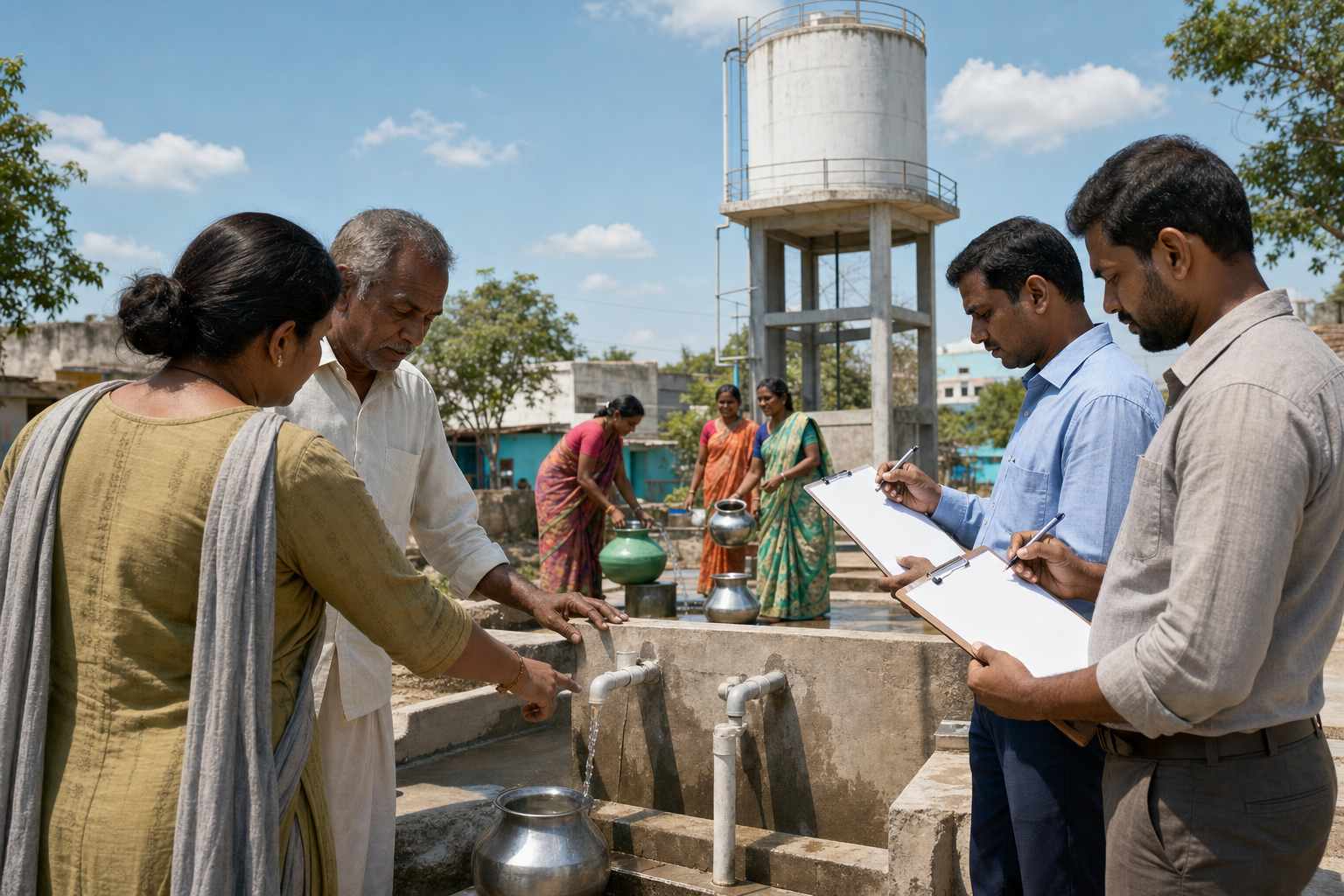
Measurement supplies the corresponding discipline on the programme side. The article recommends theories of change, logic models, risk registers, independent audits, disclosures and grievance procedures. In practical terms, these tools should connect resources to activities, activities to outcomes, and foreseeable risks to named controls. The source invokes social return on investment as a useful ambition, although it reports no calculation from which an HJS programme’s return could presently be assessed.
The policy synthesis is straightforward: finance makes delivery possible, compliance preserves legitimacy, and evaluation shows whether the delivery created value. A durable state–civil-society relationship depends on all three, not simply on shared language about service or national development.
Key takeaways
- The supplied source reports a ministerial briefing but no public minutes, funding decision, formal partnership or programme-level commitment.
- Its four themes form a plausible sequence: dharmic ethics can motivate service, cooperative unity can mobilise capacity, welfare can produce public benefit, and measurable benefit can contribute to nation-building.
- Pluralism is central to the source’s formulation; unity becomes constructive when it respects distinct traditions and ties cooperation to shared civic responsibilities.
- The agenda’s credibility ultimately depends on defined beneficiaries, inclusive access, lawful finance, participant safeguards, transparent reporting and outcome-based evaluation.
Future reporting can move this agenda from vision to evidence by identifying concrete programmes, governance responsibilities, funding arrangements and indicators that communities can independently understand. The decisive measure will be whether dharma-inspired service produces benefits that are inclusive, demonstrable and accountable over time.