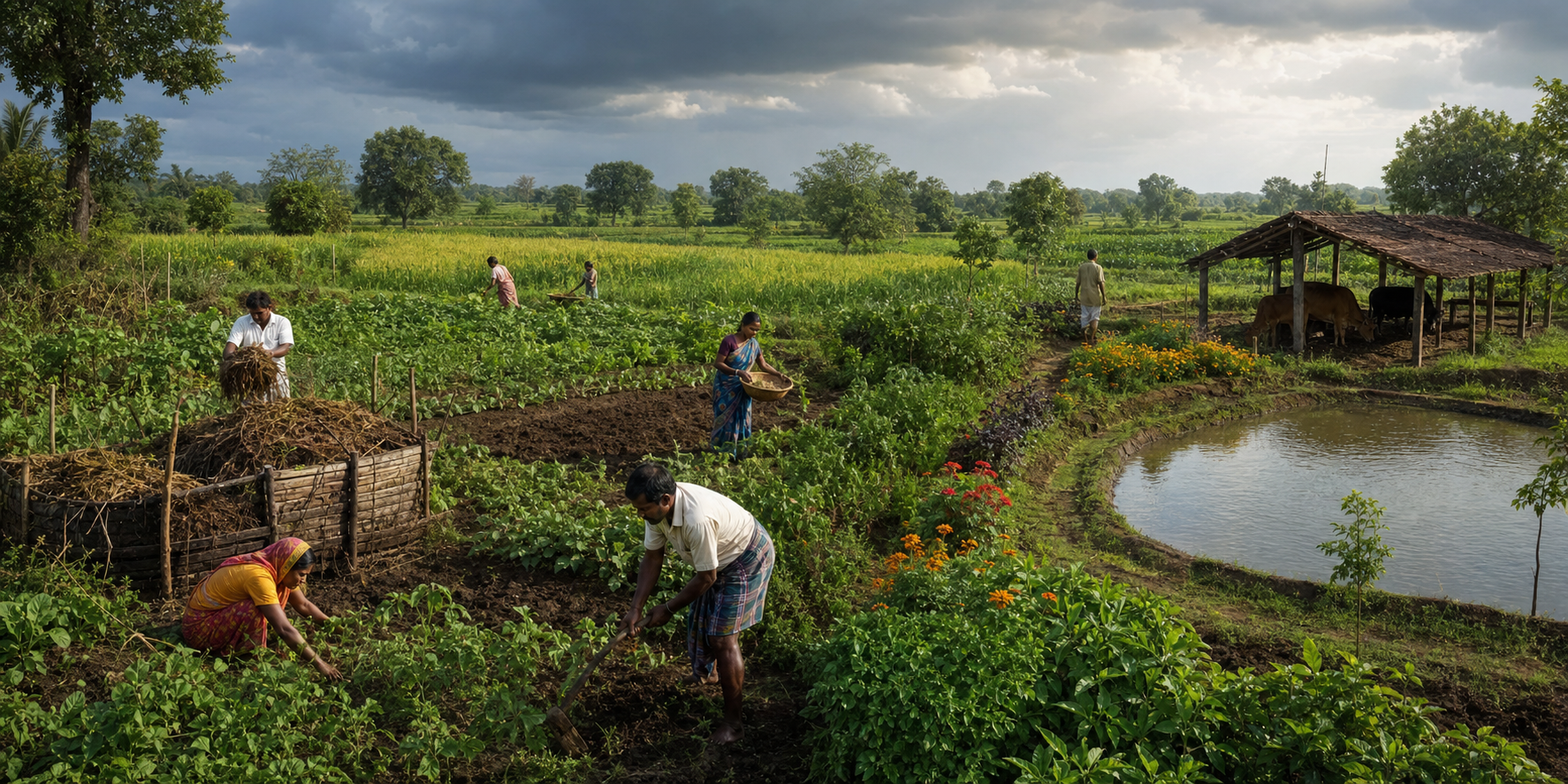
A climate-resilient farm can still fail if its water source is poorly governed, its seed supply arrives late, or its harvest must be sold under distress. The central lesson of dharmic rural outreach is therefore systemic: soil, water, crops, livelihoods and community institutions must reinforce one another.
The framework reported by DharmaRenaissance Blog offers a practical way to connect those elements. Its value lies less in prescribing one universal technique than in showing how locally tested agronomy, collective action and ethical commitments can be assembled into a fairer form of climate adaptation.
Key takeaways
- Resilience should be judged by stable livelihoods, water security and social inclusion, not crop yield alone.
- Healthy soil and efficient irrigation work best when watershed governance protects the water on which farms depend.
- Diversified crops, local seed systems, post-harvest support and collective marketing spread different kinds of risk.
- Dharmic principles become practical when they shape pest control, livestock care, water sharing, mutual aid and accountable decision-making.
The village system, not a single technique, is the unit of resilience
The source article describes smallholders confronting several pressures at once, including irregular monsoons, rising temperatures, episodic drought and flooding, declining soil organic matter, pest resurgence, fragmented holdings, volatile markets and indebtedness. Because these stresses interact, an isolated intervention can simply move vulnerability elsewhere. A higher-yielding crop may demand more water; a new irrigation asset may deepen inequity if allocation rules are unclear; greater production may depress income if storage and market access remain weak.
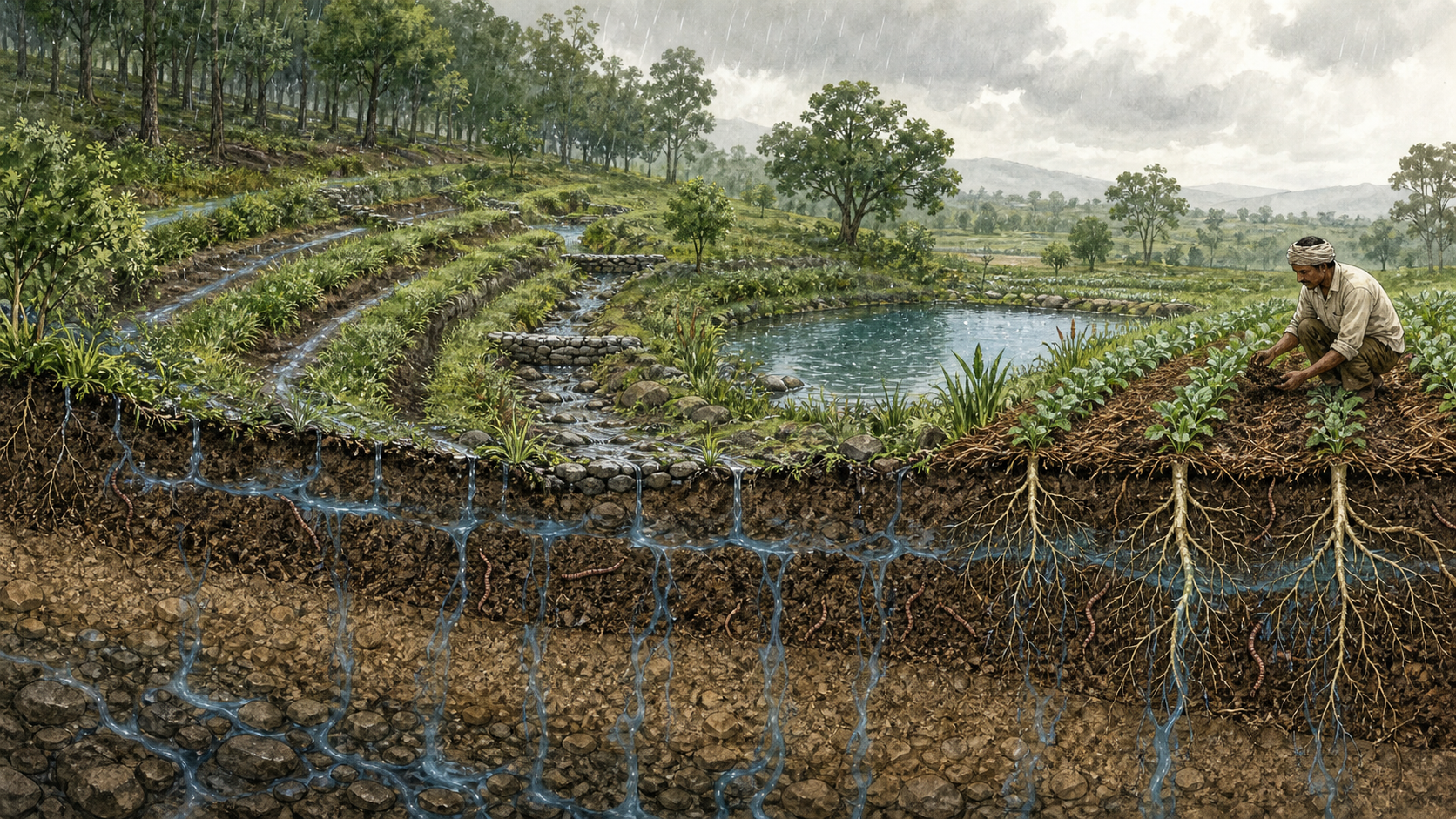
The reported model responds by linking four kinds of resilience. Ecological resilience begins with living soil and diverse fields. Hydrological resilience connects watershed works with efficient use on individual farms. Economic resilience extends from seed choice to processing and sale. Social resilience determines who participates, who carries risk and who benefits. The following comparison synthesizes how these layers fit together.
| Resilience layer | Practices reported in the framework | Collective requirement | Suggested evidence of progress |
|---|---|---|---|
| Soil and field ecology | Residue retention, rotations, intercropping, cover crops, composting, balanced nutrient management and integrated pest management | Field demonstrations, soil testing and trusted extension | Soil health, input intensity and yield stability |
| Water | Contour bunds, vegetative barriers, check dams, recharge structures, farm ponds, mulching and micro-irrigation | Seasonal water budgets, maintenance rules and equitable drought-time sharing | Water-use efficiency and pre- and post-monsoon groundwater levels |
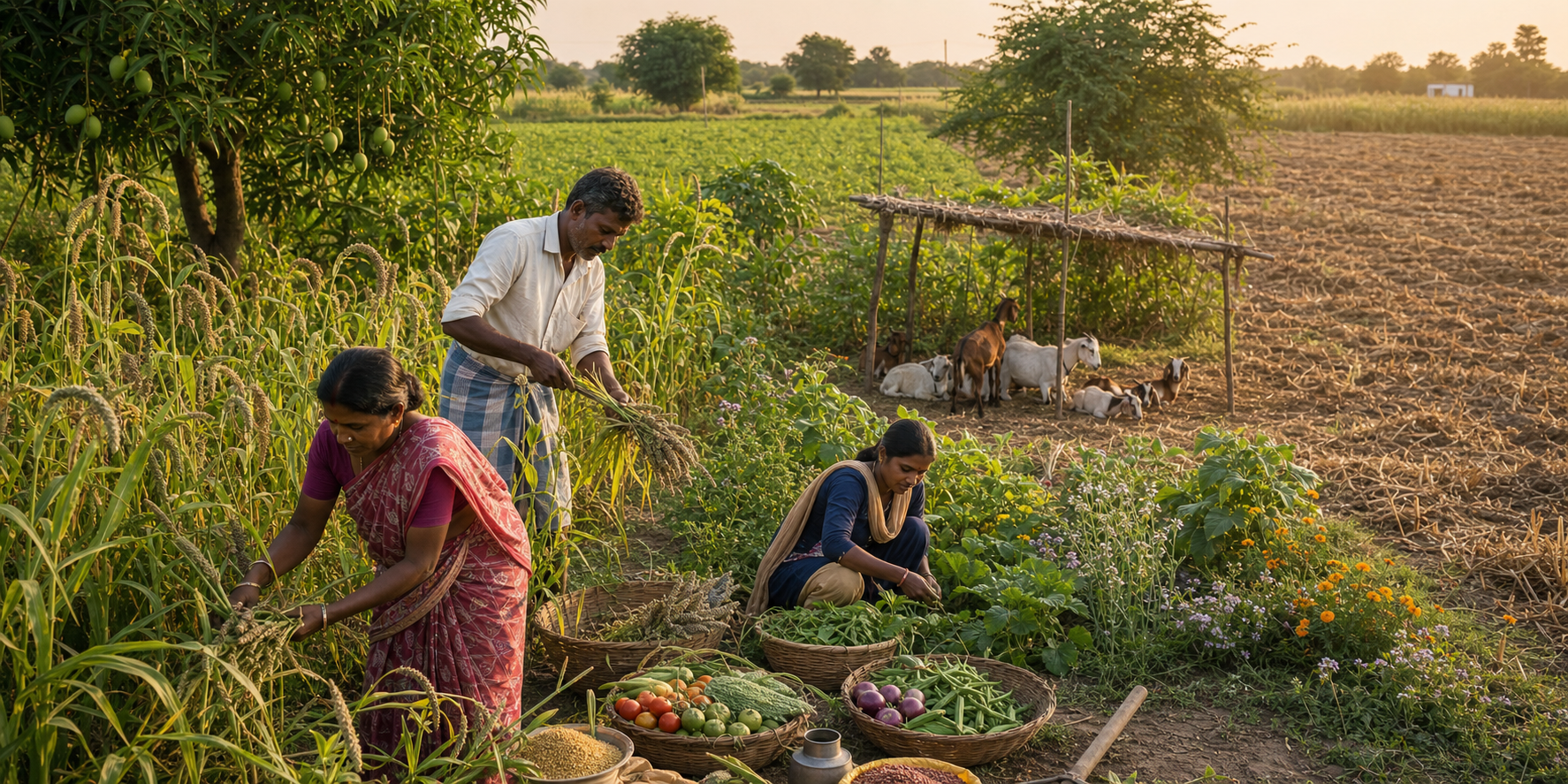
| Crops, seed and food | Millets, pulses, oilseeds, intercropping, agroforestry, fodder components and stress-tolerant varieties | Community seed banks and participatory varietal selection | Yield stability and dietary diversity |
| Livelihoods | Grading, moisture control, storage, primary processing, value addition and diversified sales channels | Self-Help Groups, cooperatives, Farmer Producer Organizations and links to public programs | Net income, participation in decisions and migration patterns |
This systems view also clarifies why mixed crop-livestock farming matters. The source presents fodder and livestock as parts of a nutrient cycle rather than as separate enterprises. Agroforestry similarly serves several functions at once by adding longer-duration assets, moderating field microclimates and increasing landscape diversity. Such combinations distribute exposure instead of placing the household’s prospects on one crop or one season.
Adoption should move from visible trials to shared infrastructure
The most credible starting point is a baseline grounded in local constraints. The source recommends participatory planning and seasonal follow-up rather than importing an identical package into every village. Soil condition, water availability, labor, household resources, crop preferences and market access all affect which change is sensible first.
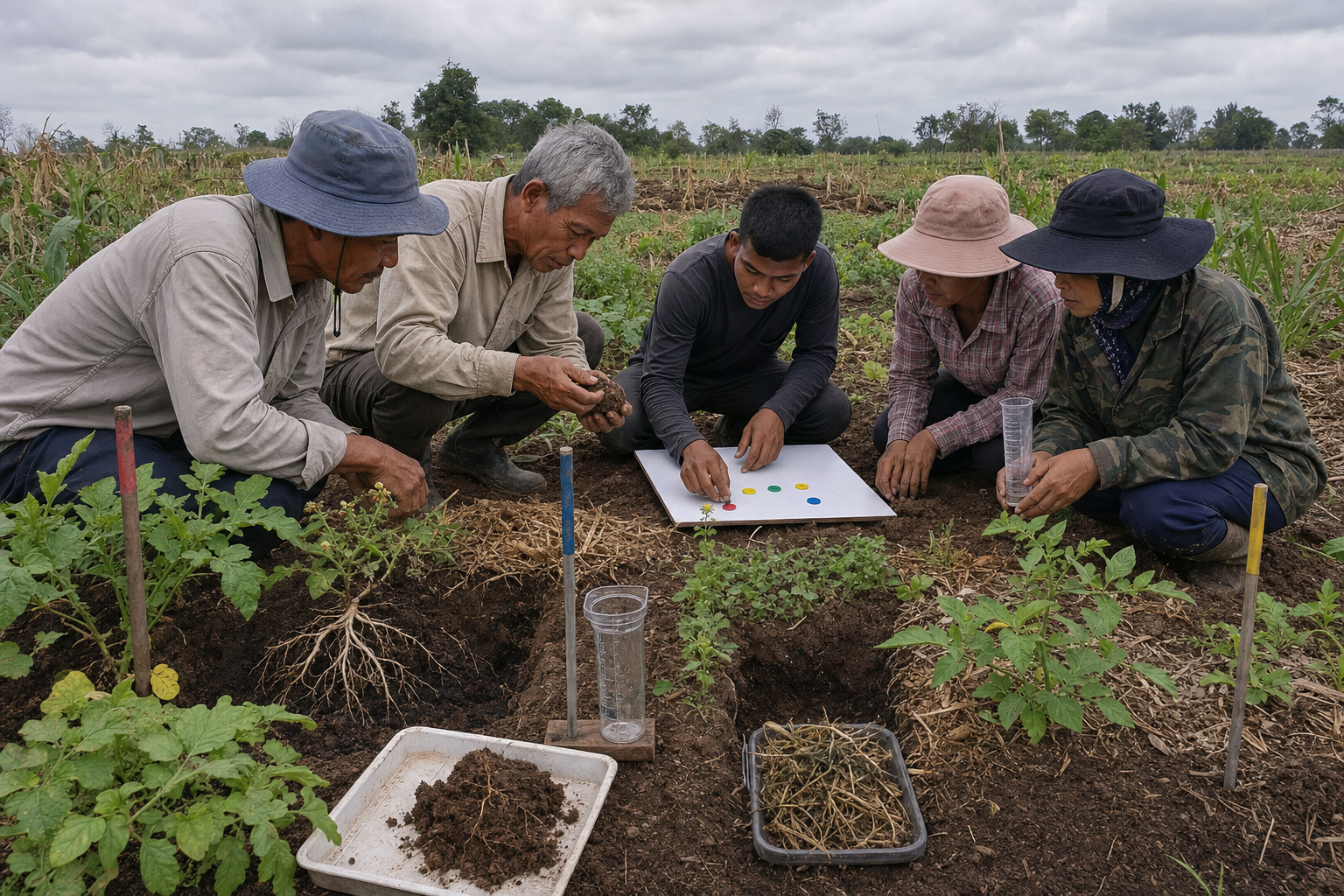
Small, observable trials can then reduce the cost of uncertainty. Farmer Field Schools, demonstration plots and peer-led field days allow cultivators to compare practices under familiar conditions. Simple records of labor, input costs, yields and net margins keep the discussion focused on household viability rather than yield alone. Local-language calendars, short videos and phone advisories can widen access, but the article treats them as complements to trusted relationships, with privacy and informed consent preserved.
This testing discipline is especially important for biological inputs. The article does not dismiss traditional preparations such as panchagavya, but calls for batch consistency, pathogen screening and side-by-side demonstrations against validated biological controls such as Trichoderma and Pseudomonas fluorescens. That approach respects inherited practice without asking farmers to accept an untested input on cultural authority alone.
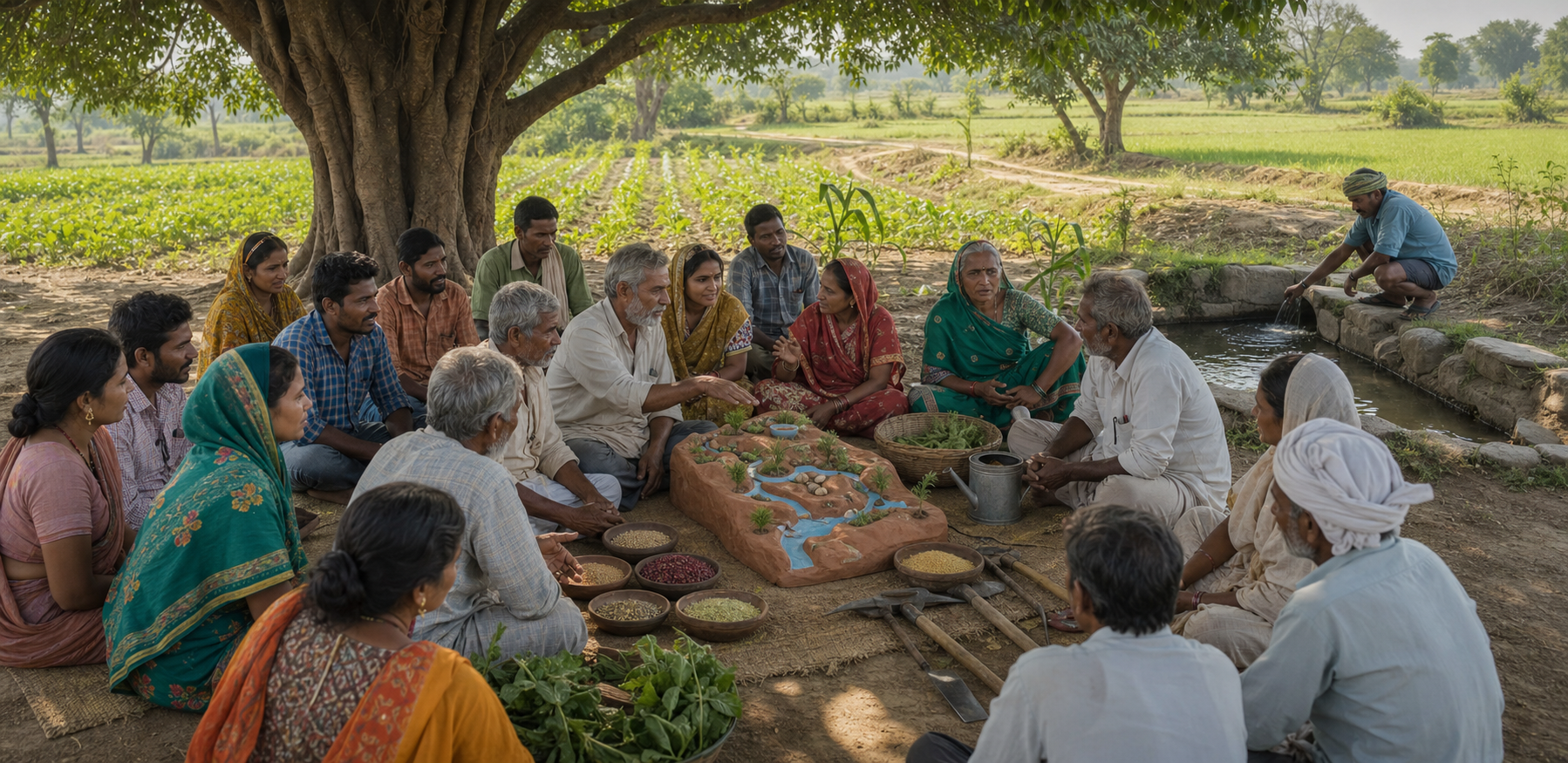
Once farmers can see workable field-level gains, larger investments become easier to coordinate. Watershed structures require agreement about siting, upkeep and distribution; producer organizations require transparent records and defined roles; seed banks require timely replenishment and varietal choices that reflect farmer preferences. Panchayats, water-user groups, Self-Help Groups and producer collectives therefore function as operating institutions, not decorative partners.
The final link is protection beyond the farm gate. The reported framework combines safe storage, grading and primary processing with collective marketing, local buyers, institutional procurement and digital channels where appropriate. Savings, suitable credit, weather advisories, contingency planning, insurance literacy and convergence with public programs can help households absorb shocks. None removes climate risk, but together they reduce the chance that one failed season becomes a debt or migration crisis.
Dharmic ethics become meaningful through operating rules
Dharmic language adds value only when it changes practical decisions. In the source’s formulation, ahimsa supports lower-toxicity pest management and humane livestock care. Seva encourages mutual assistance and voluntary effort. Karuna and daya give moral weight to water sharing and risk pooling, while sarbat da bhala directs attention toward collective welfare. Aparigraha adds a principle of restraint to a model seeking lower dependence on unnecessary inputs.
Integrated Pest Management illustrates the connection. The article favors sanitation, crop diversity, neem-based formulations, traps, biological controls and threshold-based decisions before broad-spectrum chemical use. Agronomically, this can protect beneficial organisms and slow resistance; ethically, it translates non-harm into a decision process rather than an absolute slogan.
Water governance presents the harder ethical test. Recharge pits, check dams or farm ponds do not by themselves determine who receives water during scarcity. Transparent seasonal budgeting, maintenance obligations and drought-time allocation rules are needed to align hydrology with legitimacy. Compassion becomes durable when it is embodied in rules that villagers can understand, question and enforce.
The source situates these values across Hindu, Buddhist, Jain and Sikh communities. That plural framing is important: a shared ethical vocabulary can support cooperation without erasing distinct traditions. It also keeps dharmic farming from becoming a narrow label for a particular input recipe. The deeper proposition is that cultivation should sustain land, animals and vulnerable households alongside production.
Credibility requires measurement, inclusion and honest limits
The available source presents a program design and proposed indicators rather than comparative outcome data. Its recommendations should therefore be read as a framework for local testing, not as independent proof that every listed practice will succeed in every landscape. Differences in soils, rainfall, labor, markets and institutions make adaptation essential.
Its monitoring agenda is nevertheless useful because it spans the system. Proposed measures include soil organic carbon and basic soil-health indicators, groundwater levels, water-use efficiency, input intensity, yield stability, net income, dietary diversity, women’s role in decisions and migration. Examining these together can reveal trade-offs that a single production figure would conceal. A practice that raises output but also raises debt, labor burdens or water conflict would not qualify as comprehensive resilience.
Equity must be tested just as deliberately. The article calls for women’s leadership in Self-Help Groups and producer organizations, roles for young people as service providers and digital facilitators, and entry points suited to households with different resources and risk tolerance. Participation counts are not enough; decision-making power, access to assets and the distribution of gains also matter.
The next stage for climate-resilient dharmic farming is disciplined local learning: communities can begin with modest trials, publish understandable results, revise weak practices and expand only what proves agronomically sound, economically viable and socially fair. In that process, dharma serves not as a substitute for evidence but as a guide to what the evidence should ultimately protect.