
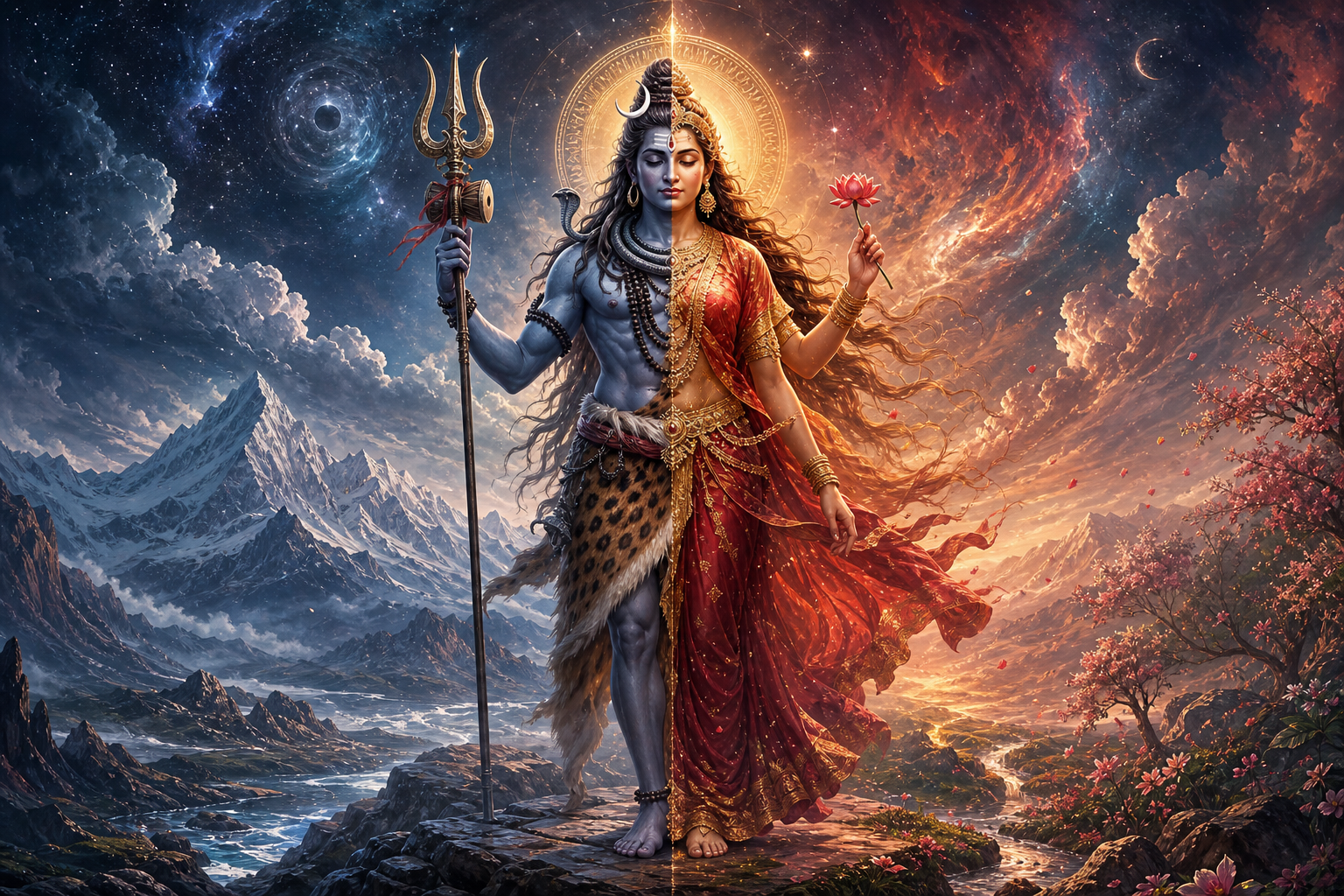
Fierce Shaiva-Shakta forms ask the viewer to hold together what surface appearances seem to separate: terror and compassion, destruction and protection, stillness and movement, plurality and oneness. Bhairava, Kali, Shiva as the Kirata hunter, Bhootatmane Bhairava and Ardhanarishvara express these relationships through different theological languages.
Read together, the forms present a coherent insight: divine grace does not merely soothe. It can expose pride, dissolve false identity, discipline power and restore awareness of the unity underlying apparent opposites. Their challenging imagery becomes most intelligible when iconography, narrative, philosophy and ethics are interpreted together.
Why terror can signify grace rather than cruelty

The study of the sixty-four Bhairavas and the account of Shri Kali converge on a crucial interpretive point: fierce imagery is directed against bondage rather than offered as a celebration of violence. Bhairava’s weapons, skull imagery and cremation-ground associations confront ignorance, mortality and egoic attachment. Kali’s sword and severed head are similarly interpreted as signs of discernment and the removal of ahamkara, the limited identity that mistakes itself for ultimate reality.
Death imagery therefore serves a pedagogical purpose. The skull and cremation ground place impermanence before the devotee without concealment. What terrifies an identity built upon permanence can liberate a seeker prepared to acknowledge change. In both accounts, destruction is meaningful because of what it removes: delusion, pride, inertia and the forces associated with adharma.
The Arjuna Anugrahamurti narrative translates this symbolism into action. It reports that Arjuna, undertaking tapas in preparation for the conflict ahead, encounters Shiva disguised as a Kirata hunter and accompanied by Parvati in a corresponding form. A dispute over a slain boar leads to combat. Arjuna’s celebrated skill proves ineffective, and recognition comes only after his confidence has been exhausted. Shiva then reveals himself and grants the Pashupatastra.
The sequence gives fierce grace a precise shape: concealment, resistance, defeat, recognition and responsible empowerment. Shiva does not destroy Arjuna; he removes the pride that would make extraordinary capability dangerous. Arjuna’s strength is not rejected, but placed under a higher discipline. Grace is thus neither indulgence nor punishment. It is the transformation that makes a seeker able to receive power without being governed by it.
This theological pattern should not be turned into the careless claim that every hardship is secretly beneficial. The sources interpret particular sacred narratives and images; they do not justify avoidable suffering or suspend moral judgment. Their more defensible lesson is that spiritual growth may require confrontation with attachments that comfort alone cannot dislodge.
Shiva and Shakti offer two vocabularies for one reality
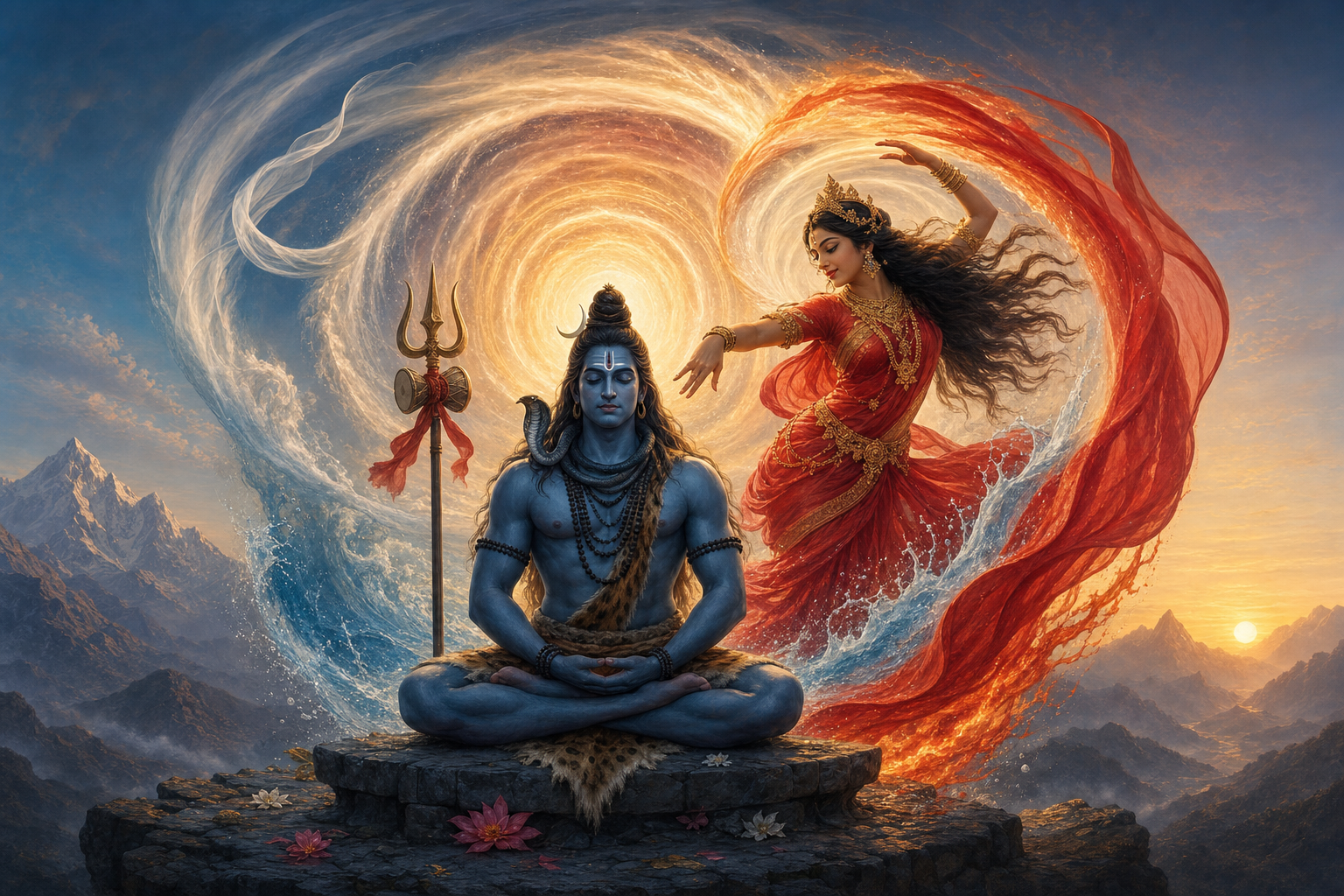
Fierce grace rests upon a deeper Shaiva-Shakta account of divine unity. The Kali article describes Shiva as the still ground of consciousness and Shakti as dynamic power. Kali standing upon Shiva is accordingly read not as a crude contest for dominance but as a visual statement about energy acting upon, and remaining inseparable from, awareness. Power is neither denied nor left without a conscious ground.
The Ardhanarishvara account makes the same non-separation visible in another way. Shiva and Parvati share one body, conventionally with Shiva on the right and Parvati on the left, although the source notes regional variation. The form retains distinction without converting distinction into opposition: ascetic stillness and creative abundance, masculine and feminine symbolism, contemplation and manifestation belong to one sacred whole.
The discussion of Bhootatmane Bhairava extends unity beyond the divine couple. It interprets the name as Bhairava dwelling as the inner Self of beings and manifested realities, including the five great elements of earth, water, fire, air and space. Divine unity is therefore not only represented by two halves of an image; it is encountered within embodiment, nature, breath, ritual substances and the field in which experience occurs.
| Sacred form | Mode of expression | Dimension of unity |
|---|---|---|
| Kali with Shiva | Dynamic power acting upon still consciousness | Energy remains grounded in awareness |
| Ardhanarishvara | Shiva and Parvati represented in one body | Difference is retained within non-separation |
| Bhootatmane Bhairava | Consciousness contemplated within beings and elements | The sacred pervades embodied and material existence |
These forms do not offer competing definitions of unity. They approach it at different scales. Kali and Shiva dramatize the relation between force and awareness; Ardhanarishvara embodies complementary polarity; Bhootatmane brings the insight into the elemental world. Together they prevent unity from becoming a merely abstract doctrine.
Multiplicity becomes a map of non-separation

The sixty-four Bhairavas may initially appear to pull in the opposite direction from Ardhanarishvara: one vision multiplies divine forms while the other joins two halves into one body. The Bhairava source, however, presents the sixty-four as a mandala rather than an unrelated catalogue. Eight principal Bhairavas are each expanded into eight emanations, producing an ordered field associated with directions, energies, protection and spiritual transformation.
Within that account, the number sixty-four signifies completeness, and its recurrence is compared with such groupings as the sixty-four Yoginis and sixty-four arts. The article also cautions that lists, names and ritual details vary among texts, regions and lineages. Such variation matters: the mandala should be understood through the tradition that transmits it, not reconstructed as though every source supplied one uniform inventory.
The synthesis with Ardhanarishvara and Bhootatmane clarifies the theological logic. Oneness need not mean featureless sameness. A single sacred reality can be contemplated as complementary principles, as consciousness within the elements or as an ordered plurality of protective powers. Multiplicity identifies distinct modes of encounter; unity explains why those modes do not constitute disconnected realities.
This also explains why weapons, directions, bodily features and ritual materials receive such attention. They function as a symbolic grammar. A direction locates a force within a sacred order; a weapon names an operation such as cutting attachment; an element connects cosmic teaching with embodied experience. The forms become contemplative tools when their relationships are read, not merely counted.
Key takeaways
- Fierce imagery should be interpreted by asking what form of bondage it confronts, not by isolating its most alarming feature.
- Destruction and blessing belong together when dissolution removes ego, ignorance or unpreparedness rather than serving violence for its own sake.
- Shiva-Shakti unity preserves meaningful distinctions while locating them within a deeper non-separation.
- The many Bhairava forms operate as an ordered contemplative map, while Ardhanarishvara supplies an equally important image of integrated wholeness.
- The ethical value of sacred power is measured through discernment, humility, protection and restraint.
The ethical test of fierce symbolism
The sources consistently tie sacred force to discipline. In the Arjuna narrative, the Pashupatastra is not simply a reward for martial ability. It comes after defeat and recognition, and its reception entails knowledge, restraint and responsibility. The deeper qualification for power is therefore not the ability to deploy it, but the capacity to remain governed by dharma.
The Bhairava mandala sharpens this distinction. Its account interprets Krodha Bhairava as sacred anger transformed into protective clarity rather than uncontrolled rage. Ruru Bhairava is connected with disciplined knowledge and the danger of power separated from wisdom. These readings establish criteria by which fierceness can be evaluated: whether it protects, clarifies and overcomes obstruction, or merely gives spiritual language to aggression.
Kali’s symbolism adds an inward and communicative dimension. Her sword signifies decisive discernment, while the article’s Tantric reading of her garland connects heads with letters, speech and the manifested universe. On that interpretation, purification concerns not only dramatic action but also language: truthful expression, mantra and restraint become part of the discipline of Shakti.
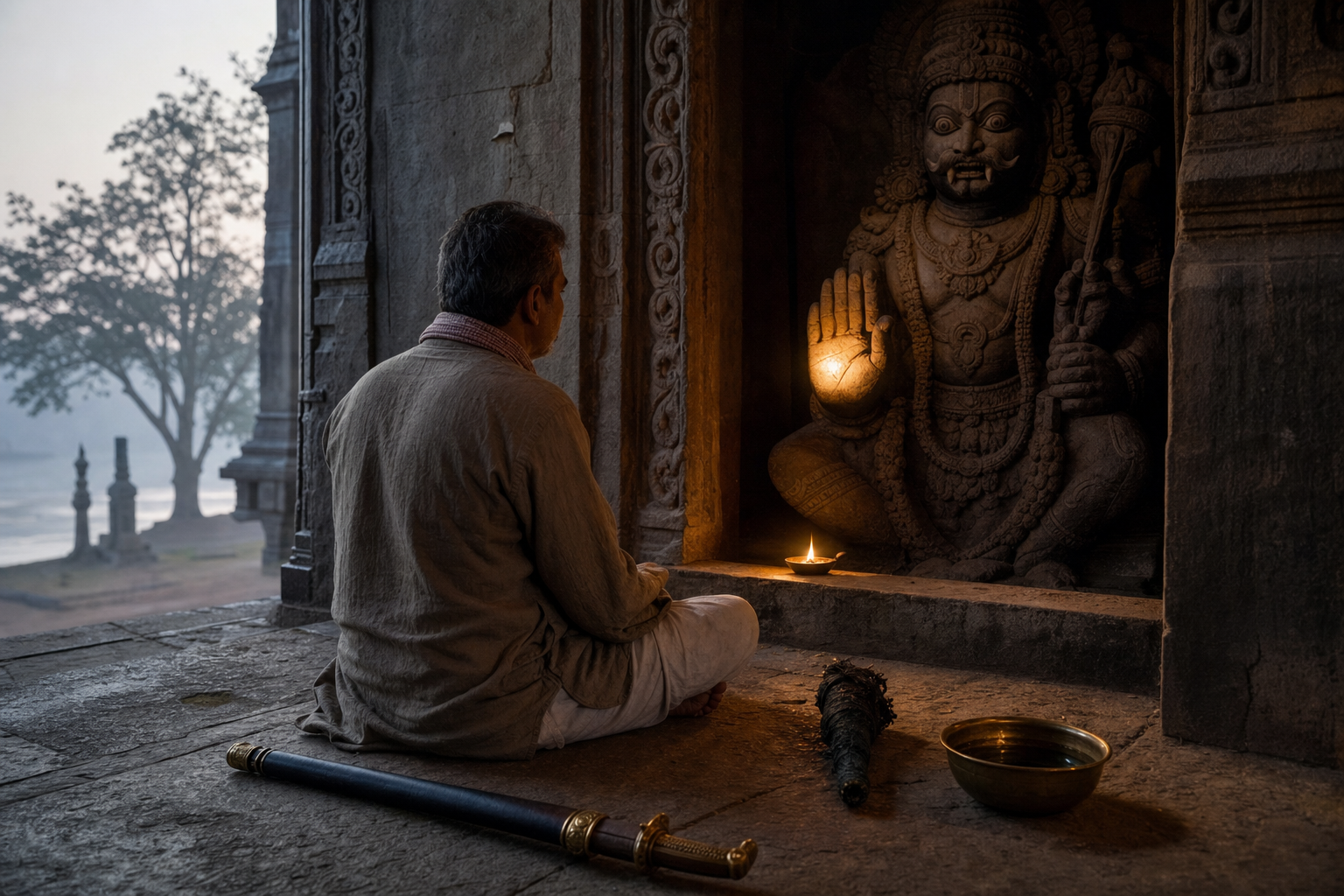
Bhootatmane Bhairava carries the same test into material life. The source associates earth with grounded conduct, water with purification and adaptability, fire with transformation, air with breath and movement, and space with openness and sound. It then draws an ethical implication: if the divine is contemplated within beings and elements, nature cannot be treated merely as an object for exploitation. Offerings such as water, a lamp and sacred ash can become reminders that worship and responsibility occupy the same elemental world.
Three interpretive boundaries consequently emerge. Fierce divinity is not permission for human cruelty; Shiva-Shakti imagery is not a warrant for gender domination; transcendence is not contempt for embodiment. Arjuna’s trial places capability under humility, Ardhanarishvara places polarity within wholeness, and Bhootatmane places spiritual consciousness within the lived environment.
A mature engagement with these forms can carry their iconography forward without softening its intensity or detaching it from ethics. When narrative, symbol and practice remain connected, fierce grace becomes a discipline of fearless awareness, responsible power and reverence for the unity present within difference.
References
- DharmaRenaissance Blog — Ashtashta Bhairavas: The 64 Fierce Guardians of Shakta-Shaiva Tantra
- DharmaRenaissance Blog — Arjuna Anugrahamurti: Shiva’s Fierce Grace Through Trial, Combat and Compassion
- DharmaRenaissance Blog — Shri Kali’s Fierce Grace: Powerful Symbolism of the Divine Mother in Hindu Dharma
- DharmaRenaissance Blog — Bhootatmane Bhairava: Powerful Insight into Shiva and the Five Elements
- DharmaRenaissance Blog — Ardhanarishvara Shiva: Powerful Symbol of Divine Balance and Shakti Unity