
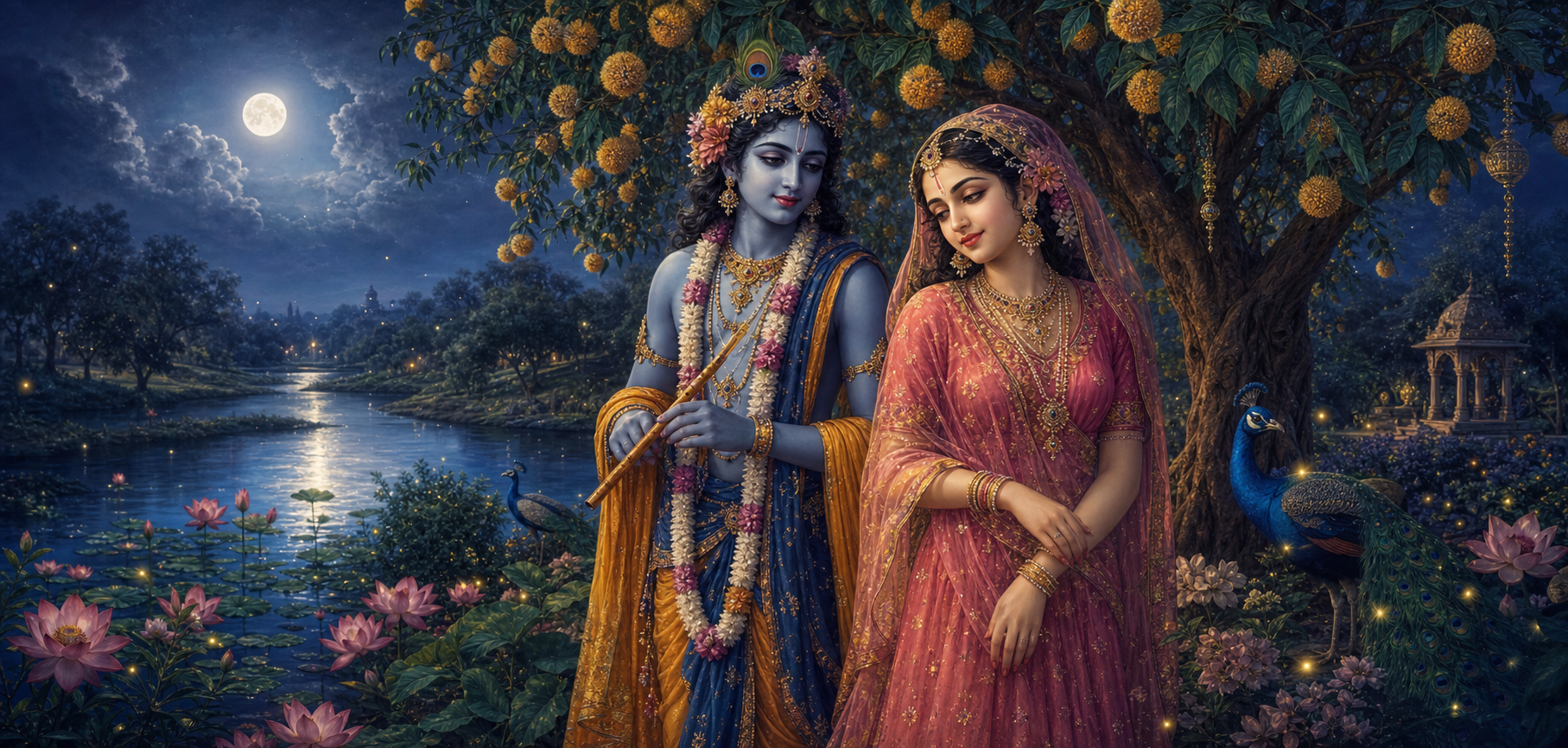
Radha’s place in Gaudiya Vaishnava thought becomes clearer when two questions are considered together: who Radha is in relation to Krishna, and how her love becomes perceptible through longing, remembrance, service, and tears. The answers connect theology with bhakti-rasa, the disciplined understanding of devotional relationship and emotion.
Taken together, the source articles present Radha neither as an ornamental figure nor as ordinary romance projected onto the Divine. One emphasizes the theological grammar of ecstatic love; the other explores Radha as divine potency, sacred feminine presence, and the doorway to intimate devotion. Their convergence shows why love in this tradition is not merely directed toward God: it belongs to the very structure of divine reality.
Radha as both divine love and divine potency
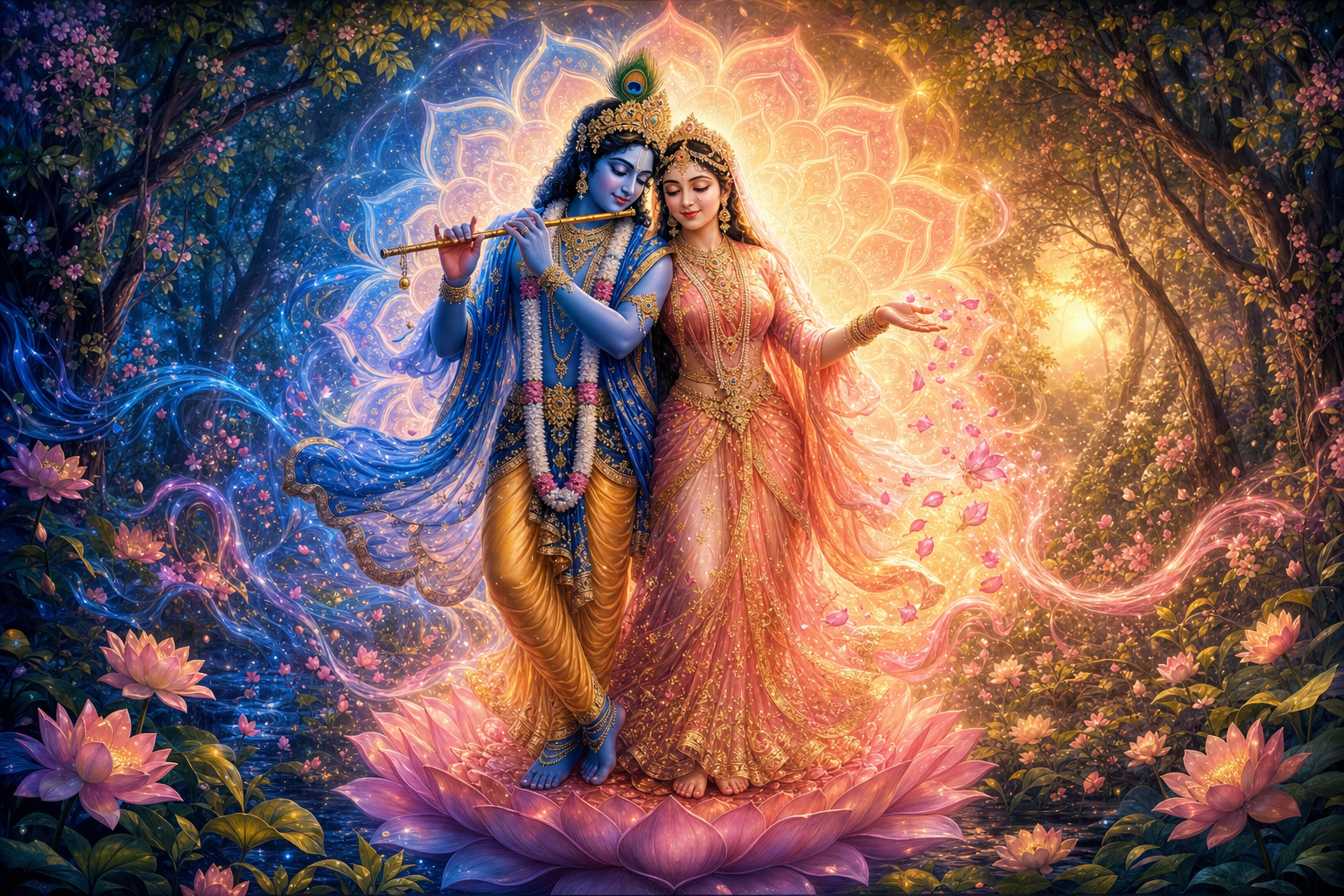
Both source essays identify Radha as Krishna’s hladini-shakti, the pleasure-giving potency through which divine bliss is expressed and reciprocated. The article on Radha’s sacred mystery explains this relationship through the broader Hindu concept of shakti: divine power is not an incidental possession but divinity in dynamic expression. Its analogy of fire and heat conveys inseparability without collapsing every distinction. Radha and Krishna can therefore be understood relationally while belonging to one divine fullness.
The article on Sri Radha’s tears gives this claim a more technical Gaudiya formulation. It reports that the Sri Caitanya-caritamrita presents Radha and Krishna as one reality manifest in two forms for tasting divine love. It also identifies Radha with mahabhava, the fullest development of devotional love. Within that framework, she is simultaneously the supreme lover of Krishna, the divine capacity by which Krishna’s bliss becomes relational, and the highest disclosure of what devotion can become.
This synthesis prevents two common reductions. Radha cannot be understood adequately as only a human-like devotee standing outside God, but neither does her identity as divine potency make relationship irrelevant. Her theological significance lies precisely in holding unity and relationship together. Divine love is intrinsic to the Divine, yet it becomes intelligible through beloved, lover, longing, response, and service.
Bhakti-rasa gives devotional emotion a grammar
The first source grounds its account in the framework attributed to Rupa Gosvami’s Bhakti-rasamrita-sindhu and its summary in The Nectar of Devotion. In that presentation, devotional emotion has identifiable supports, stimuli, intensifiers, expressions, and stages of maturation. Bhakti-rasa is therefore not a license to treat every strong feeling as spiritual realization. It is a way of understanding how a stable relationship with Krishna becomes awakened, deepened, and expressed.
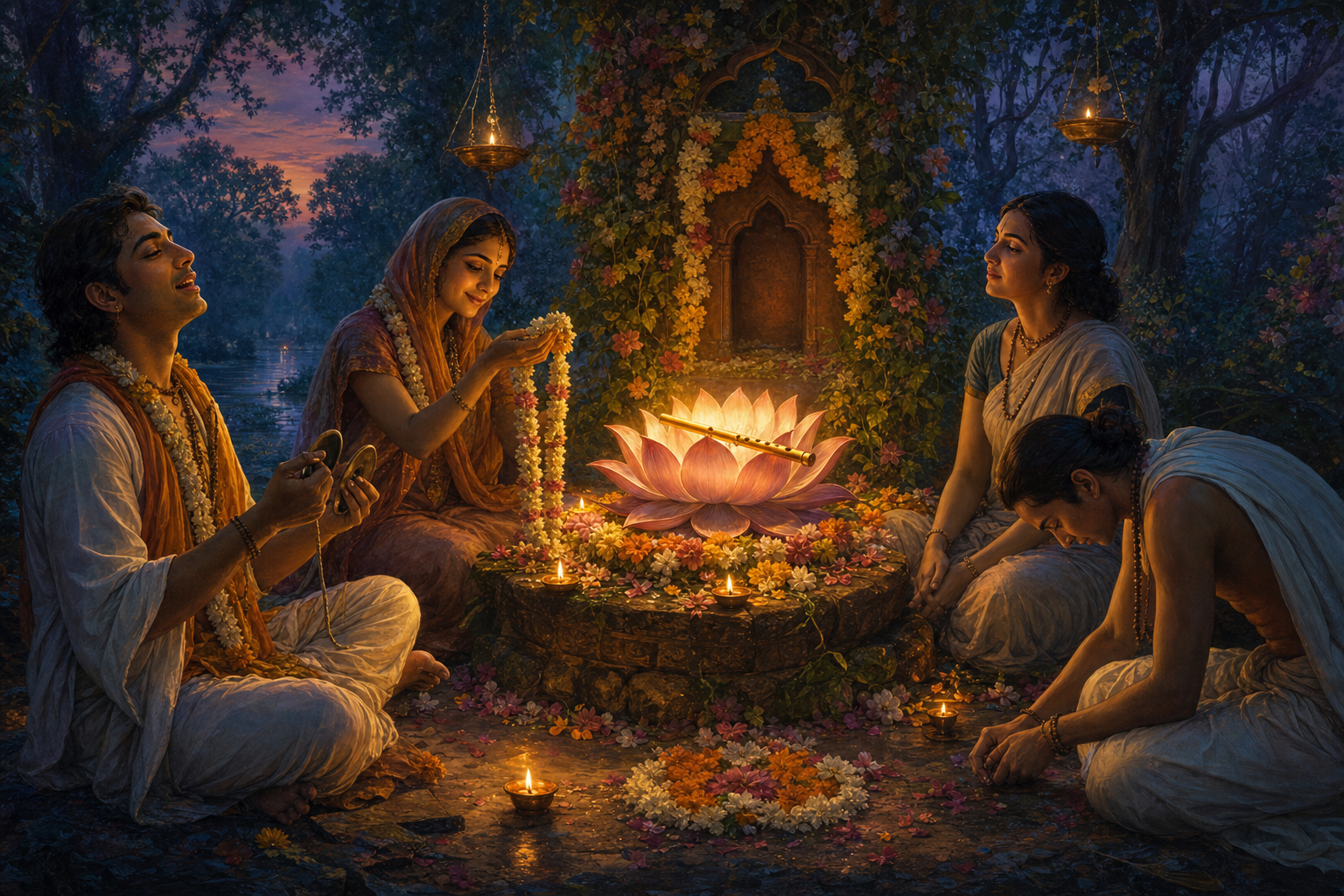
The same source names Krishna’s flute, smile, footprints, sacred places, tulasi, festivals, and the company of devotees among the stimuli that can awaken remembrance. These things matter not because an object automatically manufactures ecstasy, but because it carries relational meaning for a devotional consciousness. A flute can become a summons, a footprint a sign of presence, and a festival a meeting point of memory, discipline, and affection.
The second source approaches the same terrain through a seeker-centered account associated with Radhanath Swami’s The Journey Home. It contrasts spirituality understood primarily as self-mastery, extraordinary power, or escape with yoga fulfilled as loving union and service. Where the first article supplies an analytical vocabulary, the second emphasizes existential discovery: knowledge, discipline, and renunciation acquire their deepest orientation when they serve selfless love.
Read together, these approaches show why rasa is more than mood. It joins metaphysical conviction, cultivated attention, sacred memory, embodied response, and an enduring disposition to serve. Emotion belongs within this whole; it does not replace it.
Why tears and separation matter

Tears are inherently ambiguous in ordinary experience. They can accompany grief, fear, exhaustion, joy, tenderness, or relief. The first source reports that Radha’s tears are interpreted differently within Gaudiya devotional theology: they are expressions of prema, intensified through meeting and separation from Krishna. Their significance comes from the love they disclose, not from crying considered in isolation.
Separation is central to this interpretation because absence can intensify rather than extinguish relationship. When Krishna is not visibly present, sounds, places, fragrances, memories, and sacred objects can become more charged with his significance. The ordinary human experience in which a song or familiar path revives a relationship offers a limited analogy. Bhakti-rasa develops that structure of memory into devotional perception, while Radha represents its highest intensity.
This also clarifies why the Radha-Krishna relationship should not be read as material romance with sacred names attached. As the first source stresses, the love of Vraja is presented as selfless, Krishna-centered, and free from acquisitive desire. Radha’s sorrow does not accuse the beloved of failing to satisfy her ego. It reveals consciousness so thoroughly oriented toward Krishna that remembrance, absence, speech, senses, and bodily expression all participate in love.
Nor does the theology make visible emotion a competitive measure of spiritual rank. The source cautions that symptoms can be imitated, whereas prema cannot be produced theatrically. Humility, steadiness, service, and decreasing self-centeredness provide a more reliable interpretive context than intensity alone. Radha’s tears consequently function as theological language, not a devotional technique to be copied.
Sacred landscape becomes a school of attention

The sources also illuminate why Vrindavan and the Yamuna are more than scenery in accounts of Radha. The second article presents the Yamuna as a sacred presence carrying the memory of Krishna’s pastimes, while its portrayal of Vrindavan’s saints associates closeness to Radha with simplicity, surrender, longing, and genuine humility. Theology, landscape, memory, and devotional character are thus brought into one field.
The first article’s discussion of devotional stimuli explains how that field operates. Sacred geography, ritual observance, natural forms, music, and companionship train attention by repeatedly directing it toward Krishna. The world is not rejected as a distraction in itself; perception is educated so that selected places, times, and encounters support remembrance. Bhakti becomes an integrated discipline of intellect, senses, memory, speech, conduct, and affection.
The second source further situates Radha within the Dharmic understanding of the sacred feminine. Its emphasis is not simply that feminine imagery adds emotional warmth to an otherwise masculine theology. Radha as shakti presents compassion, receptivity, tenderness, and relational intimacy as active divine capacities. Softness is not equated with passivity: it can unsettle ego and make the practitioner receptive to grace more deeply than spiritual ambition can.
This perspective gives Radha’s mystery a practical edge. The measure of devotional culture is not how vividly it discusses exalted emotion, but whether its practices form people who are less possessive, more attentive, humbler in service, and increasingly capable of love without demand.
Key takeaways
- Radha is presented as both Krishna’s supreme devotee and his inseparable hladini-shakti, making divine love intrinsic to divine reality.
- Bhakti-rasa supplies a disciplined framework for relating stimuli, remembrance, emotion, bodily expression, and mature devotional character.
- Radha’s tears signify selfless prema intensified by union and separation; tears by themselves do not establish spiritual attainment.
- Vrindavan, the Yamuna, festivals, sacred objects, and devotional community form an ecology of remembrance that educates perception.
- Authentic engagement with Radha’s example tends toward humility and service, not emotional performance or claims of superiority.
The enduring task for bhakti communities is to preserve this balance of theological depth and ethical sobriety. Approached through study, remembrance, and unforced service, Radha’s mystery can continue to refine how divine love is understood without turning its most intimate expressions into spectacle.
References
- DharmaRenaissance Blog — Sri Radha’s Tears: Powerful Lessons on Ecstatic Love and Bhakti-Rasa
- DharmaRenaissance Blog — Radha’s Sacred Mystery: A Powerful Guide to Divine Love, Bhakti, and Shakti