

Hindu deity symbolism links visible form with the formation of attention. A cowherd, an upward-facing aspect of Shiva, a flute, sacred sound, a lamp, or a temple’s rising form can communicate theology while also shaping how devotees perceive, act, and worship.
Read together, the source articles present two complementary movements in devotional life: Krishna gathers the outward-moving senses into harmony, while Ishana Shiva directs awareness beyond its ordinary horizon. The discussion of courageous bhakti then shows how this inner formation can become visible through worship, ethical conduct, and community life without turning devotion into spectacle.
Symbolism begins with relationship, not isolated decoding
Hindu iconography is sometimes approached as though each object had only one fixed definition. The sources instead describe symbols whose meanings operate across several levels. The article on Krishna as Goswami reports that the Sanskrit word go can refer not only to the cow but also to the senses, speech, rays of light, and the earth. Krishna’s pastoral identity can therefore be read agriculturally, psychologically, ethically, and devotionally at the same time.
The account of Ishana Shiva makes a related point through a different theological framework. It describes Hindu iconography as a disciplined visual language in which direction, posture, expression, and sacred attributes communicate philosophical meaning. Ishana’s upward orientation is consequently more than a sculptural feature: within the article’s Shaiva interpretation, it directs contemplation toward transcendence, knowledge, grace, and liberation.
These cases suggest that a deity’s image is best understood through the relationship it creates. Krishna’s cows matter because he knows, nourishes, leads, and protects them. Ishana’s upwardness matters because it reorients the devotee standing before the murti. Symbolism is not merely information concealed inside an object; it is an invitation to see and live differently.
Krishna gathers attention while Ishana lifts its horizon
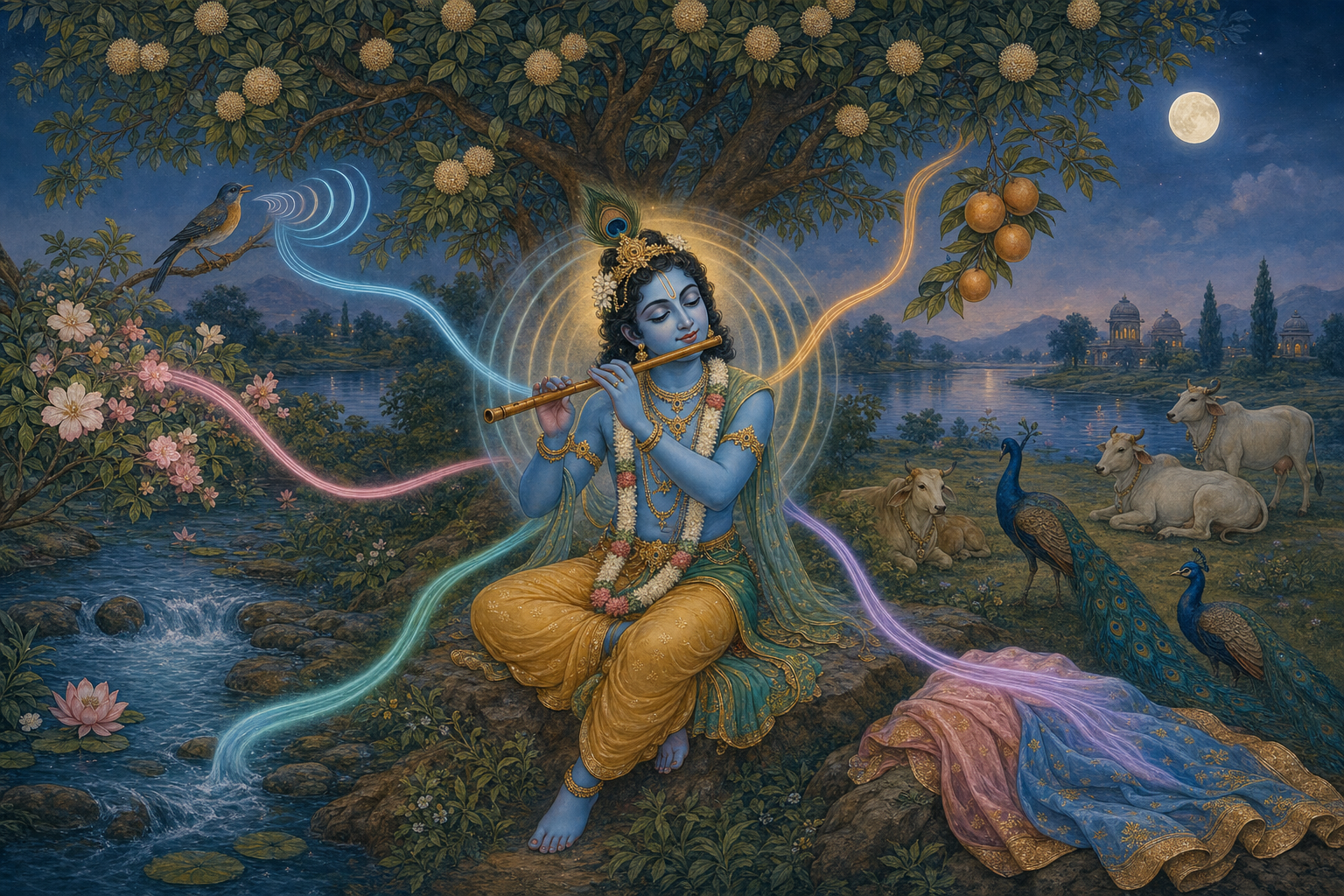
The Krishna article interprets names such as Gopala, Govinda, Goswami, and Hrishikesha through the problem of sensory dispersion. Like a herd moving toward different attractions, the senses turn toward forms, sounds, tastes, fragrances, and tactile experiences. The comparison does not portray sensory life as evil. It presents the senses as valuable but mobile faculties that require intelligent direction.
Within this reading, Krishna’s cowherd activity becomes a model of mastery without hostility. He gathers and protects rather than destroying the herd. His flute symbolizes a divine call around which scattered beings and perceptions become coordinated. Sense discipline thus means ordering experience around dharma and devotion, not treating the body or the world as an enemy.
The Ishana article addresses fragmentation from a vertical rather than pastoral perspective. It presents Ishana as the upward aspect within Panchabrahma, alongside Sadyojata, Vamadeva, Aghora, and Tatpurusha. The source commonly associates these aspects with creation, preservation, dissolution, concealment, and revelation or grace. Ishana gathers these activities into a vision of higher unity, pointing beyond the horizontal field of ordinary preoccupations.
The two images should not be collapsed into an interchangeable formula. The Krishna account is rooted in Vaishnava names, pastoral imagery, and the governance of the senses; the Ishana account unfolds through Shaiva ideas of consciousness, sacred direction, and fivefold divine activity. Their shared insight is more precise: spiritual maturity requires both integration and orientation. Attention must be gathered from distraction, and it must also be directed toward an end greater than appetite or ego.
Worship turns iconography into embodied practice
The sources do not leave symbolism at the level of abstract interpretation. The Krishna article explains how sensory faculties can be redirected through devotional use: hearing can receive mantra and kirtan, taste can be joined to gratitude through prasadam, speech can become truthful or prayerful, and touch can become service. The same faculties that produce attachment when ruled by craving can support clarity when connected to a higher purpose.
Ishana’s symbolism extends this transformation from the body to sacred space. The article connects Ishana’s upward orientation with the vertical imagination of the Hindu temple: the sanctum concentrates divine presence, while the rising shikhara or vimana lifts the mind toward a cosmic axis. It also links Ishana with sacred sound and the contemplative movement through which mantra gives way to silence and realization.
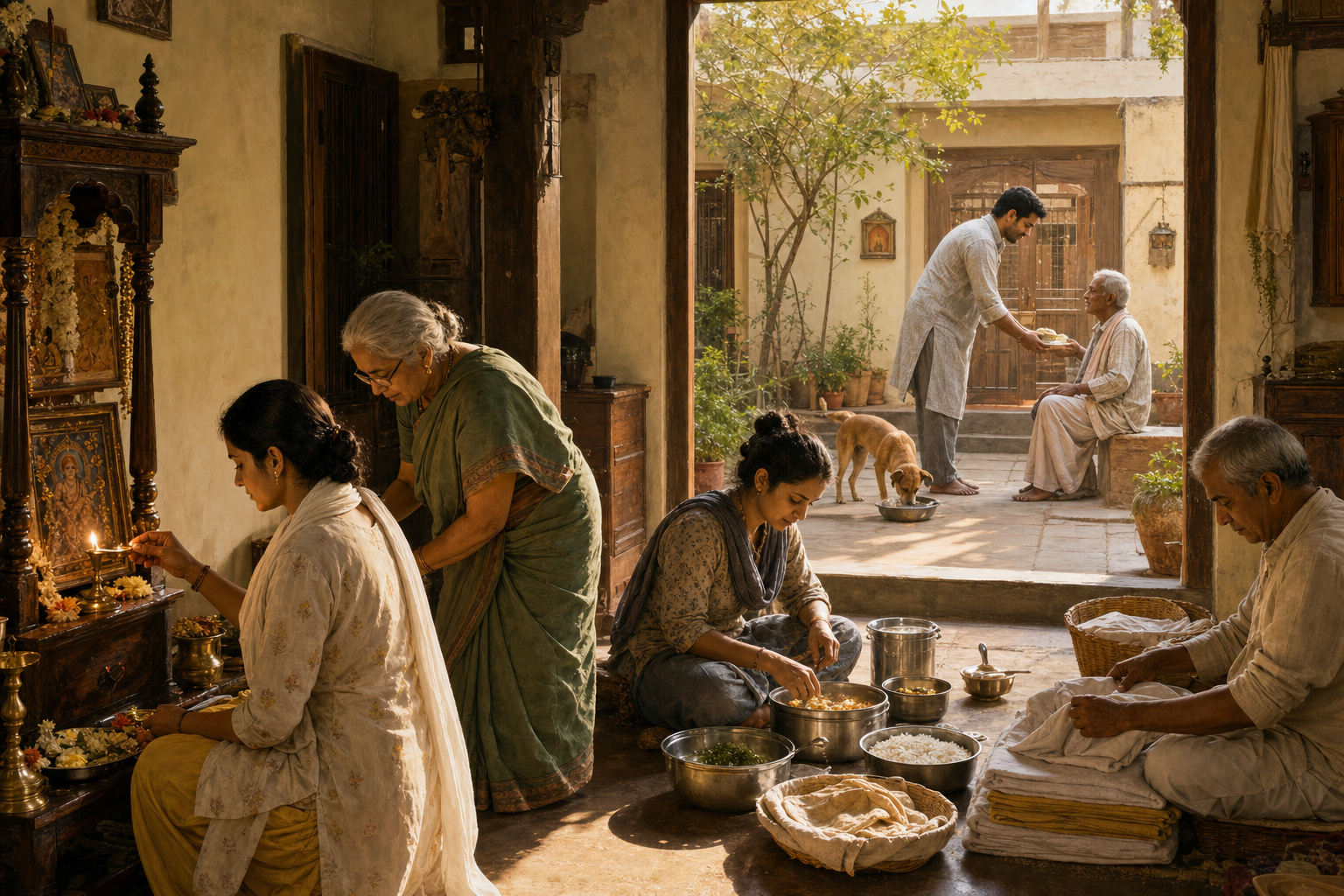
The article on the courage of bhakti supplies the everyday devotional setting for these ideas. It describes the temple bell, the lamp before a murti, flowers, stotra recitation, mantra repetition, prayer, festival observance, kirtan, and seva as practices that train attention, gratitude, reverence, and moral orientation. On this account, ritual is neither a decorative remnant nor an automatic guarantee of transformation. Its value lies in the habits it repeatedly cultivates.
A useful way to read a devotional symbol, therefore, is to ask what faculty it addresses, what disorder it diagnoses, and what quality it seeks to cultivate. Krishna’s herd addresses dispersed sensation and teaches caring governance. Ishana’s gaze addresses confinement to the immediate and teaches spiritual orientation. The lamp, mantra, offering, and act of service bring such meanings into the rhythms of embodied life.
Public bhakti gains meaning through ethical discipline
The source on courageous bhakti argues that Hindu devotion has both inward and public dimensions. It reports that devotional traditions across regions and languages generated poetry, song, pilgrimage, temple practice, festivals, and community worship. Bhakti, in that account, is not opposed to philosophical thought; it includes loving remembrance while coexisting with inquiry, selfless action, and contemplative discipline.
Public visibility, however, is not presented as an end in itself. The article distinguishes confident devotion from aggressive religiosity and warns against reducing faith either to something hidden through embarrassment or to a slogan without inner discipline. Its proposed standard is conduct marked by learning, humility, service, integrity, respect for others, and responsibility in shared spaces.
The Krishna and Ishana interpretations deepen that standard. A person symbolically drawn to Krishna as master of the senses cannot coherently treat uncontrolled anger, harmful speech, or craving for recognition as devotional virtues. Likewise, Ishana’s upward pull loses practical meaning if worship never raises conduct beyond ego and agitation. The credibility of visible bhakti depends on whether its symbols have begun to shape the devotee.
This relationship between inward discipline and outward expression also protects Hindu plurality. The bhakti article emphasizes the presence of multiple deities, paths, sampradayas, and philosophical standpoints. Symbolic literacy can support that plurality by allowing each form to retain its theological particularity while still revealing shared concerns such as disciplined attention, reverence, service, and liberation from lower impulses.
Key takeaways
- Hindu deity symbolism works through relationships among image, worshipper, practice, and ethical purpose, not through isolated visual definitions.
- Krishna’s cowherd imagery presents sense mastery as protective guidance, while Ishana Shiva’s upward orientation presents spiritual life as an ascent beyond limited perception.
- Ritual gives symbolism practical force by training sight, hearing, speech, taste, touch, memory, and attention through repeated devotional acts.
- Public bhakti becomes constructive when visible practice is supported by humility, learning, self-restraint, service, and respect for religious plurality.
Devotional education can carry these traditions forward by teaching not only what a face, flute, cow, mantra, lamp, or temple form signifies, but also what habits of attention and responsibility each symbol asks a devotee to develop. Such literacy can keep inherited forms spiritually intelligible without reducing them to private sentiment or public performance.

References
- DharmaRenaissance Blog — Krishna as Goswami: Powerful Symbolism of Cows, Senses, and Inner Mastery
- DharmaRenaissance Blog — Ishana Shiva Iconography: Sacred Upward Gaze, Panchabrahma Power and Grace
- DharmaRenaissance Blog — The Sacred Courage of Bhakti: Why True Devotion Should Never Be Hidden