
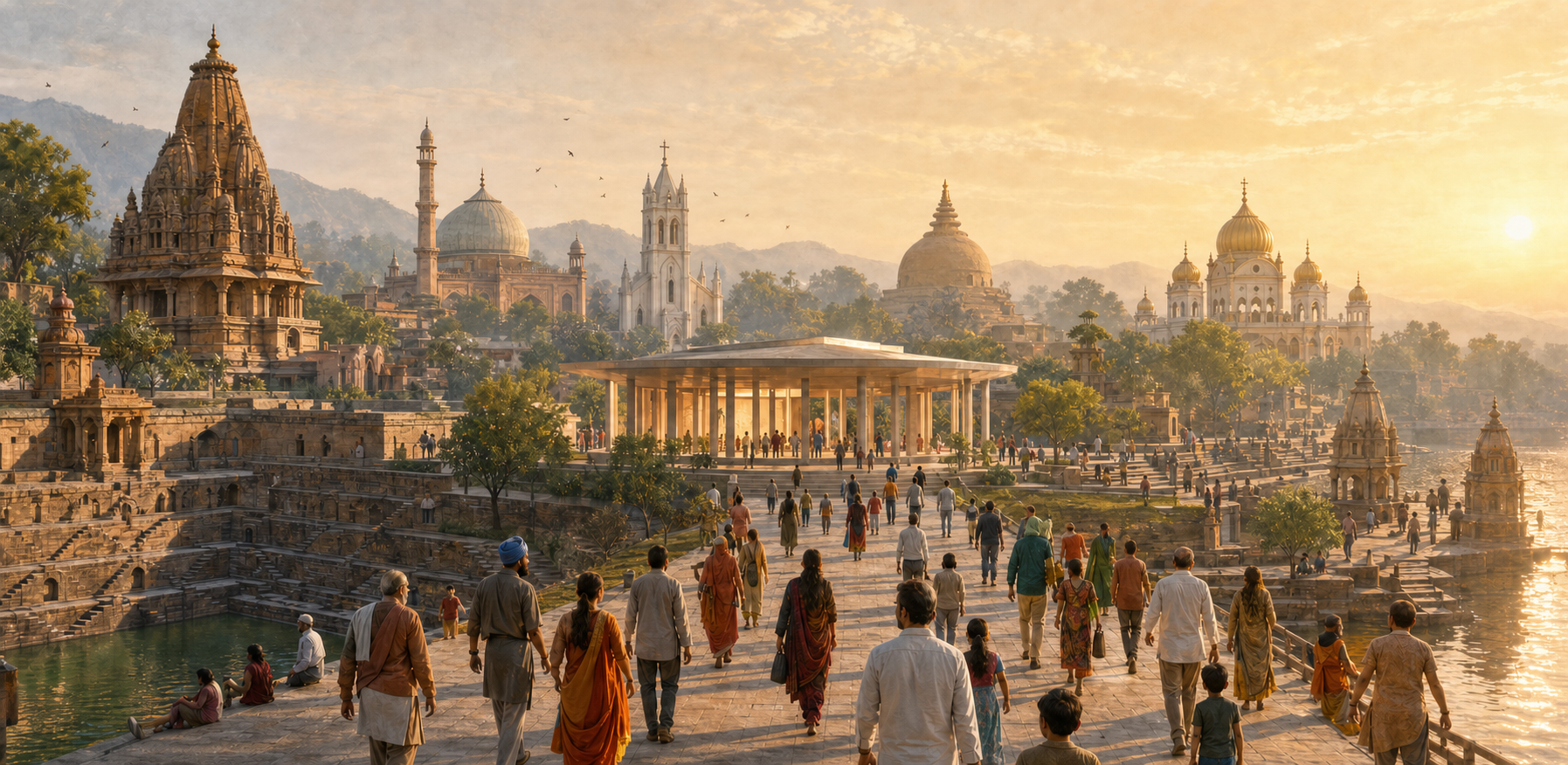
Debates over Bharat and secularism often become confused because they ask one word to carry several different questions. Was India a modern state before independence? Did the subcontinent possess an older civilizational identity? Must equal citizenship require the public erasure of inherited traditions? The source essays approach these questions from different directions, but together they reveal a more useful framework: civilizational continuity, constitutional government, and religious liberty should be distinguished before their relationship is judged.
The resulting picture is neither a claim that the present republic has existed unchanged since antiquity nor an argument that modern institutions should reproduce a premodern order. It is an inquiry into how a plural civilization can remember its inheritance while protecting citizens from sectarian coercion.
Three meanings hidden inside one national name
The first necessary distinction is among state, civilization, and territory. The HinduPost essay on Bharat before 1947 explicitly accepts that the sovereign republic, with its present constitutional institutions and citizenship, did not exist before independence and constitutional consolidation. Its objection is to treating that proposition as proof that no older Bharat existed in cultural memory.
The essay reports several forms of continuity: the use of Bharatavarsha in Puranic geography, ancient external names derived through Sindhu, pilgrimage networks, literary exchange, overlapping philosophical vocabularies, and periods of political integration amid many kingdoms and republics. It also points to the constitutional formulation, “India, that is Bharat,” as modern legal recognition of an already familiar civilizational name. These examples do not establish that ancient boundaries were identical to those of the present republic. They instead challenge the assumption that political plurality eliminates civilizational consciousness.
The Indica Today review of Bharat That Is India develops the same argument through cultural history. It describes Bharat as a continuum sustained by memory, sacred geography, knowledge traditions, ethical concepts, institutions, and practices rather than by uninterrupted rule from one capital. A Dharma Civilization Foundation essay on India and Hindu pluralism adds an experiential dimension: India has been encountered through rivers, pilgrimage, spiritual disciplines, oral traditions, philosophical controversy, and symbolic memory as well as through political chronology.
Taken together, these sources support a layered claim. The modern republic is historically specific; the cultural field called Bharat is older; and neither should be mistaken for a timeless, unchanging map. This formulation preserves historical precision while making room for forms of belonging that do not depend upon permanent political uniformity.
Secularism is a translation problem, not a yes-or-no test
The sources diverge most usefully over secularism. A Pragyata essay argues that the category arose from European conflicts involving churches, rulers, denominational establishments, and competing claims to temporal and spiritual authority. It contrasts those histories with an Indian landscape of sampradayas, darshanas, mathas, sanghas, panths, temples, monastic lineages, and household practices that lacked a single civilizational church. The essay also reports that “secular” was added to the Constitution’s Preamble through the Forty-second Amendment in 1976, during the Emergency, rather than appearing in the original 1950 text.
That genealogy raises a legitimate question: does a concept developed for one institutional problem adequately describe another civilization? It does not, by itself, settle the normative question of how a modern state should treat citizens of different convictions. A word can have a foreign history while naming protections that remain valuable. Conversely, retaining the word does not guarantee impartial government.
The Dharma Civilization Foundation essay on India’s two visions supplies the balancing argument. It treats equal citizenship and protection against sectarian domination as compatible with civilizational literacy. On that account, the real choice is not between a culturally empty state and a confessional state. It is between different ways of combining public memory, individual freedom, institutional fairness, and critical reflection.
This synthesis also clarifies why translating dharma simply as “religion” creates difficulties. Across the sources, dharma includes ethical obligation, sustaining order, conduct, discipline, social responsibility, and spiritual pursuit. It can inform a public vocabulary of duty without granting any priesthood control of the state. Yet invoking dharma cannot exempt power from constitutional restraint or make every inherited practice just. The same sources acknowledge sectarian conflict, social inequality, patronage disputes, and the need for reform. Civilizational difference explains why European models cannot be copied mechanically; it does not prove that premodern India was free of coercion or injustice.
Pluralism has an indigenous grammar
One of the strongest connections among the sources is their account of plurality as intrinsic to Dharmic civilization rather than borrowed from modern liberal vocabulary. The Dharma Civilization Foundation discussion of Rig Veda 1.164.46 carefully distinguishes the Sanskrit phrase ekam sat vipra bahudha vadanti from the popular paraphrase “Truth is one; paths are many.” As the essay explains it, the verse speaks of one Reality articulated in manifold ways; it does not literally use the word “paths,” nor does it declare every proposition identical.
That nuance matters politically as well as philosophically. Pluralism need not mean that differences are superficial or that all claims are equally persuasive. It can mean that disagreement takes place within a shared reality and does not automatically require suppression. The essay on Hindu pluralism illustrates this through the coexistence of multiple darshanas, devotional forms, authorities, local practices, and lineages. Its banyan-tree image presents continuity as branching and adaptive rather than centralized.
The wider Dharmic field intensifies this point. The source articles repeatedly describe Hindu, Buddhist, Jain, and Sikh traditions as distinct in doctrine, scripture, institution, and historical experience while also connected through geography, debate, patronage, pilgrimage, ethical inquiry, and concepts concerning duty, liberation, discipline, compassion, service, and self-cultivation. A civilizational account becomes misleading if it absorbs these traditions into a featureless unity. It is equally incomplete if it represents them as sealed communities whose histories never intersected.
This indigenous grammar differs both from mere tolerance and from enforced sameness. Tolerance can imply that a dominant authority permits outsiders to remain. Dharmic plurality, as these authors present it, more often involves overlapping participation, argument, borrowing, and the recognition of several legitimate disciplines. That inheritance cannot alone resolve every problem of a modern, religiously diverse republic. It can, however, contribute conceptual resources for protecting difference without treating all public expressions of sacred life as threats.
Civilizational literacy without civilizational coercion
The practical issue is therefore not whether Bharat should remember its civilization, but how that memory should enter education, scholarship, and public institutions. The book review emphasizes Indian traditions of mathematics, medicine, metallurgy, astronomy, grammar, logic, education, and trans-Asian intellectual exchange. It also warns that civilizational pride should not harden into exaggerated certainty and that large economic claims require attention to method and regional complexity. That combination of recovery and scrutiny is essential: inherited knowledge should neither be dismissed in advance nor accepted merely because it flatters collective identity.
The essay on India’s two visions makes a related educational case. It argues that English and Western thought are not themselves the problem; the problem arises when they become the sole standard by which Indian traditions are judged. It calls for renewed engagement with Sanskrit alongside Pali, Prakrit, Tamil, and India’s regional languages, treating them as archives of philosophy, literature, science, statecraft, and spiritual practice. It also insists that cultural recovery remain open to reform and that no political party can own a civilization older than contemporary electoral alignments.
A sharper problem of authority appears in the Indica Today essay on the Gita and Yoga Sutra. It reports a May 2026 controversy in which a European scholar questioned whether those works should necessarily be called Hindu texts because the English category “Hinduism” became widespread later. The essay accepts that colonial administration and scholarship helped standardize modern classifications, but argues that a comparatively late label does not erase older lineages of reception, commentary, devotion, and practice. It identifies an asymmetry when external classification is treated as rigorous knowledge while a community’s account of its own inheritance is reduced to uncritical attachment.
The essay on Hindu pluralism introduces a productive counterweight: modern historiography can test evidence, correct romantic claims, and distinguish documentation from assumption. Read together, the two arguments suggest reciprocal accountability. Communities should be able to name and interpret their inheritance, but insider status should not make claims immune to evidence. Academic scholars should be able to examine categories and textual development, but disciplinary authority should not automatically overrule living traditions. Rigor requires both historical criticism and attention to indigenous concepts such as dharma, darshana, sampradaya, moksha, bhakti, and yoga as analytical ideas rather than decorative vocabulary.
A workable civic settlement would consequently rest on four connected principles: non-sectarian state power, equal civic standing, serious civilizational education, and freedom for internal criticism. Such a settlement would allow Bharat to be publicly intelligible without turning Bharatiyata into a compulsory creed. It would also judge institutions by symmetrical standards: neither inherited traditions nor imported theories would receive automatic immunity from examination.
Key takeaways
- Bharat as a civilizational memory is not the same claim as the existence of the present constitutional state in antiquity.
- The European genealogy of secularism explains why the term can fit India imperfectly, but it does not remove the modern need for equal citizenship and restraints on sectarian power.
- Dharma cannot be translated adequately as church-based religion; it also concerns conduct, responsibility, ethical order, and spiritual discipline.
- Dharmic pluralism preserves real differences among Hindu, Buddhist, Jain, and Sikh traditions while recognizing their long histories of exchange and debate.
- Civilizational recovery is most credible when communities retain interpretive agency, scholarship remains evidence-conscious, and cultural memory does not become political compulsion.
The most promising path is not to force Bharat into a borrowed binary between public amnesia and religious establishment. It is to develop institutions capable of combining historical self-knowledge with equal civic dignity. That work will depend less on winning a battle over one label than on creating better education, more reciprocal scholarship, and standards of public fairness that citizens across traditions can recognize.
References
- Indica Today — Bharat That Is India: A Powerful Review of Civilizational Identity and Dharma
- HinduPost — Bharat Before 1947: Powerful Historical Evidence Against a Colonial Myth
- Indica Today — Powerful Truth: Why Erasing the Gita and Yoga Sutra Wounds Dharmic Unity
- Pragyata — Why Imported Secularism Still Fails India’s Dharmic Civilizational Reality
- Dharma Civilization Foundation — India’s Two Powerful Visions: Heritage, Secularism, and the Future of Dharma
- Dharma Civilization Foundation — India, Hinduism, and the Powerful Freedom of Dharmic Pluralism and Insight
- Dharma Civilization Foundation — Powerful Vedic Insight: How One Reality Sustains Many Sacred Truths