
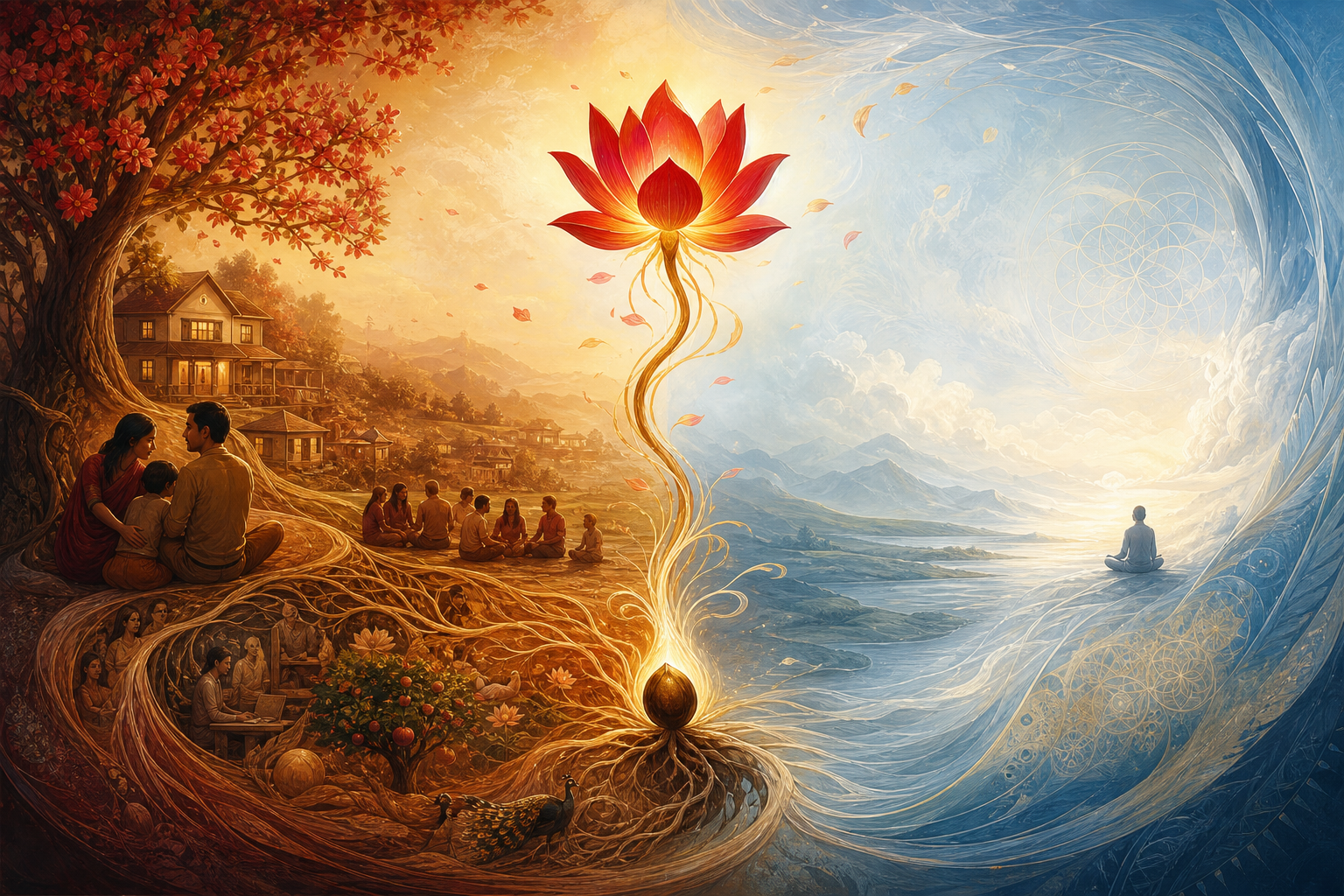
Hindu thought places desire inside a tension larger than pleasure itself: life must be compelling enough to continue, yet no finite experience can provide final freedom. Kama can therefore sustain creation while also deepening the attachments from which spiritual practice seeks release.
This framework avoids a simple verdict that desire is either sacred or sinful. The more useful question is how desire functions: what it brings into being, what obligations follow from it, and whether a person remains governed by it.
Creation requires participation, not merely existence

The DharmaRenaissance source presents creation as a problem of motivation. Brahma can bring forth beings, but the continuation of the world still depends on their willingness to generate and sustain further life. Existence by itself does not ensure investment in family, lineage, or the future.
The article illustrates this distinction through Brahma’s mind-born sons, especially Sanaka, Sanandana, Sanatana, and Sanatkumara. As the source recounts, these Kumaras decline the work of procreation and choose knowledge, celibacy, austerity, and liberation. Their refusal is presented not as hostility toward creation but as insight into the entanglements accompanying embodied life.
This episode makes desire philosophically significant. If spiritually lucid beings can turn away from multiplication, cosmic continuity needs more than biological capacity. Attraction, pleasure, affection, hope, and the wish for continuity give embodied beings reasons to remain involved in a transient world. Desire is thus not identical with creation, but it helps convert created life into participating life.
Kama gains meaning through dharma and consequence
As the source explains, kama can mean desire, pleasure, or sensual enjoyment and belongs among the four purusharthas alongside dharma, artha, and moksha. Its inclusion among recognized human aims prevents pleasure from being treated as inherently illegitimate. Its position beside the other aims also prevents it from becoming an absolute good.
Dharma supplies the necessary measure. Desire may contribute to intimacy, family formation, care, and social continuity, but its consequences extend beyond a private moment. Commitments, dependencies, duties, and new life can follow. A dharmic evaluation therefore asks not only whether pleasure is experienced, but whether conduct respects responsibility and the well-being of others.
Karma supplies a second measure. The source connects desire with action, action with karmic consequence, and consequence with continued experience in samsara. Sexual desire has a particularly visible creative dimension because it can lead to birth, yet the underlying principle is broader: longing repeatedly directs consciousness toward objects, identities, and futures in which it seeks completion.
Household life and renunciation answer different needs
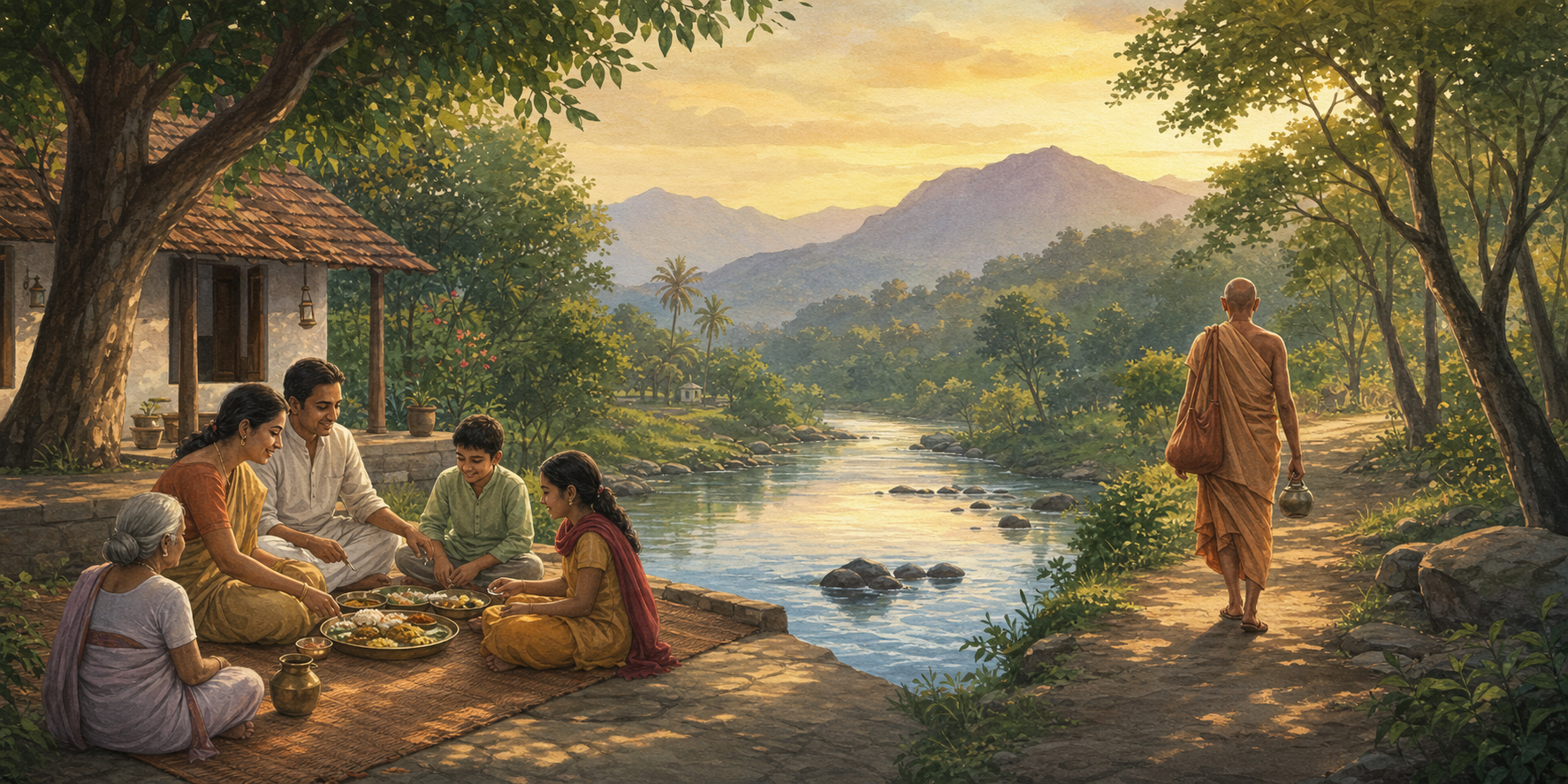
The contrast between the Kumaras and the householder reveals two legitimate orientations rather than a contest between spiritual success and failure. Renunciation expresses the inward movement away from multiplication and attachment. Household life accepts worldly participation and attempts to discipline it through service and duty.
According to the source, the grihastha sustains children, elders, guests, students, ascetics, ritual life, and charity. This makes the householder more than a person who pursues private satisfaction. Household responsibilities support the wider social and spiritual order, including paths followed by those who renounce domestic life.
The two orientations also illuminate each other’s limits. A society composed only of renunciates could not reproduce or maintain its institutions. A society that recognized only acquisition, pleasure, and lineage could lose sight of freedom from possessiveness. Hindu thought holds both possibilities together because human beings do not share one temperament, one stage of life, or one degree of detachment.
Liberation changes the relationship to the temporary

The source uses maya to explain why finite life feels urgent and precious. In this account, maya is not merely a claim that relationships or experiences are worthless. It gives emotional force to spouse, child, home, memory, status, and continuity. The error arises when their profound relative value is confused with permanence or ultimate fulfillment.
This distinction also clarifies why embodiment can bind and educate at the same time. The article describes human birth as both an entry into samsara and a rare opportunity for self-realization. Family attachment can intensify ego and fear, yet family responsibility can cultivate patience, sacrifice, compassion, and service. The same setting produces different spiritual effects depending on how it is understood and lived.
Liberation, in this synthesis, need not begin with contempt for desire. It begins with seeing desire accurately: as a force capable of creation, care, fixation, and repeated becoming. Dharma regulates its expression; spiritual discipline loosens its claim to sovereignty; moksha names freedom from mistaking any temporary satisfaction for the final end.
Key takeaways
- Creation requires beings to become invested in embodied life; desire helps generate that investment.
- Kama is a recognized human aim, but its place beside dharma and moksha makes it neither forbidden nor supreme.
- Household life can turn desire into responsibility, service, and social continuity.
- Renunciation preserves the insight that lineage, identity, and pleasure cannot provide permanent freedom.
- The spiritual issue is not simply whether desire exists, but whether it is understood and governed or allowed to govern.
Read this way, the tension between creation and liberation remains a practical question rather than a remote mythic puzzle. Future reflection can move beyond choosing between indulgence and rejection, toward forms of life in which affection is honored, consequences are accepted, and the temporary is not mistaken for the ultimate.