
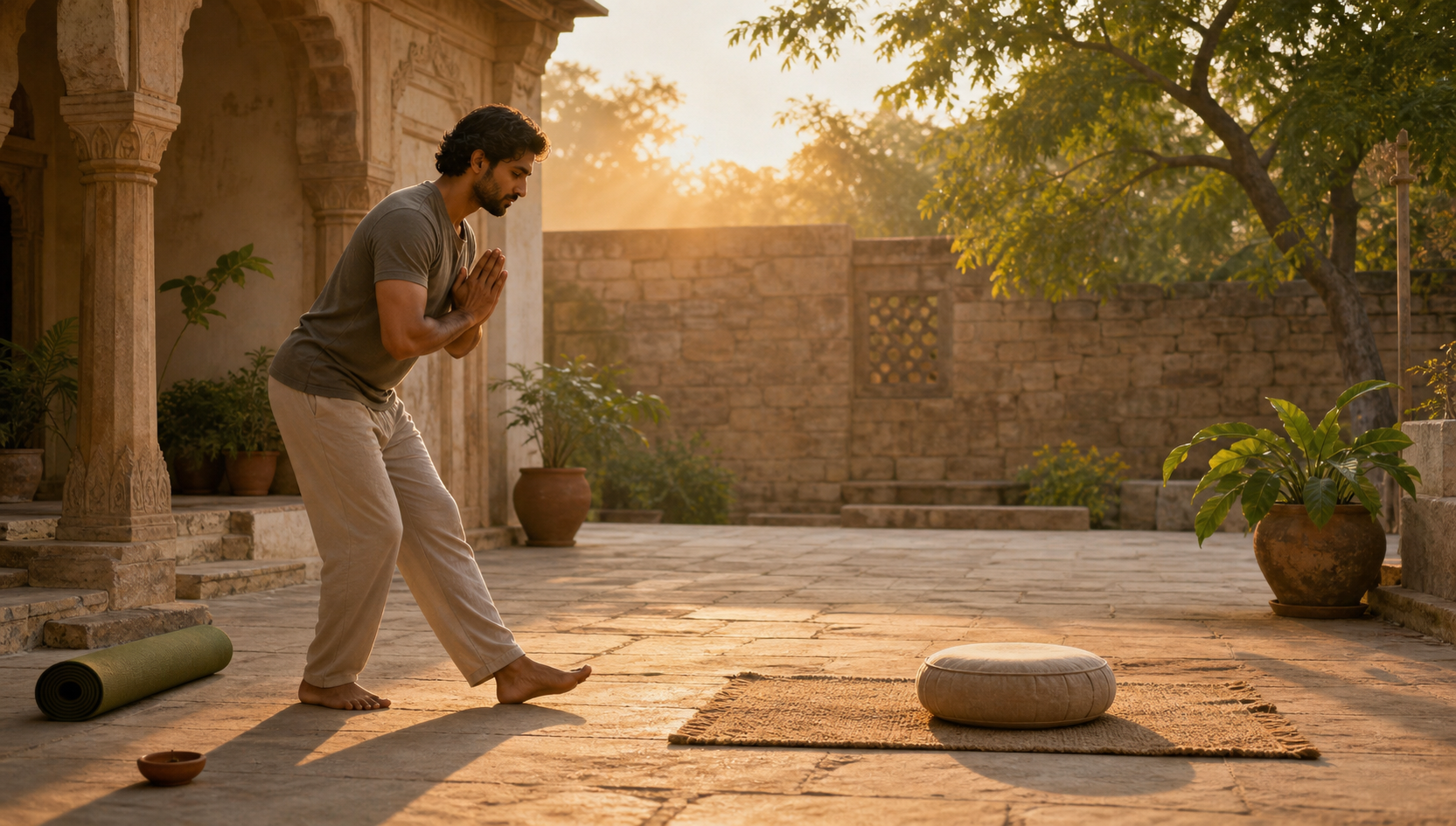
Yogic discipline is sometimes imagined as a contest in which the body must be subdued, the mind defeated, and every lapse punished. The three source articles instead describe a more integrated undertaking: Hatha Yoga works through embodiment, Raj Yoga orders life toward inner steadiness, and Hindu reflection on self-criticism explains why correction becomes counterproductive when it turns into a verdict on personal worth.
Read together, these perspectives offer a practical standard for compassionate self-discipline. Practice must be demanding enough to alter habits, but humane enough to preserve clarity, patience, and the willingness to begin again.
Discipline is meant to educate the person, not punish the self
The article on Raj Yoga presents spiritual sovereignty as command over impulses, fears, memories, cravings, and mental restlessness rather than authority over other people. Its account of the eight limbs moves from ethical restraint and personal observance through posture, breath, sensory withdrawal, concentration, meditation, and absorption. Meditation, in this view, is the flowering of an entire way of living rather than an isolated technique.
The Hatha Yoga article approaches transformation through the body, breath, senses, and vital energy. It describes hatha in terms of effort and persistence, while also reporting the later interpretation of ha and tha as solar and lunar forces brought into balance. Posture, pranayama, mudra, bandha, cleansing disciplines, and attention are consequently presented as means of preparation, not as displays of physical prowess.
The article on self-criticism supplies an essential boundary for both paths. It distinguishes a temporary error in conduct from the deepest identity of the person, drawing on the Vedantic distinction between changing body-mind experience and atman, the witnessing self. This does not remove accountability. It makes accountability more exact: a practitioner can examine an action, intention, habit, fear, or attachment without converting one failure into a total judgment of the self.
Across the three accounts, discipline is therefore educational. It identifies what can be trained and applies a suitable practice. Punishment is different: it expends energy on humiliation without necessarily clarifying what should change.
Hatha and Raj Yoga address different layers of one transformation

The source articles do not present Hatha and Raj Yoga as competitors. The Hatha article reports that the Hatha Yoga Pradipika treats Hatha Yoga as a support for Raja Yoga, while the Raj Yoga article places bodily steadiness and regulated breath within a wider ethical and contemplative architecture. Their relationship can be understood as complementary rather than hierarchical.
| Aspect | Hatha Yoga emphasis | Raj Yoga emphasis | Synthesised significance |
|---|---|---|---|
| Primary field | Body, breath, senses, and vital energy | Conduct, attention, and states of consciousness | Embodied regulation supports mental steadiness |
| Meaning of effort | Persistent and technically disciplined practice | Responsible use of a tested path and inherited guidance | Effort can be rigorous without being wasteful |
| Role of posture | Stability, alignment, endurance, and inward awareness | A steady, comfortable basis for meditation | Performance remains subordinate to contemplation |
| Main safeguard | Preparation, moderation, and guidance for subtler techniques | Ethical foundations before advanced concentration | Technique and character must develop together |
This comparison also clarifies what compassionate discipline is not. It is not permission to avoid effort because a practice is uncomfortable. Nor is difficulty evidence that a practice is spiritually valuable. The Hatha article warns that a posture which produces injury, comparison, ego, or greater restlessness has failed its deeper purpose. The Raj article similarly argues that inherited knowledge and grace reduce confusion but do not eliminate the seeker’s responsibility to practise.
The useful question is therefore not, “How much can the practitioner endure?” It is, “Does this effort produce greater stability, ethical clarity, and freedom from compulsion?” That test joins the embodied precision of Hatha Yoga to the inward sovereignty of Raj Yoga.
Why compassion belongs inside tapas

The self-criticism article draws a sharp distinction between self-correction and identity-based condemnation. Self-correction is specific and forward-moving: a word, habit, decision, or pattern requires attention. Self-condemnation is global: a mistake is treated as proof that the whole person is inadequate. The former can generate tapas, the disciplined heat of transformation; the latter commonly generates shame, concealment, exhaustion, or avoidance.
This distinction deepens the ethical teachings reported in the Raj Yoga article. Ahimsa and satya can operate as a paired test for inner speech: observation must be truthful, but truthfulness need not become psychological violence. Santosha does not require satisfaction with harmful conduct, and tapas does not require hostility toward the person attempting to change it. Svadhyaya, or self-study, needs enough inner stability to examine causes rather than merely repeat accusations.
The self-criticism article interprets the three gunas as another diagnostic aid. A punitive inner voice may sound morally serious while expressing the heaviness of tamas or the agitation and comparison associated with rajas. Sattva offers a different quality of discipline: clear observation, balance, and a greater capacity to learn. Compassion is valuable here not because it makes standards softer, but because it makes perception less distorted.
The same article reads Krishna’s instruction to the distressed Arjuna as a model of corrective guidance. Arjuna’s crisis is neither ignored nor made into his permanent identity; it becomes the occasion for clarification and disciplined action. Its discussion of karma yoga extends the point by shifting attention from obsessive identification with results toward intention, quality of effort, and responsible action. This offers a way to remain accountable when outcomes are imperfect.
A practical rhythm for firm but non-punitive practice

Describe the disturbance before judging the person
A lapse can first be named in concrete terms: attention wandered, speech became harsh, a routine was missed, or comparison displaced inward awareness. The self-criticism article recommends investigating the intention, repeated habit, attachment, fear, or confusion involved. This converts a vague accusation into information that practice can address.
Match the discipline to the layer that needs training
If bodily tension or irregular breathing is reinforcing agitation, the Hatha account points toward stable posture and appropriately taught breath regulation. If sensory distraction is dominant, the Raj framework points toward pratyahara, followed by the gradual cultivation of concentration. If the problem concerns conduct or motive, yama, niyama, and self-study belong before more ambitious meditative goals. Advanced breath, bandha, mudra, and cleansing methods require the preparation and guidance emphasised in the Hatha article.
Evaluate effects rather than admiring severity
A discipline can be assessed by what it cultivates. Greater steadiness, reduced reactivity, clearer responsibility, and a more reliable return to practice indicate useful training. Injury, ego, despair, concealment, or abandonment suggest that intensity, method, or motivation needs revision. This evaluation preserves both tapas and ahimsa.
Resume without pretending the lapse did not matter
Repeated practice, or abhyasa, is a shared thread across the source material. Its logic is incompatible with perfectionism: repetition is necessary precisely because steadiness is not yet complete. Raj Yoga adds the resources of guidance, lineage, and surrender; karma yoga loosens the demand that every effort immediately secure a desired result. The practitioner can acknowledge consequences, make correction, and return without using shame as fuel.
Key takeaways
- Hatha Yoga disciplines embodied conditions; Raj Yoga situates posture and breath within ethical, attentional, and contemplative development.
- Grace and inherited guidance can reduce wasted effort, but neither removes the responsibility to practise.
- Compassionate discipline corrects a specific action or pattern without treating it as the person’s ultimate identity.
- Tapas is best judged by the clarity and steadiness it produces, not by the amount of discomfort endured.
- When practice fails, investigation, proportionate correction, and a deliberate return are more useful than shame.
The next step for yogic practice is not necessarily greater intensity. It is greater precision: choosing the right discipline, applying it without inner violence, and allowing repeated effort to mature into steadiness.
References
- DharmaRenaissance Blog — Raj Yoga Explained: The Royal Path of Effortless Grace Beyond Kingship
- DharmaRenaissance Blog — Hatha Yoga Explained: Powerful Discipline, Breath, and the Deeper Meaning of Yoga
- DharmaRenaissance Blog — Less Self-Criticism, Deeper Progress: A Hindu Insight for Inner Growth