
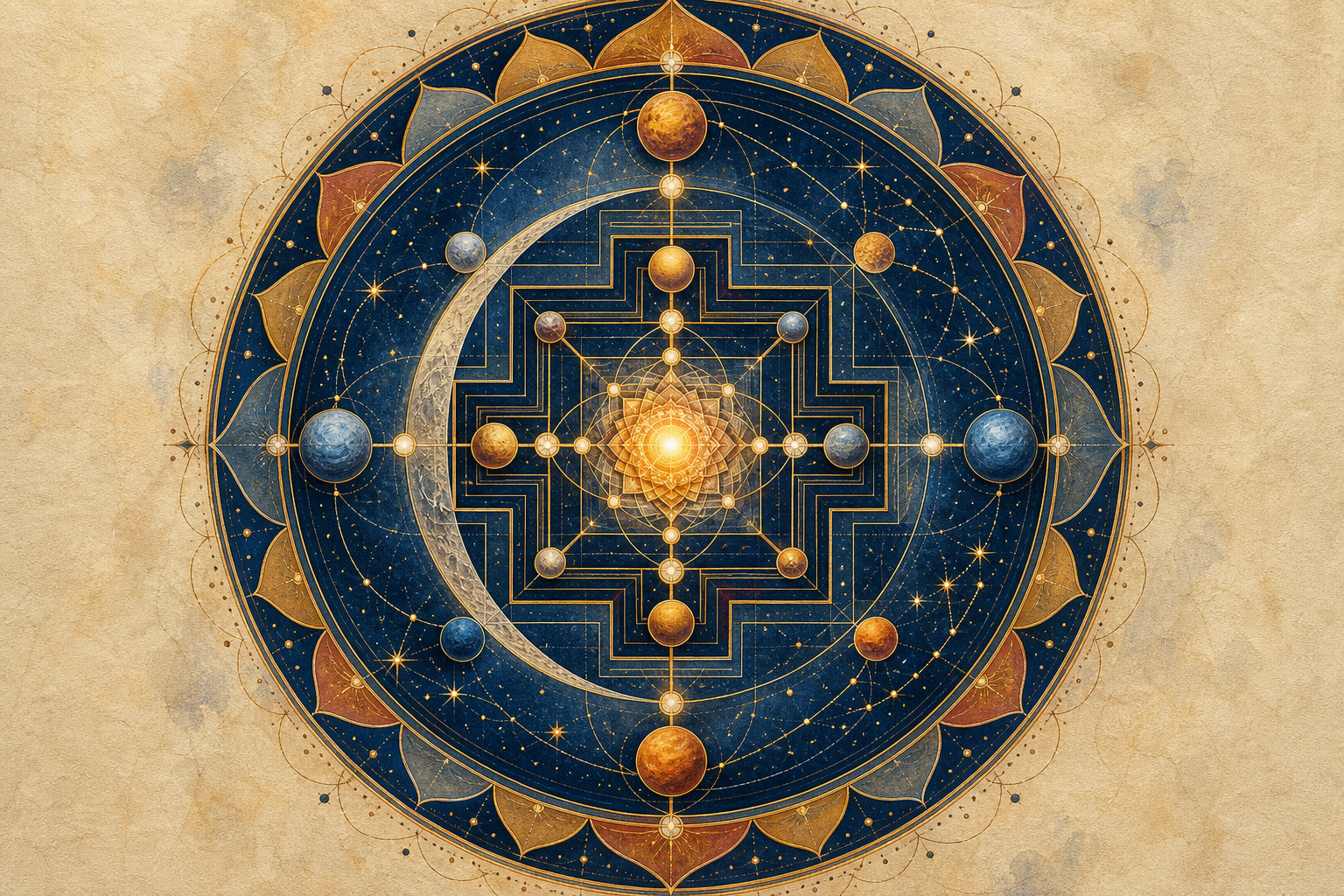
Sarvatobhadra Chakra is best understood as a map of intersecting influences rather than a shortcut for declaring a transit favourable or unfavourable. It brings planetary movement into contact with nakshatra, rashi, tithi, weekday and the sounds associated with a name, allowing an astrologer to examine where pressure or support may be concentrated.
The practical value of the method lies in refinement. A broad transit may look manageable while a sensitive natal or calendrical point is receiving a strong impact; an apparently difficult transit may also be moderated by protective influences. The chakra therefore helps clarify what is being activated, how forcefully it may be activated and how cautiously the result should be interpreted.
A transit becomes a network rather than a single position
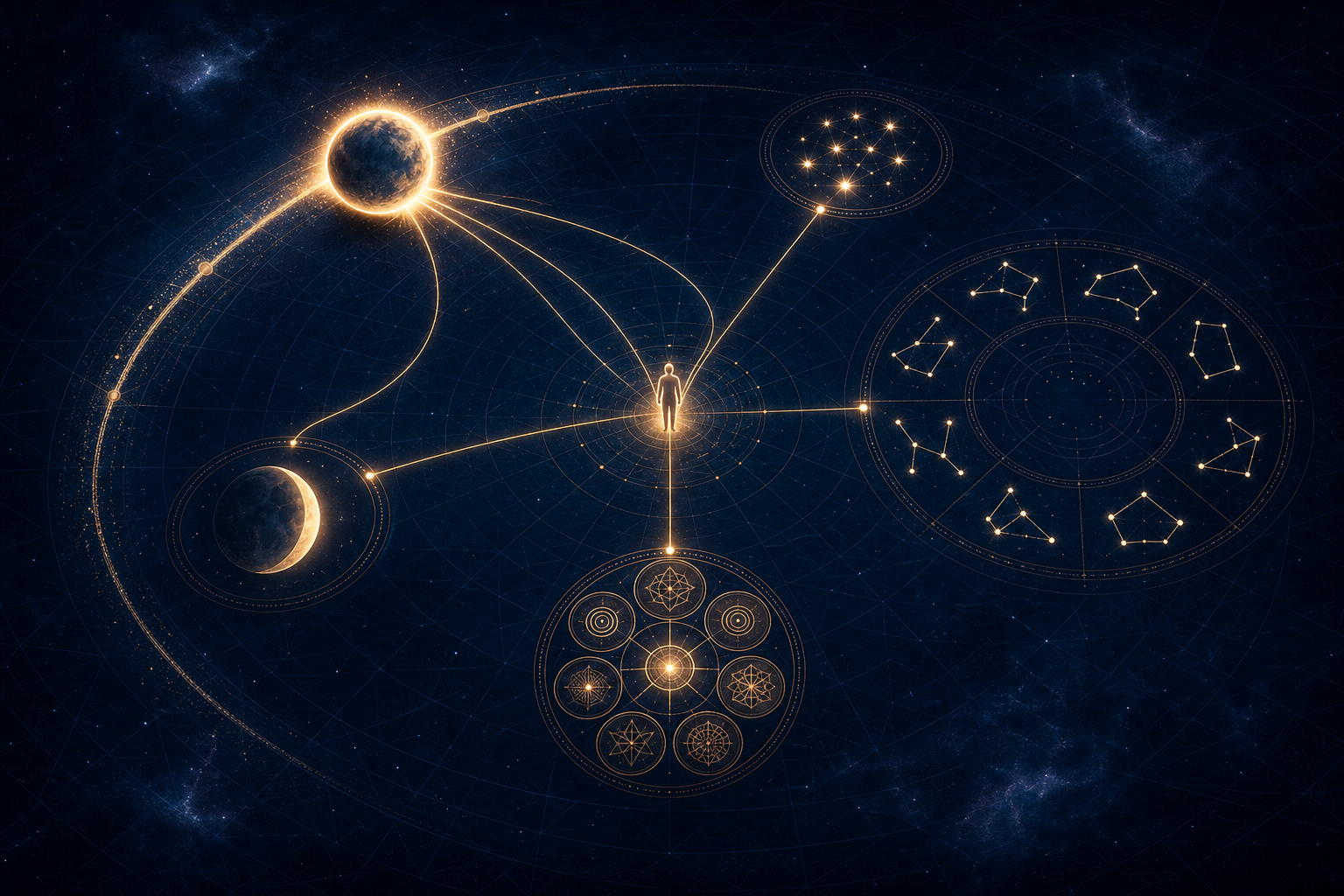
Conventional transit analysis commonly starts with planets moving through signs and houses. The DharmaRenaissance account explains that Sarvatobhadra Chakra expands the inquiry by considering several layers simultaneously: the affected lunar mansion, zodiac sign, lunar day, weekday and akshara, or sound-letter. Its name reflects this comprehensive intention: the source interprets sarva as all or everywhere and bhadra as auspicious, wholesome or beneficial.
This helps explain the traditional association, noted by the source, between the chakra and the expression Trilokya Deepa, a lamp illuminating the three worlds. In technical terms, the image points to a system designed to illuminate a transit from more than one direction. Its breadth does not mean that every layer produces a separate prediction. The layers instead work as coordinates locating the particular point at which a general planetary movement becomes personally or temporally relevant.
The method also expresses a qualitative understanding of time. Tithi, vara and nakshatra describe more than chronological sequence: they distinguish rhythms and conditions within which an action occurs. The source connects this outlook with decisions involving travel, ritual, business, marriage, investment, relocation, pilgrimage and spiritual discipline. The chakra’s role is not to make those choices automatically, but to expose timing factors that a broad sign-based reading might not reveal.
The grid connects celestial movement with lived identity
According to the supplied account, the traditional Sarvatobhadra Chakra is a nine-by-nine square containing 81 spaces. Its outer boundary holds 28 nakshatras, including Abhijit between Uttarashada and Shravana. That inclusion distinguishes the chakra from much modern predictive work based on 27 nakshatras and underscores the system’s strong lunar-mansion orientation.
The inner arrangement incorporates the 12 rashis, 30 tithis, seven varas and a set of aksharas. Each layer answers a different part of the interpretive question. Nakshatra supplies a finely divided reference for planetary contact; rashi retains the broader zodiacal setting; tithi and vara connect the reading with the lunar calendar and weekday rhythm; akshara introduces the first sound of a person’s name.
The akshara component is especially important when considering what makes this method distinctive. The source situates it within Indian traditions in which a name may carry associations of lineage, memory, blessing, deity and identity. Sarvatobhadra Chakra translates that cultural understanding into an astrological reference point. It can consequently offer a structured supplementary approach in some prashna, muhurta or transit questions even when a complete horoscope is unavailable.
That flexibility should not be confused with independence from other Jyotisha methods. The source explicitly presents the chakra as a refinement rather than a replacement for the birth chart, dasha, panchang or muhurta principles. A name or calendar factor can identify a meaningful contact, but it cannot by itself supply all the context ordinarily obtained from a complete natal and timing analysis.
Vedha is the interpretive hinge of the system

Once planets in transit are located in the chakra according to their current nakshatra or other relevant position, the central task is to examine their vedha. The source explains the term through the ideas of piercing, obstruction and direct impact. In practice, vedha identifies the points that a transiting planet strikes, stimulates, blocks or protects.
The word’s obstructive sense can invite an overly negative reading, but the supplied article cautions against treating every vedha as misfortune. The character of the contact depends on the planet, its condition and the receiving point. In the source’s examples, Jupiter may signify protection, counsel, learning or gain, while Mercury may emphasise intellect and communication. Venus may indicate comfort but can also bring relationship- or opponent-related concerns according to context. Saturn, Mars, Rahu and Ketu may correspond with pressure, delay, austerity, injury, disruption, confusion or karmic friction.
These associations are interpretive possibilities, not self-executing verdicts. The same apparent contact can operate differently when the planet’s condition changes or when another influence intervenes. The source reports that dignity, speed and retrograde motion can make a vedha more noticeable, whereas weakness or debilitation may reduce its effect. It also states that a favourable vedha can soften or counter an unfavourable one.
This produces a more useful question than simply asking whether a planet is benefic or malefic: what kind of contact is occurring, how strong is the planet producing it, what exactly receives the contact and what countervailing influence is present? The answer emerges from the relationship among those factors. Isolating any one of them turns a layered diagnostic method into the kind of rigid prediction it is meant to refine.
A disciplined reading moves from reference point to response

A careful analysis begins by establishing the relevant personal and temporal references rather than immediately labelling the current planets. The Janma Nakshatra, occupied by the Moon at birth, is one of the most important personal points identified by the source. It also names derived nakshatras such as Karma, Adhana, Vinasha, Samudayika and Samghatika, which help differentiate the field in which a contact may become significant.
The next task is to map the transiting planets and identify which of those references receive vedha. Only then should planetary condition and competing influences be judged. This sequence keeps the interpretation anchored to both the target and the source of the contact: a strong vedha to a sensitive point deserves more attention than a generic transit description, while protection elsewhere in the grid may change the practical assessment.
Context must then translate symbolism into the actual decision under consideration. The source gives the example of a difficult vedha to the Janma Nakshatra near the beginning of a journey, undertaking, ritual or business decision. Traditional caution in such a case does not necessarily require abandoning the action. Depending on the wider assessment, it may support delay, additional preparation, consultation, prayer, purification or the selection of a more suitable muhurta.
This distinction is essential to responsible practice. Sarvatobhadra Chakra can highlight vulnerability, but it does not establish that one feared event must occur. Its practical function is closer to risk differentiation: it helps identify the activated field, the relative force of the influence and the kinds of preparation that may be appropriate. Final judgement still belongs within the larger chart and the circumstances of the person seeking guidance.
Key takeaways
- Sarvatobhadra Chakra refines transit analysis by combining nakshatra, rashi, tithi, vara and akshara rather than relying on one zodiacal placement.
- Its nine-by-nine grid contains 81 spaces and uses 28 nakshatras, including Abhijit, according to the supplied DharmaRenaissance account.
- Vedha indicates direct influence or obstruction, but its result is not automatically harmful; the planet, its strength, the receiving point and protective contacts all matter.
- The Janma Nakshatra and other derived nakshatras help connect a general transit with a particular area of experience or action.
- The chakra is a supplementary diagnostic framework, not a substitute for the birth chart, dasha, panchang or muhurta analysis.
Used with that restraint, Sarvatobhadra Chakra can support more discriminating transit judgements: not certainty about an isolated symbol, but better-informed timing, preparation and response as planetary conditions change.