
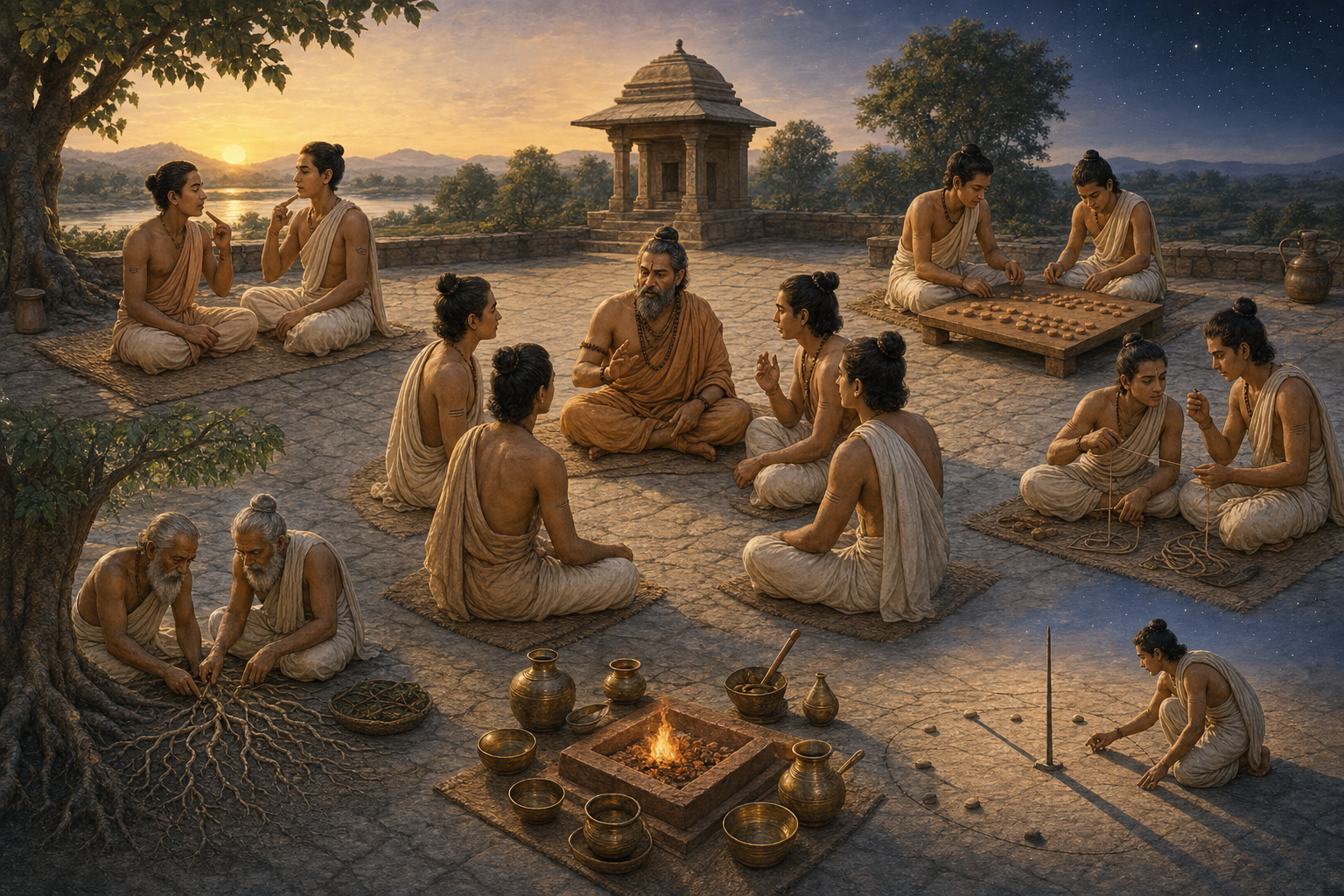
Vedic preservation is often imagined primarily as an achievement of memory. Memory was essential, but the source article presents a more comprehensive picture: the Veda had to be protected as sound, language, metre, meaning, timed observance and disciplined practice.
The six Vedāṅgas supplied this protective framework. Rather than six loosely related subjects, they can be understood as an interconnected system that guards the Veda at every point between hearing a mantra and applying it correctly.
Preservation required more than retaining the words
The source describes the Veda as an oral, intellectual, ritual and contemplative tradition. That breadth explains why textual memory alone could not secure its continuity. A passage might retain recognizable words while its accent changes, its syllabic pattern deteriorates, an ancient expression becomes obscure, or its ritual setting is forgotten.
The term Vedāṅga, meaning a “limb” of the Veda, expresses this functional relationship. Śikṣā, Vyākaraṇa, Chandas, Nirukta, Jyotiṣa and Kalpa do not compete with the Veda or merely add information around it. Each protects a condition under which Vedic knowledge remains intelligible and usable.
This produces a layered model of preservation. Śikṣā asks whether the inherited sounds are being pronounced accurately. Vyākaraṇa examines whether linguistic forms are understood correctly. Chandas keeps the rhythmic architecture visible. Nirukta recovers the meanings of difficult words. Jyotiṣa relates observance to appropriate time, while Kalpa carries knowledge into ordered procedure. Preservation therefore extends from the smallest audible distinction to the complete enactment of a rite.
Six safeguards and the distinct losses they prevent
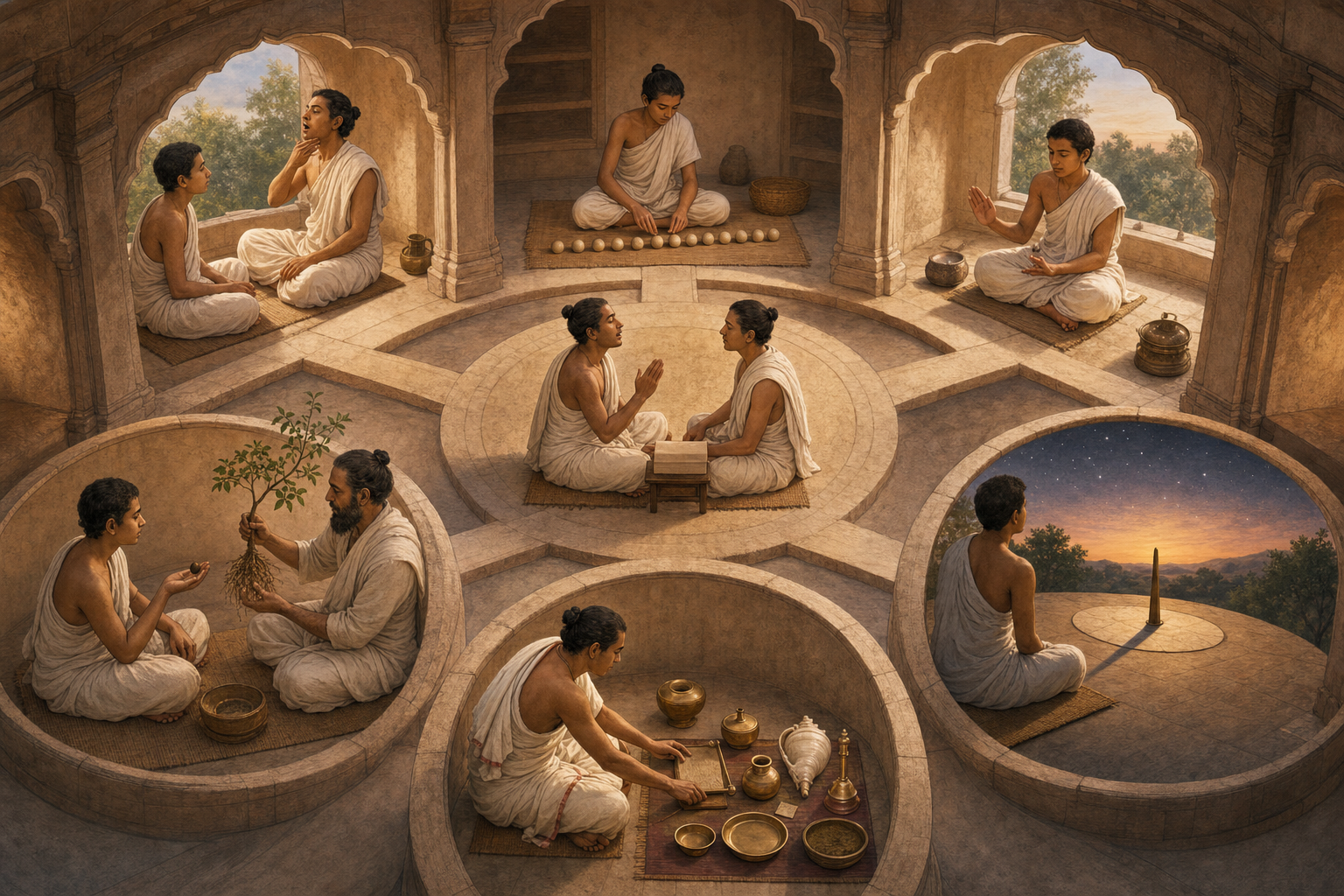
Reading the disciplines through the risks they address reveals their complementarity. The following comparison synthesizes the functions assigned to them in the source article.
| Vedāṅga | What it safeguards | What may be lost without it |
|---|---|---|
| Śikṣā | Articulation, accent, vowel quantity and the ordered production of sound | The precise audible form of a mantra |
| Vyākaraṇa | Word formation, linguistic structure and valid usage | Grammatical accountability and clarity of expression |
| Chandas | Syllabic pattern, metre and rhythm | The formal structure that supports accurate recitation and memory |
| Nirukta | Explanation of difficult Vedic vocabulary through semantic and etymological inquiry | Access to meanings obscured by linguistic distance |
| Jyotiṣa | The timing required for Vedic observance | The connection between prescribed action and its proper occasion |
| Kalpa | Ritual sequence and procedure | The orderly translation of inherited knowledge into practice |
Śikṣā offers the clearest example of the system’s attention to detail. The source identifies the Vedic accents udātta, anudātta and svarita, along with short, long and pluta quantities. It also notes the existence of branch-specific prātiśākhyas. These features indicate that preservation operated through technically defined teaching traditions, not through an undifferentiated instruction simply to “pronounce carefully.”
Vyākaraṇa supplies a different kind of control. The source places Pāṇini’s Aṣṭādhyāyī at the centre of the grammatical tradition and associates it with Kātyāyana’s vārttikas and Patañjali’s Mahābhāṣya. Its relevance to preservation lies in constraining interpretation: inherited words cannot responsibly be assigned whatever meaning happens to seem convenient.
Chandas adds an independent test. The source names metres including Gāyatrī, Anuṣṭubh, Triṣṭubh, Jagatī, Bṛhatī, Paṅkti and Uṣṇih. A metrical pattern organizes recitation and assists memory, but it can also expose disruption: a missing, lengthened or misplaced syllable may disturb a structure that the learner has internalized as rhythm.
Nirukta responds to another problem: faithfully repeated language may cease to be understood. The article associates this discipline with Yāska and presents etymological and semantic analysis as a way of approaching difficult Vedic words. It thus protects against a separation between accurate recitation and informed comprehension.
Jyotiṣa and Kalpa broaden the field beyond the verbal form. In the source’s functional account, the former protects time and the latter ritual order. Their inclusion shows that preservation is incomplete if a mantra survives in isolation while knowledge of when and how it is to be employed disappears.
Interlocking disciplines create resilience
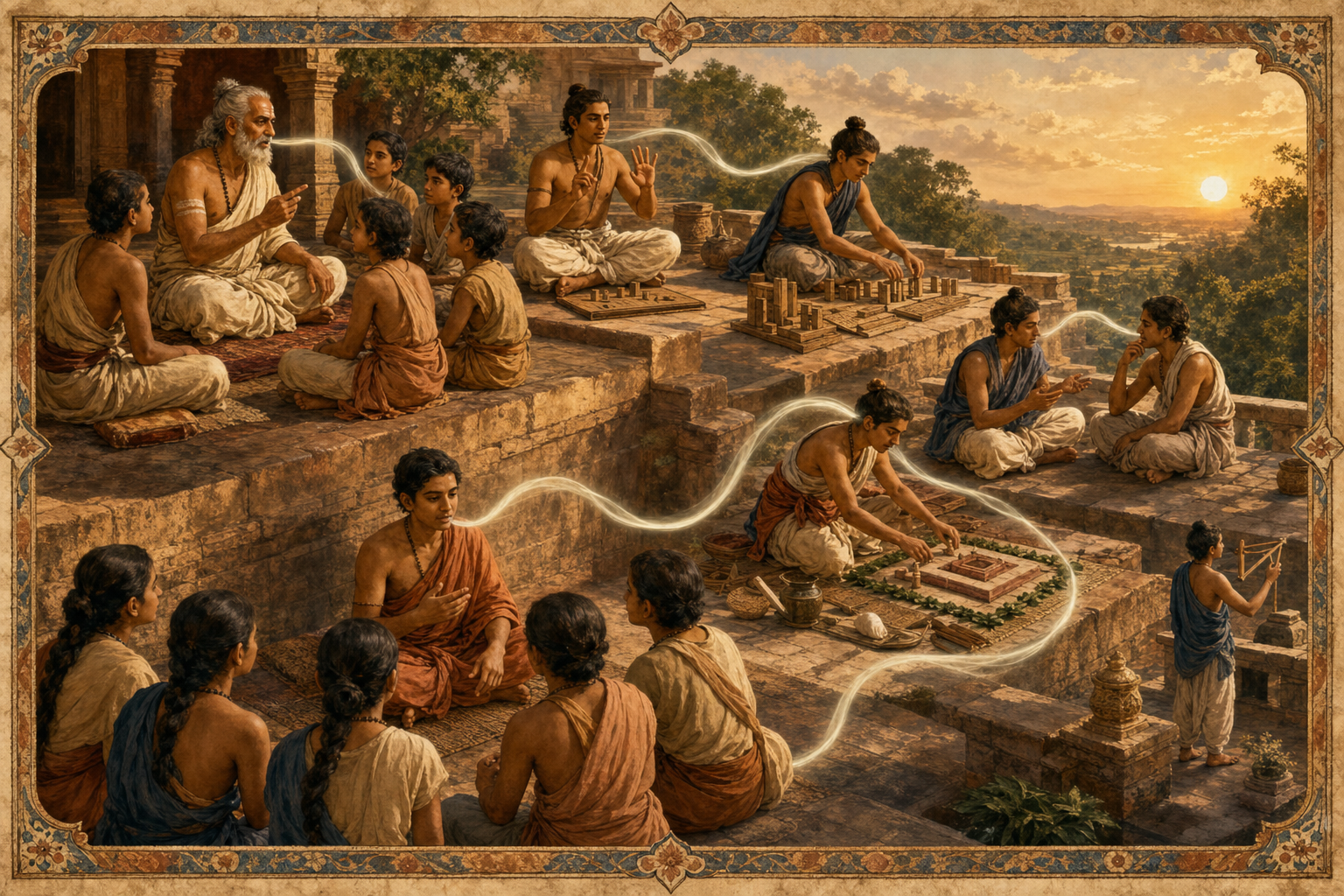
The strength of the Vedāṅga framework lies in overlap without redundancy. Sound, metre and grammar can check different features of the same utterance. Grammar and Nirukta approach language from related but non-identical directions: one disciplines form and usage, while the other investigates difficult meaning. Jyotiṣa and Kalpa then connect verbal knowledge with circumstance and action.
A modern information-system analogy can clarify this relationship, provided it is treated only as an analogy. Śikṣā protects the fidelity of the signal; Chandas supplies a recognizable pattern; Vyākaraṇa validates structure; Nirukta aids semantic recovery; Jyotiṣa provides temporal context; and Kalpa governs execution. No single layer can substitute for all the others.
This also explains why devotion and technical discipline are not opposites in the account summarized by the source. Reverence motivates preservation, but technique makes fidelity teachable and testable. The traditional warning concerning an incorrectly accented mantra, recalled in the article through the story of Tvaṣṭā and Vṛtrāsura, underscores the ethical seriousness attached to careful speech. Its practical lesson is that a tradition centred on sacred utterance places responsibility on the speaker.
Key takeaways
- The Vedāṅgas preserve a complete chain of transmission, from pronunciation and linguistic form to meaning, timing and performance.
- Śikṣā, Chandas and Vyākaraṇa provide different checks on an utterance, so one kind of accuracy cannot conceal another kind of error.
- Nirukta helps prevent memorized language from becoming semantically inaccessible as vocabulary grows distant from later learners.
- Jyotiṣa and Kalpa show that Vedic continuity includes contextual and procedural knowledge, not words alone.
- The framework joins reverence to disciplined verification, making precision a shared responsibility of teachers and learners.
Preservation remains a relationship, not merely an archive

The article’s discussion of minute correction under a trained teacher points to the human foundation of the entire system. A learner adjusts the tongue, breath, vowel length or accent in response to attentive instruction. Such exchanges preserve information, but they also cultivate patience, concentration and humility before an inherited form.
This perspective helps distinguish storage from transmission. A written text can retain visible words, and a recording can preserve an instance of recitation. Neither by itself explains why an accent is correct, how a grammatical form is derived, what an obscure expression conveys, or how knowledge belongs within an ordered practice. The Vedāṅgas preserve those relationships of explanation and correction.
Future efforts to sustain Vedic learning can therefore benefit from treating the six disciplines as a connected curriculum. Tools for recording, notation and textual access may support that work, but continuity will still depend on learners who can relate sound to structure, structure to meaning, and meaning to responsible practice.