
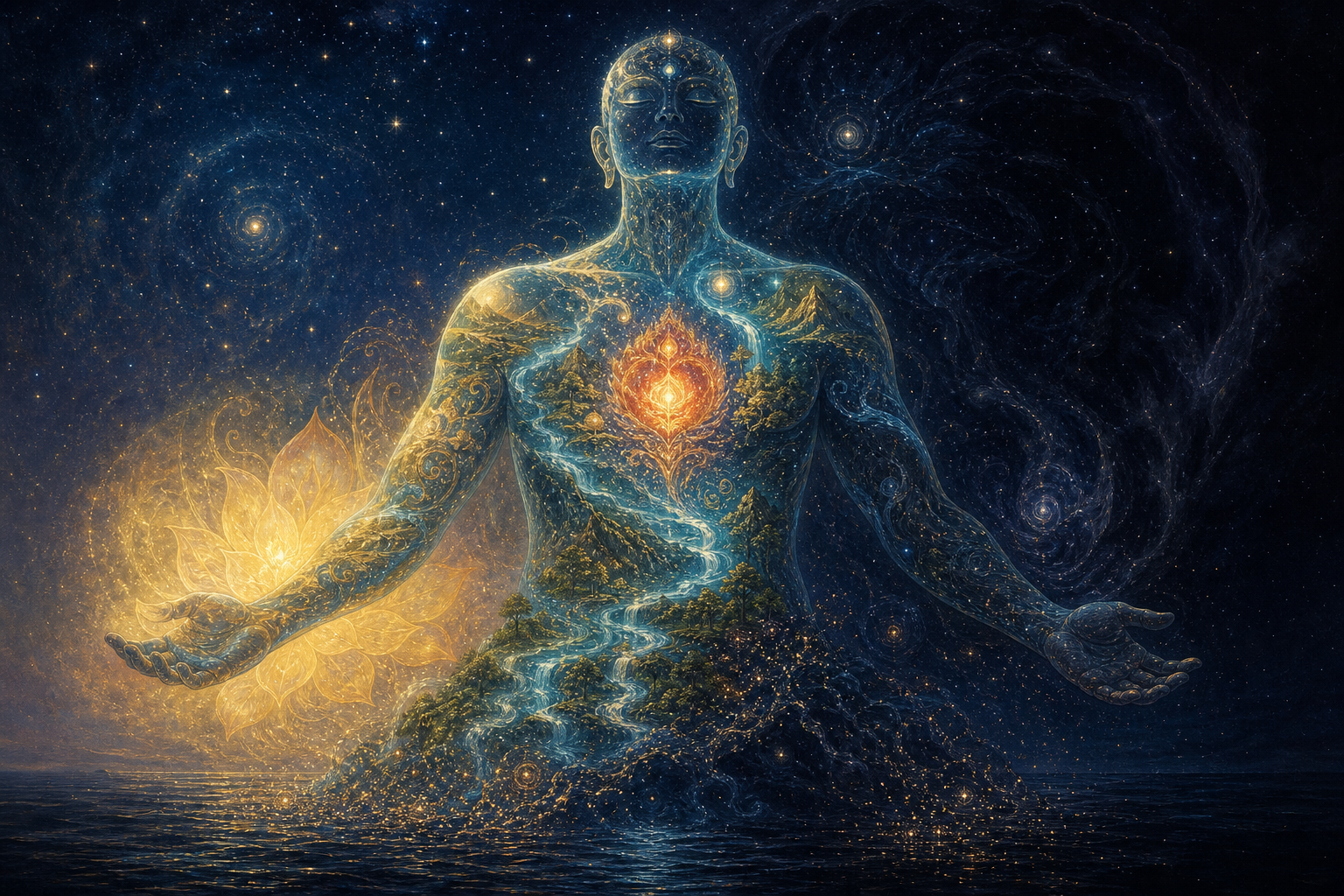
Two distant passages of the Srimad-Bhagavatam illuminate a single question: what does embodiment mean in a cosmos that is sacred, ordered and ultimately subject to withdrawal? One describes the universal form taking shape through limbs, circulation, appetite, heart and mind; the other depicts the supports of cosmic life failing under the force of time.
Read together, the passages offer more than a cosmological picture. They present the body as a field of entrusted powers, the natural world as a larger physiology and dissolution as the test that prevents either body or cosmos from being mistaken for an independent, permanent reality.
Manifestation and withdrawal form one theological arc
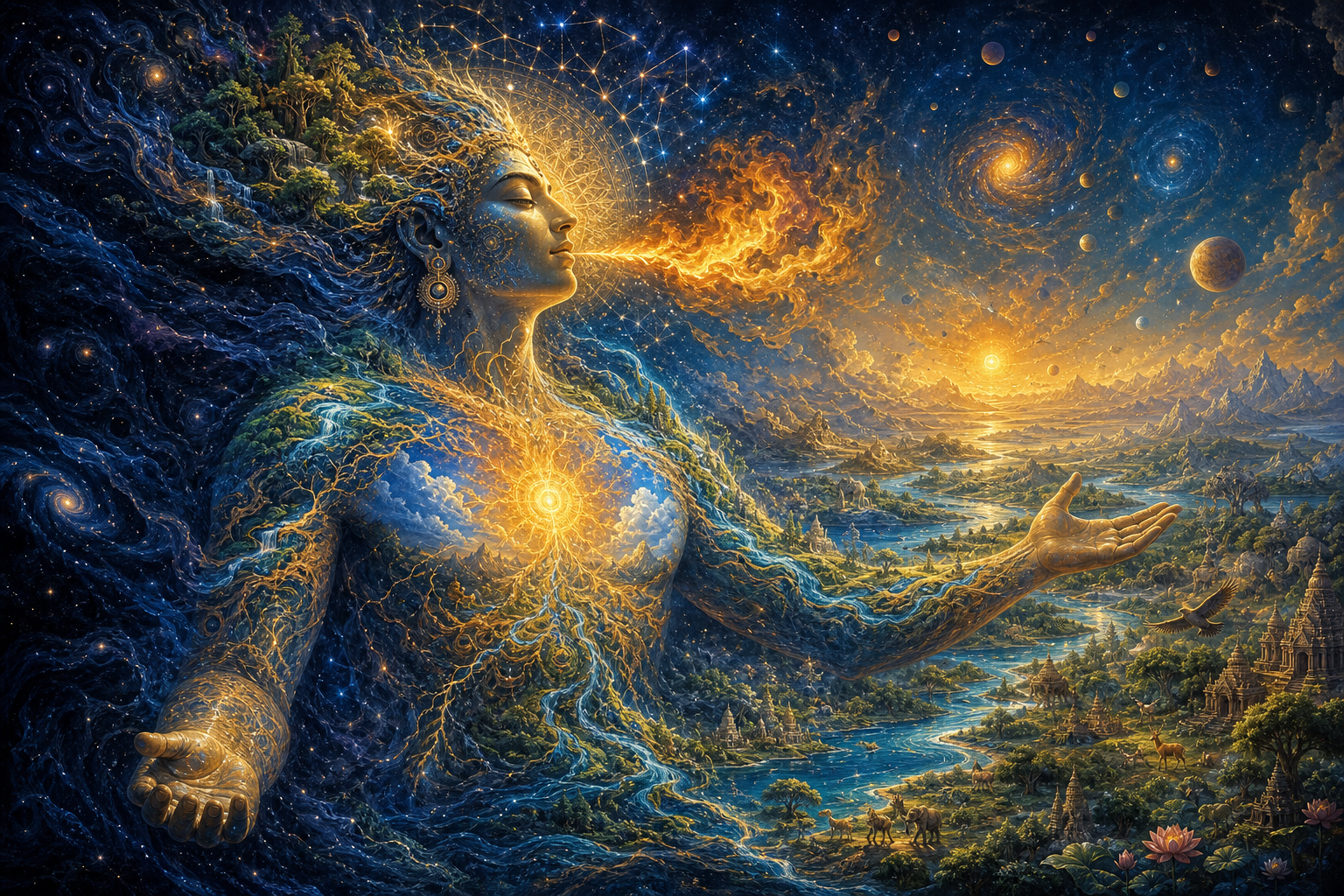
The article on Srimad-Bhagavatam 3.26.58-60 places those verses within Lord Kapila’s teaching to Devahuti. It reports that the chapter moves through the principles of material nature toward the manifestation of the virat-purusha, the cosmic person. Organs appear together with their functions and governing intelligences: embodiment is presented as an ordered network rather than an accidental collection of parts.
The article on Srimad-Bhagavatam 11.3.9 approaches the cosmos from the opposite direction. Within King Nimi’s dialogue with the nine Yogendras, an inquiry into maya leads to an account of dissolution. The source reports a hundred-year drought, an increasingly fierce sun and heat afflicting the three worlds as pralaya approaches. What appeared stable is progressively deprived of the conditions that sustained it.
These accounts cover different textual settings and scales, but their theological logic converges. The world is neither dismissed as meaningless nor granted absolute independence. It manifests through an intelligible order, functions through relationships and is withdrawn through time. Creation and dissolution therefore correct two opposite errors: contempt for embodied existence and attachment to it as permanent.
The cosmic body turns anatomy into responsibility

The bodily correspondences reported in the discussion of 3.26.58-60 are not offered as modern anatomical claims. Each organ is joined to a capacity and a wider cosmic reference, allowing ordinary actions to be examined morally and contemplatively.
| Embodied element | Reported cosmic or functional link | Contemplative implication |
|---|---|---|
| Hands | Grasping and releasing; Indra | Power may become service, generosity or domination. |
| Feet | Movement; Vishnu | Motion acquires direction when aligned with preservation and dharma. |
| Veins and blood | Rivers and life-bearing flow | Personal vitality and ecological circulation mirror one another. |
| Abdomen | Hunger, thirst and the ocean | Appetite discloses the creature’s dependence on conditions beyond itself. |
| Heart | The emergence of mind | Thought belongs within a wider interior life of desire, memory and moral orientation. |
This pattern resists the idea that a faculty belongs to the ego merely because the ego can employ it. A hand can offer, protect or seize. Feet can carry a person toward duty or into restless distraction. The same capacity remains materially recognizable while acquiring a different significance according to its direction.
The correspondence between veins and rivers extends that responsibility beyond the individual. The source interprets rivers as channels in a cosmic physiology, sustaining landscapes as circulation sustains tissues. Within that sacred ecology, pollution is more than inefficient resource management: it represents injury to a life-bearing order. This is an ethical implication of the passage, not a claim that its symbolism substitutes for environmental science.
The movement from abdomen to heart and mind also links thought to embodied dependence. Hunger and thirst narrow attention; bodily disturbance can unsettle the mind; and wounded interior life can distort judgment. The source accordingly connects steadiness with regulated living, clean food, sacred sound, service, prayer, pilgrimage and study. Its anthropology is broader than a description of brain processes, yet it need not be posed as a rejection of neuroscience. It asks what biological explanation alone may leave unanswered about meaning, intention and moral formation.
Dissolution reveals what the cosmic body cannot guarantee

If the universal form teaches interdependence through living correspondences, the account of pralaya exposes that dependence by removing its supports. According to the discussion of 11.3.9, rain and habitability fail while the normally life-sustaining sun becomes unbearable. The reversal is important: forces that nourish within one phase of cosmic order can participate in withdrawal when the cycle turns.
The source presents kala not simply as measured duration but as an active principle of divine governance. Bodies, kingdoms, identities, intellectual constructions and celestial regions operate within time; none can place itself beyond time. The reference to the three worlds therefore enlarges impermanence beyond personal mortality. Even the grandest structured environment remains conditioned.
This makes dissolution the necessary counterpart to the cosmic-body vision. Sacredness does not mean material permanence. Rivers may be revered as life-bearing channels, yet flowing water is not an unconditional possession. Hands and feet may express divine order, yet their strength is temporary. Mind may emerge from the heart within the symbolic sequence, yet embodied thought remains vulnerable to thirst, loss and time.
The article on 11.3.9 interprets this vulnerability through maya: the temporary is experienced as ultimate, the dependent as self-sufficient and the changing as securely permanent. Pralaya exposes that confusion at cosmic scale. Smaller dissolutions already make the same point through ageing, disrupted households, broken relationships, uncertain work and the collapse of familiar assumptions. The purpose is not fatalism, but discrimination between what deserves responsible care and what can bear ultimate trust.
A disciplined reading avoids both literalism and abstraction
Both source articles caution, in different ways, against collapsing Purānic cosmology into modern technical description. The virat-purusha passage is not an anatomy manual, and the drought preceding pralaya is not presented as a forecast for a named modern date. Their primary work is theological and contemplative: they disclose dependence, intelligent order, impermanence and the limits of egoic ownership.
Nor should symbolism make the material world irrelevant. The body-cosmos correspondences intensify attention to action, appetite and rivers, while dissolution gives that care urgency. Ecological concern is therefore a legitimate ethical resonance, provided the verse is not reduced to environmental commentary. Technology may manage resources and extend comfort, as the second source observes, but it does not abolish dependence on water, soil, sunlight, atmosphere or cooperation.
Key takeaways
- The universal form presents organs, functions and cosmic governance as related dimensions of embodied life.
- The correspondences turn bodily power into an ethical trust: action, movement, appetite and thought require direction.
- Cosmic dissolution shows that sacred material forms remain conditioned and cannot provide permanent security.
- Bhakti, humility, restraint and compassion answer impermanence by reorienting life, not by denying the world.
Future engagement with these passages can fruitfully hold cosmology, ecology and spiritual practice together. Their continuing challenge is to care for the world’s living order without confusing stewardship with ownership, and to use embodied capacities before time withdraws the opportunity to direct them.
References
- DharmaRenaissance Blog — Srimad Bhagavatam 3.26.58-60: Powerful Vision of Body, Cosmos and Mind
- DharmaRenaissance Blog — Powerful Lessons from SB 11.3.9: Cosmic Dissolution and Dharmic Resilience