
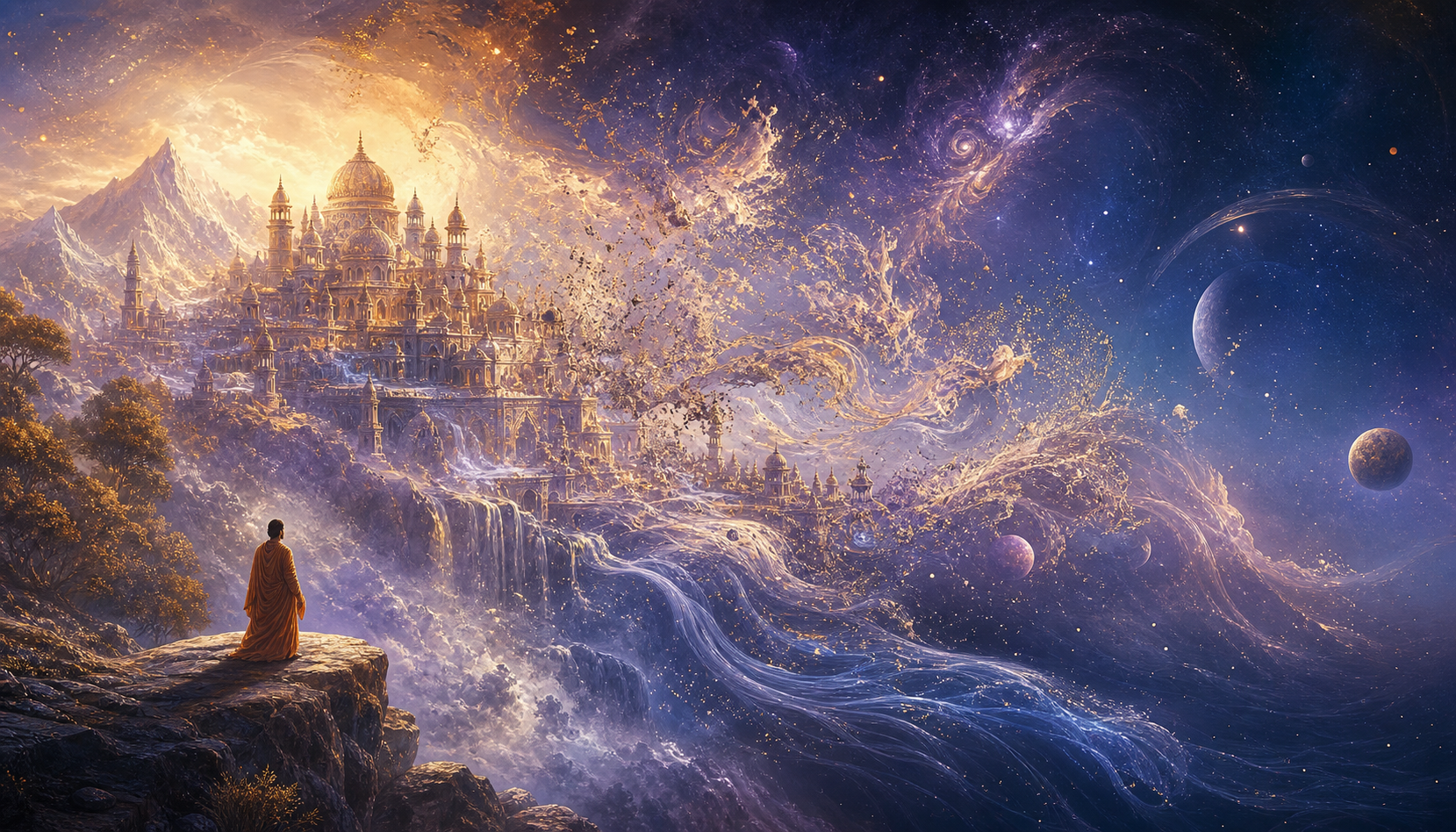
The Mudippura Bhadrakali tradition is best understood not as a single festival or shrine type, but as a relationship among a consecrated divine form, a particular place, hereditary ritual service and a community that encounters the Goddess in motion. Its centre is the Thirumudi: the sacred head-form or crown through which Bhadrakali becomes visibly present.
The available DharmaRenaissance account brings together the tradition’s theology, geography and performance. Read as a whole, it explains why the Mudippura is more than a building, why Kaliyoottu is more than a retelling of myth, and why local distinctions must be preserved when comparing this tradition with other Kerala ritual arts.
Meeting the Goddess through the Thirumudi
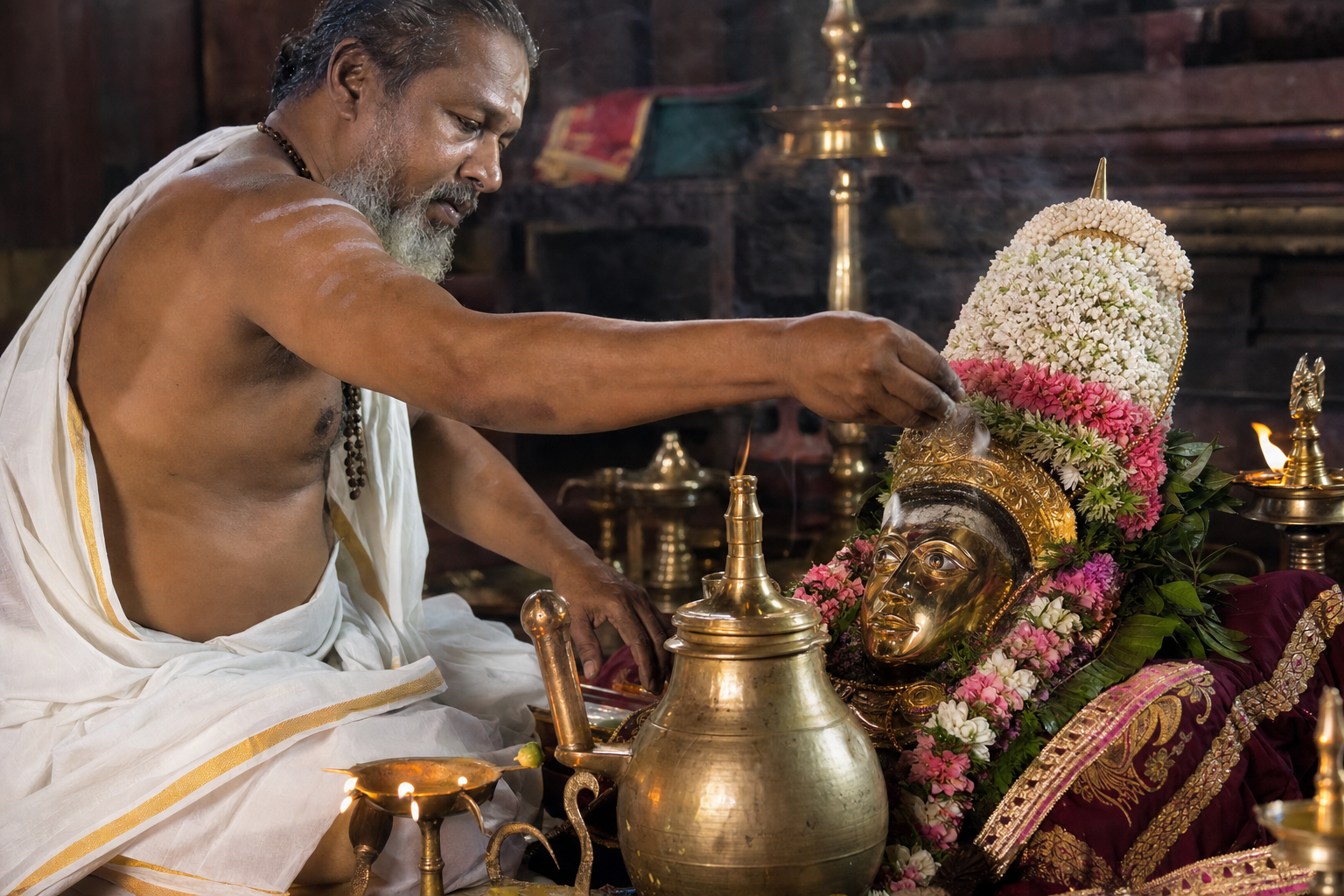
In ordinary usage, mudi can refer to the head or hair. Within Mudippura worship, however, Thirumudi denotes a decorated and consecrated form in which the presence of Devi is made perceptible. The DharmaRenaissance article consequently describes a Mudippura both as the sacred house of the Mudi and, in translation, as a “Crown House.” Neither expression should reduce the Thirumudi to ceremonial ornament.
The distinction matters because the Thirumudi joins containment with revelation. It is guarded and worshipped within a sacred house, yet it can also be carried into public ritual space. The Goddess is therefore not represented only as a fixed image enclosed in a shrine. According to the source, devotees may encounter her as a presence that moves through the locality, receives offerings, approaches households and acts against disorder.
The report identifies Vellayani Devi Temple near Thiruvananthapuram as a prominent example, describing the temple’s golden Thirumudi as the emotional focus of its festival cycle. Such darshan is presented as an encounter with Shakti rather than a display of craftsmanship alone. Bhadrakali’s fierceness has the same relational meaning: she is revered as Amma, whose formidable form expresses protection of families, land, cattle, harvest and moral order.
When the village becomes part of the sacred field
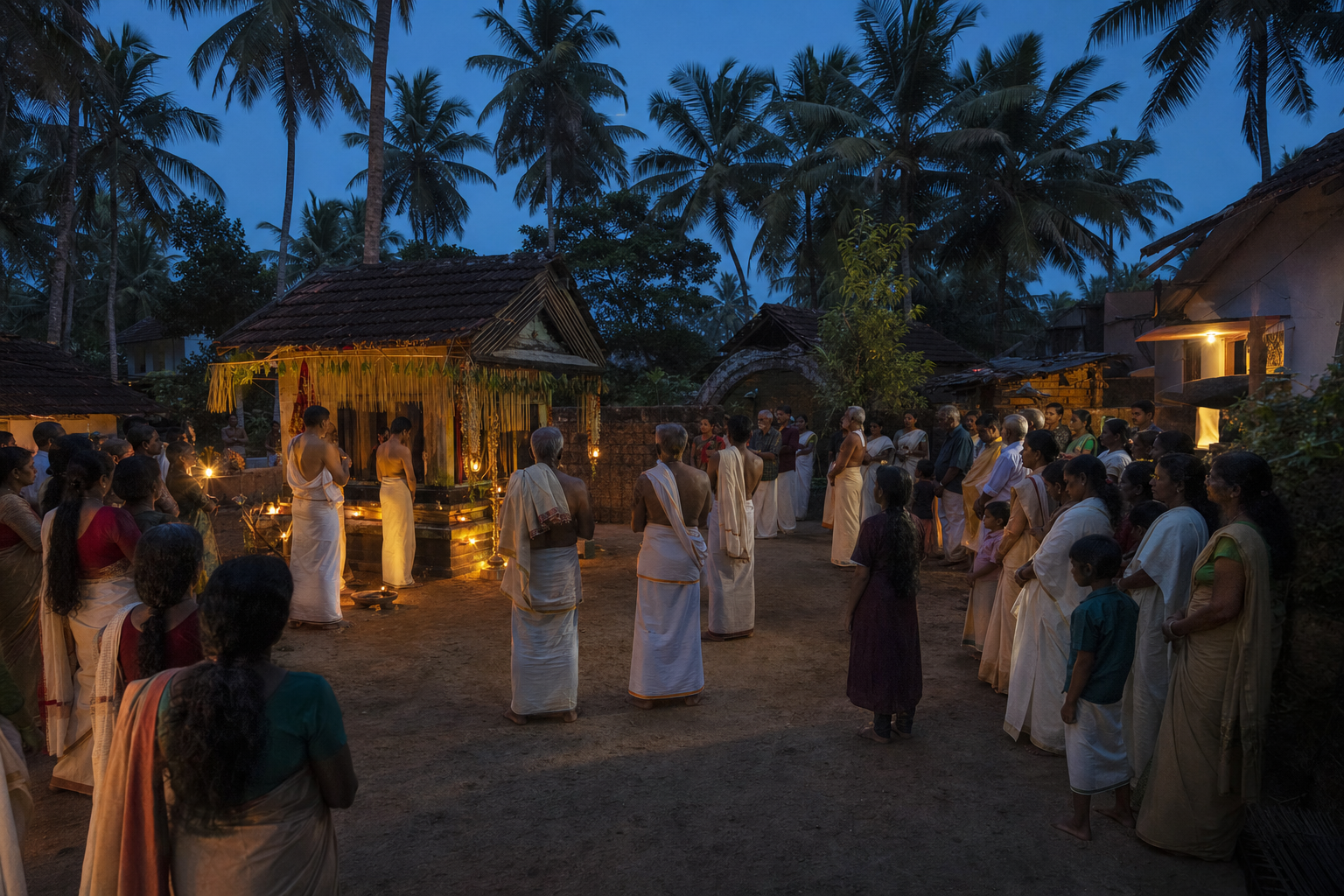
The DharmaRenaissance account locates Mudippura shrines especially in Thiruvananthapuram, Kollam and adjoining parts of the older Travancore cultural region. It reports considerable variation in scale. Some are public temples with extensive festivals, while others are smaller shrines sustained through hereditary custody and local memory. They may also stand near sacred groves, family shrines or other Bhagavathy temples.
What connects these settings is not architectural uniformity but the association between Devi and a particular territory. When the Thirumudi or its ritual bearer moves beyond the shrine, ordinary village space acquires ceremonial direction and meaning. A procession can be understood as the Goddess surveying and sanctifying the area entrusted to her protection; an offering links household concerns to the wider ritual community.
This place-based character also helps explain the tradition’s religious complexity. The source describes Agamic worship existing alongside local goddess devotion, oral song, trance, martial imagery, agrarian rhythms and responsibilities assigned through inherited social roles. These elements are not presented as fragments awaiting standardisation. Together they form a local ritual grammar in which temple worship, livelihood, kinship and collective memory remain connected.
Kaliyoottu turns the Darika myth into communal action
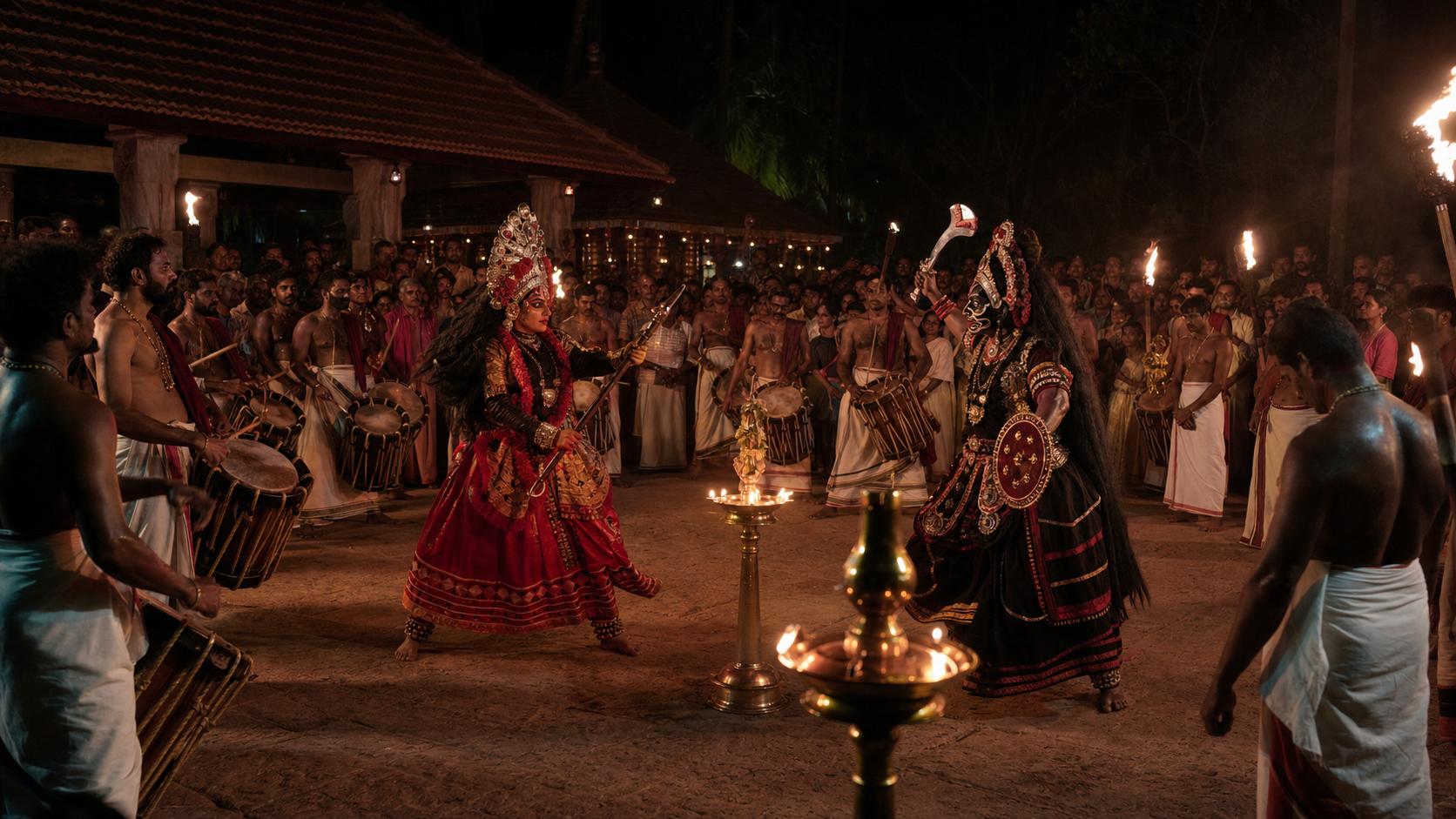
The theological narrative underlying many Mudippura observances concerns Bhadrakali’s defeat of Darika. As recounted by DharmaRenaissance, Darika acquires protection against men and becomes oppressive; Shiva brings forth a female divine power capable of confronting him. Bhadrakali destroys Darika and re-establishes order. In ritual use, the story gives visible form to the community’s confrontation with fear, injustice, disease and uncertainty.
Kaliyoottu, also called Kali natakam in some settings, is reported as the ritual most closely associated with many Mudippura traditions. Its name refers to feeding or propitiating Kali, but its scope extends across songs, percussion, offerings, vows, lamps, costumes and processional movement. The participants do not merely watch a completed story. They enter a ceremonial environment in which the Goddess is born, searches for Darika, battles him and restores peace.
The report says that Vellayani’s celebrated Kaliyoottu traditionally lasts about 65 to 70 days and is held once every three years. That example illustrates the possible scale of the observance, but it should not be treated as a template for every Mudippura. The same source cautions through its descriptions that ritual details differ among temples.
Several named stages reveal how the myth is mapped onto space. Kalamkaval represents the Goddess moving in search of Darika; Uchabali and Dikkubali involve offerings and directional action; Paranettu places the confrontation in an elevated setting; and Nilathil Poru brings the climactic battle to the ground. Direction, height, rhythm and bodily movement thus carry narrative meaning without depending on verbal explanation alone.
The Vathi and the embodied language of ritual
The Vathi occupies a pivotal position in the account of Mudippura worship. During ceremonies such as Kalamkaval, this ritual specialist may carry or embody the presence associated with the Goddess. DharmaRenaissance describes the role as one shaped by inheritance, training, austerity, bodily discipline and recognition from the community. It therefore cannot be adequately interpreted as secular acting in religious costume.
Costume, ornament, controlled movement and trance-like intensity mediate a passage from human ritual service to divine representation. For devotees, the resulting encounter can combine awe, fear, affection and surrender. The body functions here as a sacred text: gesture indicates intention, direction establishes ritual territory, and the Thirumudi marks the concentrated presence of power.
The source places this tradition in conversation with Mudiyettu, Theyyam, Padayani, Thirayattam and Bhuta Kola, but the comparison should not erase their different names and settings. Mudippura refers to the sacred house and the tradition centred on the Mudi; Kaliyoottu is an associated cycle of Bhadrakali ritual; Mudiyettu is a related form of ritual theatre enacting the Kali-Darika battle. DharmaRenaissance reports that Mudiyettu is concentrated more in central Kerala districts including Thrissur, Ernakulam, Kottayam and Idukki, and that UNESCO recognised it as intangible cultural heritage in 2010. The shared mythic world is therefore a basis for comparison, not evidence that the practices are interchangeable.
Key takeaways
- The Thirumudi is a consecrated form through which Bhadrakali is encountered, not merely a decorative crown.
- A Mudippura connects the Goddess to a specific locality, its households, inherited responsibilities and communal memory.
- Kaliyoottu converts the Darika narrative into a shared ritual process involving movement, offerings, music and staged confrontation.
- The Vathi and the named ritual stages show that bodily action, spatial direction and ornament carry theological meaning, while local variations remain important.
Future documentation of the tradition will be most valuable when it records local terminology, custodial knowledge, songs, ritual calendars and community interpretations together. Preserving only the visible spectacle would miss the network of relationships that enables the Thirumudi to remain a living focus of worship.