
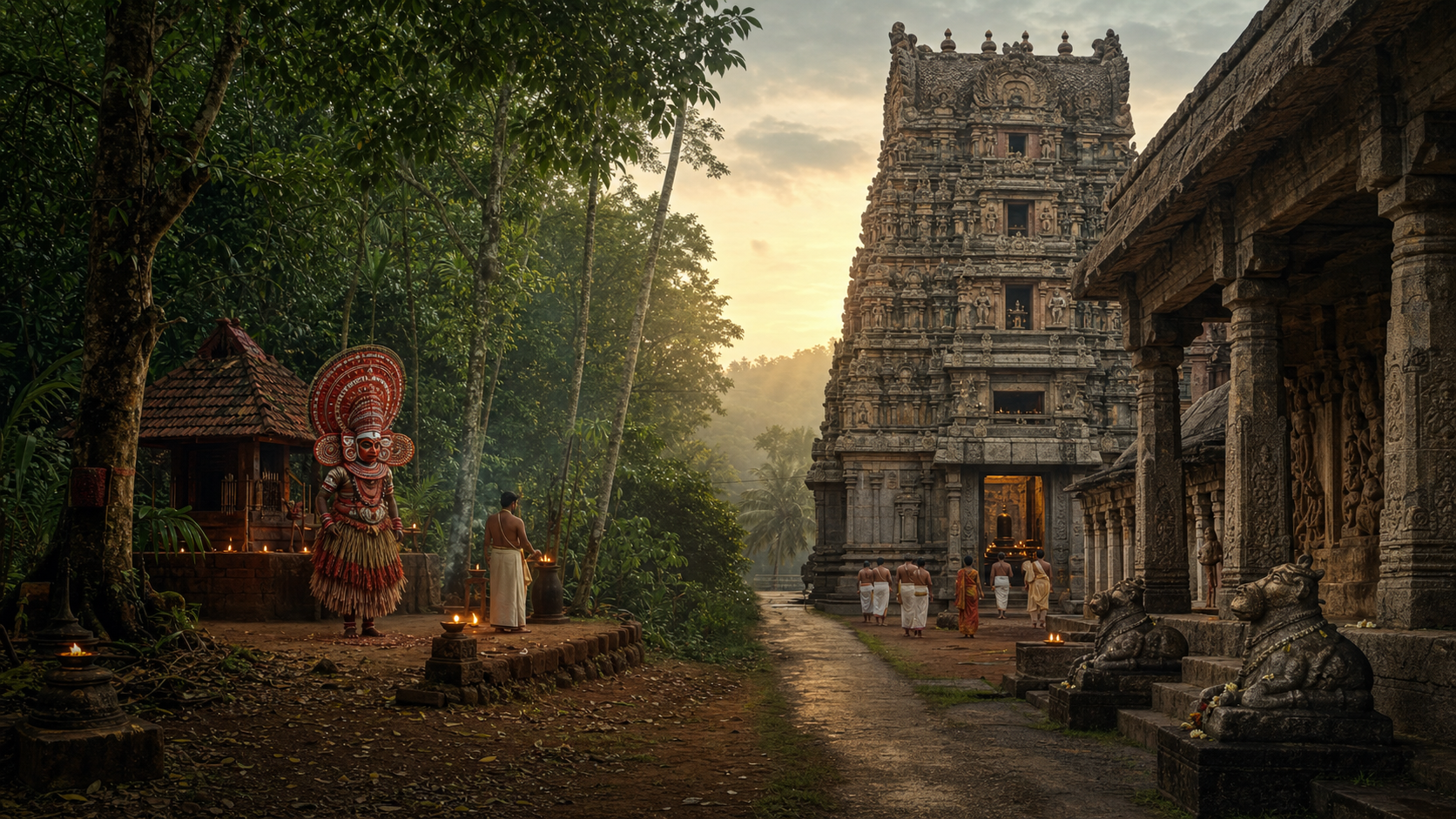
South Indian Shaivism is best understood not as a single ritual system but as a family of traditions shaped by particular landscapes, communities, and institutions. Two contrasting accounts illuminate that range: the Karumakan Theyyam of North Kerala and the Pandya devotional memory associated with Kasi Viswanatha in the Tirunelveli-Tenkasi region.
These sources do not describe equivalent customs, nor do they provide a comprehensive survey of the South. Their value lies in the comparison. One places Shiva-related divinity in a sacred grove and an embodied ritual performance; the other locates Shiva bhakti within temple-centered kingship, family conflict, and public duty. Read together, they show how regional Shaiva traditions connect divine presence with local questions of protection, authority, humility, and belonging.
Two sacred settings, one regional question
The Karumakan account presents a tradition rooted in the ritual world of North Kerala. It reports that Karumakan is revered in local settings as a manifestation associated with Kiratha Shiva, the hunter form through which Shiva appears beyond courtly and conventionally polished settings. The article places this presence within Theyyam and the kavu, or sacred grove, where forest symbolism, community memory, ancestral continuity, and worship converge.
The Pandya account approaches regional Shaivism from another direction. It recounts a devotional story about Varathunga Pandian and Athivirarama Pandian in the later Pandya landscape of Tirunelveli and Tenkasi. The source remembers the two rulers primarily as brothers and makes Varathunga’s devotion to Kasi Viswanatha the moral center of a narrative about pride and reconciliation. It also cautions, in effect, against treating devotional memory as a straightforward chronology: the brothers’ religious significance within the story matters more than a precise reconstruction of their political relationship.
The contrast establishes a useful interpretive question. How does a community recognize Shiva’s presence in its own world? In the Kerala account, that recognition occurs through a deity who enters the grove and assumes a visible ritual body. In the Tamil account, it occurs through the lingam, temple worship, and the submission of royal authority to a sacred order. Neither setting is merely a regional copy of an abstract model. Each gives Shaiva devotion a locally intelligible form.
How Shiva becomes present through body, shrine, and memory
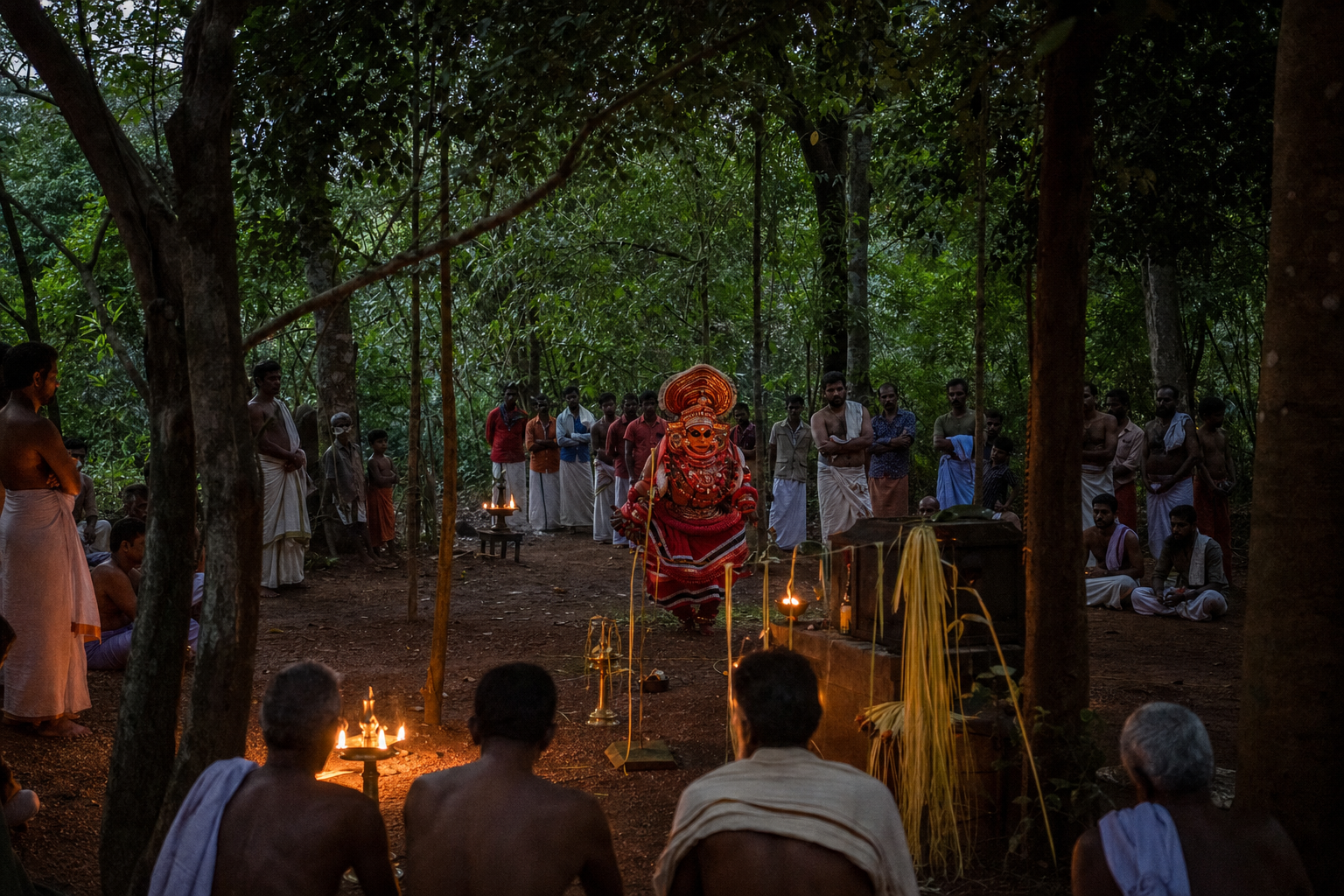
The Karumakan article emphasizes the immediacy of Theyyam. According to its description, the performer does not simply represent a deity for an audience. Preparation, costume, rhythm, invocation, and ritual transformation make the performer the deity’s living presence for the duration of the rite. Devotees can approach, seek blessings, voice grievances, and bring ordinary concerns into a direct sacred encounter.
Karumakan’s reported connection with Kiratha Shiva gives that encounter a distinct theological character. The hunter form places divinity in wilderness and uncertainty, where appearances can test human judgment. The source interprets Karumakan’s darkness not as an absence of auspiciousness but as a sign of mystery, concealed potency, and protective force. Movement, facial presentation, weapons, drumming, lamps, and offerings consequently do more than decorate a performance: they communicate who the deity is and what kind of power the community believes is present.
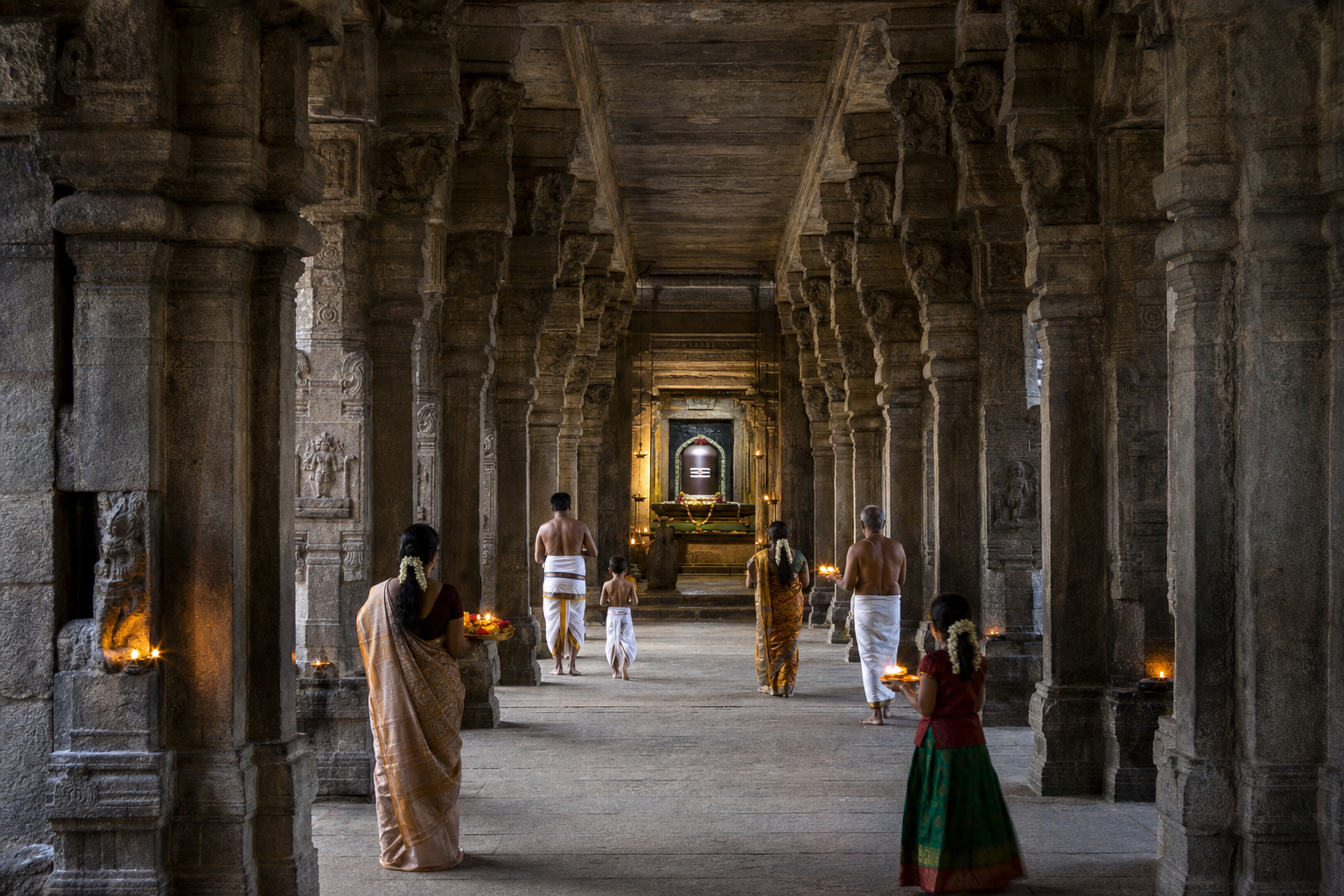
The Pandya narrative locates presence differently. Its devotional focus is Kasi Viswanatha, approached through the stillness of the lingam and acts such as offering water, flowers, lamps, mantra, and silence. The source reports that the Kasi Viswanathar tradition at Tenkasi connected the southern Tamil region with the sanctity associated with Kashi. This does not make Tenkasi a secondary imitation in the article’s telling. It makes pan-Indian Shaiva significance available within Tamil sacred geography.
These are different religious media. Theyyam privileges a time-bound encounter in which sound, movement, and a transformed human body make divinity responsive and visible. Temple devotion privileges continuity: a consecrated center around which worship, patronage, memory, and public life can accumulate. The comparison cautions against defining Shaivism only by texts or permanent icons. It also cautions against isolating performative traditions from the wider theological language with which their practitioners may understand them.
Sacred geography also orders social and political life
In the Karumakan account, the grove is both habitat and boundary. The source describes the kavu as a ritual ecology in which trees, serpents, ancestors, guardians, goddesses, and fierce deities belong to a network of reverence. Its environmental significance follows from relationship rather than from modern administrative language: land is protected because it is inhabited by presence, memory, obligation, and consequence. Karumakan’s hunter and guardian character belongs to that moral geography.
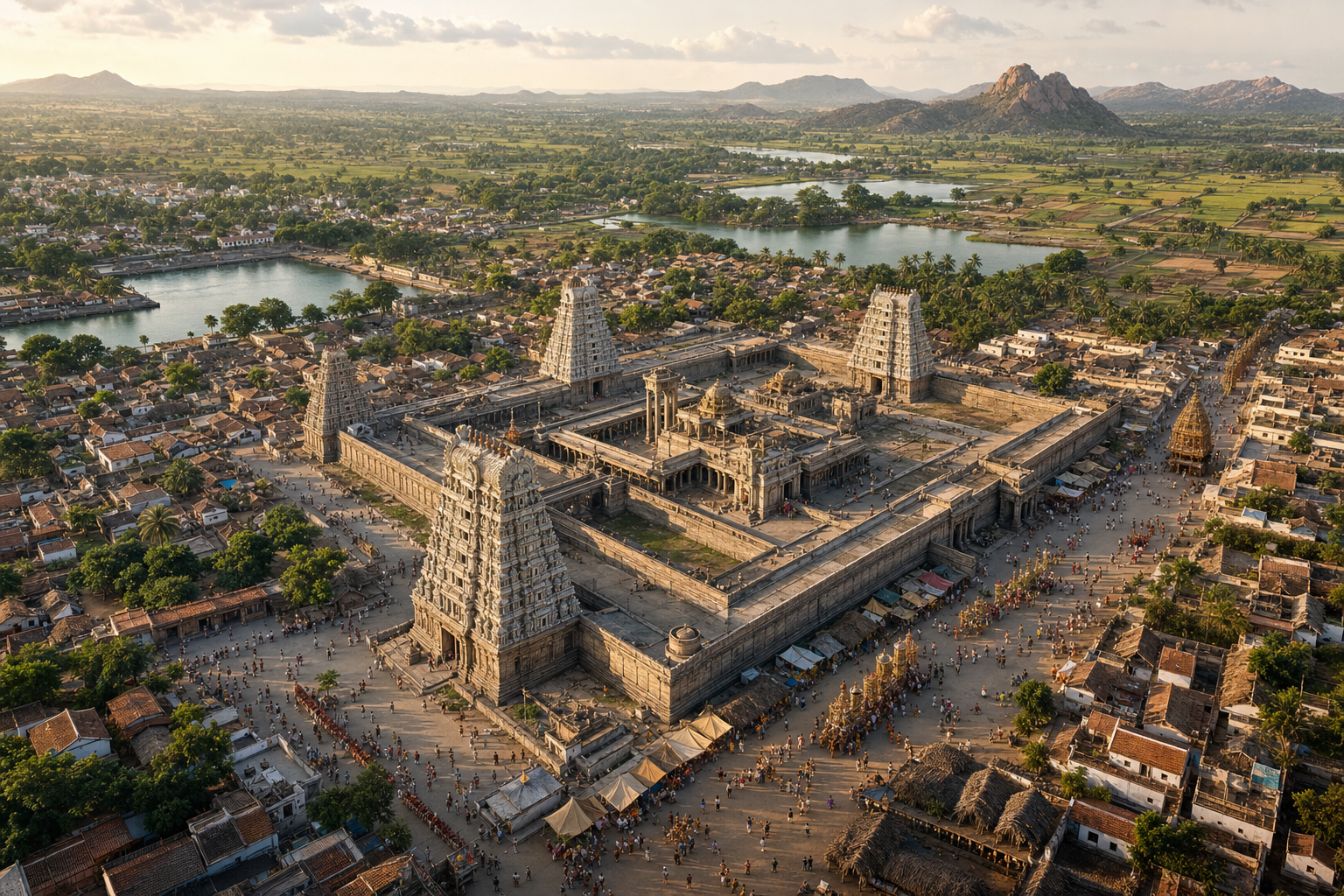
The Tamil account describes the temple as another kind of ordered environment. It reports that South Indian temples could serve not only worship but also memory, endowment, artistic activity, learning, festivals, food distribution, and political legitimacy. In the Pandya story, devotion therefore tests the ruler as well as comforting the devotee. Authority is legitimate only when it recognizes limits beyond personal will.
Both sources consequently connect sacred space with the restraint of power, although the power at issue differs. The Karumakan article notes that many Theyyam performers come from communities historically outside elite ritual hierarchies, yet the transformed performer is approached as the deity by devotees across social positions. The Pandya story reverses status in another register: kings must become humble before Shiva, and political strength must answer to dharma.
These ritual reversals should not be simplified into a claim that hierarchy disappears. The more defensible synthesis is that each tradition creates a sacred setting in which ordinary rank is no longer absolute. The grove authorizes a performer to speak with divine force; the temple reminds the ruler that sovereignty is held in trust. In both cases, Shaiva devotion supplies a language for judging authority rather than merely blessing it.
Key takeaways
- Regional Shaivism can be embodied in a temporary ritual presence or organized around the continuity of a temple and its devotional memory.
- The Karumakan source joins Kiratha Shiva symbolism to Theyyam, sacred groves, protection, and community access to the deity.
- The Pandya source uses devotion to Kasi Viswanatha to examine royal pride, family reconciliation, and the ethical limits of political power.
- Both accounts present sacred geography as morally active: the grove governs relationships with land and guardians, while the temple places kingship within a larger dharmic order.
Reading regional traditions without flattening their differences
The comparison challenges a rigid division between a supposedly local religion and a supposedly classical one. The Karumakan article explicitly situates a highly regional performance within the broader Shaiva imagination of the divine hunter. The Pandya article, meanwhile, shows a Tamil temple tradition drawing meaning from the sacred prestige of Kashi while remaining embedded in southern political and family memory. Regional specificity and wider Hindu reference are intertwined in both accounts, though in different proportions.
Care is still necessary. An embodied Theyyam cannot be reduced to an illustration of a Sanskritic motif, because its force also comes from performers, inherited roles, local speech, grove ecology, and community memory. Likewise, the Pandya narrative cannot be used as an uncomplicated political record, because the source presents it as a devotional lesson whose moral architecture may not follow strict historical sequence. Preserving those distinctions makes comparison more accurate rather than less meaningful.
A productive study of South Indian Shaivism will therefore attend to several kinds of evidence at once: ritual action, oral memory, sacred landscape, temple institutions, political narratives, and theological interpretation. Future documentation can deepen understanding by recording how communities themselves relate these layers, especially as groves, performance lineages, temples, and inherited stories encounter changing social conditions.
References
- DharmaRenaissance Blog — Karumakan Theyyam: Powerful Kiratha Shiva Tradition of North Kerala’s Sacred Forests
- DharmaRenaissance Blog — Sacred Brotherhood of Varathunga and Athivirarama Pandian: A Powerful Lesson