
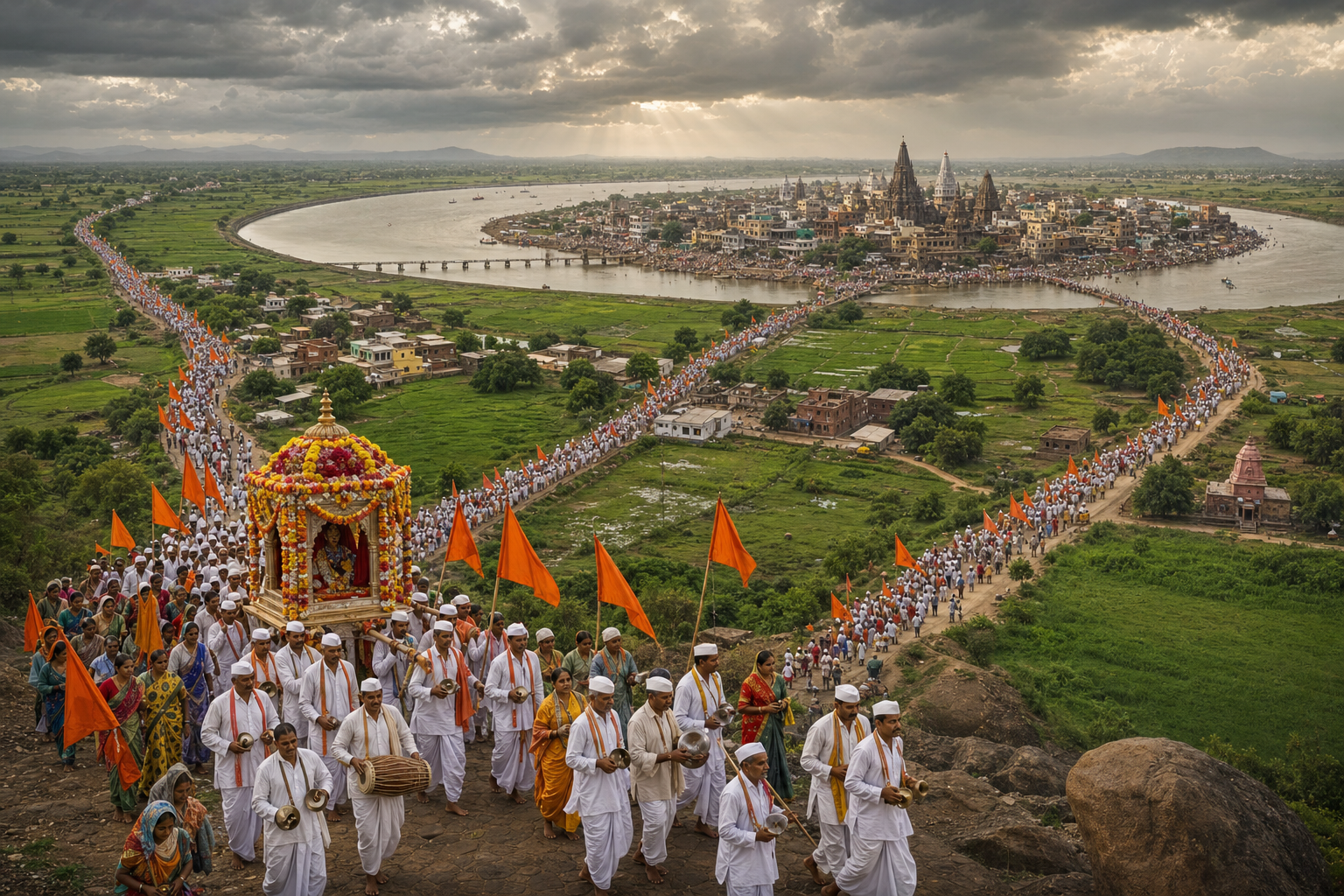
The processions that converge on Pandharpur, or borrow from its Palkhi grammar, are best understood as parts of a devotional network rather than copies of one master procession. The six source accounts connect saint lineages in Maharashtra and Karnataka through pilgrimage, poetry, music, sacred memory, hospitality and service.
This network is neither uniform nor composed of routes of equal scale. Some traditions undertake long foot pilgrimages to Pandharpur; others enter the wider devotional geography through local processions, songs, samadhi sites or a shared relationship with Vittala. Recognizing those differences reveals how regional bhakti traditions remain distinct while sustaining a common sacred center.
Key takeaways
- Pandharpur functions as a devotional hub, but its associated Palkhis differ substantially in route, scale, lineage and form of remembrance.
- Each saint brings a distinctive kind of authority into the network: mystical discipline, literary preservation, philosophical transformation, resistance to exclusion or musical teaching.
- Marathi abhangas and Kannada Haridasa compositions connect communities without making the Warkari and Haridasa traditions identical.
- Dindis, village hospitality, food, sanitation, medical support and route discipline are part of the religious practice, not merely services surrounding it.
- A festival date does not establish a local procession schedule; the 2026 routes and halts described in the sources still require confirmation from responsible organizers.
Pandharpur is a hub with unequal devotional routes
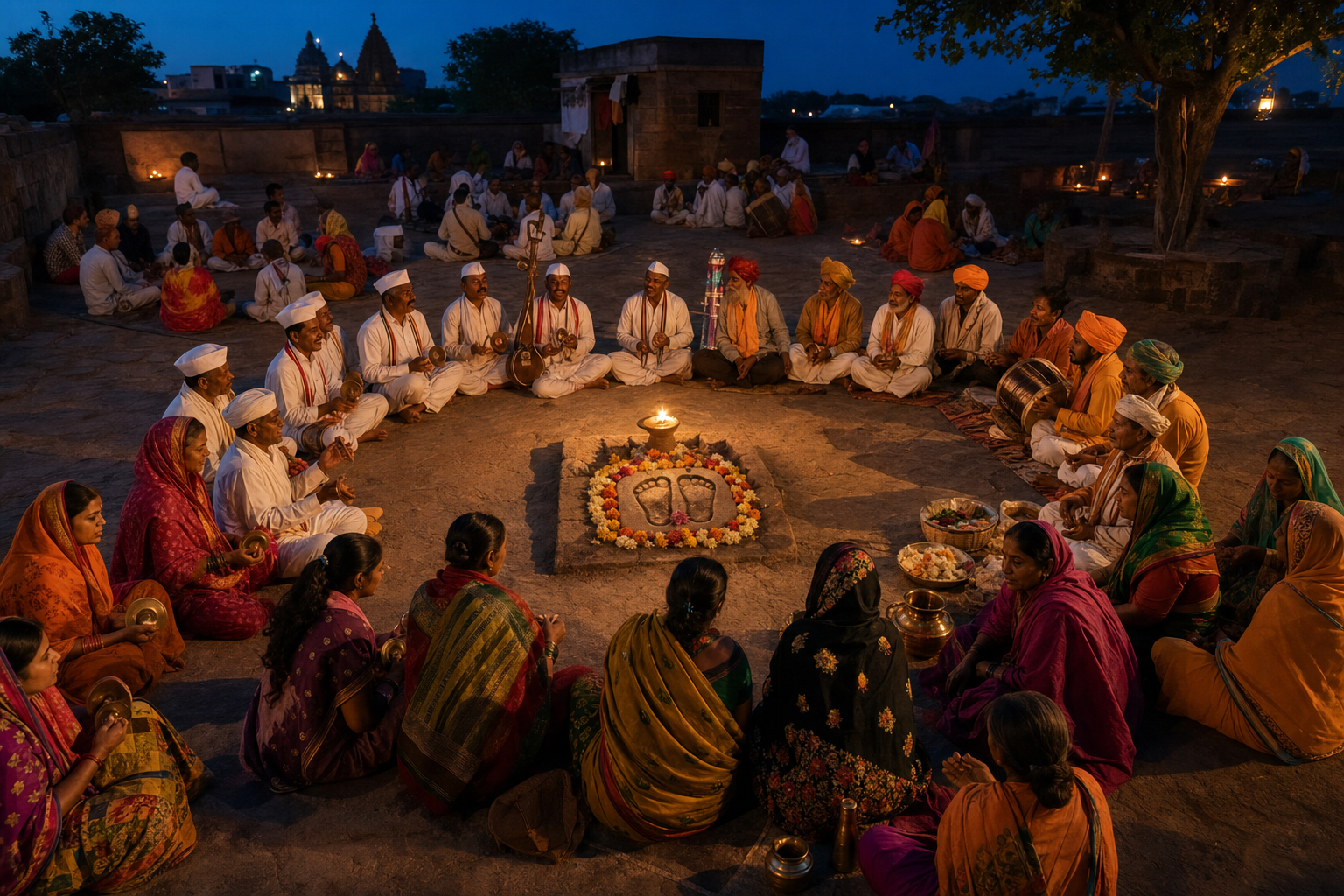
Across the accounts of the Gajanan Maharaj, Jaganade Maharaj, Changdev Maharaj, Kanhopatra and Purandara Dasa traditions, Pandharpur provides the central orientation. Vithoba, also approached as Vitthal, Vittala or Panduranga, gives the network a shared devotional focus, while Rakhumai, the Chandrabhaga river and the memory of generations of saint-poets deepen the sacred geography. The sources describe a Palkhi as a moving locus of saintly presence, often organized around padukas or another symbolic representation. Dindis gather around that center to walk, sing and maintain collective discipline.
The spokes leading toward that hub are not interchangeable. The Gajanan Maharaj account presents the Shegaon-Pandharpur journey as a long Payi Wari connecting the saint’s samadhi tradition in Vidarbha with the Vithoba-centered landscape. The Changdev Maharaj account locates another stream in the Tapi-Purna region and explains its place among the many smaller Palkhis and dindis that accompany the better-known Wari processions.
Other connections depend less on a large autonomous route. The Kanhopatra account explicitly cautions against equating her remembrance with the major long-distance processions from Alandi or Dehu. Her presence is concentrated in song, hagiographic memory, Pandharpur and a samadhi traditionally located within the Vithoba temple precincts. The Kanakadasa account similarly distinguishes locally organized Palkhis and commemorations from a single statewide route comparable to the principal Wari processions. The network therefore has strong and light connections: roads walked for weeks, local ceremonial circuits, musical repertoires, temple sites and stories carried between communities.
Saint lineages contribute different forms of authority
The Palkhi does not carry a generic idea of sainthood. Each source associates its saint with a particular spiritual inheritance and a corresponding way of maintaining the wider network. The final column below is an interpretive synthesis of the function emphasized by each account.
| Saint tradition | Distinctive memory reported by the source | Function within the network |
|---|---|---|
| Gajanan Maharaj | The Shegaon-centered tradition presents devotion, service and knowledge as mutually supporting disciplines. | It connects a Vidarbha spiritual center to Pandharpur through an organized foot pilgrimage. |
| Santaji Jagnade Maharaj | The account remembers him as a close companion of Tukaram and associates him with preserving Tukaram’s abhangas. | It represents custodial seva: devotional inspiration survives because communities record, remember and transmit it. |
| Changdev Maharaj | Warkari hagiography portrays a powerful yogi whose encounter with Dnyaneshwar, his siblings and especially Muktabai redirects spiritual pride toward humility. | It brings yogic and philosophical traditions into a bhakti network governed by surrender rather than display. |
| Kanhopatra | Her largely hagiographic and oral memory centers on a woman resisting inherited stigma and coercion by claiming refuge in Vithoba. | Her songs and sacred location make dignity, agency and access to the divine part of Pandharpur’s moral geography. |
| Kanakadasa | The Karnataka Haridasa saint is associated with Kannada composition, Krishna and Adikeshava devotion, and criticism of arrogance and caste pride. | Local processions and musical remembrance create a comparative bridge to the Warkari model without implying an identical route. |
| Purandara Dasa | The source links the Haridasa composer, his Purandara Vittala signature and his remembered role in Carnatic music pedagogy. | Shared devotion to Vittala gives a Kannada musical lineage a direct point of entry into the Pandharpur landscape. |
Seen together, these lineages explain why the network can expand without erasing difference. Jagnade’s remembered work of preservation is not the same as Gajanan Maharaj’s integrated discipline, Kanhopatra’s claim to spiritual dignity or Changdev’s passage from yogic accomplishment to humility. The common destination does not flatten those stories; it gives them a public setting in which their differences can be heard.
Songs and shared divine names cross regional boundaries
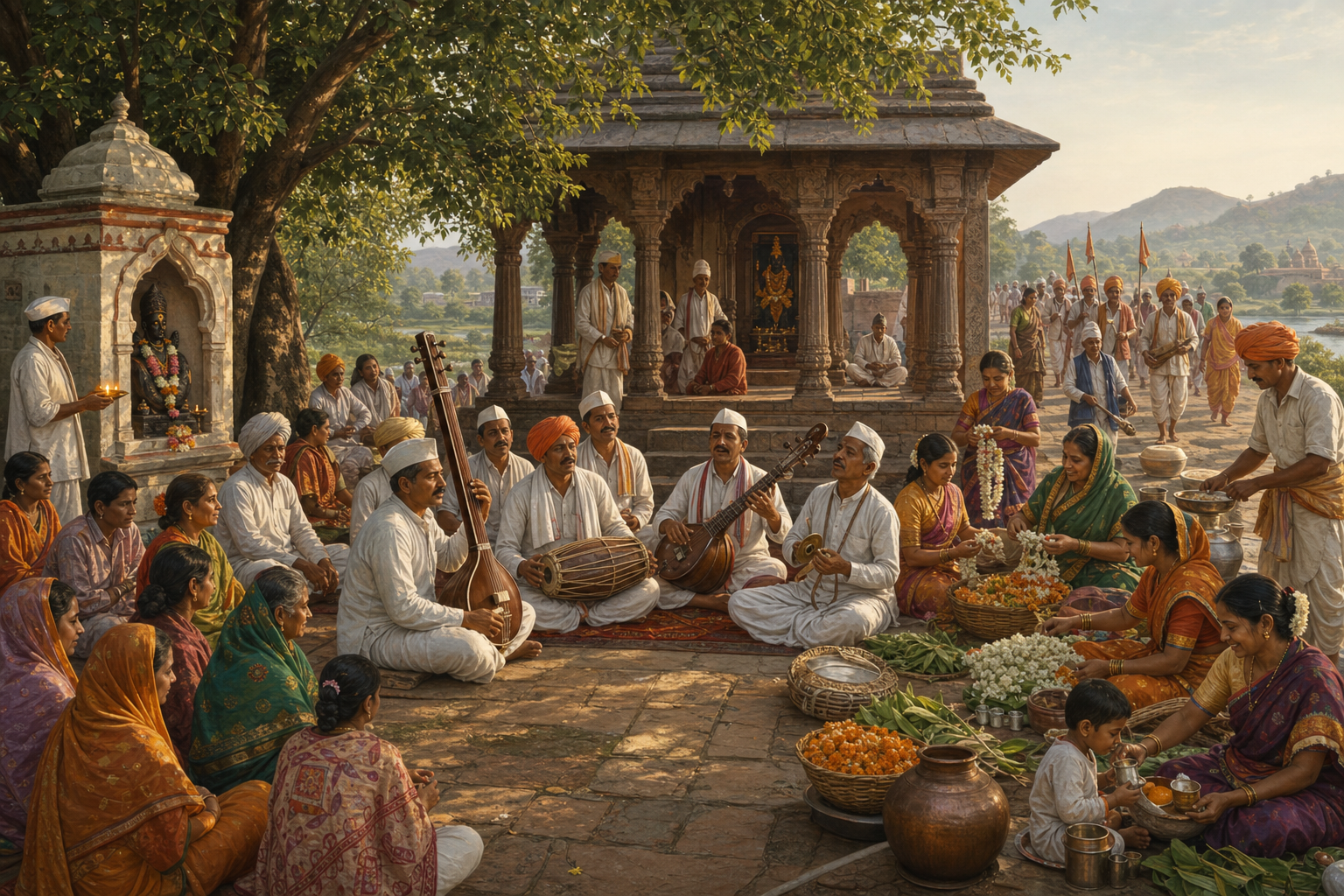
The Marathi and Kannada streams meet most naturally through sound. The Warkari sources describe abhangas, kirtan, cymbals, mridang and repeated remembrance of Vithoba as practices that coordinate movement and attention. The Haridasa accounts emphasize Kannada devaranamas, Dasa Sahitya and musical instruction. Both make demanding religious ideas available through vernacular language and repeatable forms, although their literary histories and theological settings remain distinct.
Purandara Dasa provides the clearest bridge in the source set. His devotional signature, Purandara Vittala, invokes the same divine name that draws pilgrims toward Pandharpur, while his Karnataka identity and Carnatic legacy remain visible. The source consequently presents his Palkhi as more than the ceremonial inclusion of an outside figure: it reflects a devotional relationship already carried by the name of Vittala.
Kanakadasa illustrates a more comparative connection. His account situates him in the Haridasa world of Kannada literature, Dvaita Vedanta, Krishna devotion and places such as Kaginele and Udupi. It compares that world with the Warkari combination of Vithoba, abhangas, dindis and pilgrimage. The similarity lies in public pedagogy, congregational song, humility and accessible language; it does not establish that every Kanakadasa procession travels to Pandharpur.
Santaji Jagnade’s remembered preservation of Tukaram’s compositions reveals the complementary infrastructure behind this musical circulation. A song must be composed, but it must also be retained, copied or remembered, taught and performed. The procession then returns it to collective life. Kanhopatra’s quieter mode of remembrance makes the same point from another direction: a saint can remain integral to the network through poetry and sacred place even without a vast independent route.
Discipline and service turn routes into public institutions
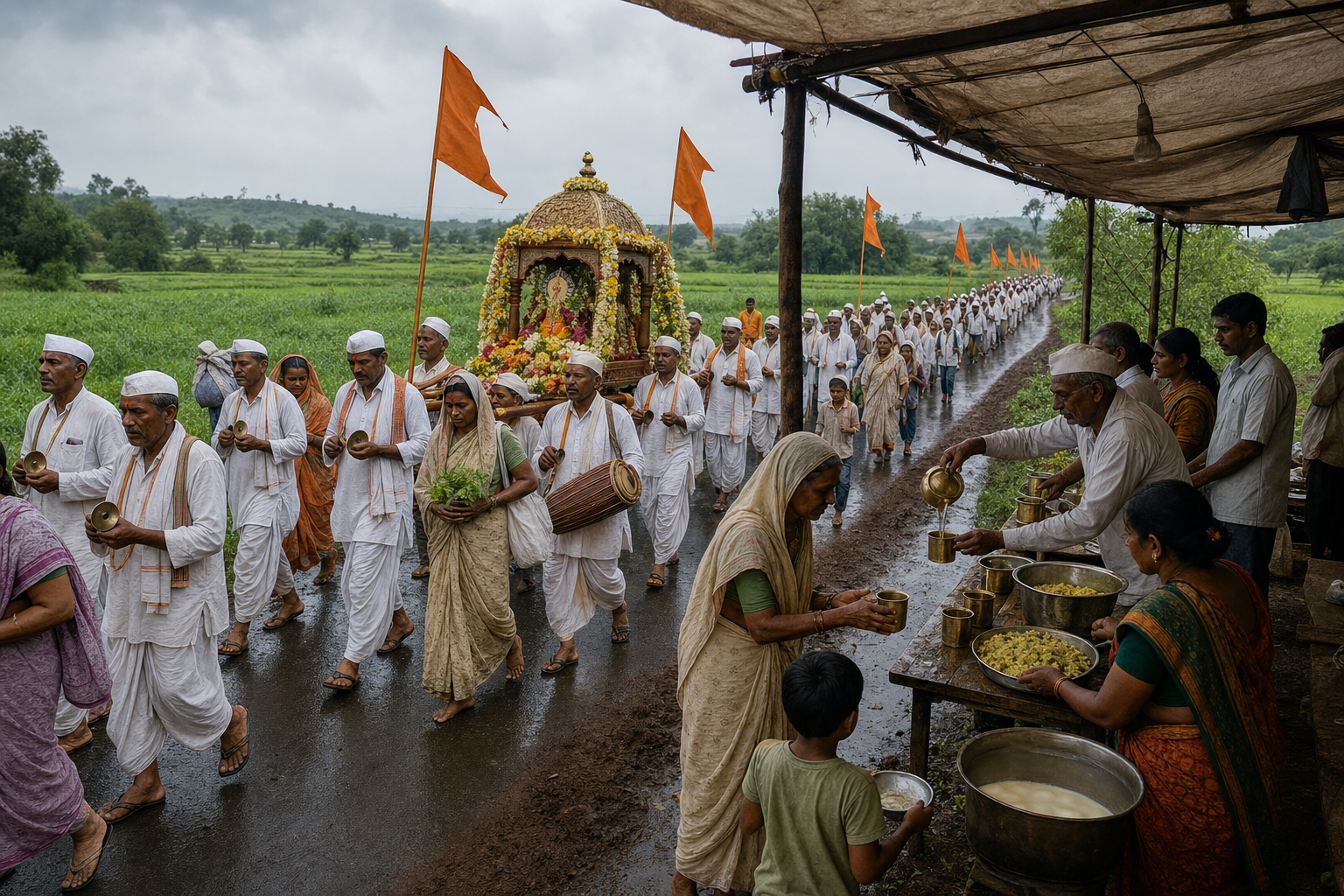
The sources repeatedly resist treating devotion as emotion alone. Their accounts of dindis include internal leadership, timings, flags, musical groups, rest patterns and expected conduct. The journey also depends on food, water, sanitation, shelter, medical readiness, traffic coordination and cooperation with settlements along the route. These practical arrangements form a distributed institution: the Palkhi can move because pilgrims, host communities, volunteers and public authorities perform different but connected responsibilities.
This organization is also an ethical test. Shared walking, food, fatigue and worship can reduce visible social distance and make humility tangible. Yet the sources do not justify claiming that pilgrimage abolishes inequality. The Gajanan Maharaj account expressly notes that social realities do not disappear, while the Kanakadasa and Kanhopatra accounts place caste pride, inherited stigma and gendered vulnerability near the center of their moral narratives. Equality in the Wari is therefore better understood as a devotional standard repeatedly enacted and tested, not an automatically completed social fact.
Changdev’s story adds another dimension to that standard. The hagiographic encounter with Dnyaneshwar, Nivruttinath, Sopan and Muktabai contrasts spiritual display with receptive humility. Read beside the dindi system, the lesson becomes institutional as well as personal: even extraordinary status must submit to a shared discipline. Kanhopatra’s story tests the institution from the opposite side by asking whether the devotional community recognizes the person whom society has made vulnerable. Together, the accounts show that a bhakti network is judged not only by how many people it gathers, but also by the conduct it cultivates.
What the 2026 labels can and cannot establish
Three of the source articles report 25 July 2026 as Ashadhi Ekadashi: the accounts devoted to Purandara Dasa, Changdev Maharaj and Kanhopatra. The Changdev article additionally reports departures of the major Tukaram and Dnyaneshwar Palkhis from Dehu and Alandi on 7 and 8 July respectively. These are source-reported dates, not independently verified schedules in this synthesis.
The sources are more cautious about the smaller or locally organized observances. The Gajanan Maharaj and Jaganade Maharaj accounts direct participants to institutional and local notices for routes and halts. The Changdev and Kanhopatra accounts likewise distinguish their commemorations from the fully publicized schedules of the largest Palkhis. The Kanakadasa article discusses a Jayanthi date and possible local events but warns against treating either as proof of one statewide Palkhi route. The practical conclusion is straightforward: a calendar anchor identifies a devotional season, whereas an organizer’s current notice establishes where and how a particular group will move.
Future documentation can make this regional network easier to understand without standardizing it. Reliable route notices, accessible histories of participating lineages, records of Marathi and Kannada repertoires, and transparent information about halts, health support and sanitation would preserve both the devotional inheritance and the local differences on which it depends.
References
- DharmaRenaissance Blog — Sant Gajanan Maharaj Palkhi 2026: Powerful Guide to the Shegaon-Pandharpur Wari
- DharmaRenaissance Blog — Sant Jaganade Maharaj Palkhi 2026: Powerful Warkari Journey of Bhakti and Unity
- DharmaRenaissance Blog — Sant Kanakadasa Palkhi 2026: Powerful Guide to Bhakti, Unity and Heritage
- DharmaRenaissance Blog — Purandara Dasa Palkhi 2026: Powerful Wari Journey of Unity and Bhakti
- DharmaRenaissance Blog — Sant Changdev Maharaj Palkhi 2026: A Powerful Wari Lesson in Humility and Bhakti
- DharmaRenaissance Blog — Sant Kanhopatra Palkhi 2026: Powerful Warkari Legacy of Courage and Bhakti