
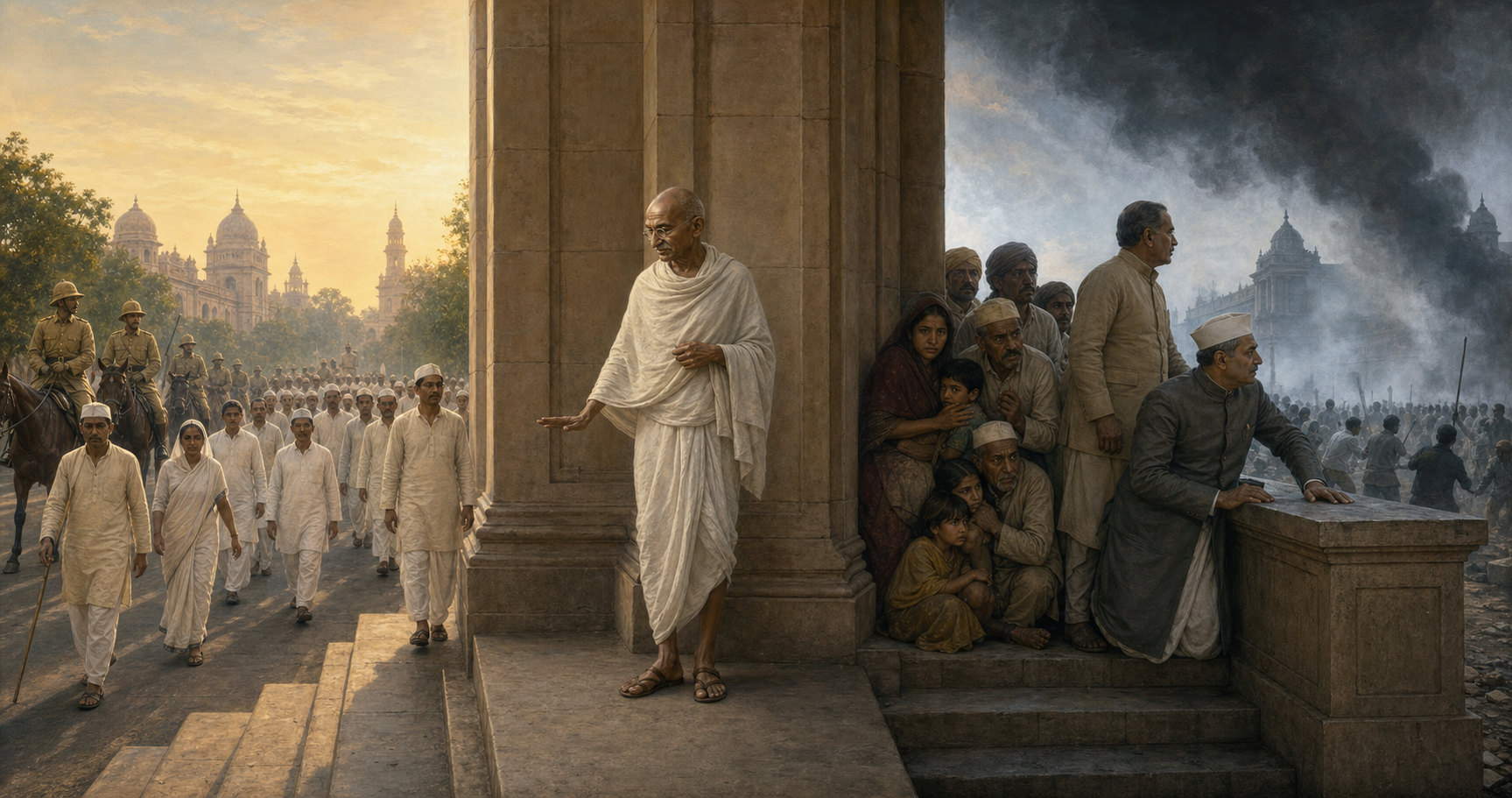
Gandhian ahimsa becomes hardest to assess when it crosses from a person’s refusal to injure into a political authority’s duty to protect. Distinguishing moral witness, mass resistance, and government responsibility reveals why non-violence could be a formidable anti-colonial method without automatically supplying a complete doctrine of statecraft.
The supplied record contains one interpretive article rather than several independent reports. Its historical particulars therefore remain source-reported, not corroborated here. The useful synthesis lies in testing its examples against a broader question: how can a freedom movement retain moral discipline while preparing institutions capable of preserving liberty, civic equality, and public order?
Moral witness, mass resistance, and state duty are different tests
Ahimsa can operate on at least three political levels. As personal ethics, it disciplines the individual against hatred and injury. As collective action, it can organize refusal, sacrifice, and public pressure. As a rule for government, however, it must answer an additional question: what happens when innocent people face coercion that moral appeal does not stop?
The DharmaRenaissance article credits Gandhi’s language of sacrifice, repentance, and brotherhood with helping to mobilize millions. That achievement belongs primarily to the second level. Nonviolent mass action is not mere passivity; it can impose political and moral costs through organized non-cooperation. Yet success as a mobilizing discipline does not by itself establish that unconditional non-resistance is suitable for national defence.
The article illustrates this change of scale through Gandhi’s reported writing in Harijan in 1940. According to its account, Gandhi urged Britain to meet Nazi Germany with nonviolent moral courage rather than armed defence. Admirers can read this as consistency under extreme pressure, while critics can see an individual ethic being extended to people whose lives a state is obligated to protect. The example does not settle every question about Gandhi’s thought, but it exposes the category problem clearly.
A government possesses force without being required to glorify or routinely use it. Protective capacity can support deterrence, law, and negotiation. Conversely, renouncing force does not remove coercive actors from the field. A responsible assessment of ahimsa must therefore ask who bears the risk when resistance fails, whether those people consented to that risk, and what lawful alternatives remain available.
Colonial asymmetry made unity both necessary and insufficient
Under colonial rule, moral politics unfolded within an unequal contest. The imperial state retained organized authority and coercive capacity, while the nationalist movement had to create legitimacy and solidarity among diverse constituencies. In such a setting, Gandhi’s emphasis on Hindu-Muslim brotherhood could serve simultaneously as an ethical commitment and as the connective tissue of a broad anti-colonial coalition.
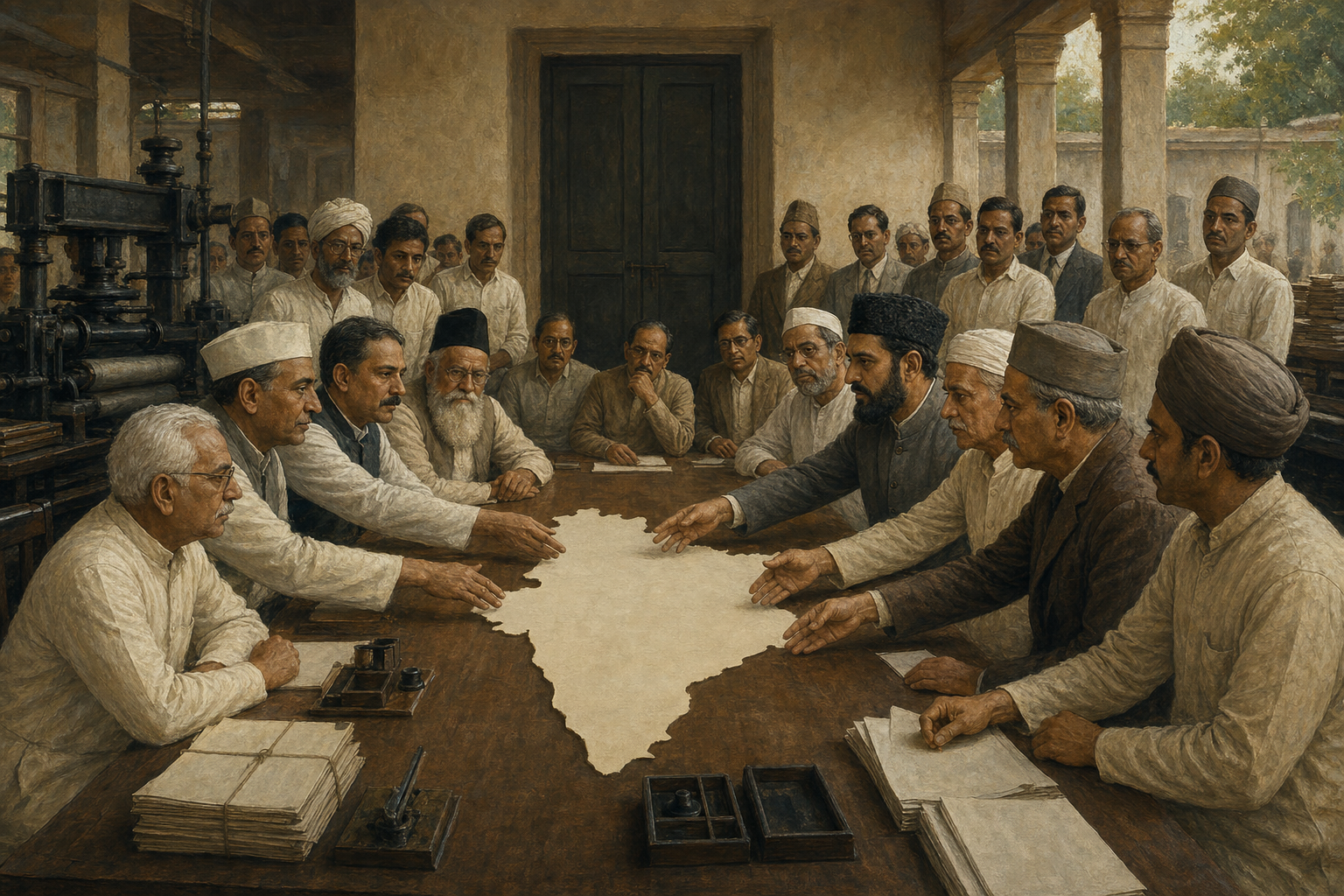
The source article nevertheless stresses that Indian politics contained rival projects, including British imperial interests, Congress nationalism, revolutionary nationalism, constitutional liberalism, Hindu consolidation, pan-Islamic sentiment, Marxist approaches, regional ambitions, and Muslim separatist politics. This catalogue is presented by one interpretive source, but it highlights a sound analytical distinction: agreement on ending foreign rule does not necessarily imply agreement on who will exercise sovereignty afterward or under what constitutional terms.
Brotherhood can make cooperation imaginable; it cannot determine the distribution of authority, guarantee equal citizenship, or resolve conflicting claims to nationhood. Those tasks require institutions, reciprocal obligations, enforceable rights, and accepted procedures for settling disputes. When unity remains principally a moral appeal, actors with clearer territorial or communal objectives may enter negotiations with a structural advantage.
There is also a general mechanism of colonial statecraft to consider: divisions among those seeking freedom can preserve an imperial power’s leverage. This is contextual analysis rather than a specific episode established by the supplied article. It means that the nationalist leader faces two dangers at once. Ignoring internal divisions can leave the future state unprepared, while treating every difference as betrayal can deepen the fractures on which colonial power depends.
What the reported 1925 press dispute can and cannot prove
The article uses a reported 1925 controversy involving the Muslim Outlook of Lahore, the Tanzeem of Amritsar, and an account in The People dated 18 October 1925. It says the dispute considered whether a post-British order would constitute Muslim rule or an Islamic state in which Hindus might participate. It also reports that one Muslim Outlook passage contemplated Muslims taking power after British withdrawal, potentially with Afghan assistance.
These particulars have not been independently checked against the periodicals because they reach the reader through the supplied secondary article. Even if the cited passages are accurate, their evidentiary value must be kept proportional. A polemical editorial can establish that a political idea was being articulated; it cannot, without supporting evidence, demonstrate how representative that idea was, what organizational capacity stood behind it, or how an entire religious community understood the future state.
The source itself cautions against turning the reported language into collective blame. That caution is essential. The relevant historical question is not whether a community can be judged through its most severe publication, but whether nationalist leadership adequately recognized organized currents whose constitutional aims differed from an undifferentiated ideal of fraternity.
This distinction also improves the critique of Gandhi. The strongest case is not that trust or reconciliation was inherently naive. It is that reconciliation needs a realistic account of the other party’s objectives, incentives, and ability to honor a settlement. Evidence of ideological divergence should trigger constitutional clarification and political preparation, not communal generalization.
A dharmic approach joins restraint to protective judgment
The source describes Gandhi’s limitation as a form of state-blindness: insufficient attention to institutions, incentives, coercive capacity, and competing collective interests. That criticism is more useful than inflammatory accusations about personal disloyalty because it can be evaluated as a claim about political design. A virtuous leader may still misjudge threats, rely on one-sided concessions, or fail to convert goodwill into durable rules.
Against both absolute non-resistance and reckless militancy, the article invokes a dharmic vocabulary that includes rajadharma, kshatra, danda, samvada, and loka-sangraha. Its central contention is that compassion belongs within a wider structure of duty, order, dialogue, social welfare, and the capacity to restrain aggression. Jain and Buddhist emphases on discipline and wisdom likewise complicate any attempt to equate ahimsa with helplessness.
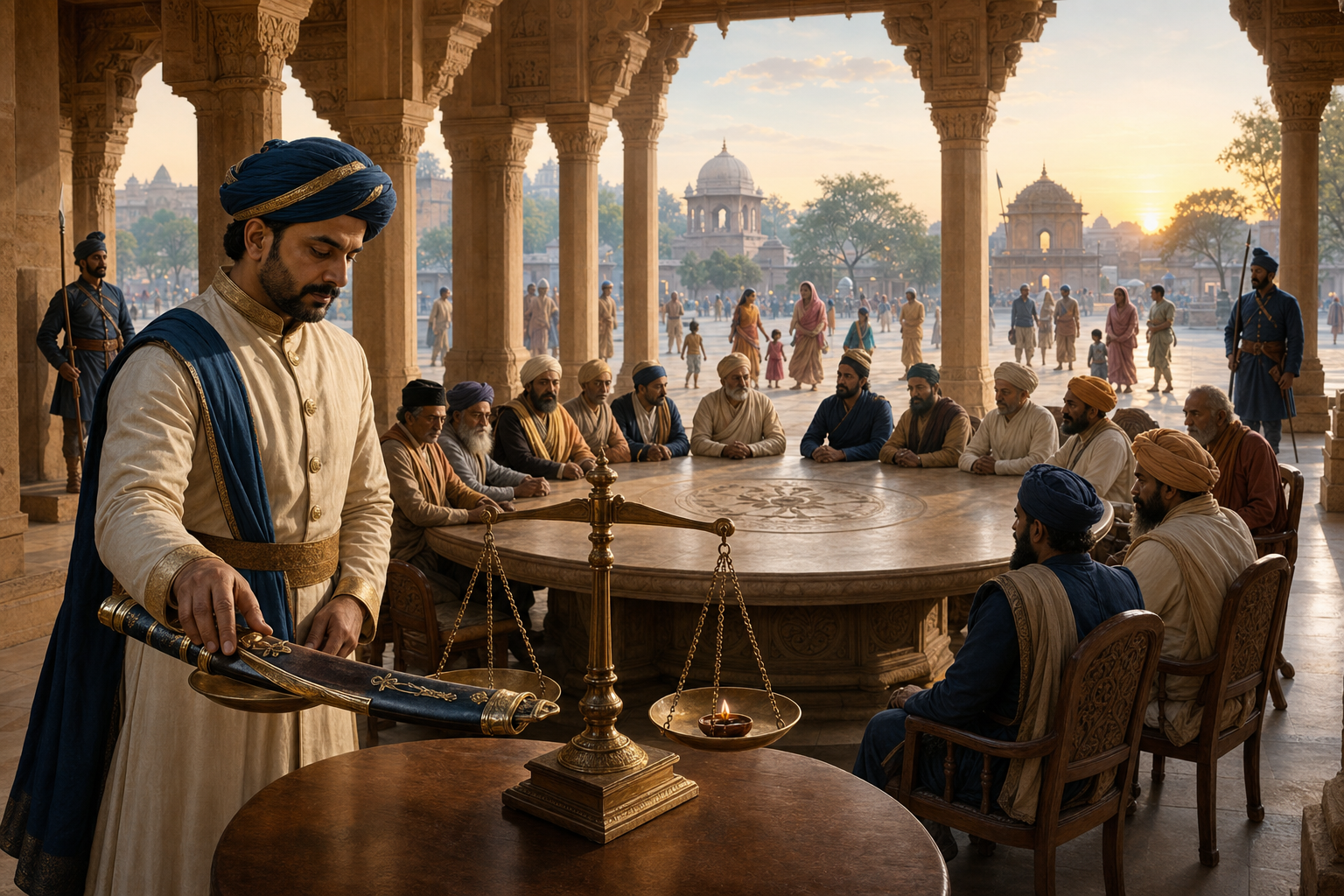
This framework does not offer moral permission for unlimited force. It instead makes political restraint accountable to the people affected by it. Protective action should possess legitimate authority, answer a genuine threat, use no more coercion than required, and remain subject to law and public judgment. Nonviolent alternatives deserve serious preference, but the decision cannot ignore foreseeable harm to those whom the state exists to defend.
The resulting synthesis is neither a rejection of Gandhi nor an elevation of power into the highest good. Gandhian discipline can restrain vengeance, widen participation, and preserve the moral purpose of politics. Statecraft contributes institutional memory, credible protection, and an unsentimental reading of rival objectives. Each corrects a danger in the other: power without ethical limits becomes domination, while ethical aspiration without protective capacity can transfer the cost of purity to the vulnerable.
Key takeaways
- Personal ahimsa, organized civil resistance, and a state’s duty of protection are related but distinct political questions.
- Gandhi’s unifying language could strengthen anti-colonial mobilization without resolving disagreements over sovereignty or the constitutional order that would follow.
- Brotherhood becomes durable politically when it is expressed through equal citizenship, reciprocal duties, enforceable rights, and shared procedures.
- The reported 1925 editorials are evidence of a particular ideological current, not sufficient evidence for conclusions about an entire community.
- A balanced statecraft preserves nonviolence as a strong presumption while maintaining lawful, restrained, and accountable means of protection.
The continuing task is to build public institutions in which moral courage shapes the use of power without displacing responsibility for security. That standard offers a more productive legacy for Gandhian debate than either sanctification or dismissal.

References
- DharmaRenaissance Blog — Gandhi, Ahimsa, and Statecraft: A Hard Lesson in Idealism, Power, and Unity