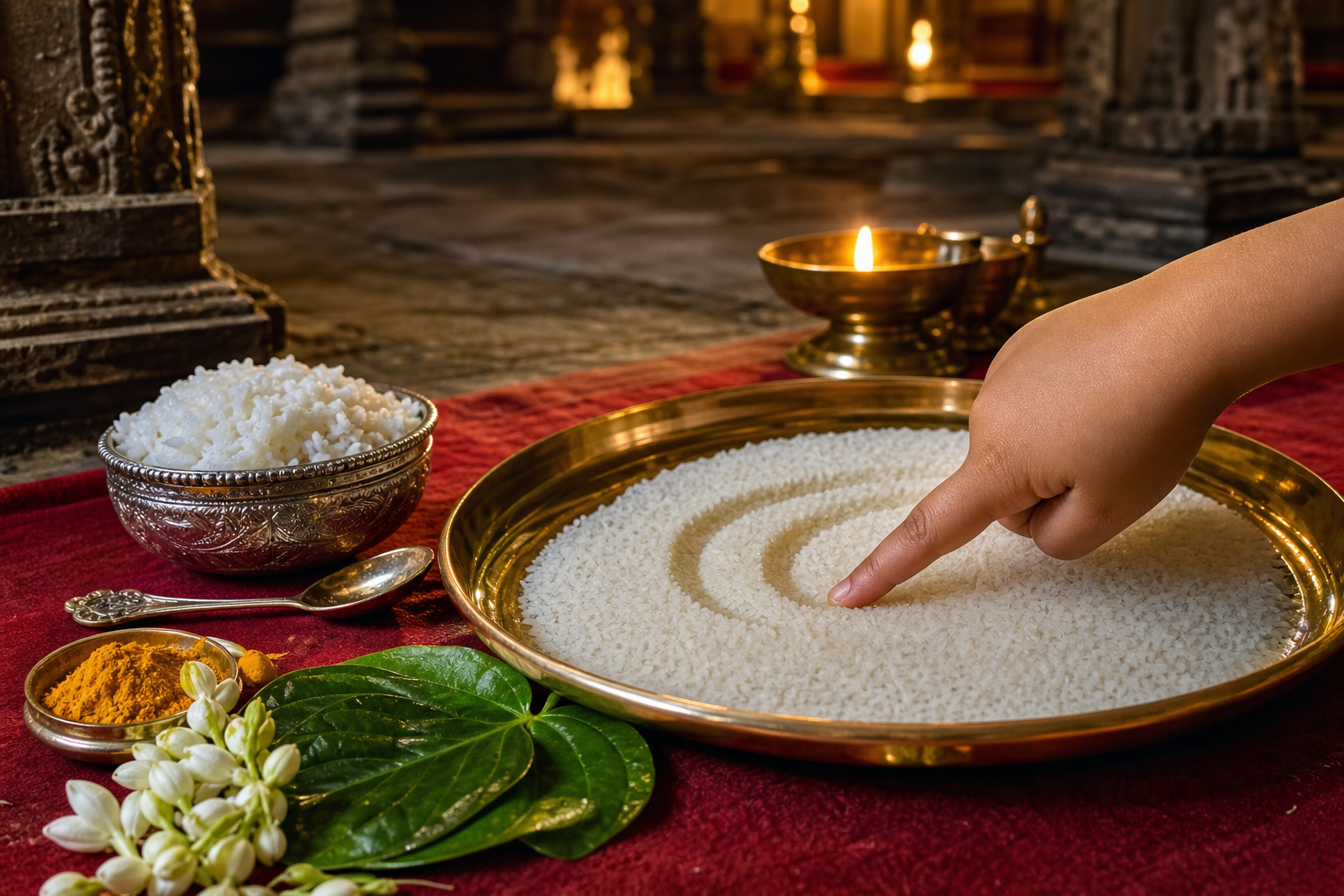
A DharmaRenaissance Blog report says Tirumala Tirupati Devasthanams (TTD) was scheduled to introduce Akshara Govindam and Annaprasana services at Sri Vakulamata Temple in Tirupati from 3 July 2026. The plan brings a child’s ceremonial entry into learning and first ritual feeding into one temple setting.
The two rites mark different stages of childhood, but their placement together creates a coherent theme: nourishment of the body and cultivation of the mind under a maternal sacred presence. The available source explains that meaning in detail, although it does not independently confirm whether the services became operational after the intended launch date.
Two distinct childhood rites in one sacred setting
The report describes Akshara Govindam as a service intended for children aged 3 to 5 years. It places the customary beginning of letters, sounds and guided study within the devotional world of Sri Venkateswara Swamy and Sri Vakulamata. The ceremony is presented as a sacred beginning to education, not as a substitute for formal schooling.
Annaprasana serves a different purpose. It marks a child’s first ceremonial reception of solid food and expresses the idea that nourishment is more than consumption. In the interpretation offered by the source, food is connected with life, purity, gratitude and divine offering.
The report presents the services together but does not establish that they form one combined ceremony or must be performed during the same visit. Their meaningful connection is thematic: one acknowledges the food that sustains a growing child, while the other sanctifies the learning that will shape the child’s understanding and conduct.
Why the Vakulamata setting carries special meaning
According to the report, Sri Vakulamata is revered in the Tirupati tradition as the maternal figure associated with Sri Venkateswara Swamy. That association gives the chosen venue more than geographic convenience. It places two early-life rites in a setting identified with care, nourishment and guidance.
The symbolism works at several levels. A mother or caregiver is commonly a child’s first source of food, security, speech and instruction. A temple connected with a maternal deity can therefore hold both Annaprasana and Akshara Govindam without erasing their differences. Feeding concerns the child’s embodied growth; the beginning of letters concerns attention, memory and participation in a knowledge tradition.
The setting also turns an intimate family milestone into a shared religious occasion. Parents, elders and priests become participants in a ceremony that locates individual development within family memory, community practice and devotion.
What food and letters signify in the two ceremonies
Akshara Govindam: learning as a responsibility
The source notes that akshara can refer to a letter or syllable, the basic element through which literacy unfolds. It can also carry a deeper suggestion of that which does not perish. Within the ceremony, this layered meaning allows a child’s first writing to represent entry into language, inherited memory and enduring knowledge.
This understanding broadens the purpose of education beyond grades, competition or employment. The ritual framing asks families to associate learning with humility, discipline, truthfulness, compassion and service. A guided hand moving across rice, a slate or another writing surface becomes a small act carrying a larger expectation: knowledge should refine conduct as well as develop ability.
Annaprasana: nourishment received with gratitude
Annaprasana places a similar ethical frame around eating. The first ceremonial feeding recognizes that food reaches a family through interdependent sources, including the natural world and human labour. The rite consequently begins the child’s relationship with solid food through blessing and gratitude rather than treating nourishment as an ordinary possession.
Read side by side, the ceremonies express a compact philosophy of upbringing. A child requires material care and intellectual formation, but both are understood as gifts carrying responsibilities. Food supports life; education should help that life be directed wisely.
What families still need to verify with TTD
The reported venue, intended launch date and 3-to-5-year age range for Akshara Govindam are the principal planning details supplied by the article. It does not provide post-launch confirmation, an Annaprasana age rule, service timings, fees, capacity limits or a confirmed booking channel.
The source therefore advises families to consult official TTD communications for registration procedures, required documents, offerings, eligibility rules, queue arrangements and temple-specific instructions. The reported age band should be understood as applying to Akshara Govindam; it should not automatically be transferred to Annaprasana without official guidance.
Implementation will also shape the experience. The report identifies age-sensitive scheduling, hygiene, trained priests, clear directions for parents, crowd management and a calm environment as important considerations. These are presented as conditions for a child-friendly service, not as verified features already in operation.
Key takeaways
- TTD was reported to have scheduled Akshara Govindam and Annaprasana services at Sri Vakulamata Temple from 3 July 2026.
- Akshara Govindam was described as intended for children aged 3 to 5; the source supplied no corresponding Annaprasana age rule.
- The ceremonies remain distinct rites, connected by a shared emphasis on nurturing the child’s body, mind and character.
- Sri Vakulamata’s maternal association gives the venue a symbolic relationship to both nourishment and early guidance.
- Operational status, registration, timings, documents and other practical rules require confirmation through official TTD information.
If the initiative is sustained with clear procedures and gentle, child-centred administration, its lasting value will extend beyond the ceremonial day. It can help families treat the beginning of eating and learning as foundations for gratitude, discipline and responsible growth.