

The Bhagavad Gita reaches modern readers through more than translation. Its transmission depends on preserving the relationship between spiritual anthropology, moral responsibility, disciplined action, and devotion while making those ideas intelligible in new languages, formats, and communities.
Two accounts illuminate complementary parts of that work. One follows Krishna’s argument from the imperishable self to Arjuna’s concrete duty; the other describes how commentary, publishing, online study, and respect across Vaishnava traditions can carry that argument into contemporary life. Together, they show why access without context can flatten the Gita, while fidelity without effective teaching can leave its wisdom unheard.
The teaching moves from identity to responsibility
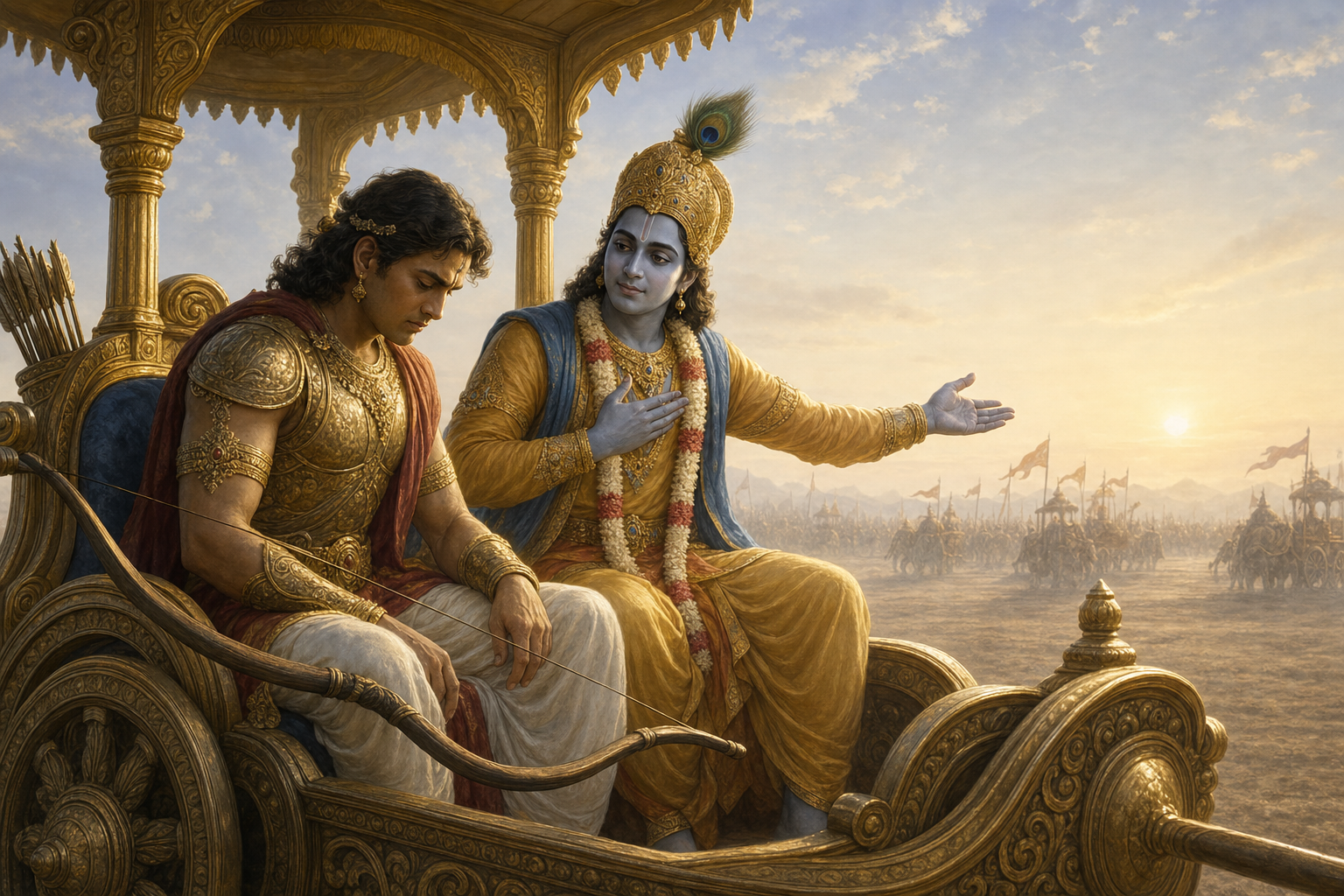
The discussion of Bhagavad Gita 2.28 onward emphasizes the sequence of Krishna’s instruction. Verses 2.28-2.30 place embodied life within a larger horizon: beings are described as unmanifest before birth and after death, while the self cannot be destroyed with the body. The self is also presented as wondrous, a reality that may remain difficult to understand even after it has been heard and discussed.
This sequence matters pedagogically. Krishna does not begin by issuing an isolated command to act. He first challenges the identity from which Arjuna is interpreting loss. If the person is reduced to the temporary body, death appears to erase the whole being and emotion can become the final judge of action. Recognition of the atman does not make suffering trivial; it prevents grief from becoming the only available account of reality.
From verse 2.31, according to the same source, the argument turns toward Arjuna’s particular dharma as a kshatriya. Metaphysical understanding therefore leads back into responsibility rather than away from it. Dharma in this setting is not a private preference or an excuse for aggression. It concerns a warrior-prince facing a breakdown of rightful order, with responsibilities that affect allies, dependents, and the wider cause he represents.
The progression offers a useful principle for modern transmission: teachings about the self, detachment, and mortality should not be separated from teachings about conduct. Without the first, duty can harden into mere social conformity. Without the second, spirituality can become a refined justification for withdrawal.
Context prevents courage from becoming a slogan
The battlefield setting creates a persistent interpretive danger. Verses about fighting can be detached from Arjuna’s crisis and treated either as a general endorsement of force or as an embarrassment to be explained away. The first source rejects both simplifications. It presents Krishna’s counsel as a context-specific response to moral paralysis under extraordinary conditions.
The article also situates the dialogue within the Mahabharata’s failed efforts at reconciliation, reporting that Krishna had acted as a peace messenger before war became unavoidable. That framing makes restraint part of the moral picture. Arjuna is not portrayed as seeking conflict for ambition or pleasure; the question is what remains obligatory when peaceful resolution has collapsed and avoidance would leave injustice unopposed.
This context also clarifies the Gita’s treatment of compassion. Krishna does not condemn concern for others. He examines a compassion entangled with bodily identification, fear, attachment, and reluctance to fulfill responsibility. The resulting distinction is demanding: sincere feeling is morally important, but feeling alone cannot establish what is right. Compassion must remain answerable to truth, consequences, self-command, and dharma.
The source’s discussion of honor and reputation develops the same point at the social level. Arjuna’s withdrawal would not remain a private spiritual choice; it would affect public trust at a moment of leadership. Honor here is not simply wounded pride. It is the credibility required to carry a responsibility whose consequences extend beyond the individual.
Modern transmission must unite fidelity and accessibility

The account of Srila Prabhupada’s Bhagavad-gita As It Is approaches transmission through a reported encounter with a monk from the Swaminarayana tradition in Gujarat. The monk joined an online Bhagavad Gita course after hearing that the edition offered a clear and authoritative presentation. His questions about Srila Prabhupada’s wider literary work led to an explanation of the translations, commentaries, and other instructional writings associated with his mission.
The episode identifies several layers of modern scriptural transmission. The teacher supplies translation, interpretation, theological orientation, and practical application. Assistants can support recording, typing, editing, printing, distribution, and organization. A course then creates a setting in which a reader can ask questions rather than encounter the book as an isolated object. These roles are collaborative, but they are not interchangeable: publishing infrastructure carries a teaching whose interpretive center must remain identifiable.
The second source describes the edition’s layered format: Sanskrit text, transliteration, word-for-word meanings, translation, and purport. This architecture gives different readers distinct points of entry. It can support basic comprehension, attention to original terminology, study of a particular Vaishnava interpretation, and reflection on devotional practice without pretending that all those activities are identical.
Accessibility, in this model, is not achieved by removing doctrinal commitments. The phrase “As It Is” signals an intention to interpret the dialogue through disciplic succession and devotion to Krishna, rather than recasting it solely as symbolism, secular ethics, nationalism, or psychology. Readers may assess that theological claim from different standpoints, but responsible transmission should state its interpretive commitments openly. Clarity about lineage is more informative than presenting a situated commentary as if it had no standpoint.
Study becomes durable through encounter and practice

Although the two source articles address different questions, both portray the Gita as practical instruction rather than detached metaphysics. The first argues that hearing about the atman is not equivalent to living from awareness of the atman. The second reports praise for purports that connect concepts such as self, karma, yoga, devotion, desire, and surrender with conduct and discipline.
This convergence helps explain why modern transmission cannot be measured by circulation alone. A text can be widely available yet remain superficial if readers receive conclusions without the reasoning that connects them. The movement from mortality to dharma in Chapter Two requires contemplation; the movement from commentary to conduct requires teaching, questioning, and repeated application.
The reported Swaminarayana-ISKCON encounter adds an inter-tradition dimension. The monk’s interest did not require either lineage to surrender its identity. Shared reverence for scripture made serious learning possible across an institutional boundary. Such exchanges suggest that dharmic unity is strongest when it is built through informed appreciation rather than a claim that all traditions teach precisely the same thing.
Modern media can extend that encounter through digital books and online classes, but the governing questions remain traditional ones: Who is interpreting the text? Through which lineage and assumptions? Is the original vocabulary visible? Can the learner ask questions? Does study produce greater steadiness and responsibility, or merely a collection of memorable statements? These questions protect both openness and depth.
Key takeaways
- The argument beginning at Bhagavad Gita 2.28 should be read as a progression from the nature of the self to the demands of situated duty.
- Krishna’s counsel to Arjuna is presented as context-specific; separating it from the Mahabharata’s moral crisis invites misleading conclusions about violence and courage.
- Compassion and detachment do not cancel responsibility. The Gita tests emotion against truth, dharma, consequences, and disciplined action.
- A layered edition can widen access while preserving Sanskrit terminology, translation choices, commentary, and an explicit lineage-based interpretation.
- Books, editorial support, teachers, courses, and communities form an ecosystem of transmission, but each serves a distinct function.
- Respect across traditions becomes substantive when differences remain visible and shared study is grounded in humility toward shastra.
The next stage of the Gita’s transmission will depend not only on wider digital reach, but on whether teachers and communities can preserve the text’s full movement from insight to obligation. Formats will continue to change; the enduring test will be whether study forms readers capable of clear judgment, disciplined compassion, and responsible action.
References
- DharmaRenaissance Blog – Bhagavad Gita 2.28 Onward: Powerful Lessons on Duty, Death, and Inner Courage
- Dandavats – How Srila Prabhupada’s Bhagavad-gita As It Is Inspires Dharmic Unity