

The Bengal border and Punjab’s separatist memory appear to belong to different security files. The first source centres on Bharat Raksha Manch’s allegations about unlawful entry from Bangladesh and demographic change; the second examines the rehabilitation of Khalistani symbolism and the persistence of transnational extremist networks. Read together, they pose one difficult question: how can India defend territorial and civic order without turning entire communities into suspects?
The comparison offers a practical framework. National security becomes more credible when threats are precisely defined, claims are tested against evidence, enforcement is constrained by due process, and Dharmic solidarity protects the civic trust that extremists and illicit networks seek to weaken.
Different security problems, but a shared strategic vulnerability

The Bengal source reports that a Bharat Raksha Manch meeting in Kolkata placed alleged illegal infiltration, demographic change, border security and Hindu social protection at the centre of its deliberations. The article locates those concerns in a borderland containing riverine stretches, agricultural areas, dense settlements and social connections older than the present international boundary. It also acknowledges that geography, livelihood and administrative weakness can complicate enforcement.
The Punjab source, by contrast, discusses renewed Khalistani rhetoric through a controversy involving Damdami Taksal and praise for Jarnail Singh Bhindranwale. It treats such political signalling as part of a broader risk environment that may include propaganda, overseas platform capture, financial networks, intimidation, narcotics-linked activity and exploitation by foreign actors. The source does not equate the Sikh community or diaspora with extremism; it identifies organised separatist factions as the concern.
| Security lens | Bengal article | Punjab article | Shared lesson |
|---|---|---|---|
| Primary concern | Suspected unlawful border entry and document fraud | Separatist rehabilitation and networked radicalisation | The threat must be named more narrowly than the community around it |
| Enabling conditions | Difficult terrain, informal economies, trafficking and weak verification | Selective memory, political symbolism, propaganda, finance and foreign sanctuary | Security failures develop through systems, not identity alone |
| Risk of overreach | Lawful residents may be profiled because of religion or poor documentation | Sikh identity may be wrongly conflated with Khalistani extremism | Collective suspicion weakens legitimacy and cooperation |
| Policy requirement | Reliable status determination, border management and accountable investigation | Intelligence, financial enforcement, community partnership and historical clarity | Firm enforcement and civic safeguards must operate together |
These are not identical threats, and merging them into a single theory would obscure more than it explains. Their common feature is structural: both can grow when identity anxiety, unresolved trauma, political incentives and weak institutions interact. Both also become harder to address when public debate offers only denial on one side and collective accusation on the other.
Dharmic unity is a security method, not religious uniformity
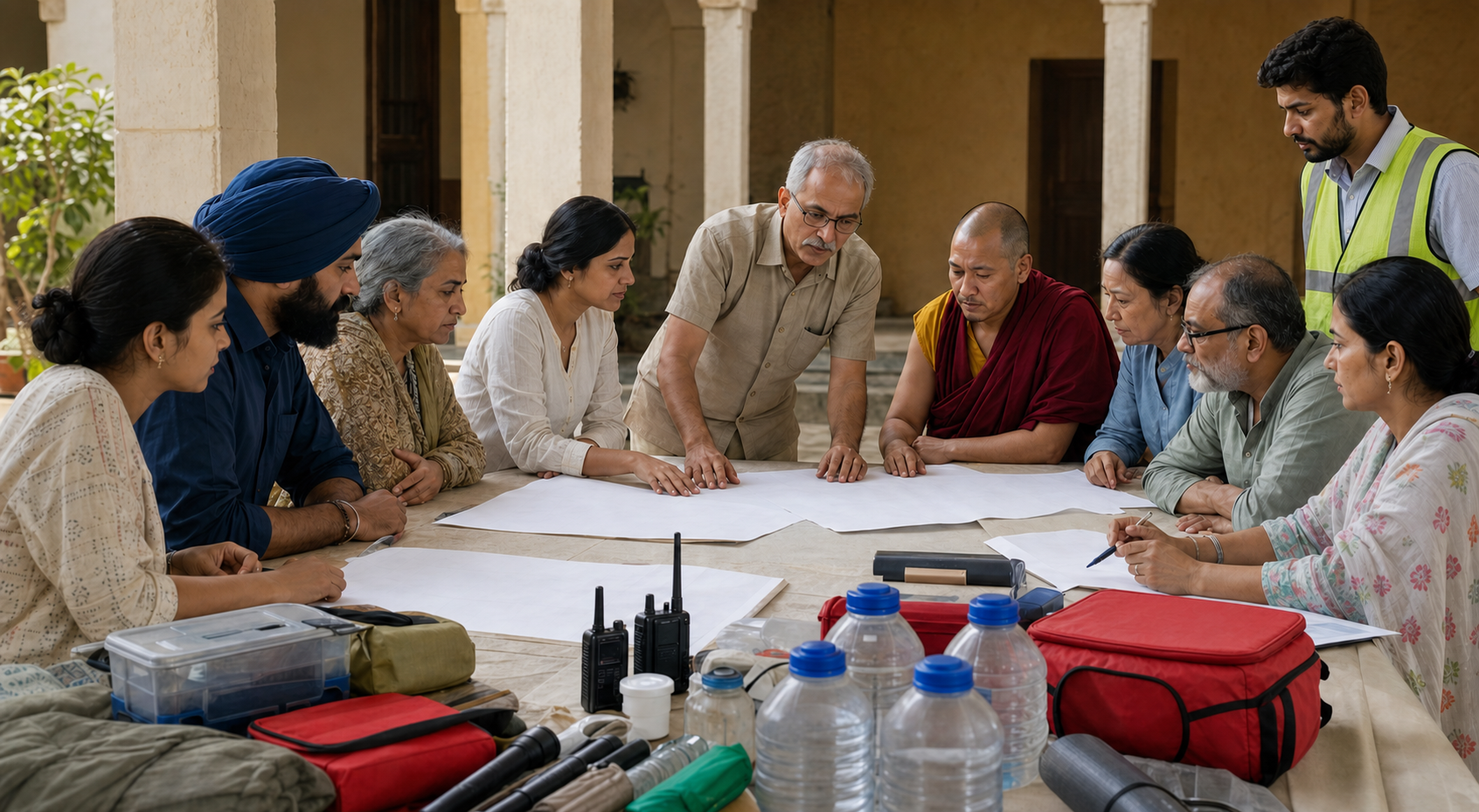
In this context, Dharmic unity is most useful as an ethical and civic method. It need not assert that Hinduism, Sikhism, Buddhism and Jainism are institutionally or theologically identical. The Bengal article invokes their traditions of responsibility, protection, restraint and respect for lawful order. The Punjab article similarly emphasises Sikh principles including seva, sangat, courage and defence of the vulnerable while rejecting attempts to reduce Sikh identity to separatism.
That distinction matters strategically. Separatist movements benefit when a community can be persuaded that its faith, dignity and legitimate grievances are inseparable from an extremist project. Communal mobilisation benefits when unlawful conduct by particular people can be presented as evidence against a whole religious population. A unifying ethic interrupts both manoeuvres: it honours each tradition while denying violent or fraudulent actors the protection of collective identity.
The sources also imply that solidarity must be reciprocal. The Punjab account situates current rhetoric within the suffering caused by terrorism, Operation Blue Star, the assassination of Indira Gandhi, the anti-Sikh violence of 1984 and the counterinsurgency that followed. The Bengal account recalls Partition, displacement, the creation of Bangladesh after the 1971 Liberation War and the memories carried by Hindu refugees from East Pakistan and Bangladesh. A mature national memory has room for these different wounds without converting any one of them into hereditary blame.
Unity therefore has an operational value. Citizens are more likely to report intimidation, resist recruitment and cooperate with lawful institutions when they are treated as partners rather than presumptive threats. Cultural confidence can also reduce the appeal of movements that turn fear or historical grievance into political isolation. This is social resilience, not a substitute for policing.
Evidence and due process separate vigilance from suspicion

Both source articles are interpretive and advocacy-oriented rather than independent verification reports. Their specific allegations should accordingly be treated as reported claims, with the strength of each claim assessed separately. This is especially important because demographic change, political symbolism and participation in a criminal network require different kinds of evidence.
The Bengal source is cautious on this point. It notes that the 2011 Census recorded West Bengal as Hindu-majority with a significant Muslim minority and that some districts near Bangladesh had higher Muslim population shares than the state average. It also says population change may reflect fertility patterns, historical settlement, economic mobility, internal migration or cross-border movement. A demographic trend alone therefore cannot determine who entered unlawfully or establish that infiltration caused the entire change.
Documentation presents a related challenge. According to the Bengal article, ration cards, voter identity cards, Aadhaar, land records, birth certificates and school records do not all carry the same legal significance. Fraudulent papers may expose a verification failure, while missing papers may result from poverty, displacement, flooding or administrative neglect. A defensible process must establish what a document proves, examine how it was issued and give the affected person a lawful opportunity to answer the evidence.
The Punjab source focuses more on ideological signalling. It argues that political praise for Bhindranwale can normalise a symbol linked in the article to the period of militancy and can reopen the grief of victims. It further describes contemporary separatism as potentially hybrid, operating through online messaging, overseas lobbying, intimidation, finance, criminal syndicates and cross-border assistance. Those are serious lines of inquiry, but rhetoric, sympathy, funding, conspiracy and violence are not interchangeable categories. Investigation must connect individuals to particular conduct rather than infer operational guilt from Sikh belief, attendance at a gurdwara or membership in the diaspora.
The source’s discussion of Air India Flight 182 illustrates why dismissing organised extremism can be dangerous: it reports that the 1985 bombing killed hundreds of innocent people. Yet the same history demonstrates why the investigative focus must remain on perpetrators, facilitators and networks. Broad stigma can silence moderate voices and create precisely the alienation that extremist organisers exploit.
Key takeaways
- Classify the threat before choosing the response: irregular entry, forged documentation, trafficking, extremist propaganda, illicit financing and violent conspiracy are related in some cases but are not the same offence.
- Apply one evidentiary standard to every community. Demographic identity cannot prove unlawful residence, just as religious pride or historical grievance cannot prove participation in separatist violence.
- Protect cultural confidence without granting immunity to political actors who exploit sacred institutions, collective trauma or religious language for unlawful ends.
- Remember victims comprehensively. Hindu refugees, Sikh victims of state or mob violence, and Hindu and Sikh victims of militancy should not be forced into competing narratives of suffering.
- Measure success through safer communities, reliable institutions and disrupted networks, not through louder rhetoric or wider suspicion.
Building a layered agenda for secure and confident communities

At the border, the Bengal source proposes fencing, surveillance, riverine patrols, coordination between state police and central forces, anti-trafficking action and faster prosecution of document fraud. It also argues that enforcement must be paired with lawful livelihood opportunities because poverty and informal trade can sustain illicit networks. That combination is important: physical barriers may alter routes, but resilient administration must also reduce the local incentives and institutional gaps on which smugglers and traffickers depend.
Against separatist networks, the Punjab source recommends intelligence work, scrutiny of financial flows, digital monitoring, diplomatic engagement and cooperation with Sikh communities. It also points to alleged use of drones, smuggling routes and narcotics-linked financing along the Pakistan border. Any action based on such claims requires case-specific evidence and accountable authority, but the strategic insight is sound: a networked threat cannot be answered by isolated arrests or speeches alone.
Community capacity is the bridge between these security tracks. The Bengal article identifies legal aid, documentation camps, education, hostels, temple safety, women’s security, youth training and economic resilience as forms of durable social protection. The Punjab article calls for honest historical education that includes political manipulation, militant violence, civilian suffering, the trauma of 1984, failures of justice and the restoration of order. Together, these proposals shift unity from ceremonial language to institutions that help people resist fear, misinformation and coercion.
Political accountability is equally necessary. Bengal’s demographic claims affect electoral mobilisation and debates over welfare, according to the first source; Punjab’s religious symbolism can also be used for political signalling, according to the second. Public officials, parties and advocacy organisations should therefore disclose the basis of numerical claims, distinguish allegations from established findings and avoid conferring casual legitimacy on violence. Independent research, district-level reporting and transparent case outcomes would make both exaggeration and official denial harder to sustain.
The durable course is to make lawful citizens safer, evidence harder to manipulate and violent or fraudulent networks more costly. Dharmic unity can support that future when it widens trust across traditions and gives firm action a moral boundary; it becomes counterproductive when invoked as a shortcut around proof.
References
- Hindu Existence – Bharat Raksha Manch’s Bengal Warning: Demography, Security, and Dharmic Unity
- HinduPost – Punjab’s Hard Truth: Why Khalistani Extremism Must Be Confronted With Unity