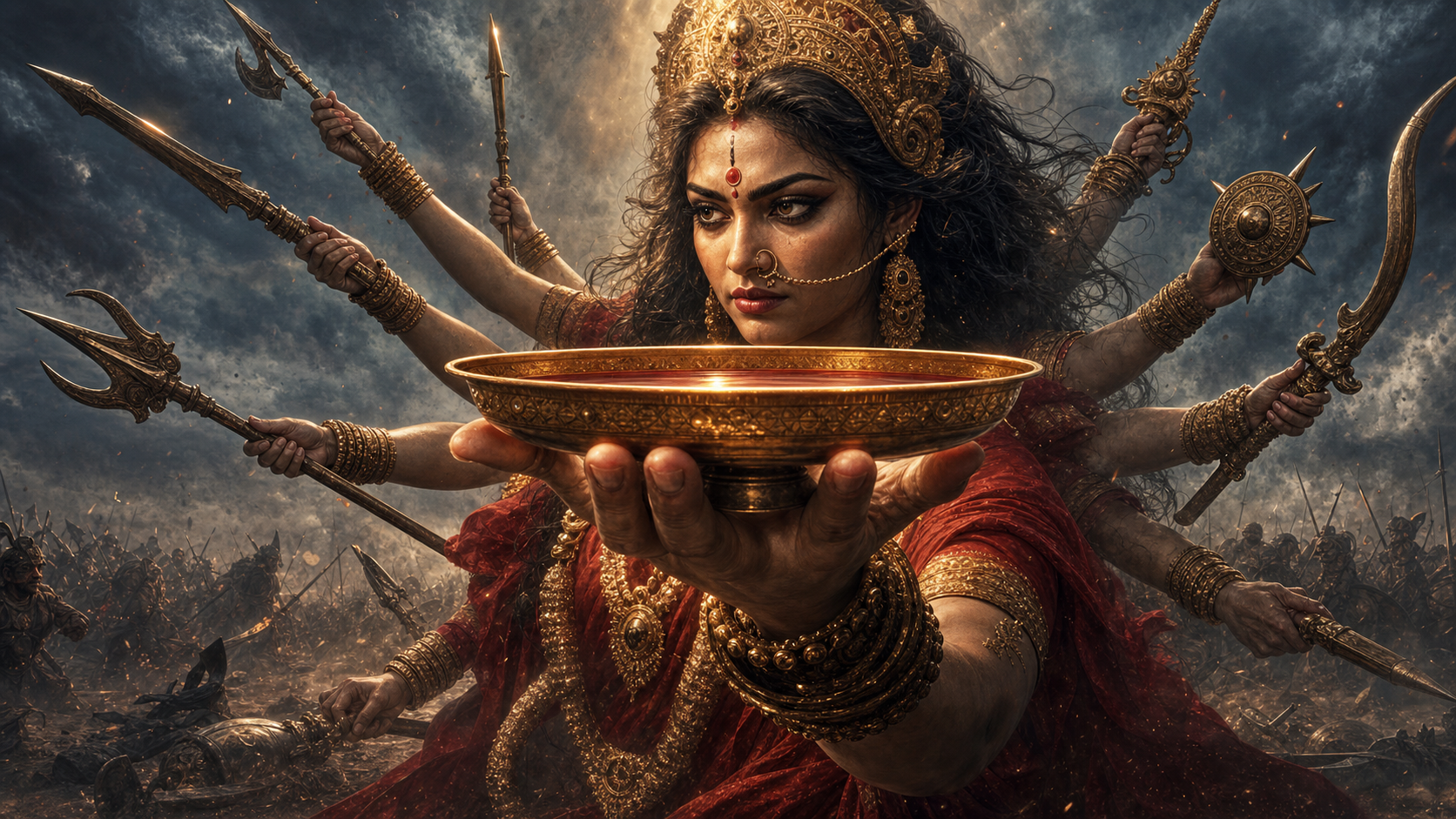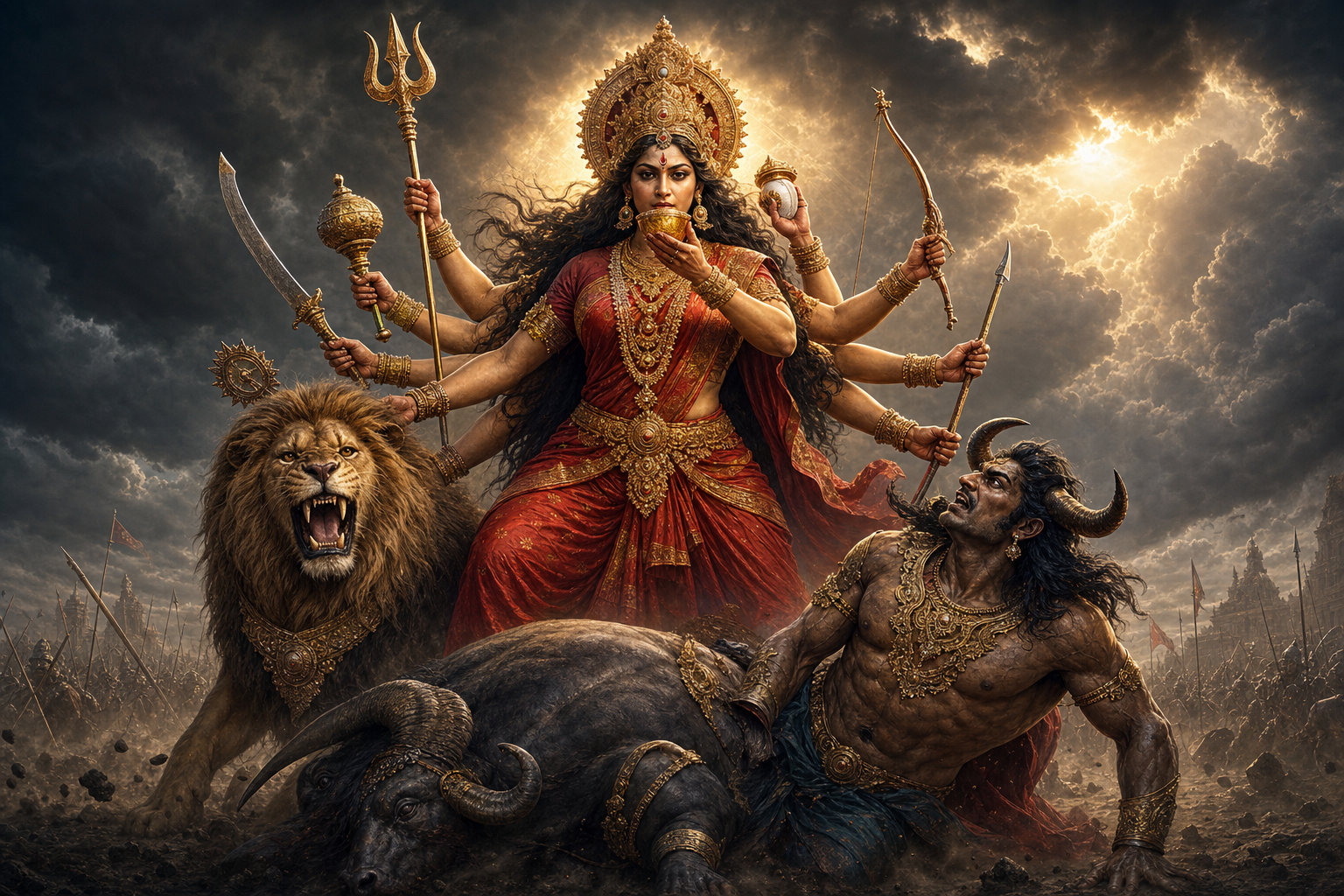
The striking feature of Ugra Chandika’s drinking is not the substance alone. It is the composure with which the Goddess drinks while confronting Mahishasura, placing a limit on his threatening roar and preparing to end his violence.
A context-first reading connects several dimensions of the image: divine sovereignty, the transformation of dangerous forces, fierce protection of dharma, and an inward struggle against arrogance and confusion. These connections also explain why the episode cannot responsibly be treated as a simple endorsement or condemnation of alcohol.
The battlefield determines what the drinking means
The supplied DharmaRenaissance article places the declaration in the third chapter of the Devi Mahatmya, during Chandika’s confrontation with Mahishasura. It renders her words as “Garj garj kshanam mudha madhu yavat pibamyaham” and translates them: “Roar, O fool, for a moment while I drink.” The article interprets this brief allowance as a reversal of intimidation: the demon may make noise, but only within the interval granted by the Goddess.
That dramatic setting governs the image. Chandika is not withdrawing from danger, losing awareness, or seeking escape. She remains the agent who speaks, drinks, fights, and decides when the demon’s apparent freedom will end. The act therefore contributes to the scene’s portrayal of sovereignty rather than interrupting it.
The same context clarifies the force of ugra. The source explains the term through meanings such as fierce, intense, and formidable. In its reading, fierceness is not cruelty pursued for pleasure; it is divine power becoming uncompromising when destructive arrogance can no longer be contained by gentler means. Chandika’s terrible appearance belongs to the restoration of order, not to the abandonment of it.
Madhu raises a question of mastery, not mere consumption
The article notes that madhu can evoke sweetness, honey, wine, or an intoxicating drink according to context. That range cautions against building an interpretation on a modern social category alone. Whatever emphasis is placed on the substance, its narrative function remains clear in the source’s account: something capable of overwhelming ordinary judgment is shown as incapable of governing Devi.
This produces the episode’s central contrast. In ordinary intoxication or compulsion, craving can turn a person into its instrument. Chandika remains the sovereign subject. The madhu neither determines her purpose nor obscures her enemy; it becomes part of the display that nothing on the battlefield stands outside her power.
The source consequently presents “sacred intoxication” as the intensity of divine purpose rather than human escapism. Its discussion of rasa reinforces that point: Devi is encountered not only as an abstract principle but through distinct moods that include nourishment, beauty, terror, and righteous ferocity. Chandika’s drinking belongs to the mood of fearless action directed toward dharma.
The article also draws an analogy with Tantric and Shakta settings in which socially restricted substances may be ritually transformed through discipline, mantra, lineage, and sacred intention. The distinction is crucial. An analogy about transmutation is not a general prescription for consumption, and a deity’s battlefield act is not automatically a rule for everyday conduct. The relevant principle is that a dangerous force may be taken into a disciplined sacred field and redirected, not that restraint has become unnecessary.
Fierce protection and the inward Mahishasura
Mahishasura gives the episode both ethical and psychological depth. The source describes him as a shape-shifting embodiment of arrogance, domination, violence, and spiritual blindness. It also presents the buffalo form through a common association with tamas: heaviness, inertia, ignorance, and brute impulse. His changing forms can therefore suggest the adaptability of ego, which reappears as pride, anger, self-justification, or injured self-importance whenever one disguise fails.
Against that instability, Chandika is unwavering. The demon’s roar sounds formidable, but the Goddess treats it as temporary noise rather than decisive power. Read inwardly, the exchange offers a disciplined way to understand fear, compulsion, rage, shame, or despair: their intensity does not establish their authority. Noise may accompany the weakening of a destructive pattern, just as Mahishasura’s roar precedes rather than prevents his defeat.
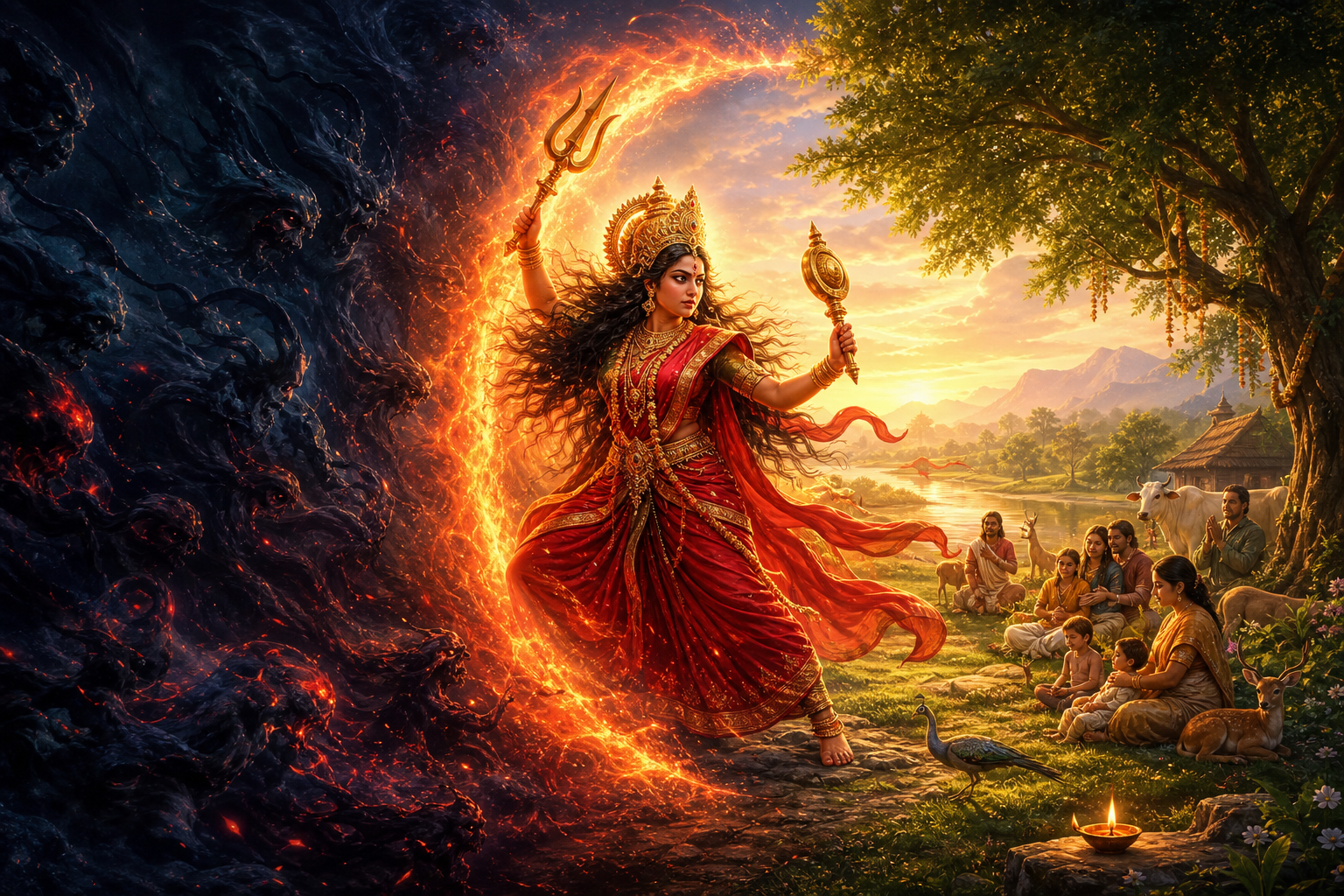
This psychological application should supplement rather than replace the sacred narrative. Mahishasura is not merely a private emotion, and Chandika is not merely a technique of self-help. The inward reading becomes meaningful because it participates in the larger theological pattern: Shakti confronts adharma, exposes its disguises, and restores the conditions under which life can flourish.
The episode also broadens the meaning of the divine feminine. Maternal tenderness, beauty, nourishment, judgment, strategy, and martial force need not be competing attributes when they serve the protection of dharma. In the source’s interpretation, Chandika’s wrath protects the possibility of gentleness. Her fierceness is ethically bounded by its object and purpose: it answers predatory disorder rather than celebrating aggression itself.
Key takeaways
- The battlefield context makes Chandika’s drinking an expression of command, not an episode of distraction or escape.
- The semantic range of madhu matters, but the scene’s decisive contrast is between being ruled by a force and remaining sovereign over it.
- Ritual transmutation provides an interpretive analogy, not a casual license for intoxication or excess.
- Mahishasura’s roar can be read inwardly as the noise of ego and confusion, while retaining the narrative’s theological meaning.
- Chandika’s fierce form presents protective force as compatible with compassion when it is disciplined by dharma.
Further engagement with this passage will be most fruitful when textual context, theological symbolism, ritual discipline, and ethical limits remain together. That approach allows the image to retain its unsettling force without turning it into either a scandal or a slogan.