
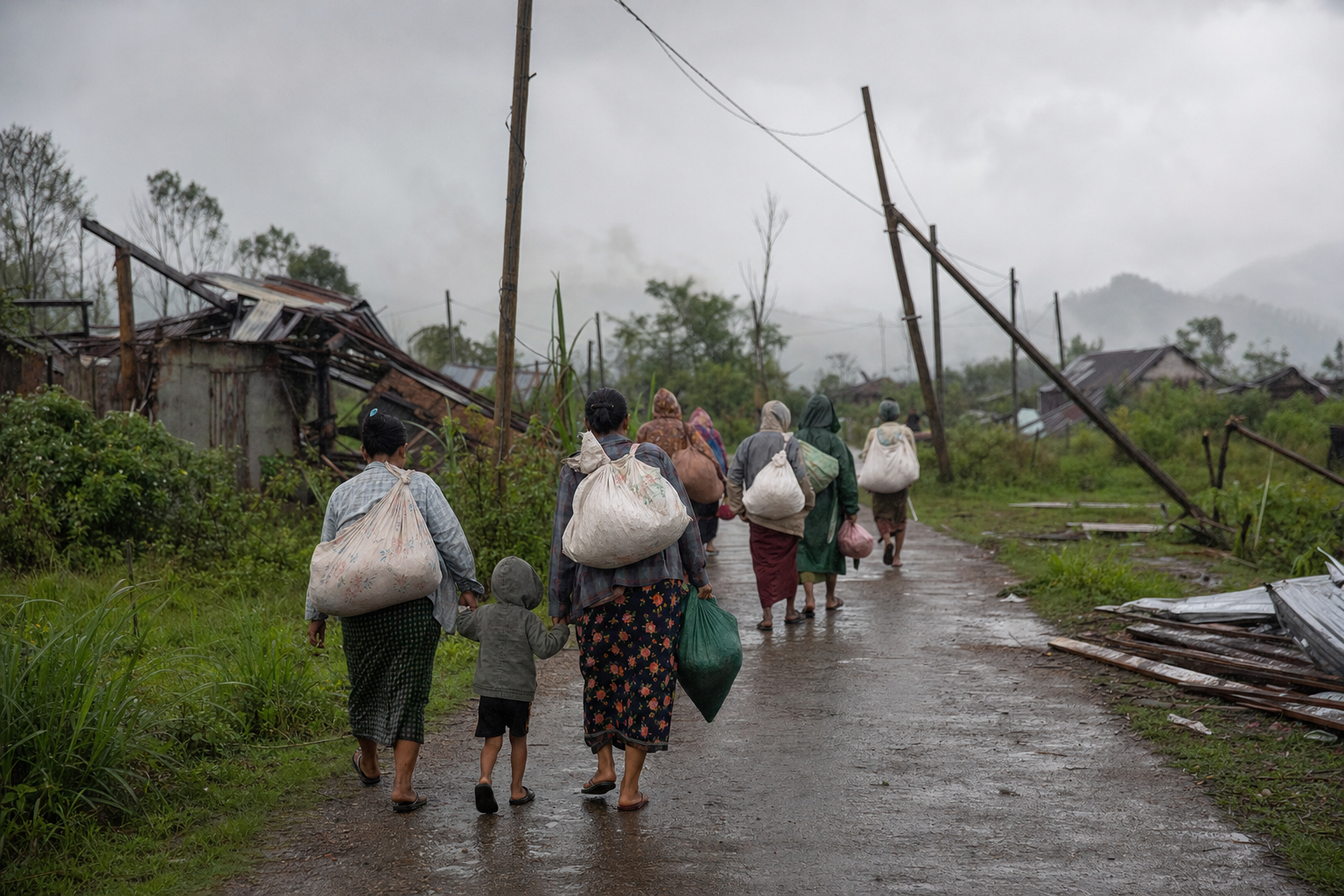
Myanmar’s emergency is best understood not as a single struggle for political control, but as an overlapping civil war, displacement crisis, collapse of public services and regional security problem. The interaction among these pressures explains why battlefield developments alone cannot show whether conditions are improving for civilians.
The supplied dossier contains one member article rather than several independently reported accounts. Its figures and descriptions are therefore attributed below as source-reported claims, while the synthesis focuses on how the political, military, humanitarian and regional dimensions connect.
Key takeaways
- The conflict that followed the 1 February 2021 military coup has developed into a fragmented war involving the armed forces, ethnic resistance organisations, People’s Defence Forces and numerous local armed actors.
- Displacement is inseparable from economic distress and the breakdown of education, healthcare, agriculture and community life.
- Air attacks and shifting territorial control make civilian protection and humanitarian access difficult even in areas far from conventional front lines.
- India, China, Bangladesh and Thailand encounter different consequences from the crisis, but regional diplomacy faces the same central tension between strategic interests and civilian needs.
From military coup to a fragmented battlefield
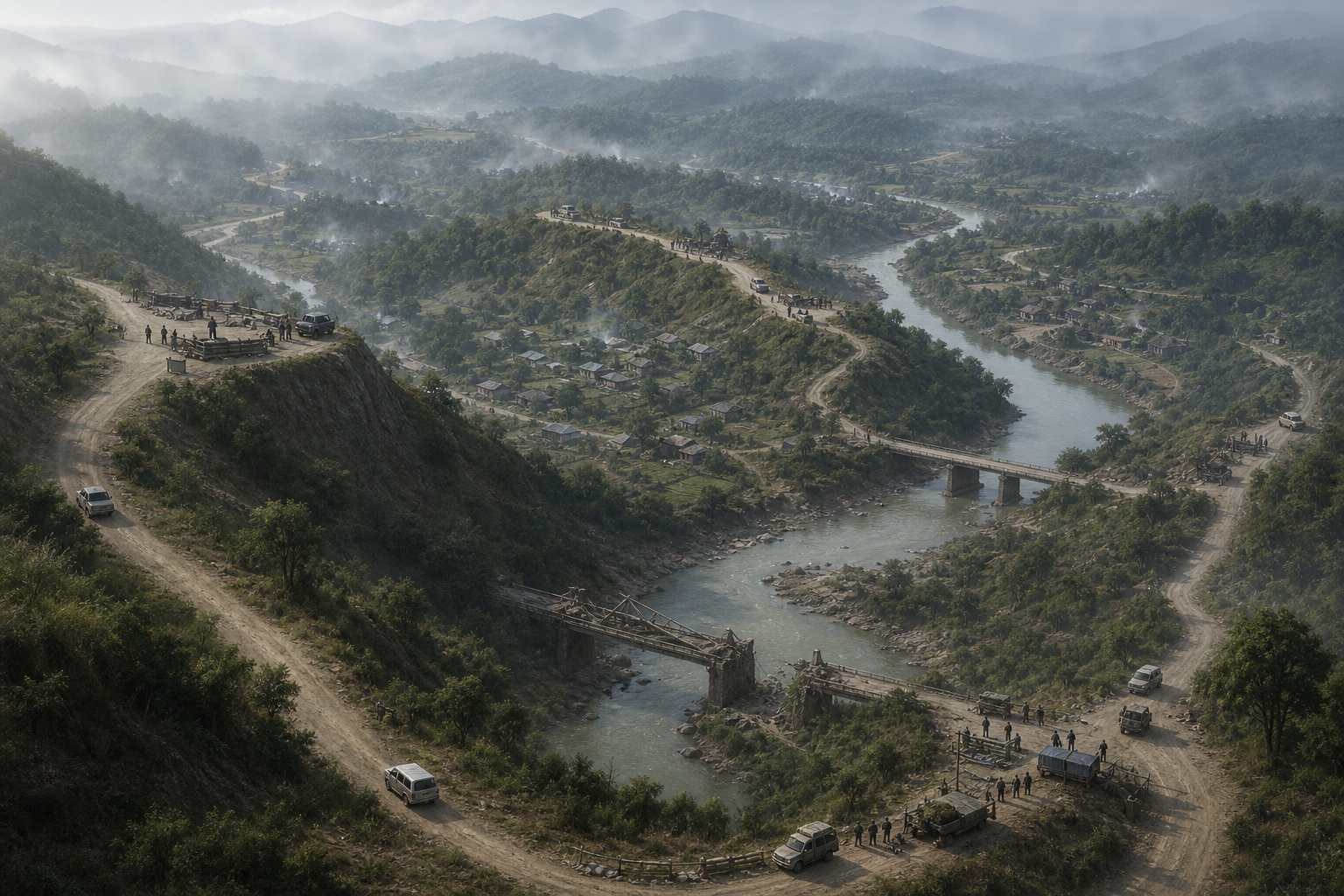
The DharmaRenaissance Blog article identifies the military takeover of 1 February 2021 as the decisive turning point. It reports that the armed forces under Min Aung Hlaing removed the elected administration associated with Daw Aung San Suu Kyi and the National League for Democracy. Protests, arrests and repression were followed by armed resistance and counterinsurgency, turning a constitutional rupture into a prolonged conflict.
That transition matters because it changed the structure of the crisis. The supplied article describes a patchwork in which the military-aligned administration controls only a limited portion of Myanmar, resistance organisations administer other areas, and additional territory remains contested. Roads, taxation, policing, courts, schools and aid access may consequently fall under different authorities. A settlement negotiated only between the military and one opposition body would not necessarily address this decentralised reality.
The article, citing conflict-monitoring estimates, reports more than 1,000 distinct armed groups and says Armed Conflict Location & Event Data Project reporting has indicated more than 100,000 deaths since the coup. It contrasts that figure with earlier United Nations-related estimates in the tens of thousands. These are not interchangeable measures: differences in definitions, periods and documentation methods can produce substantially different totals. The defensible conclusion from the supplied material is that the death toll is heavily contested but severe.
Rakhine State illustrates how national conflict and long-standing regional tensions now overlap. According to the article, the Arakan Army controls a large part of the state after capturing most of its townships and has advanced toward Sittwe. Its growing territorial power may weaken military control, but a change in the authority holding territory does not by itself guarantee civilian safety, inclusive governance or reliable access to assistance.
The source also reports that disputed elections held in December 2025 and January 2026 were followed by Min Aung Hlaing’s transition from coup leader to president. It says voting was impossible in many conflict areas, major opposition forces were excluded and military power remained embedded in the political system. On that account, civilian titles and electoral procedures did not resolve the underlying legitimacy dispute.
Displacement has become a collapse of everyday systems
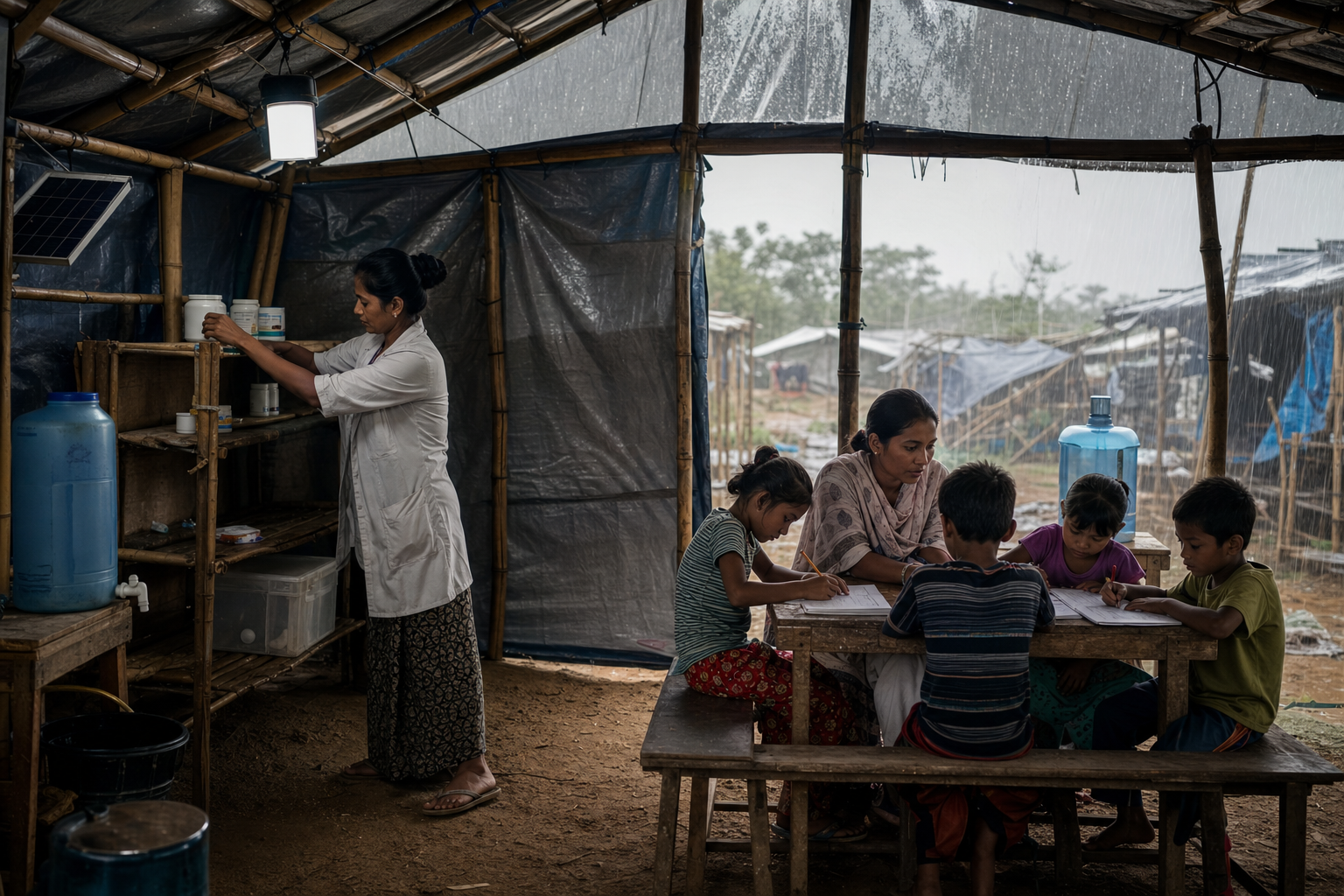
The humanitarian burden cannot be captured by refugee numbers alone. The supplied article reports that more than 5.3 million people are in acute distress as refugees, internally displaced people or civilians trapped in conflict-affected areas. It separately reports that more than one million people have fled to neighbouring countries, particularly Bangladesh, Thailand and India, while about 3.7 million are displaced within Myanmar. These categories describe different legal and practical situations, but all involve disrupted livelihoods, insecure shelter and uncertain access to essential services.
Internal displacement can be especially precarious because flight does not necessarily remove a family from the conflict. The article says residents have abandoned hundreds of villages amid air attacks, house burnings, targeted killings, forced recruitment and arbitrary detention. A displaced household may remain within reach of armed actors while losing land, crops, income, documentation and community support at the same time.
The source reports chronic poverty affecting nearly 80 percent of a population of about 55 million. Read alongside displacement, that estimate points to a reinforcing cycle: violence interrupts farming and trade; lost income reduces access to food, medicine and transport; and material insecurity makes further displacement, exploitation or recruitment more likely. Humanitarian relief may address immediate deprivation, but it cannot fully compensate for the repeated destruction of local economic life.
Education shows how a wartime emergency can become a generational one. The article says more than six million children and young people are expected to be out of school during the 2026-27 academic year, which it characterises as nearly half of the estimated school-age population. The consequences extend beyond missed lessons. Closed or unsafe schools remove a source of routine and social protection, while prolonged absence can expose young people to labour exploitation, trafficking, forced recruitment and permanent loss of opportunity.
Healthcare is deteriorating through a similar mechanism. The supplied account says doctors, nurses and other health workers have been killed, arrested, displaced or forced underground. When staff disappear and travel becomes unsafe, a nominally functioning clinic may still be inaccessible. The humanitarian crisis therefore includes both visible destruction and the quieter disappearance of professional networks on which communities depend.
Air power intensifies these pressures. The article reports attacks involving fighter jets, drones and paramotors, with schools, clinics, religious sites, refugee settlements and marketplaces among the locations reportedly struck. For communities without meaningful air defence or warning systems, the threat affects behaviour even when no strike occurs: families may avoid schools, markets, medical facilities and other places where people gather.
Border pressures collide with regional strategy
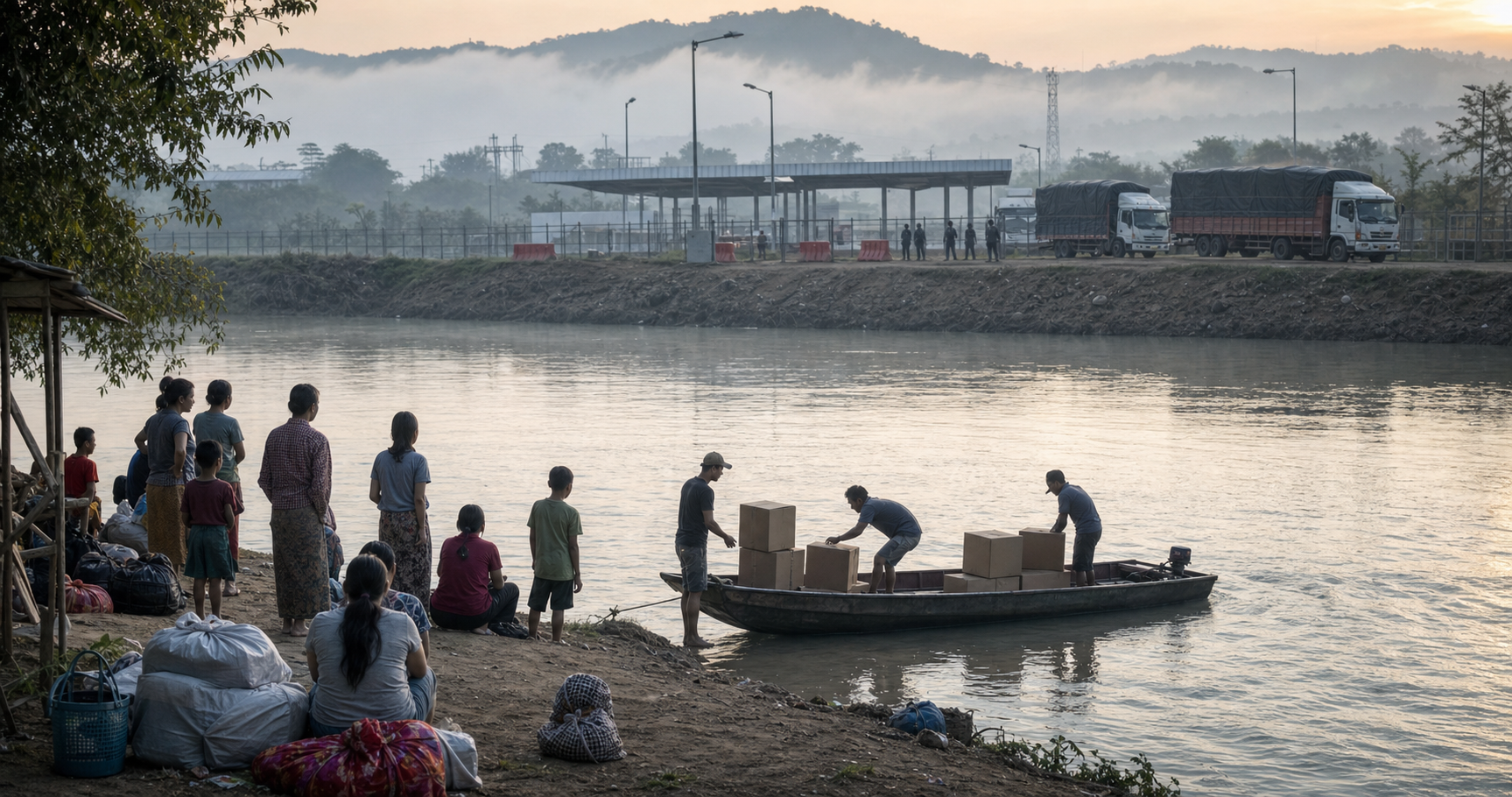
Myanmar’s neighbours do not experience the crisis in the same way. Bangladesh, Thailand and India receive people fleeing the country, according to the source. In India, the effects are especially direct in Manipur and Mizoram, where the article highlights ethnic affinities, kinship connections, porous borders and security concerns. These conditions complicate any attempt to treat cross-border movement solely as either a humanitarian matter or a border-control issue.
India also has a strategic interest in transport links through Myanmar. The supplied article identifies the Kaladan Multi-Modal Transit Transport Project and the India-Myanmar-Thailand Trilateral Highway as important to connections between India’s Northeast and Southeast Asia. China, it says, values Myanmar for access to the Indian Ocean, energy routes and influence near its southwestern frontier. Continued engagement with whoever controls institutions or territory may therefore appear necessary to both countries even when Myanmar’s political legitimacy remains disputed.
This creates a policy tension rather than a simple choice. Suspending all engagement could weaken access, communication and cross-border coordination, while diplomacy focused only on infrastructure and security could marginalise displaced communities and obscure civilian harm. The practical question is whether strategic engagement can be tied to humanitarian access, protection of civilians and accountable treatment of people crossing borders.
What a credible response must confront
A meaningful response must first recognise that Myanmar’s humanitarian and political crises cannot be separated. Food or shelter assistance may save lives, but repeated displacement will continue while villages, schools, clinics and markets remain exposed to attack. Conversely, a political process that ignores hunger, interrupted education and damaged health services will offer little immediate security to affected communities.
Humanitarian access must also reflect fragmented control. In general, aid delivery in a multi-actor conflict requires communication across front lines, safeguards against diversion and arrangements that do not make recipients appear aligned with a belligerent. The source’s description of overlapping military, ethnic and local authorities suggests that a single central channel would leave some communities unreachable or dependent on permission from parties they fear.
Education and healthcare need to be treated as core protection concerns rather than secondary reconstruction tasks. Teachers and health workers preserve institutional continuity during displacement, while functioning schools and clinics reduce some of the pressures that push families toward unsafe migration or harmful coping strategies. Support that reaches only physical buildings would remain incomplete if trained personnel cannot work safely.
Regional governments will ultimately be judged not only by the projects or security relationships they preserve, but by whether their engagement creates space for civilians to obtain safety, assistance and a voice in future governance. The next constructive step is sustained diplomacy that treats access and civilian protection as operating conditions of regional engagement, rather than benefits postponed until after the war.